
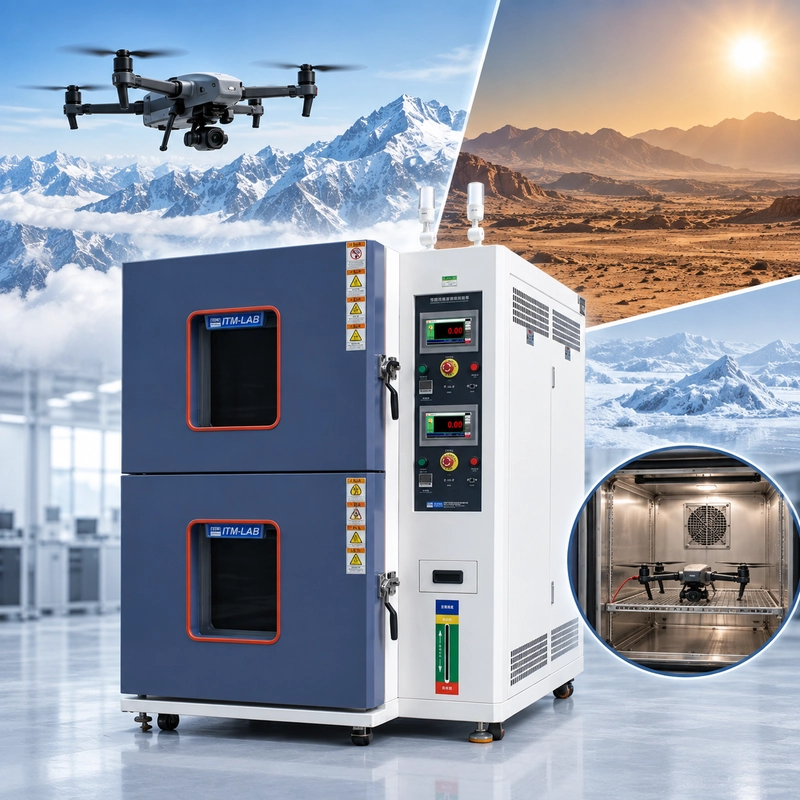
A UAV component that works perfectly at sea level has not necessarily proved that it will work at mission altitude.
The obvious difference is pressure. It is not always the most important one.
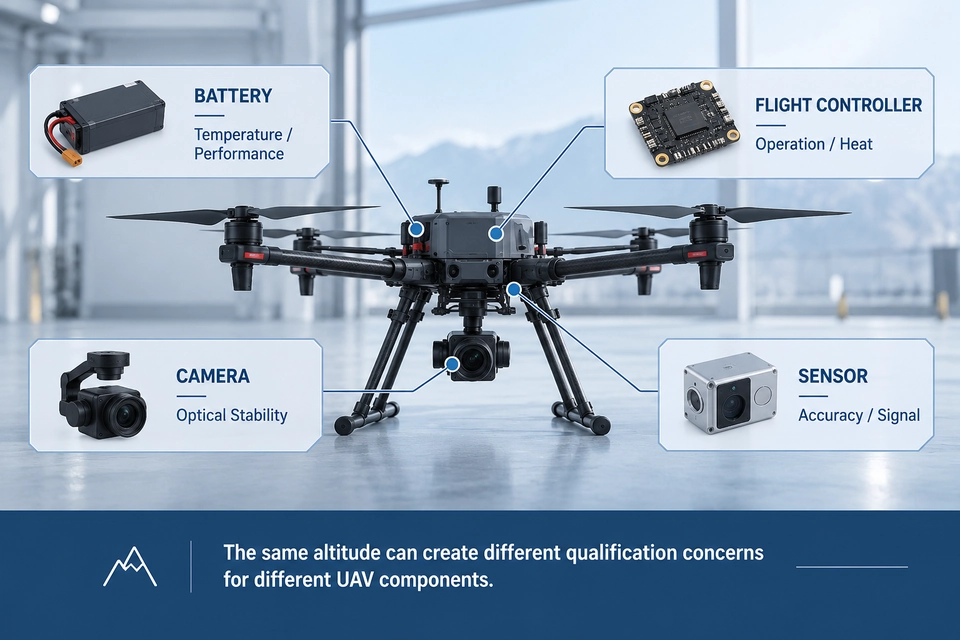
A powered flight controller still produces heat as the surrounding air becomes less dense. A battery still has to deliver power at the specified temperature. A camera or sensor still has to meet its performance requirement—not merely remain switched on.
This is where UAV altitude testing becomes more interesting than putting a DUT in a chamber and pulling a vacuum.
For many UAV components, the qualification question is closer to this:
Can the DUT operate at the required pressure and temperature, for the required duration, while the functions that matter to the mission are being monitored?
That question changes how the test should be defined—and how the altitude test chamber should be selected.
What Does Altitude Actually Change for a UAV Component?
Altitude is convenient shorthand for an operating environment. A laboratory, however, needs measurable conditions.
The first is atmospheric pressure.
Under a standard atmosphere, pressure decreases as altitude increases. NASA's atmospheric model, for example, describes pressure decreasing with altitude and provides equations for estimating pressure, temperature and density at different heights.
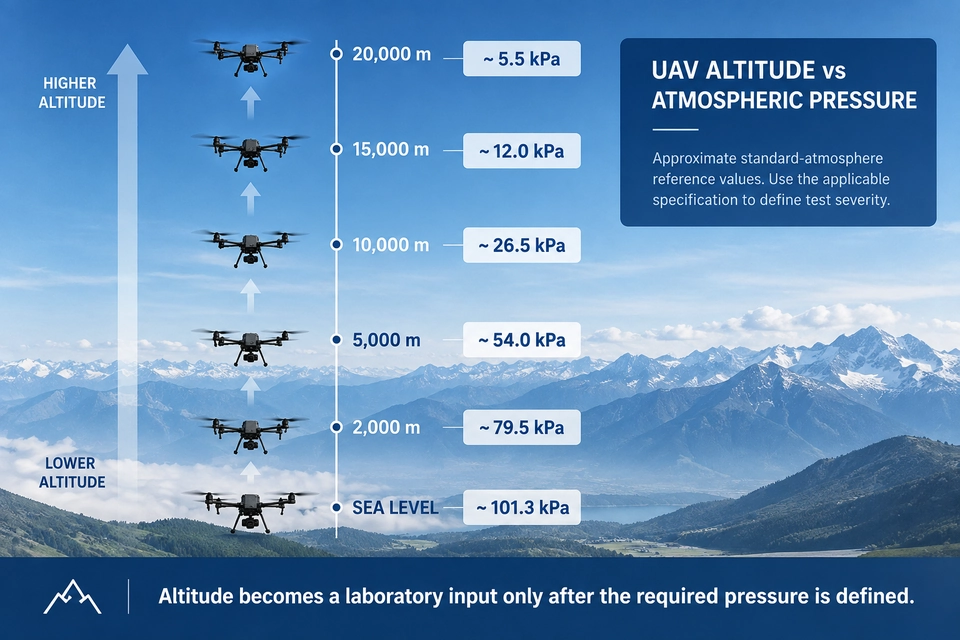
Some useful reference values are:
| Approx. Altitude | Approx. Standard Atmospheric Pressure |
|---|---|
| Sea level | 101.3 kPa |
| 2,000 m | 79.5 kPa |
| 5,000 m | 54.0 kPa |
| 8,000 m | 35.6 kPa |
| 10,000 m | 26.5 kPa |
| 15,000 m | 12.0 kPa |
| 20,000 m | 5.5 kPa |
These are reference-atmosphere values, not ready-made UAV test severities. The chamber setpoint should come from the applicable test specification, customer requirement or defined mission profile.
That distinction is important.
“5,000 m operating altitude” is useful engineering information.
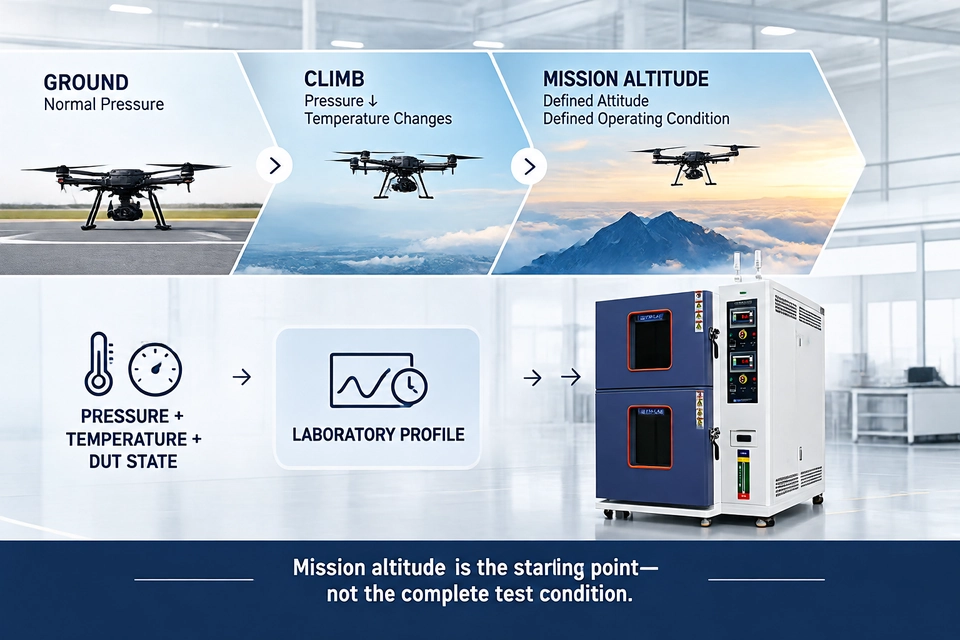
But before the test begins, it needs to become something more precise:
Required pressure + temperature + duration + DUT operating state + acceptance criteria
Temperature Is a Separate Input
Pressure has a predictable relationship with altitude under a reference atmosphere. The temperature of an actual UAV component is more complicated.
An externally mounted camera, a battery enclosed in the fuselage and a powered flight controller can all experience different thermal conditions on the same aircraft.
Solar exposure, airflow, enclosure design, nearby electronics, electrical load and mission duration can all influence component temperature.
So the test engineer should resist a tempting shortcut:
mission altitude → standard atmospheric temperature → DUT test temperature
The temperature requirement should instead come from the actual qualification basis.
Then There Is Heat
This is especially important for powered electronics.
As altitude increases, air density decreases. NASA's standard-atmosphere models describe this change in density alongside pressure and temperature.
Now consider a powered flight controller dissipating tens of watts inside an enclosure.
The chamber may be set to -20°C, but that does not mean every electronic component inside the DUT is at -20°C. The DUT is producing heat, and its thermal balance can change under reduced-pressure conditions.
That gives us a useful rule for chamber selection:
Chamber setpoint ≠ component temperature.
If the UAV component operates during the altitude test, its heat load belongs in the test definition and in the equipment RFQ.
Which UAV Components Are Most Sensitive to Altitude?
There is no single “UAV altitude test” that makes equal sense for every component on the aircraft.
The failure mechanism matters.
Battery Packs
For a battery, temperature is usually impossible to separate from the altitude discussion.
The pack still has to provide the required electrical performance while exposed to the specified operating environment. Depending on the qualification program, reduced pressure may form part of that environment as well.
That can make the relevant question:
Does the battery merely survive the altitude exposure, or must it deliver specified performance while there?
Those are different tests.
There is another distinction worth making. UN 38.3 T.1 altitude simulation is a lithium-battery transportation-safety requirement. UAV operational altitude qualification asks a different engineering question: whether the battery meets the aircraft's specified requirement in its intended environment.
The same battery may encounter both requirements, but one should not automatically substitute for the other.
Flight Controllers and Avionics
For avionics, powered testing can reveal more than a post-test inspection.
A flight controller may need to maintain communication, stable power behavior and fault-free operation throughout the altitude condition.
If the only acceptance check is “does it turn on after recovery?”, an interruption that occurred only at low pressure may never be captured.
Thermal behavior also deserves attention because avionics continue generating heat during operation.
Sensors and Communication Modules
For sensors, powered on and performing correctly are not synonyms.
Depending on the DUT, engineers may need to monitor:
measurement accuracy, signal stability, data output, communication status or measurement drift.
A sensor that survives the test but moves outside its specified accuracy band may still have failed its mission requirement.
Cameras and Gimbals
Optical payloads introduce another set of concerns.
Temperature can affect focus, alignment and mechanical behavior. The payload may need to maintain image quality or gimbal operation while the altitude condition is present.
Environmental transitions can also matter where condensation or fogging is a concern.
The common thread is simple:
Define what “pass” means before you define the chamber cycle.
Why Pressure-Only Testing Can Miss the Real Requirement
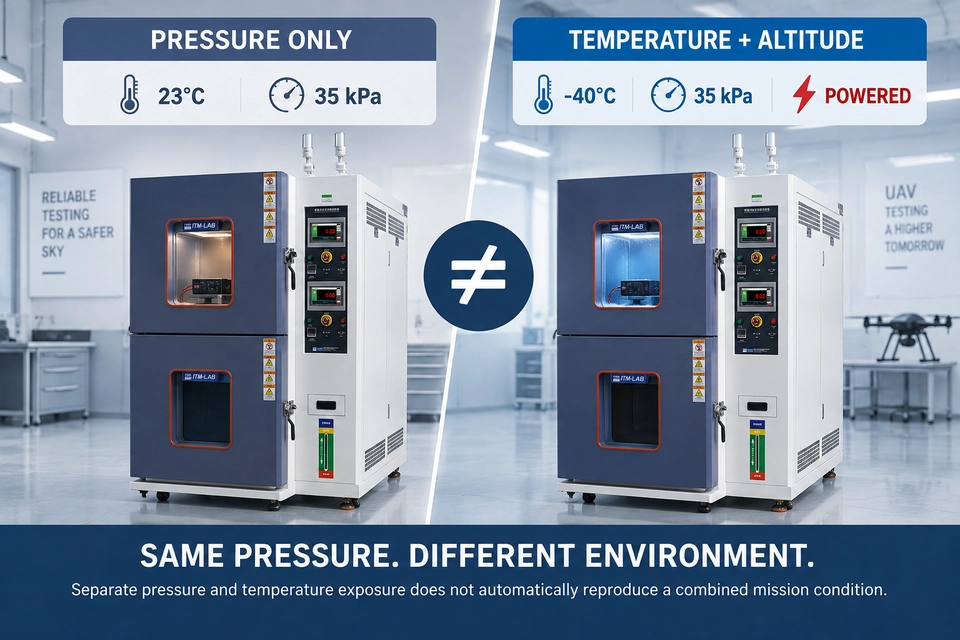
Suppose an avionics module has to operate at 35 kPa and -40°C.
A laboratory could run two separate tests.
Test A — Low Temperature
-40°C
approximately normal atmospheric pressure
And then:
Test B — Low Pressure
35 kPa
23°C
Both tests provide useful information.
Neither automatically demonstrates that the DUT will operate at:
Test C — Temperature + Altitude
-40°C
35 kPa
powered
That does not mean the combined condition will always produce a different result.
It means the interaction has not been demonstrated.
Temperature can influence materials, electronics, batteries and seals. Reduced pressure changes the surrounding air environment and can affect thermal behavior and pressure differentials.
When the qualification requirement specifies those conditions simultaneously, reproducing them separately answers a different question.
Same pressure. Different thermal environment. Different qualification question.
This is the point at which a simple low-pressure chamber and a temperature-altitude chamber stop being equivalent test tools.
MIL-STD-810H Method 500.6 or IEC 60068-2-13?
These references are often mentioned in altitude-test discussions, but they should not be treated as interchangeable labels for “put it under vacuum.”
IEC 60068-2-13:2021 is the current fifth edition of Environmental testing — Part 2-13: Tests — Test M: Low air pressure. IEC states that the test applies to specimens that can be subjected to low air pressure during transportation, storage or service. The 2021 revision also aligned severities with relevant IEC 60721 material and added guidance on selecting exposure duration.
MIL-STD-810H Method 500.6 takes a life-cycle environmental approach to low-pressure/altitude exposure and contains procedures addressing different low-pressure situations.
For UAV work, a useful high-level distinction is:
| MIL-STD-810H Method 500.6 | IEC 60068-2-13:2021 | |
|---|---|---|
| Environment | Low pressure / altitude | Low air pressure |
| General approach | Life-cycle environmental tailoring | Defined environmental test method |
| Common context | Aerospace, defense, rugged equipment | Components and equipment |
| Test selection | Applicable procedure and life-cycle requirement | Relevant specification and severity |
| UAV use | Mission-driven qualification where specified | Component/equipment low-pressure testing where specified |
The table is not intended to choose one standard over the other.
A defense UAV program, commercial component specification and customer-specific qualification plan may reference different requirements.
What matters to chamber selection is what those requirements eventually become:
pressure, temperature, duration, transition, DUT state and monitoring.
That leads to another useful principle:
Do not select the standard from the chamber. Select the chamber from the test requirement.
Turning Mission Altitude Into a Laboratory Test Profile
A phrase such as “operates up to 8,000 m” is not yet a chamber program.
It has to be translated.
Start With the Pressure Requirement
The mission altitude provides the starting point.
A standard-atmosphere reference can help translate altitude into approximate atmospheric pressure, but the final chamber value should follow the applicable specification or qualification basis.
This is where IMAGE 4 becomes useful.
Add the Temperature
Next ask whether the DUT must:
survive the temperature,
operate at the temperature,
or meet a defined performance requirement at the temperature.
These are not necessarily equivalent acceptance criteria.
Define How the Environment Is Reached
Does the test require the DUT to reach temperature first and then reduce pressure?
Should pressure and temperature change together?
Is a specific pressure-change rate required?
How is stabilization determined?
The applicable procedure should answer these questions. The chamber should be configured to reproduce them.
Define the Exposure
Reaching 35 kPa does not mean the test is finished.
The requirement also needs an exposure duration and a clear definition of when that duration begins. IEC notes that its 2021 revision added guidance on selecting exposure duration.
Decide Whether the DUT Operates
This decision affects both the test objective and the chamber configuration.
A powered DUT may require:
power wiring, signal connections, data communication, thermocouples and additional feedthroughs.
It also introduces heat into the workspace.
Decide What Counts as a Pass
For a flight controller, this could include communication and fault status.
For a camera, image or gimbal performance may matter.
For a sensor, accuracy may matter.
For a battery, electrical performance may matter.
A well-defined chamber profile without a meaningful acceptance criterion is still an incomplete qualification test.
What Usually Goes Wrong in UAV Altitude Testing?
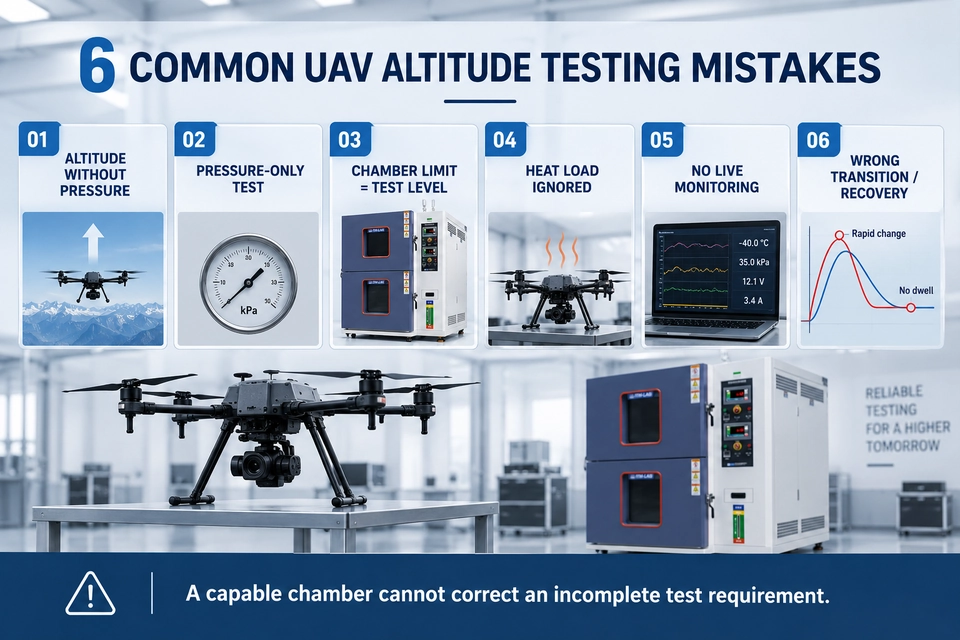
Most altitude-test problems are not caused by a chamber being unable to create low pressure. They begin earlier, when the requirement is translated into a test.
01 — Altitude Without a Defined Pressure Basis
“10,000 m” describes an environment. The laboratory still needs to know which pressure definition or specification governs the test.
02 — Pressure Only, When the Requirement Is Combined
A room-temperature low-pressure test does not reproduce a specified low-temperature/low-pressure operating condition.
03 — Chamber Limit = Test Level
This is a surprisingly easy mistake to make.
If a chamber can reach 1 kPa, that tells you something about equipment capability.
It does not mean the DUT belongs at 1 kPa.
04 — DUT Heat Load Is Ignored
A powered avionics module adds heat to the chamber and develops its own internal temperature distribution.
That matters when evaluating both chamber performance and DUT behavior.
05 — No Live Monitoring
A component can recover after returning to normal pressure.
If the requirement is operation at altitude, a post-test power-on check alone may miss the event you were trying to detect.
06 — Transition and Recovery Are Treated as Setup
Pressure reduction, temperature transition, stabilization and recovery can be part of the defined procedure.
They should not be improvised simply because the final setpoint is correct.
Selecting a Temperature + Altitude Chamber
Once the test has been defined, equipment selection becomes much less mysterious.
And the first number to look at should not necessarily be minimum pressure.
Pressure Range—and Pressure Control
A specification such as minimum pressure: 1 kPa tells you the lowest pressure the system is designed to reach under defined conditions.
UAV testing may instead require controlled operation at an intermediate condition such as 54 kPa, 35 kPa or 26.5 kPa.
That makes the ability to reproduce the required pressure profile important—not merely the ultimate low-pressure limit.
Minimum pressure is one specification. The test profile is the requirement.
Temperature and Pressure Together
If the test calls for simultaneous low temperature and reduced pressure, check the system's relevant combined-condition capability rather than reading the temperature range and pressure range as two completely independent specifications.
This is especially important when comparing chambers.
A maximum temperature, minimum temperature and minimum pressure printed on three separate lines do not by themselves describe every possible combined operating condition.
DUT Size Is Not the Same as Chamber Volume
The UAV component, mounting hardware, cables and monitoring connections all need to fit in the usable workspace.
The chamber also needs sufficient clearance for the intended test configuration.
So provide actual:
L × W × H
rather than simply saying:
“It is a medium-size flight controller.”
Powered DUTs Need Thermal Consideration
Tell the equipment manufacturer whether the specimen will operate during the test and how much heat it generates.
For electronic UAV components, this can be just as important as the DUT mass.
Feedthroughs Are Part of the Test System
Power, Ethernet, CAN, sensor lines, thermocouples or other signals may need to cross the chamber wall.
The feedthrough arrangement should therefore be defined with the monitoring plan—not after the chamber has been built.
From Test Requirement to GDJZ-535L-B Configuration
Consider a UAV component test that requires:
controlled temperature
reduced pressure
powered operation
external monitoring
That requirement points toward a temperature/low-pressure environmental chamber rather than a basic vacuum chamber.
One ITM-LAB configuration for this type of work is the GDJZ-535L-B Temperature / Climate / Low Air Pressure Test Chamber.
Key nominal capabilities include:
Workspace: 535 L
Temperature: -40°C to +150°C
Low pressure: down to 1 kPa
The 535 L workspace can accommodate many component-level UAV test setups where the DUT, required mounting arrangement and connections fit within the usable test space.
The temperature range and low-pressure capability provide room for a variety of altitude profiles, subject to the actual combined-condition performance required for the project.
And the most important number is not necessarily 1 kPa.
1 kPa is chamber capability—not UAV test severity.
A flight-controller test at 35 kPa should be configured around 35 kPa because that is the requirement—not made “more rigorous” by running at 1 kPa.
Likewise, a -40°C chamber capability does not mean every UAV component should be exposed to -40°C.
The correct configuration comes from the mission and qualification requirement.
For a practical equipment evaluation, the most useful information to send ITM-LAB is:
DUT dimensions and mass, mission altitude or required pressure, temperature profile, powered state, heat load, exposure duration, pressure/temperature transition requirements, feedthroughs and monitoring needs.
That is enough to move the discussion from:
“Do you sell an altitude chamber?”
to:
“Can this system reproduce my test?”
Three Questions We Often Need to Answer
Is a vacuum chamber the same as a UAV altitude test chamber?
Not necessarily.
If the requirement is only a defined low-pressure exposure, a suitable low-pressure system may be enough.
If the UAV component must experience controlled temperature and reduced pressure simultaneously—or operate while power, signals and temperature are monitored—the test system needs to support those requirements as well.
The correct comparison is therefore not simply vacuum chamber vs altitude chamber. It is equipment capability vs test profile.
How do I convert UAV altitude into chamber pressure?
A standard-atmosphere model provides the relationship between altitude and atmospheric pressure. NASA publishes atmospheric equations and reference data for this purpose.
But the calculated standard-atmosphere pressure should not automatically override the applicable test specification.
Use the mission altitude as the engineering starting point, then confirm the required chamber pressure from the qualification basis.
Should the UAV component operate during altitude testing?
If the objective is to demonstrate operation at altitude, powered testing and functional monitoring may be necessary.
If the requirement is storage, transport or survival exposure, the specimen state may be different.
Define the objective first. Then follow the applicable procedure.
Altitude Is More Than a Vacuum Level
The useful question in UAV altitude testing is not:
How low can the chamber go?
It is:
What environment does this component need to reproduce?
For many UAV components, that answer contains more than pressure:
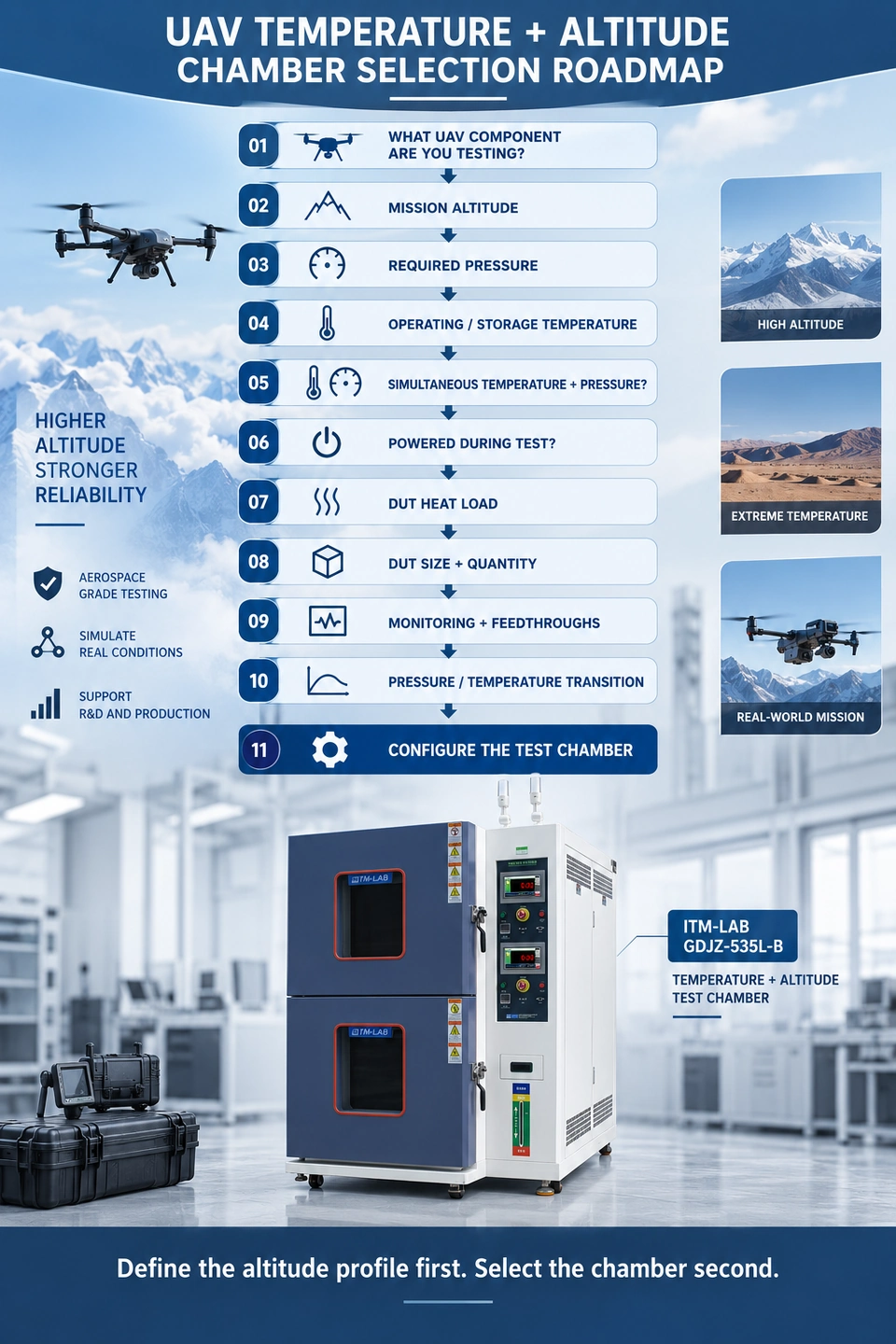
MISSION ALTITUDE
↓
REQUIRED PRESSURE
↓
TEMPERATURE
↓
DUT OPERATING STATE
↓
HEAT LOAD
↓
DURATION + TRANSITION
↓
FUNCTIONAL MONITORING
↓
CHAMBER CONFIGURATION
That sequence avoids two opposite mistakes.
One is under-testing: reproducing low pressure while leaving out a temperature or operating condition that the qualification requirement actually calls for.
The other is over-testing: using the chamber's most extreme capability simply because it is available.
Neither makes a test more representative.
For UAV batteries, flight controllers, avionics, sensors and cameras, the goal is to reproduce the specified environment and determine whether the component still does what the mission requires.
Define the altitude profile first. Select the chamber second.
