
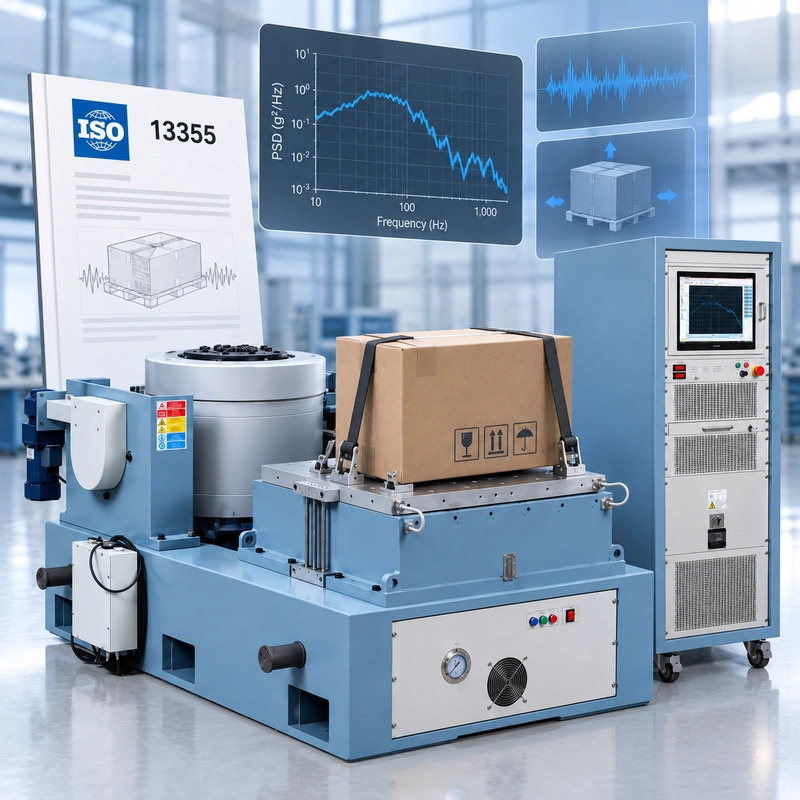
A shipping carton can come off the vibration table looking perfectly normal.
Open it, and the story may be different.
The foam has shifted. A cable has rubbed against the housing. The product has moved toward one wall of the carton. An accessory that started the test in its own compartment is no longer there.
Nothing dramatic happened at any single moment. The damage developed through repeated vibration.
That is the problem ISO 13355 is designed to investigate.
ISO 13355:2016 specifies a vertical random vibration test for complete, filled transport packages and unit loads. The method can be used to assess the strength of the package, the protection it provides to its contents, or both. It may be used as a stand-alone vibration test or as part of a broader distribution test sequence.
For a test lab, though, knowing the standard number is only the beginning.
What random vibration profile is required? How large and heavy is the filled package? How will it be restrained? Can the vibration system reproduce the required PSD after the package, restraint hardware and moving components are added?
Those questions determine whether you have a workable test system.
What ISO 13355 Actually Tests
The title of the standard is worth reading carefully:
ISO 13355:2016 — Packaging — Complete, filled transport packages and unit loads — Vertical random vibration test.
Three parts matter immediately:
Complete and filled. Random. Vertical.
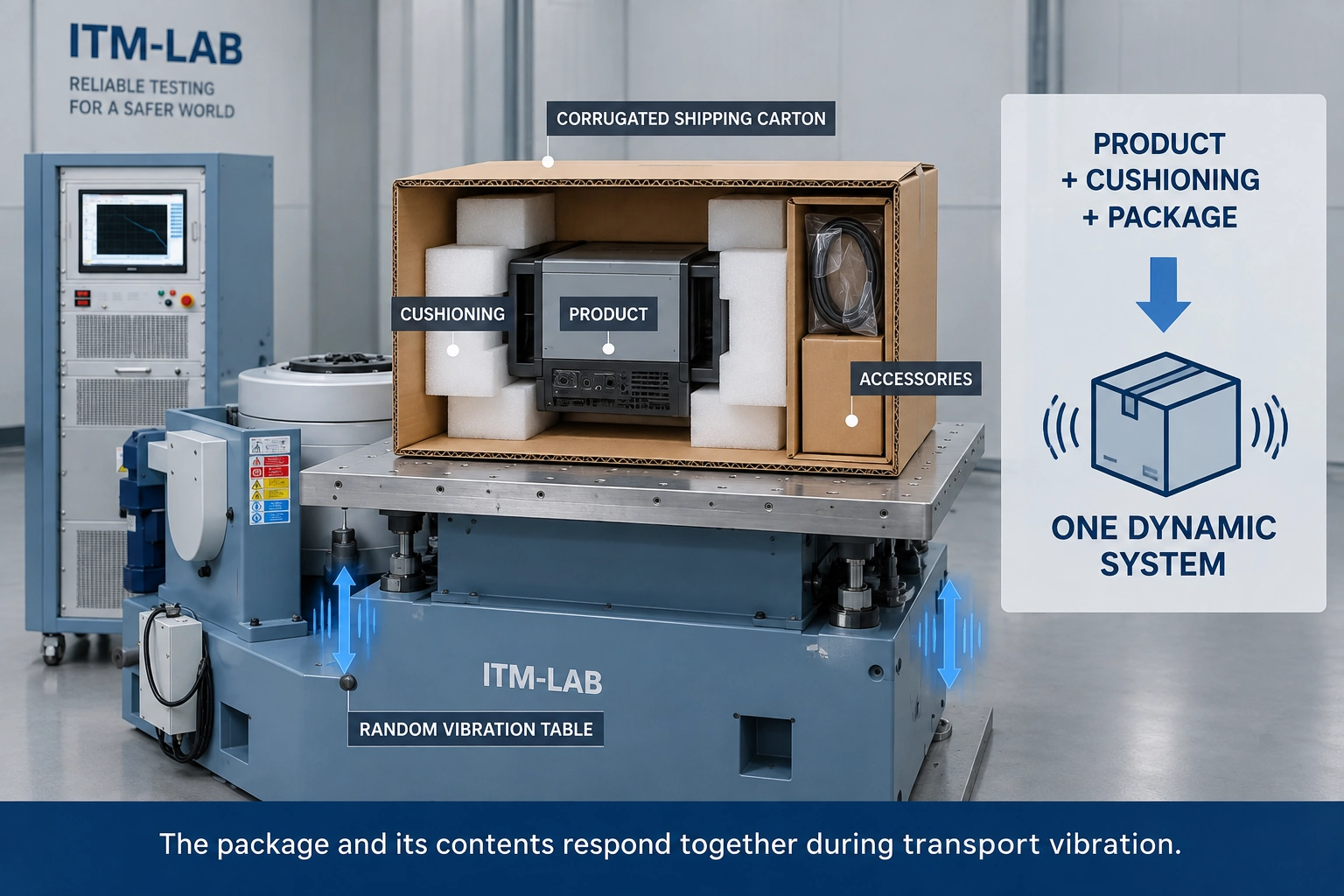
The test specimen is not simply an empty carton. Nor is it the product removed from its packaging. The method is built around the complete, filled transport package or unit load exposed to vertical random excitation.
Consider a 12 kg industrial controller.
It is shipped in a corrugated carton between two molded foam end caps. A cable kit sits beside the controller in an inner compartment, and the carton is taped closed.
On the vibration table, these are not four independent objects.
They are one dynamic system.
The controller can move relative to the foam. The foam can compress or migrate relative to the carton. The carton itself can flex. Accessories can shift and begin contacting surfaces they never touched when the test started.
That interaction is exactly why packaging vibration testing needs to consider the complete transport configuration.
Remove the packaging and you have changed the test—not simplified it.
10–200 Hz Is Not a Complete Random Vibration Specification
This is where packaging random vibration testing is often misunderstood.
A customer tells you:
“We need random vibration from 10 to 200 Hz.”
Useful information—but not enough to configure the test.
Random vibration is not defined by frequency range alone.
Real transportation environments contain vibration energy distributed across a range of frequencies. In the laboratory, the required random vibration spectrum describes that distribution.
ISO 13355 itself refers to IEC 60068-2-64 for discussion of random vibration theory.
PSD Tells You Where the Energy Is
Power Spectral Density (PSD) describes how random vibration energy is distributed with frequency.
That matters because a packaging system does not respond equally at every frequency.
The carton structure may respond strongly in one region. The cushioning system may respond in another. The packaged product may have its own dynamic characteristics.
Change where the vibration energy is concentrated and you can change how the package responds.
Grms Tells You Something Different
Overall Grms provides a measure of the overall random vibration level.
It does not replace the PSD.
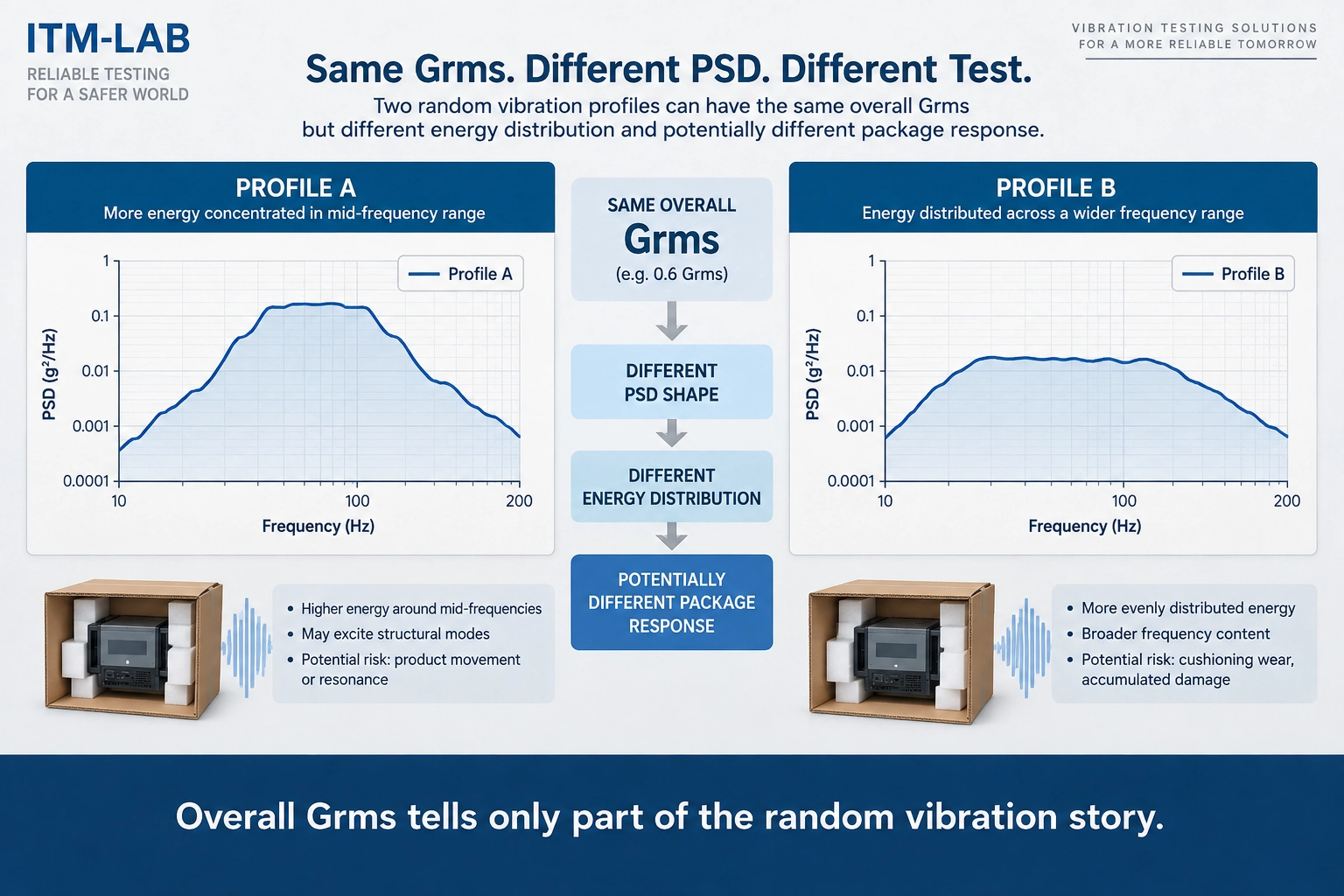
Imagine two vibration profiles with the same overall Grms.
Profile A concentrates more energy in one part of the frequency range. Profile B distributes it differently.
The overall level may be the same, but the excitation is not.
That difference can matter when the package has frequency-sensitive behavior.
So when a customer provides only:
“0.6 Grms”
there is still information missing.
For a useful test specification, you need to understand the combination of:
PSD profile, frequency range, overall Grms and test duration.
Same Grms does not automatically mean the same random vibration test.
A Practical ISO 13355 Test Sequence
The exact vibration profile, conditioning and acceptance criteria should come from the applicable standard, customer specification and test program.
From a laboratory perspective, the workflow can be broken down into seven practical stages.
1. Define the Vibration Requirement
Start with the test requirement—not the shaker.
Confirm the required random vibration profile, including the relevant:
PSD, frequency range, overall Grms and duration.
If the requirement comes from a customer specification or a broader distribution test program, keep that context with the test.
Do not select a profile simply because it is already stored in the vibration controller.
2. Prepare the Complete Package
Build the specimen in the configuration relevant to distribution.
For an electronics shipment, that might mean:
product + protective bag + foam inserts + accessories + inner packaging + outer carton.
For automotive components, it could be a carton containing several individually protected parts.
For a battery or industrial product, the specimen may be substantially heavier or form part of a unit load.
Document the configuration before testing.
3. Condition and Document the Specimen
Packaging materials can respond to environmental conditions.
Corrugated board is an obvious example: its mechanical behavior can be affected by moisture and humidity.
Apply the required conditioning where applicable, then document the package dimensions and filled mass.
For large or asymmetric loads, load distribution and center of gravity may also need to be considered when planning the setup.
4. Position and Restrain the Package
Place the specimen in the required orientation on the vibration table.
Then think carefully about restraint.
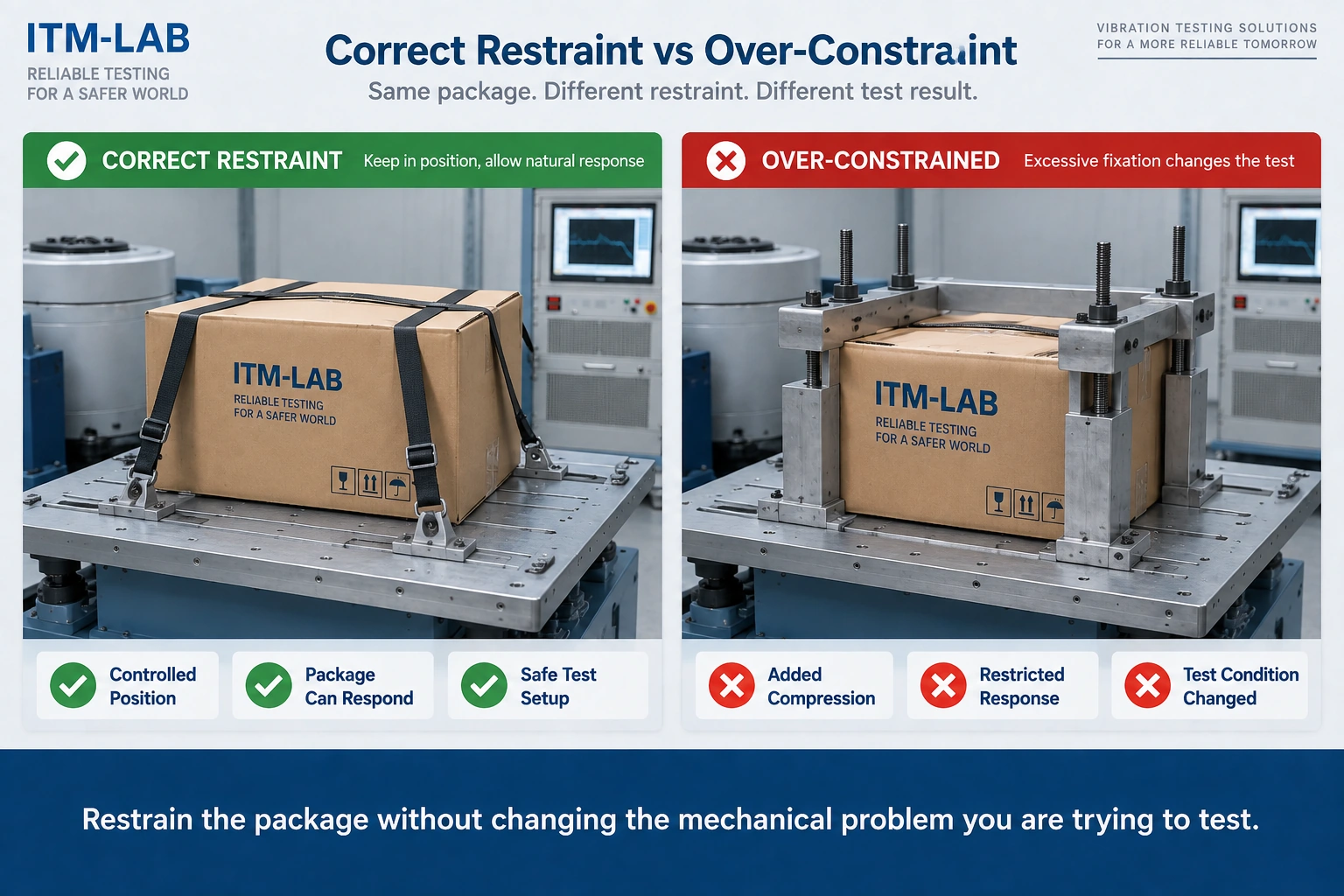
The restraint has a job: maintain the intended test condition and prevent unsafe or unintended movement.
Its job is not to turn a transport package into a rigidly clamped structural test specimen.
Too little restraint can allow uncontrolled movement.
Too much restraint can change the package response you intended to evaluate.
Restrain the Package. Don't Redesign the Test.
This becomes particularly important with large cartons and unit loads.
A strap pulled aggressively across a carton can introduce compression that was not present in the intended distribution condition. A rigid side fixture can restrict motion that the package would otherwise experience.
The restraint arrangement should therefore support the required test condition rather than simply make the specimen convenient to mount.
5. Install and Verify the Control Measurement
Random vibration requires controlled excitation.
The control accelerometer, its mounting and the vibration controller are therefore part of the measurement chain—not accessories that can be ignored once the shaker is running.
A loose sensor, poor mounting surface or unsuitable control location can compromise the test.
The system needs reliable feedback so that the controller can maintain the required random vibration input.
6. Run the Random Vibration Profile
Run the specified vertical random vibration exposure.
During the test, watch more than the timer.
Look for abnormal package movement, restraint problems, unexpected noise, loss of control or other behavior that could affect test validity.
If the test setup changes significantly during the run, document it.
7. Inspect the Package and Its Contents
Once the vibration stops, do not make the pass/fail decision from across the room.
Inspect the package systematically.
Start with the outer carton or container, then work inward through the closures, cushioning and internal packaging.
Finally, inspect the product itself.
For functional products, visual inspection may not be enough.
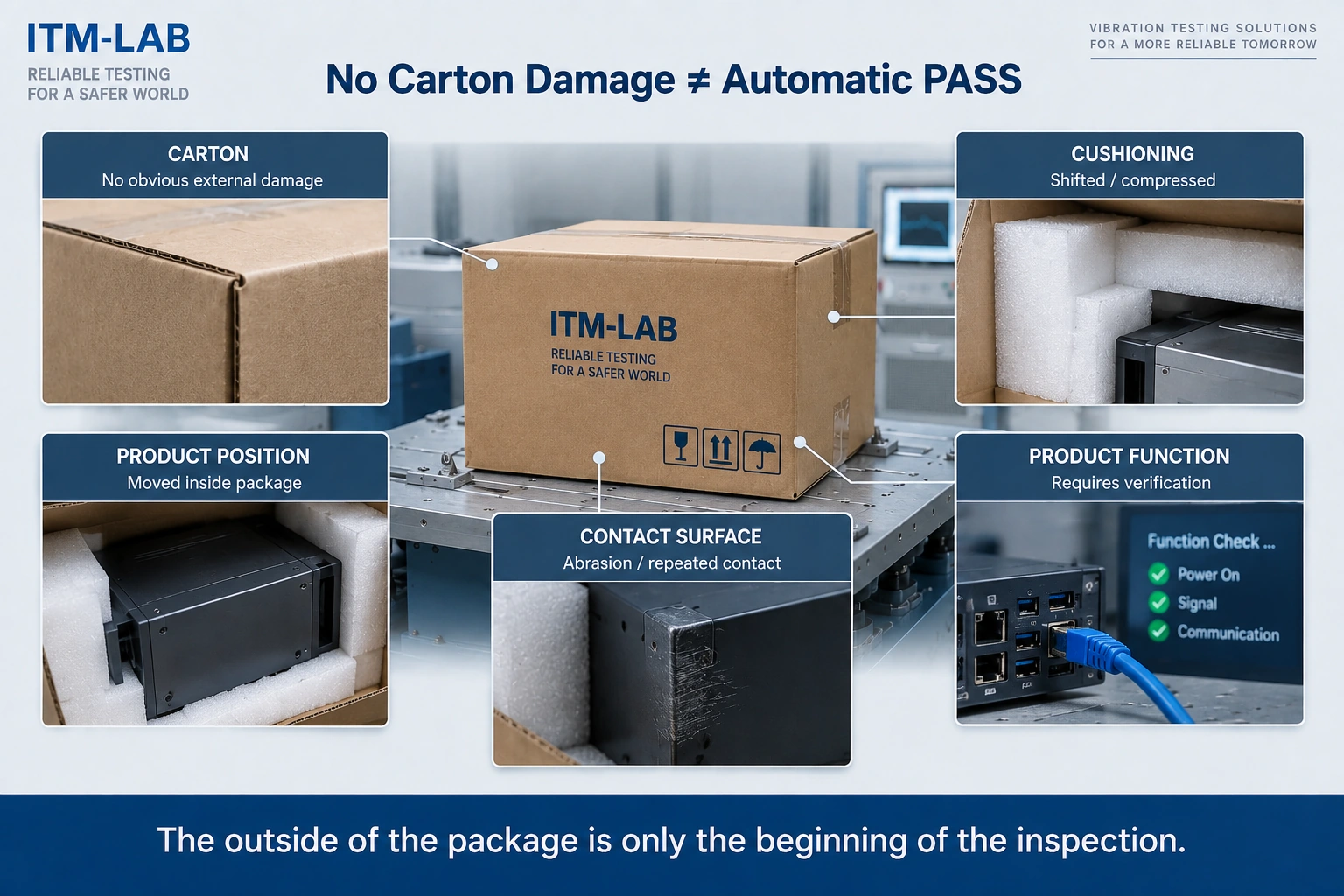
The Carton Looks Fine. Did the Package Pass?
Not necessarily.
ISO 13355 can be used to investigate both the strength of the package and the protection it offers its contents.
That means post-test inspection needs to look beyond torn cardboard.
A package can show very little external damage while something important has changed inside.
The foam may have migrated.
A molded support may have cracked.
The product may have shifted enough to contact the carton wall.
A cable may have rubbed repeatedly against a housing.
A connector or fastener may have loosened.
A medical instrument, electronic device or industrial controller may still look normal but require a functional check before its condition can be confirmed.
The acceptance criteria depend on the product and test program, but the principle is simple:
No visible carton damage does not automatically mean PASS.
This matters particularly for high-value or functionally critical shipments such as servers, automotive electronics, battery systems, medical equipment, appliances and industrial controls.
The products are different. The engineering question is the same:
Did the packaging continue to protect what was inside?
A 100 kg Payload Rating Does Not Mean Every 100 kg Random Test Will Work
This is one of the most important distinctions when selecting packaging vibration test equipment.
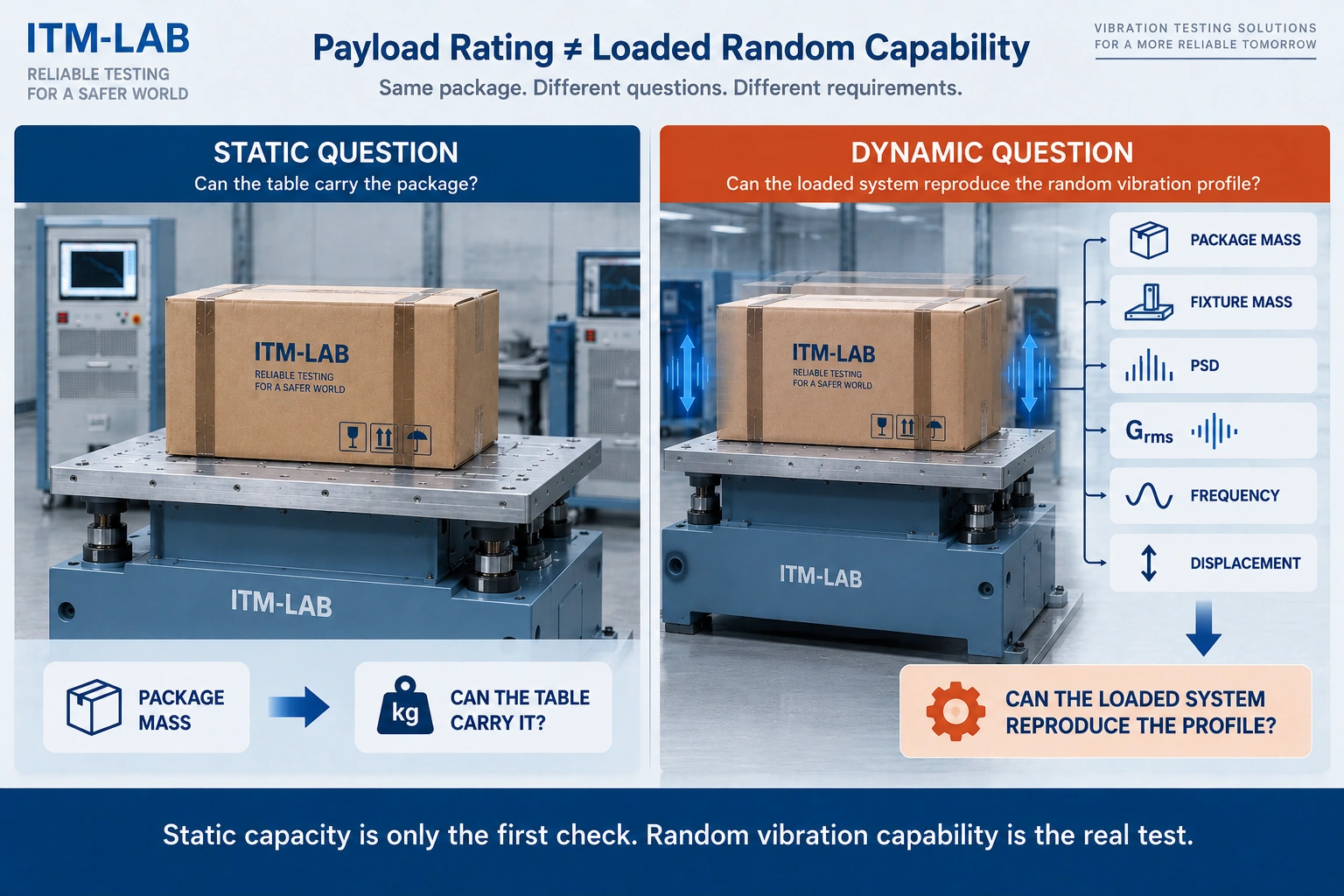
Put a 100 kg package on a stationary vibration table.
Nothing happens.
The table can carry it.
Now ask the same system to reproduce a specified PSD across a defined frequency range while that package is moving.
That is a different question.
Payload Is Only the First Check
The shaker has to accelerate the moving system.
That system can include:
Filled package
Restraint / fixture
Armature
Table or head expander
Other moving hardware
The package mass is therefore not the only mass that matters.
And mass is not the only performance parameter.
Random vibration capability also depends on the required spectrum and the operating limits of the complete shaker system.
Depending on the test, the engineering check can involve:
force, acceleration, velocity, displacement and frequency.
This is why a statement such as:
“The package weighs 80 kg and the machine supports 100 kg.”
does not finish the equipment selection.
The better question is:
Can the complete loaded system reproduce the required PSD within its force, velocity and displacement limits?
That is the capability that matters.
Random Vibration Is Not the Same as Simulated Transport Motion
The word transportation causes a lot of equipment-selection mistakes.
A machine can be designed for transportation vibration testing without necessarily being suitable for every transportation vibration method.
ISO distinguishes between different vibration methods for complete, filled transport packages. ISO 2247 addresses fixed low-frequency sinusoidal vibration, while ISO 8318 covers variable-frequency sinusoidal vibration. ISO 13355 addresses vertical random vibration.
The vibration method determines the equipment.
For ISO 13355, the system needs to generate and control the required random excitation.
A typical electrodynamic configuration includes:
Electrodynamic Shaker + Power Amplifier + Vibration Controller + Accelerometer + Test Table / Fixture
For ITM-LAB, this makes the RS-V Series Electrodynamic Vibration Test System the relevant equipment platform to evaluate for ISO 13355 applications, rather than selecting a mechanical transportation vibration machine simply because its name contains “transport vibration.”
The RS-V platform supports random vibration testing and is available in multiple force configurations. The specific configuration still needs to be matched to the actual package, table arrangement and required vibration profile.
The shaker needs to reproduce a test profile—not a standard number.
Choosing an RS-V Configuration for ISO 13355
Start with the specimen.
Not the shaker catalogue.
Package Dimensions
First determine how much usable table area is required.
A 400 × 300 mm carton and a large industrial package may require very different test interfaces even when their masses are similar.
The package needs to fit together with the required restraint arrangement.
For larger specimens, a head expander or other table configuration may also contribute to the moving system and needs to be considered in the capability assessment.
Filled Package Mass
Use the mass of the actual test specimen.
If several packages are tested simultaneously, consider the complete test load.
For unit loads, mass distribution may matter as well.
Required PSD
Provide the actual random vibration spectrum whenever possible.
This is far more useful to the equipment engineer than:
“We need an ISO 13355 machine.”
The system needs to reproduce a profile, not recognize a standard number.
Frequency Range and Overall Grms
These values help define the vibration demand, but neither should be considered independently of the PSD.
A frequency range alone is incomplete.
Grms alone is incomplete.
Together with the PSD, they describe much more of the random environment the system must reproduce.
Test Duration
Duration belongs in the test requirement as well.
The selected configuration needs to operate under the required test condition for the specified exposure.
Restraint and Fixture
Anything that moves with the shaker contributes to the moving mass.
Fixture stiffness and geometry can also affect the loaded system.
Include them in the equipment evaluation.
Force, Velocity and Displacement
Once the moving configuration and required random profile are known, the selected system can be checked against its relevant dynamic limits.
This is where equipment selection becomes an engineering task rather than a payload comparison.
The ITM-LAB RS-V Series includes electrodynamic vibration configurations covering approximately 980–9,800 N random force, with vibration-controller, fixture and table configurations available according to the test requirement.
For an ISO 13355 application, the final RS-V configuration should be verified against the required vertical random profile, total moving load and table arrangement before selection.
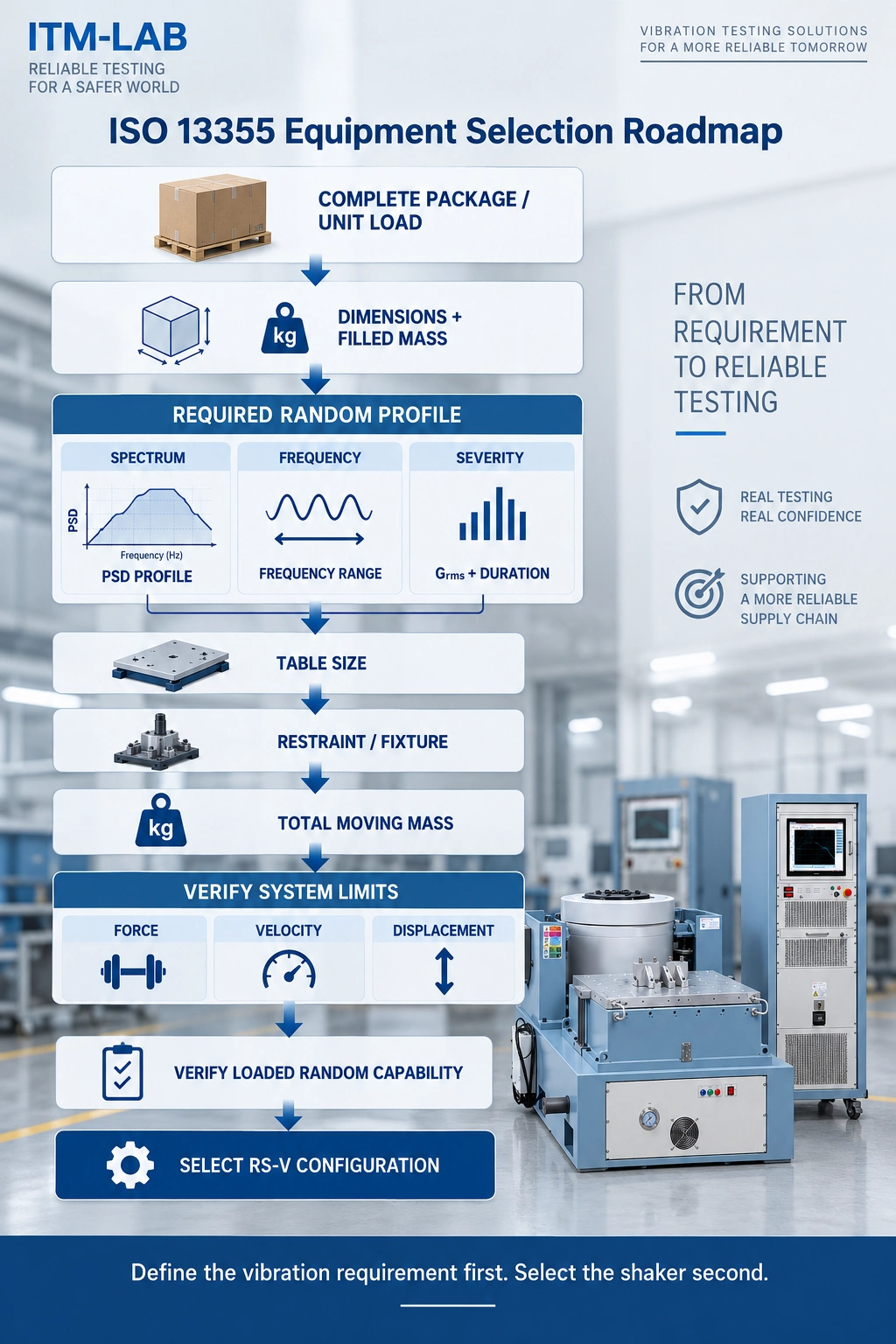
ISO 13355 Random Vibration Test System Selection Roadmap
The most reliable way to specify the equipment is to work outward from the package.
What Information Should You Send to the Equipment Supplier?
You do not need to calculate the shaker configuration yourself before requesting a quotation.
But “ISO 13355 vibration tester” is not enough information for a reliable recommendation.
A useful starting point is:
Package / product type — What are you shipping?
Package dimensions — Length × width × height.
Filled package mass — Include the product and packaging.
Quantity — One package or several simultaneously?
PSD profile — Send the required spectrum or test specification if available.
Frequency range — Required lower and upper frequencies.
Overall Grms — Required random vibration level.
Test duration — Required exposure time.
Restraint / mounting requirement — If already defined.
Applicable specification — ISO 13355 plus any customer or distribution requirements.
With those inputs, the equipment supplier can evaluate the table arrangement, moving load and shaker capability instead of guessing from package weight alone.
ISO 13355 FAQ
What is ISO 13355?
ISO 13355:2016 specifies a method for vertical random vibration testing of complete, filled transport packages and unit loads. It can be used to assess package strength, protection of the contents, or both. The current second edition was published in 2016 and confirmed during ISO's 2021 systematic review.
What is PSD in a Packaging Vibration Test?
PSD, or Power Spectral Density, describes how random vibration energy is distributed across frequency.
For test definition and equipment selection, the PSD profile should be considered together with frequency range, overall Grms and duration.
Two profiles can have the same overall Grms without having the same spectral shape.
What Type of Vibration Machine Is Used for ISO 13355?
ISO 13355 uses vertical random excitation, so the test system needs controlled random vibration capability.
An electrodynamic vibration system configured with the appropriate controller, accelerometer and test interface is one practical solution.
For ITM-LAB, the RS-V Series is the relevant platform to configure around the required random vibration profile.
How Do I Select the Right Random Vibration Shaker?
Start with the complete package and required test profile.
Define the package dimensions and filled mass, PSD, frequency range, overall Grms, duration, table requirement and restraint configuration.
Then verify the complete loaded system against the required force, velocity and displacement capability.
Do not select a shaker from payload capacity alone.
From a Standard Number to a Working Test System
ISO 13355 defines a vertical random vibration method for transport packages.
It does not make every package the same.
A lightweight electronics carton and a heavy industrial unit load can both require transport vibration testing, yet place very different demands on the equipment.
The practical selection sequence is:
Complete Package → Dimensions + Mass → PSD → Frequency Range → Grms + Duration → Table + Restraint → Total Moving Mass → Force / Velocity / Displacement → Loaded Random Capability → Shaker Configuration
Following that sequence avoids one of the most common equipment-selection mistakes: choosing a vibration system because its payload number looks large enough.
The right system is the one that can reproduce the required random vibration profile with the actual test configuration installed.
Need to Configure an ISO 13355 Random Vibration Test System?
Not sure which shaker configuration fits your package?
Start with the package dimensions and filled mass, then send ITM-LAB the required PSD profile, frequency range, overall Grms and test duration.
Our engineering team can evaluate the moving load, table and restraint requirements, vibration controller and loaded-system capability before recommending an appropriate RS-V Series configuration.
