
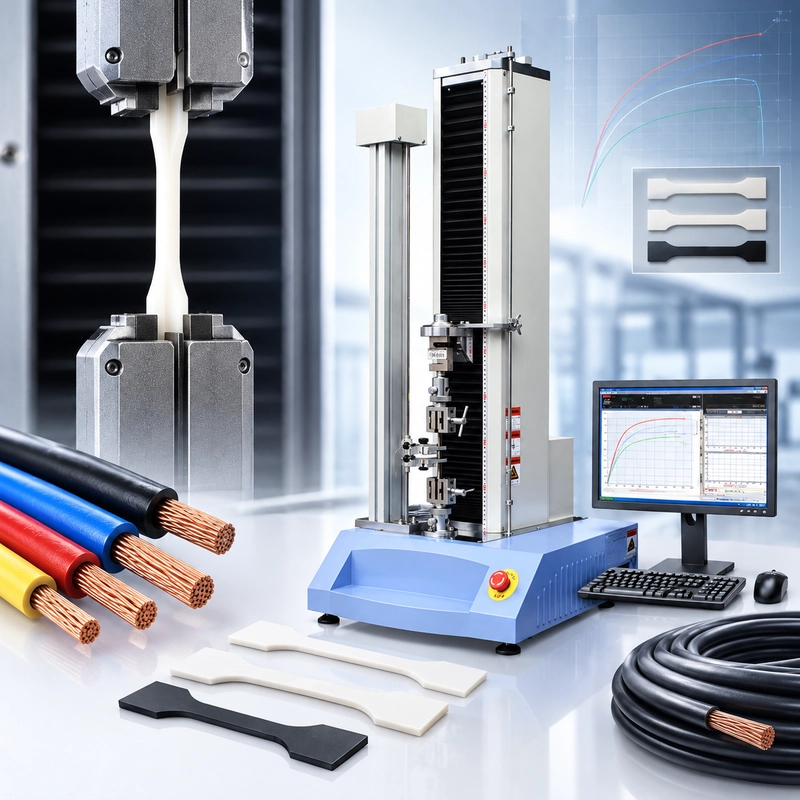
A cable manufacturer sends an RFQ:
PVC cable sheath. IEC 60811 tensile test. Need tensile strength and elongation. Please recommend a machine.
It sounds straightforward, but there is not enough information yet to choose between a 5 kN and 50 kN testing machine.
The first thing we would ask for is the specimen.
IEC 60811-501 covers procedures for determining the mechanical properties of insulating and sheathing compounds used in electric and optical fibre cables. The material may come from a large power cable, but the tensile machine is not necessarily pulling the complete cable. It is testing a prepared specimen of the applicable insulation or sheath material.
That distinction changes how the machine should be selected. Specimen form and dimensions affect the expected force. Material behavior affects grip selection and required travel. Tensile strength and elongation determine what the measurement system needs to capture.
The specimen comes before the machine.
What IEC 60811-501 Is Actually Testing
A finished cable is a mechanical system. Depending on its construction, it may contain conductors, insulation, fillers, screens, armour and an outer sheath.
Pulling the complete cable can load several of those components simultaneously. IEC 60811-501 addresses a different question: the mechanical properties of the applicable insulating or sheathing compound.
The current consolidated publication is IEC 60811-501:2012+A1:2018+A2:2023, Edition 1.2. IEC identifies it for use together with IEC 60811-100.
For a laboratory, this means that an inquiry for an “IEC 60811 tensile testing machine” should first be translated into a more specific test requirement:
Are you testing insulation or sheath? What specimen can be prepared from the cable? What force and elongation are expected? Are the specimens being evaluated in their original condition, after ageing, or both?
Those answers are more useful for equipment selection than the diameter of the finished cable.
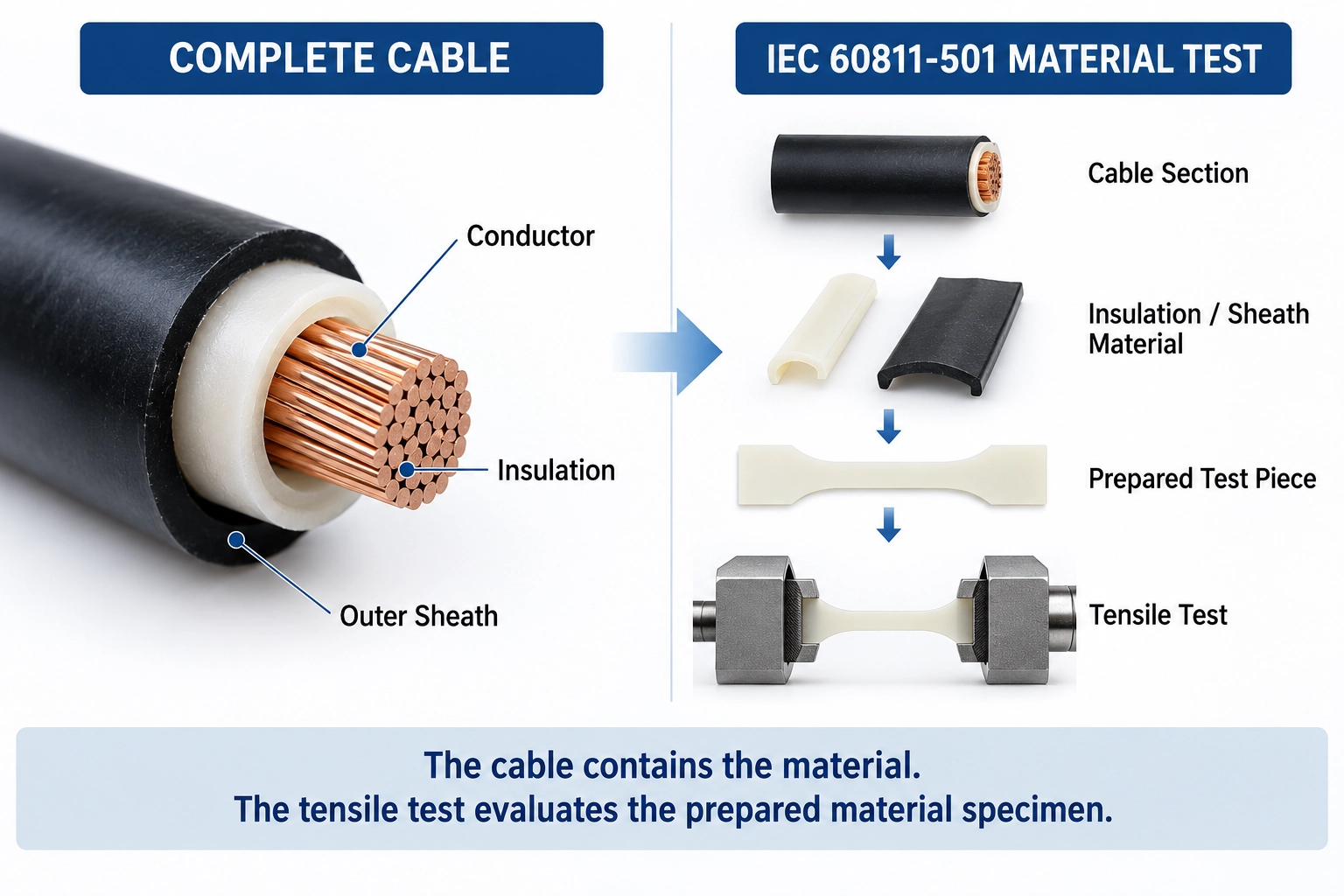
IEC 60811 is a series rather than one universal cable test. For the application discussed here, IEC 60811-501 is the key mechanical-properties method. Other parts address different aspects of non-metallic cable materials; for example, IEC 60811-401 covers thermal ageing methods in an air oven.
The practical approach is to identify the material property required by the applicable cable specification, then determine the specimen and test method needed to measure it.
The Specimen Comes Before the Machine
A manufacturer of large power cables may assume that a high-capacity tensile machine is automatically required.
That is not necessarily the case.
For IEC 60811-501 material testing, machine capacity should be based on the prepared specimen rather than the apparent size of the finished cable.
Depending on cable construction and the applicable procedure, specimen form can vary. The laboratory may work with a prepared dumb-bell-type test piece or another specimen form appropriate to the construction and method.
For an initial machine-sizing estimate:
where:
- = expected tensile force, N
- = expected tensile stress, MPa or N/mm²
- = original effective cross-sectional area, mm²
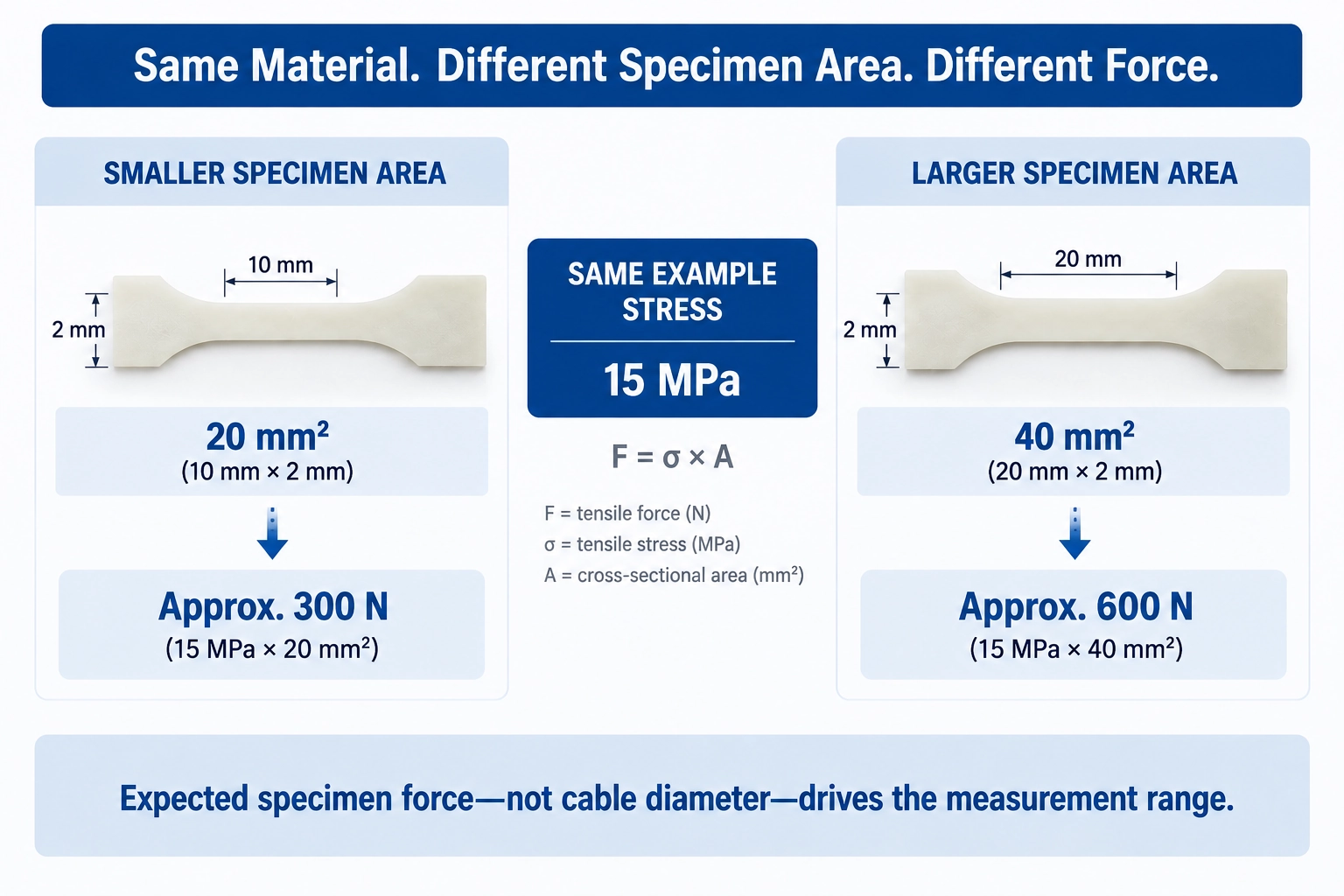
Consider a specimen with an effective cross-sectional area of 20 mm² and an expected tensile stress of approximately 15 MPa:
This is an equipment-sizing estimate, not an acceptance calculation.
If another specimen of the same material has an effective area of 40 mm², its expected force at the same stress would be approximately:
The material has not changed. The specimen geometry has.
That difference can affect the appropriate load-cell range and machine configuration.
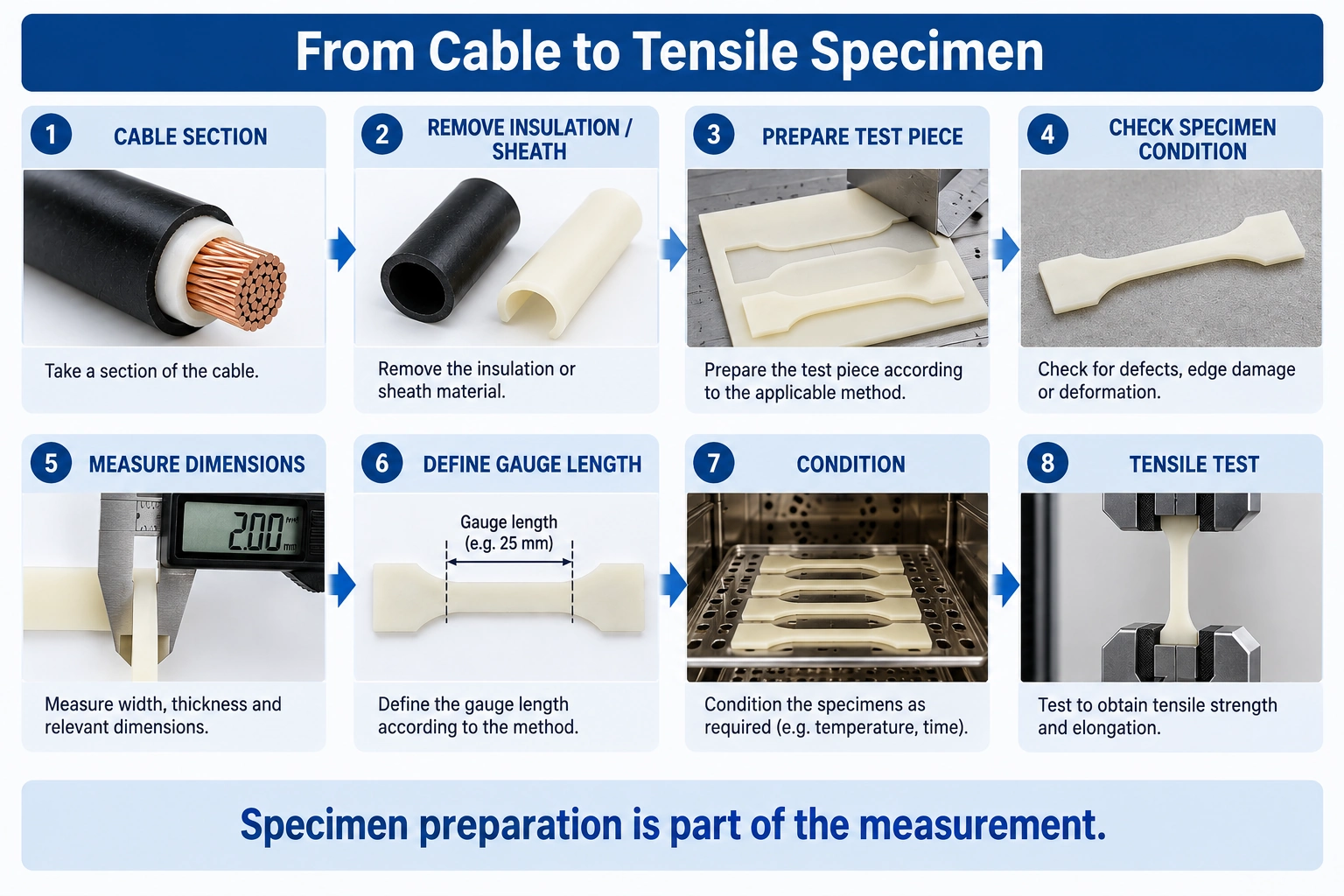
Getting from the cable to a valid specimen
Force calculation is only useful if the specimen itself has been prepared correctly.
Cable insulation and sheath materials may have to be removed from curved, extruded constructions before a suitable test piece can be prepared. This creates several opportunities for measurement error before the specimen reaches the tensile machine.
Material can be nicked during removal. Cutting can introduce damaged edges. Thickness can vary across the specimen. A prepared test piece may retain curvature or become distorted.
Dimension measurement also matters because the cross-sectional information feeds directly into the calculated tensile result.
An accurate load cell cannot correct an incorrect specimen area.
Specimen preparation, form and dimensional measurement should therefore follow the applicable IEC procedure and cable/product specification rather than a generic plastics tensile specimen taken from another test method.
Grip, Alignment and Elongation Can Change the Result
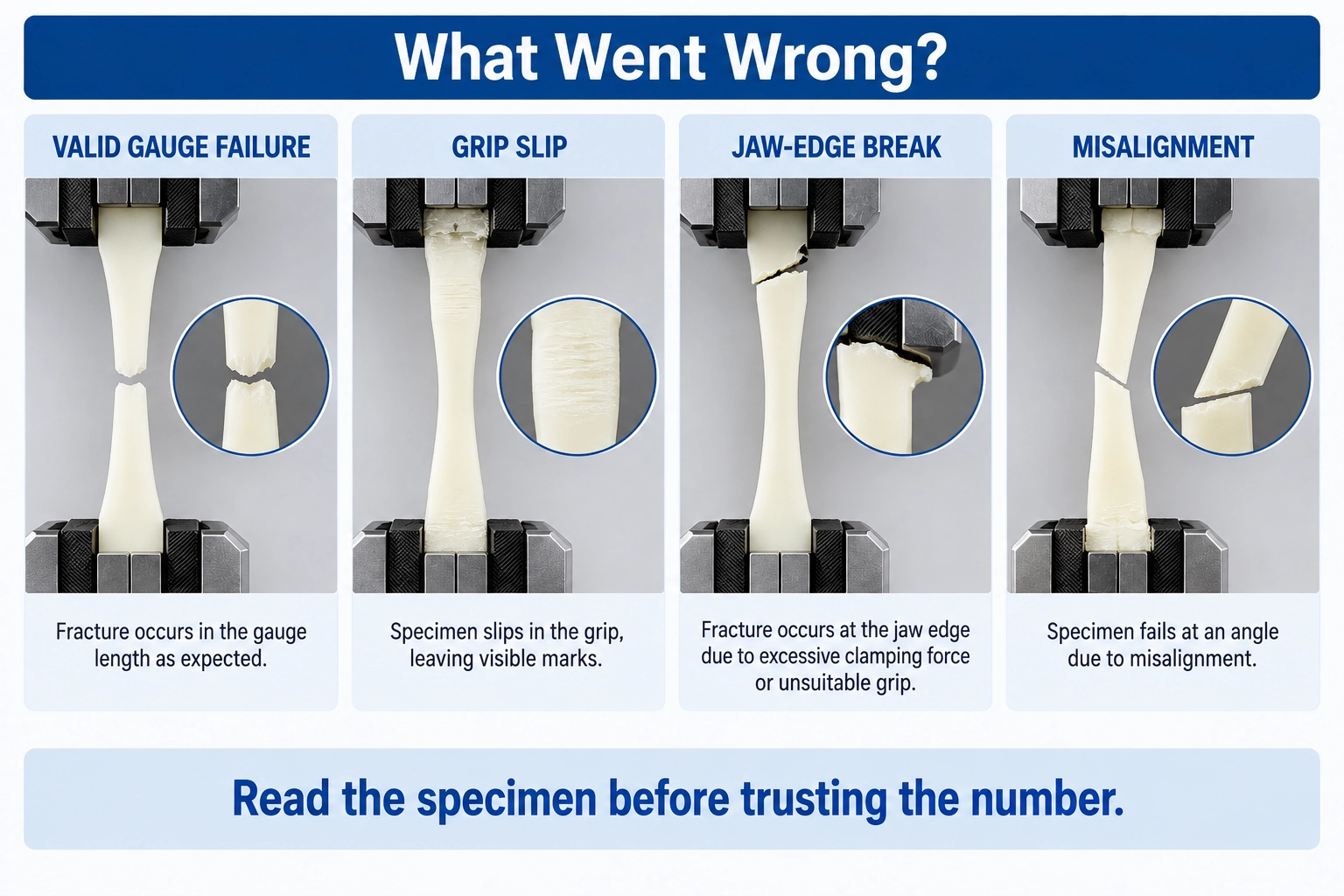
A correctly prepared specimen can still produce poor data if it is held incorrectly.
This is particularly relevant for soft PVC, flexible sheath compounds, thin insulation and highly extensible materials. The grips need enough holding force to prevent movement without creating a new failure point at the jaw.
Insufficient clamping can allow the specimen to slip. Increasing the pressure may stop the slip but damage a soft specimen and move the failure to the jaw edge instead.
Alignment matters as well. A specimen that enters the grips at an angle may experience a load path that differs from the intended tensile axis.
This is why grip selection should follow the specimen form and material behavior. Jaw surface, clamping method, grip geometry and consistency of clamping pressure can all affect the test.
After rupture, the specimen should be inspected rather than relying only on the number reported by the software.
Where did it break?
Did it move in the grips?
Are there severe jaw marks?
Was the specimen still aligned at failure?
A repeatable result is useful only when the setup is repeatedly performing the intended test.
Expected elongation affects machine selection too
Force is only one side of the equipment decision.
Consider two specimens that both break below 500 N. One reaches approximately 40% elongation while the other extends several times its original gauge length.
They may fit the same force range, but they do not create the same travel requirement.
Gauge length, initial grip separation, expected elongation and usable machine travel need to work together. A correctly sized load cell does not help if the specimen reaches the machine's available travel before the required test event occurs.
The method used to determine elongation also needs to be established.
Crosshead displacement describes movement of the machine. Material elongation describes deformation of the specimen relative to its defined original length. Depending on the test configuration, machine movement can include specimen extension together with contributions from grip movement, compliance or slip.
This does not mean that every IEC 60811-501 test automatically requires the same extensometer. It means that the required elongation result and measurement approach should be defined before the system is configured.
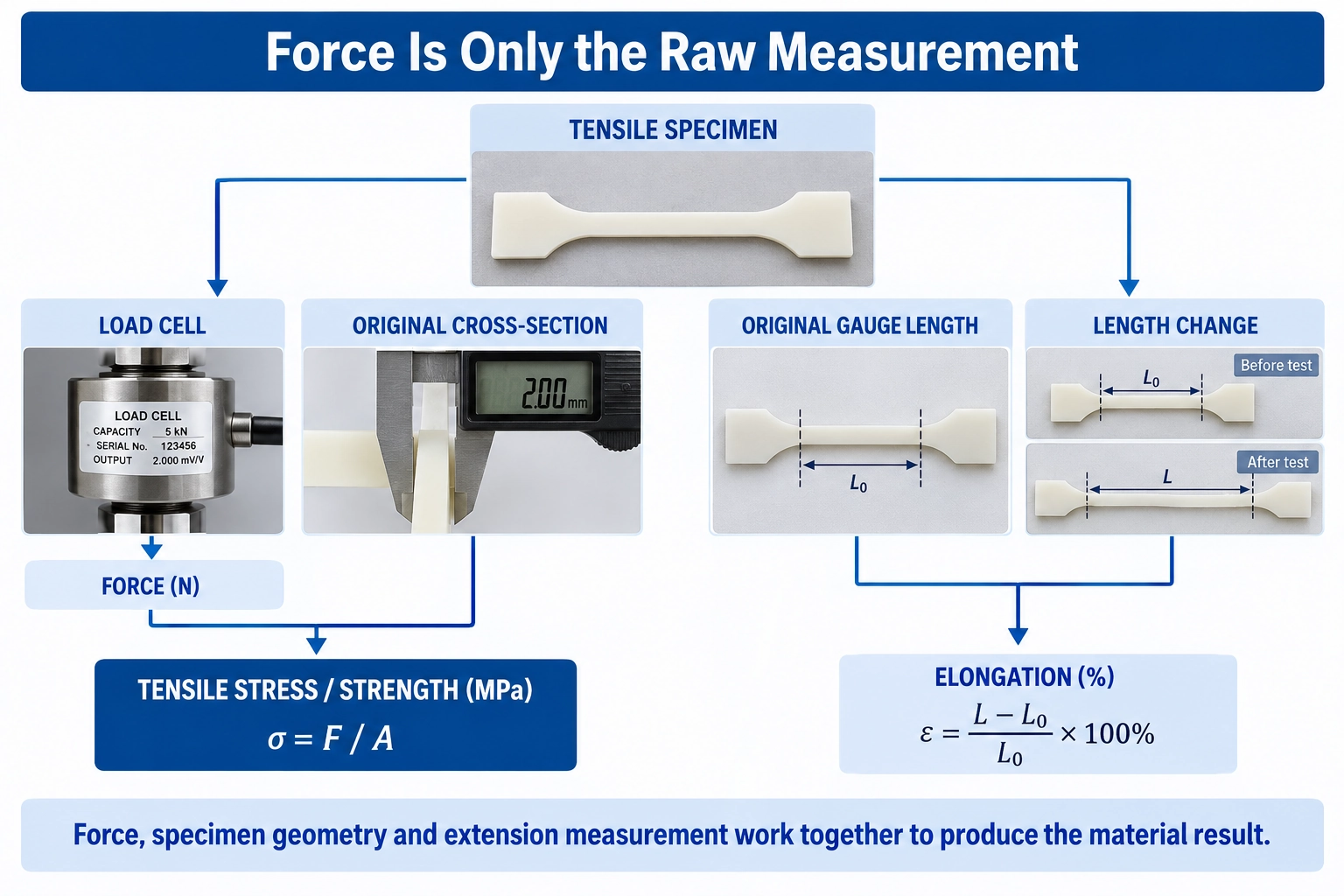
Force Is Not the Material Property
Suppose two specimens both reach 300 N.
Specimen A has an original cross-sectional area of 20 mm²:
Specimen B has an area of 10 mm²:
The load cell measured the same force, but the calculated tensile stress is very different.
This is why a raw value in newtons does not by itself describe the mechanical performance of a cable insulation or sheath compound.
Tensile properties require the force measurement to be interpreted together with specimen geometry. Elongation adds another measurement:
where represents the original reference length and the relevant extended length used by the method.
Software can calculate and report these values automatically, but it cannot compensate for poor specimen preparation, incorrect dimensions, grip slip or an incorrectly defined reference length.
This also matters when two laboratories report different results.
If tensile strength is similar but elongation differs substantially, it is worth checking specimen preparation, original dimensions, gauge definition, conditioning, grip behavior and evidence of slip before concluding that one machine is inaccurate.
Two calibrated machines can still produce different results when the specimens are not being tested in the same mechanical way.
Before and After Ageing
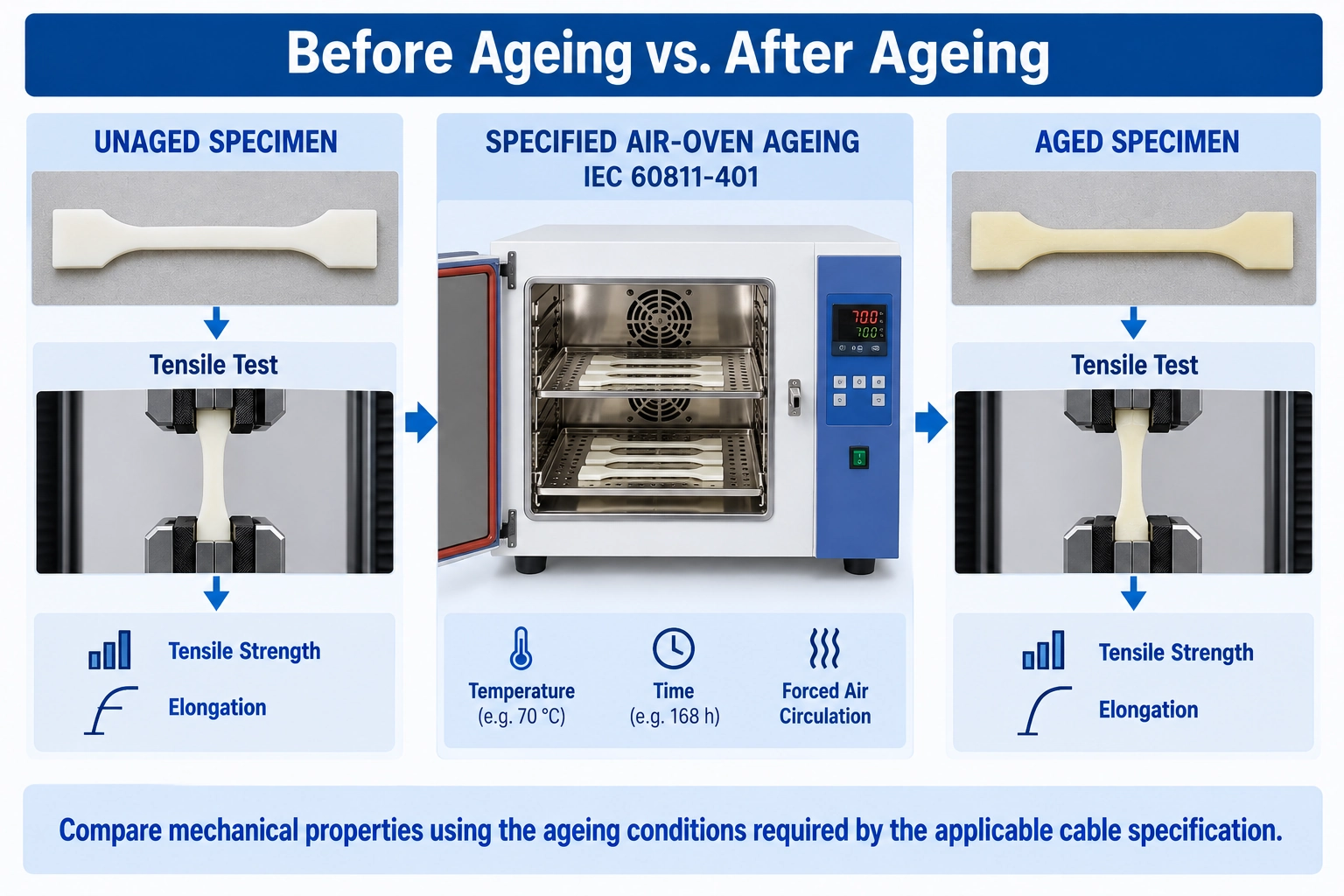
Some cable-material programs require tensile properties to be evaluated not only in the original condition but also after a defined ageing process.
IEC 60811-401 addresses thermal ageing methods in an air oven for insulating and sheathing compounds.
A typical test program may therefore compare:
Unaged specimen → tensile strength + elongation
with:
Specified ageing → aged specimen → tensile strength + elongation
The comparison helps show how the material's mechanical behavior changes after the required thermal exposure.
There is no single ageing temperature and duration that should be copied into every IEC 60811 test program. The applicable cable or product specification determines the required conditions and acceptance criteria for the material being evaluated.
That distinction matters when configuring a laboratory. The tensile machine provides the mechanical measurement; the complete test program may also require the appropriate ageing equipment and specimen-conditioning workflow.
How to Choose the Machine Capacity
At this point, machine selection becomes much more straightforward.
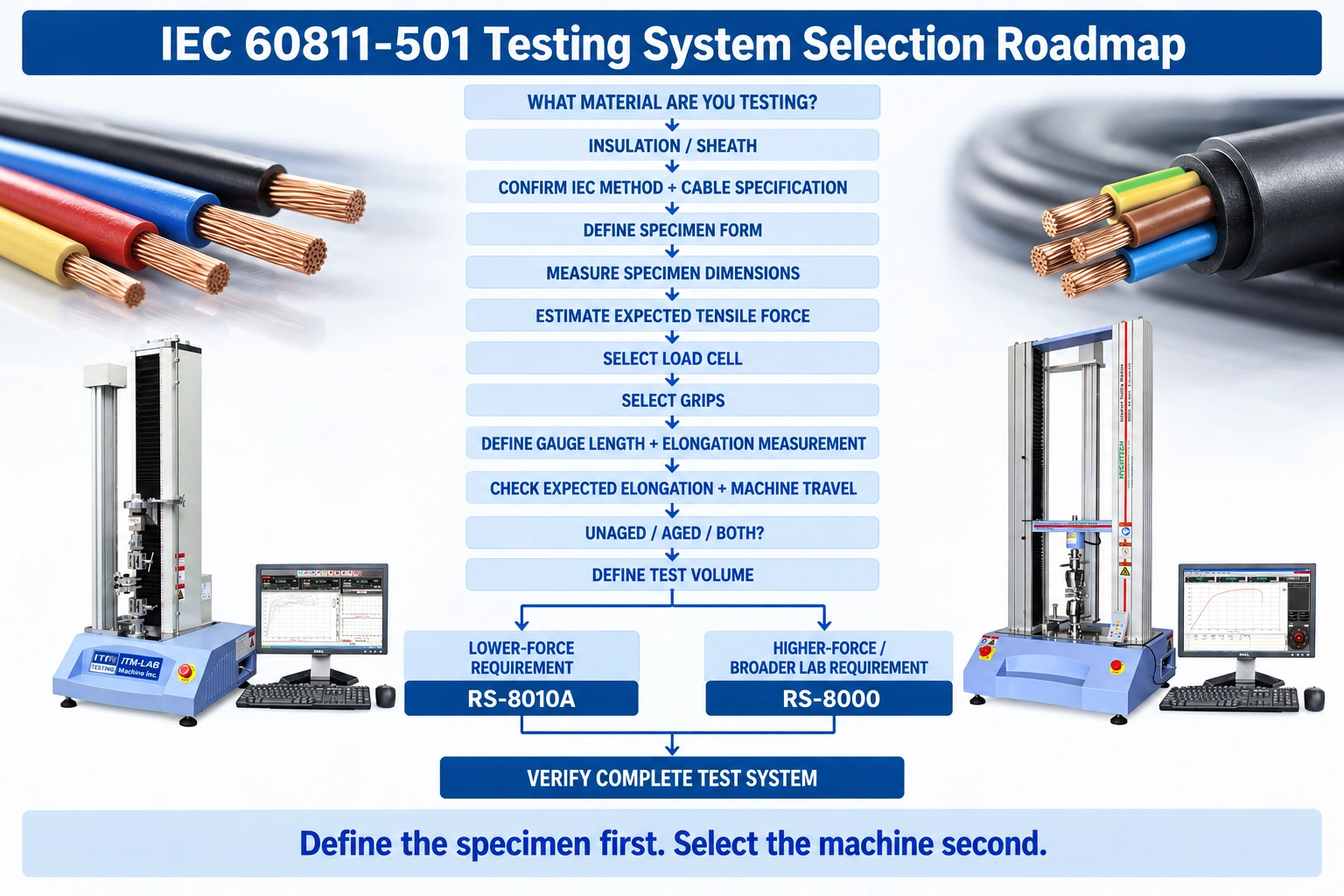
Start with the expected specimen force, then check the load-cell range, specimen form, grips, expected elongation, available travel, required measurement method and daily testing volume.
Frame capacity comes after those questions.
“Our maximum expected force is 600 N. Is a 5 kN machine enough?”
From frame capacity alone, 600 N is comfortably below 5 kN.
That does not complete the selection.
The laboratory should still verify that the chosen load-cell configuration is appropriate for the actual working range, that the specimen can be held without slipping or jaw damage, and that the available travel accommodates the expected elongation.
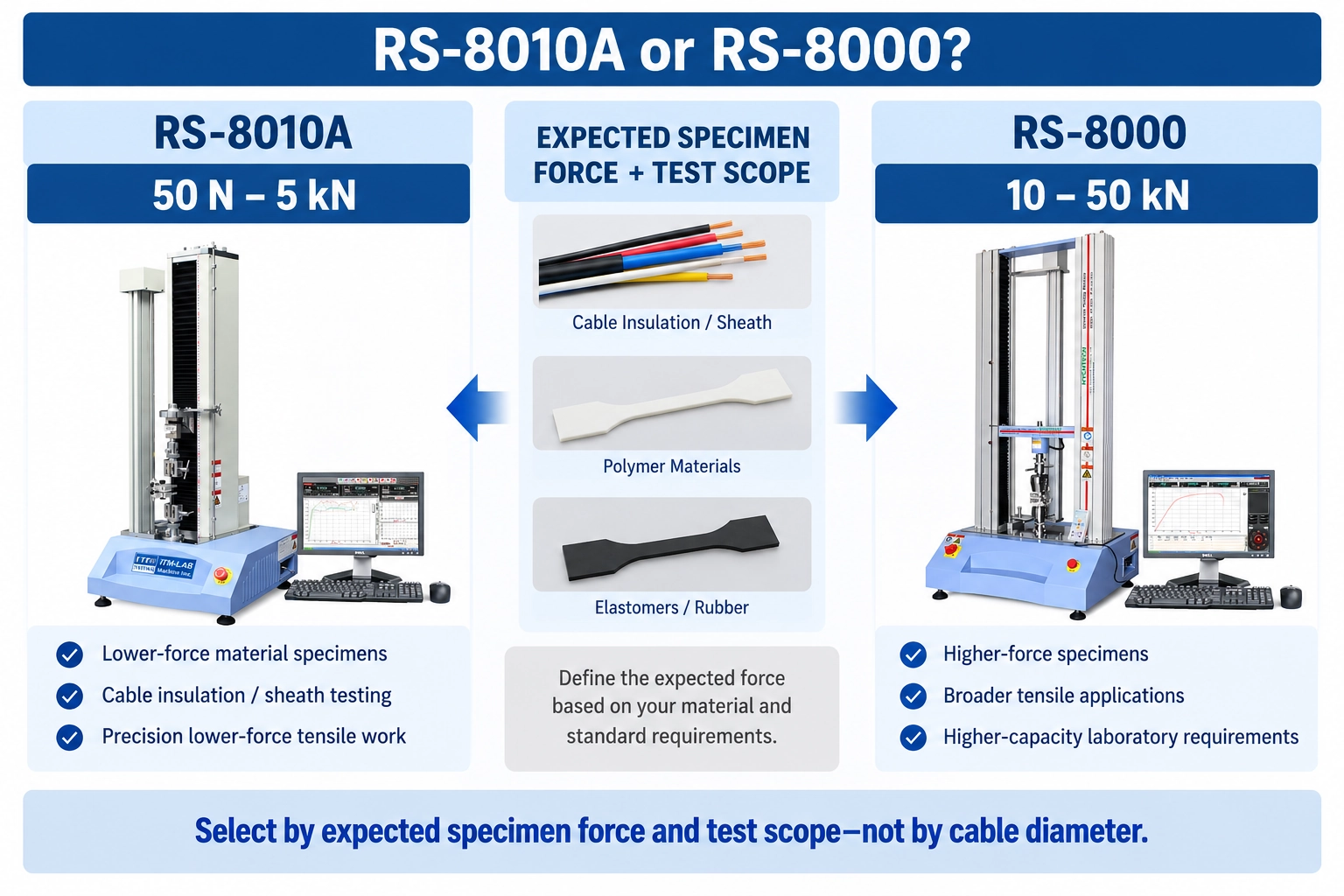
This is where the ITM-LAB RS-8010A and RS-8000 serve different requirements.
RS-8010A — lower-force IEC 60811-501 applications
The ITM-LAB RS-8010A Servo Control Universal Testing Machine covers capacities from 50 N to 5 kN.
For many lower-force cable insulation and sheath specimens, RS-8010A is the first platform to evaluate.
The complete system may include:
RS-8010A + appropriate load cell + suitable tensile grips + elongation measurement configuration + test software
The exact configuration should follow the expected specimen behavior rather than treating IEC 60811-501 as one fixed machine-and-grip package.
RS-8000 — higher-force or broader laboratory requirements
The ITM-LAB RS-8000 Servo Control Tensile Testing Machine covers 10–50 kN configurations.
RS-8000 becomes relevant when the actual test program moves into a substantially higher working-force range or when the laboratory needs a broader platform for additional higher-force tensile applications.
For example, a cable manufacturer may want one system for several material and component programs rather than a machine dedicated only to lower-force insulation and sheath specimens. In that case, the wider laboratory workload may justify the higher-capacity frame.
A large cable by itself does not.
A Real Cable-Lab RFQ
Consider this inquiry:
Material: PVC outer sheath
Method: IEC 60811-501
Expected force: 200–600 N
Expected elongation: “High”
Required results: Tensile strength + elongation at break
Test volume: 80 specimens/day
Additional requirement: Before/after thermal ageing
There is already enough information to identify RS-8010A as a platform worth evaluating.
There is not enough information to finalize the test system.
“High elongation” needs to be translated into an expected range so that machine travel can be checked. The specimen form and dimensions are still missing, as are the available specimen length and applicable cable specification.
For aged specimens, the required ageing condition must also be confirmed rather than assumed.
Daily volume adds a practical issue. A development laboratory running ten specimens per week may tolerate more manual grip adjustment. At 80 specimens per day, repeatable specimen loading, grip operation and software workflow become more important.
This is why two laboratories working to the same IEC method may reasonably require different equipment configurations.
What to Send Before Requesting an IEC 60811 Tensile Test System
A useful RFQ does not need to be long, but it should describe the actual specimen and test requirement:
Cable Type: ______
Material Under Test: Insulation / Sheath
Compound: PVC / PE / XLPE / Elastomer / Other
Applicable IEC Method: ______
Cable / Product Specification: ______
Specimen Form: ______
Specimen Width / Relevant Dimensions: ______
Specimen Thickness: ______
Expected Maximum Force: ______ N
Expected Elongation: ______ %
Required Results: Tensile Strength / Elongation / Other
Unaged / Aged / Both: ______
Required Ageing Condition: ______
Test Volume: ______ specimens/day
Cable Drawing / Specimen / Sample Available: Yes / No
With this information, the selection sequence becomes:
Specimen → expected force → load cell → grips → elongation measurement → travel → machine.
IEC 60811-501 Testing System Selection Roadmap
FAQ
What does IEC 60811-501 test?
IEC 60811-501 provides procedures for determining mechanical properties of insulating and sheathing compounds used in electric and optical fibre cables. It typically applies to cross-linked and thermoplastic compounds and is intended for use together with IEC 60811-100.
It should not be confused with a tensile test performed on an entire finished cable.
What is the difference between an IEC 60811 tensile test and a whole-cable tensile test?
IEC 60811-501 material testing evaluates a prepared specimen of the applicable insulation or sheathing compound.
A whole-cable tensile test can load multiple elements of the cable construction simultaneously and therefore answers a different mechanical question.
Is a 5 kN tensile testing machine enough for IEC 60811-501?
It can be more than sufficient for many insulation and sheath specimens, but the decision should be based on expected specimen force rather than the standard number or cable diameter.
Load-cell range, grip configuration, expected elongation and available machine travel should also be checked.
Which grips should be used for cable insulation and sheath specimens?
Grip selection depends on specimen form, thickness, surface condition, stiffness and elongation behavior.
The objective is to prevent specimen slip without introducing excessive jaw damage or premature failure at the grip edge. The final grip should therefore be selected around the actual specimen rather than assigned solely from the standard number.
Is an extensometer required for IEC 60811-501?
The elongation measurement approach should follow the applicable procedure, specimen and required result.
It is not good practice to assume either that crosshead displacement always equals specimen elongation or that every cable-material application requires the same extensometer. The measurement approach should be confirmed as part of the complete test-system configuration.
Why are cable insulation and sheath specimens tested after ageing?
Comparing mechanical properties before and after specified ageing helps evaluate changes in the material following thermal exposure.
IEC 60811-401 provides relevant air-oven ageing methods, while the applicable cable/product specification determines the required conditions and acceptance criteria.
Final Thoughts
Selecting equipment for IEC 60811-501 becomes much easier once the discussion moves away from the size of the finished cable and toward the specimen that will actually be tested.
Specimen form and dimensions influence expected force. Material behavior affects grip selection and travel. Tensile strength and elongation determine what the measurement system needs to capture. Ageing requirements may add another stage to the laboratory workflow.
For many lower-force insulation and sheath specimens, RS-8010A is the logical ITM-LAB platform to evaluate first. RS-8000 becomes relevant when the actual working force or the laboratory's broader testing program requires higher capacity.
Define the specimen first. Select the machine second.
Need to Configure an IEC 60811-501 Tensile Test System?
Send ITM-LAB your cable type, insulation or sheath material, applicable IEC method and cable specification, specimen form and dimensions, expected force, expected elongation, daily test volume, and whether testing is required before ageing, after ageing or both.
ITM-LAB can then evaluate the appropriate load cell, tensile grips, elongation measurement approach, machine travel and universal testing machine configuration for the application.
