
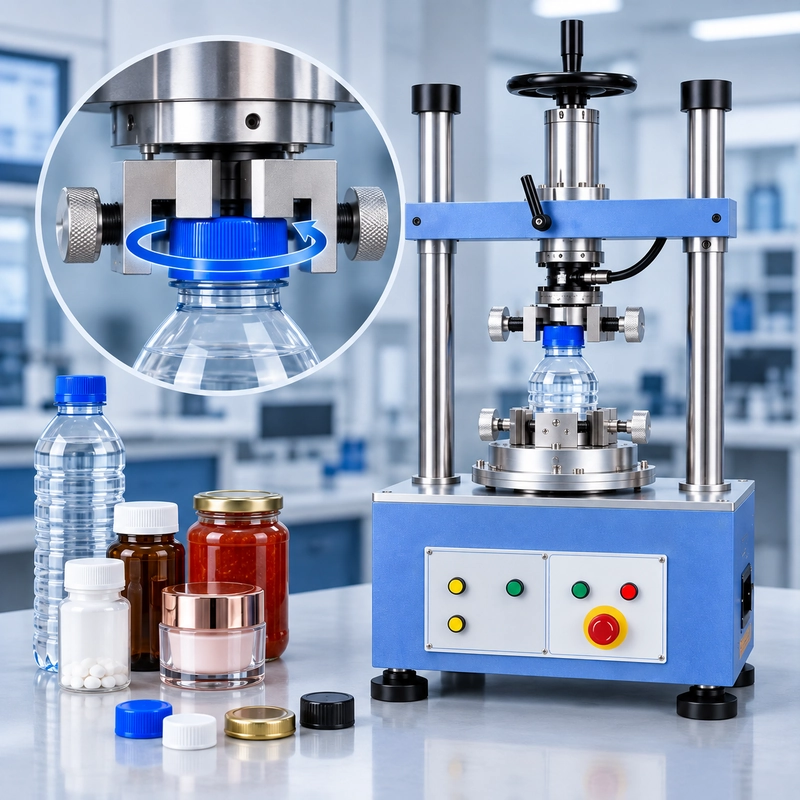
A bottle cap applied at 0.80 N·m will not necessarily require 0.80 N·m to open.
Measure it immediately after application and you may get one result. Wait 24 hours and the removal torque may be different. Change the liner, bottle finish, storage temperature, application speed, or gripping method, and the result can shift again.
That is because cap torque is not one fixed property of a package.
What matters is which mechanical event you are measuring—and when.
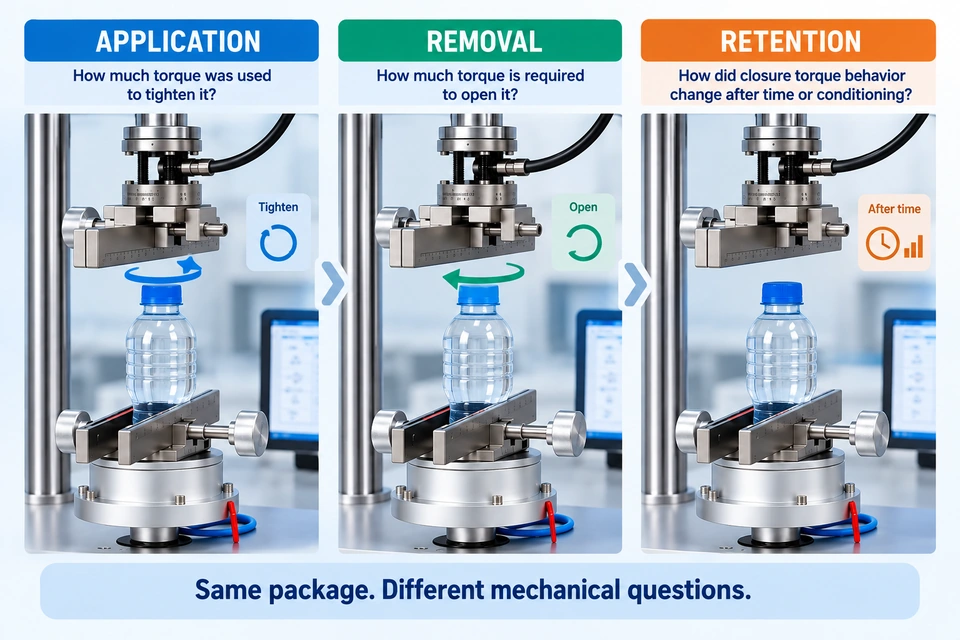
Application torque describes what happens while the closure is tightened. Removal torque describes what happens when it is opened. Torque retention looks at closure behavior after a defined period or conditioning history.
Same bottle. Same cap. Different questions.
Understanding those differences is the starting point for a useful bottle cap torque test.
What a Bottle Cap Torque Test Actually Measures
The basic setup looks simple.
The bottle or container is restrained. The cap is rotated. A torque sensor measures the rotational resistance generated during the defined event.
But a torque value without that event is incomplete.
Consider this result:
0.55 N·m
It could be the torque used to apply the cap. It could be the maximum torque measured during removal. It could be an immediate removal result or a value measured after 24 hours of storage.
All describe different test conditions.
| Measurement | What It Describes |
|---|---|
| Application Torque | Torque applied while tightening the closure |
| Removal Torque | Torque required during opening |
| Peak Removal Torque | Highest torque recorded during the defined removal event |
| Torque Retention | Closure torque behavior after a defined interval or conditioning history |
| Torque vs. Rotation | How torque develops throughout the rotational event |
The last point matters because a closure does not always produce one clean peak.
Depending on the cap, liner, seal, threads, and test method, resistance can change throughout rotation.
For routine production checks, one peak value may be enough. For engineering analysis, the shape of the event may matter too.
Application Torque and Removal Torque Are Different Events
It is tempting to think of removal torque as application torque running backward.
Mechanically, that is too simple.
A continuous-thread closure goes through a sequence:
CAP APPLICATION
↓
THREAD ENGAGEMENT
↓
CLOSURE SEATING
↓
TIME / MATERIAL INTERACTION / CONDITIONING
↓
CAP REMOVAL
Application torque belongs to the first part of that sequence.
Removal torque belongs to the last.
Between them, the package can change.
The closure may relax after tightening. A liner can continue to compress or seat. Contact between the closure and bottle finish may change. Temperature can alter polymer stiffness and friction. Storage can change the mechanical state of the package.
Removal torque is not simply application torque in reverse.
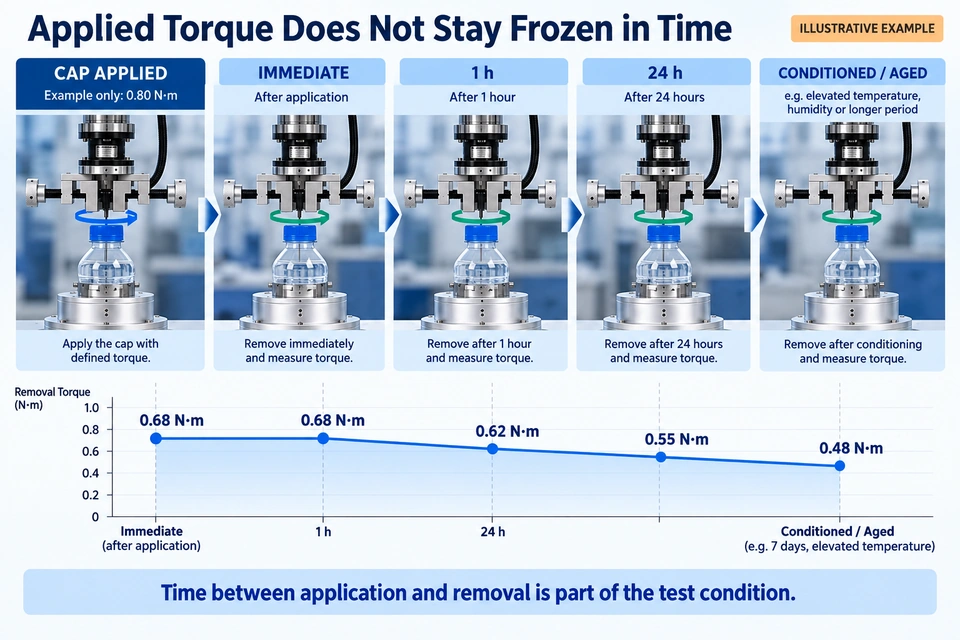
A closure applied at 0.80 N·m may later require substantially less—or behave differently in another way—during removal.
That difference does not automatically mean the package is defective. It means application and removal are separate mechanical events and should be evaluated as such.
There is also no universal rule that higher torque is better.
Insufficient application torque can be a problem for some closure systems. Excessive torque can also create difficulties, including hard opening, package deformation, or thread-related issues.
The acceptable range has to come from the package design, process requirement, applicable method, and product specification—not from a generic torque target.
What Torque Retention Actually Tells You
Torque retention becomes useful when the engineering question is no longer:
What torque was applied?
but:
What happened after application?
Consider a purely illustrative example—not a specification limit:
| Test Stage | Example Result |
|---|---|
| Application | 0.80 N·m |
| Immediate Removal | 0.68 N·m |
| Removal After 24 h | 0.55 N·m |
The important information is not that 0.55 N·m is “good” or “bad.”
Nothing in those numbers alone tells us that.
What they show is that the measured closure behavior changed between application and later removal.
Possible contributors include polymer relaxation, liner compression, seal seating, thread interaction, friction, temperature, and storage history.
This makes time part of the test condition.
A result measured immediately after application should not casually be compared with one measured the following day as though the conditions were identical.
The conditioning history needs to be defined.
One terminology caution matters here as well:
Torque retention should be interpreted according to the applicable test method or internal procedure. It is not always one universal percentage calculation.
Some test programs focus on defined application and later removal values. Others may calculate or report their relationship differently.
Before comparing torque-retention results between laboratories, suppliers, or production sites, confirm how the result was defined.
What a Cap Torque Curve Can Reveal
A production technician may only need one number.
An engineer investigating a closure problem may need to see what happened during the rotation.
Those are different data requirements.
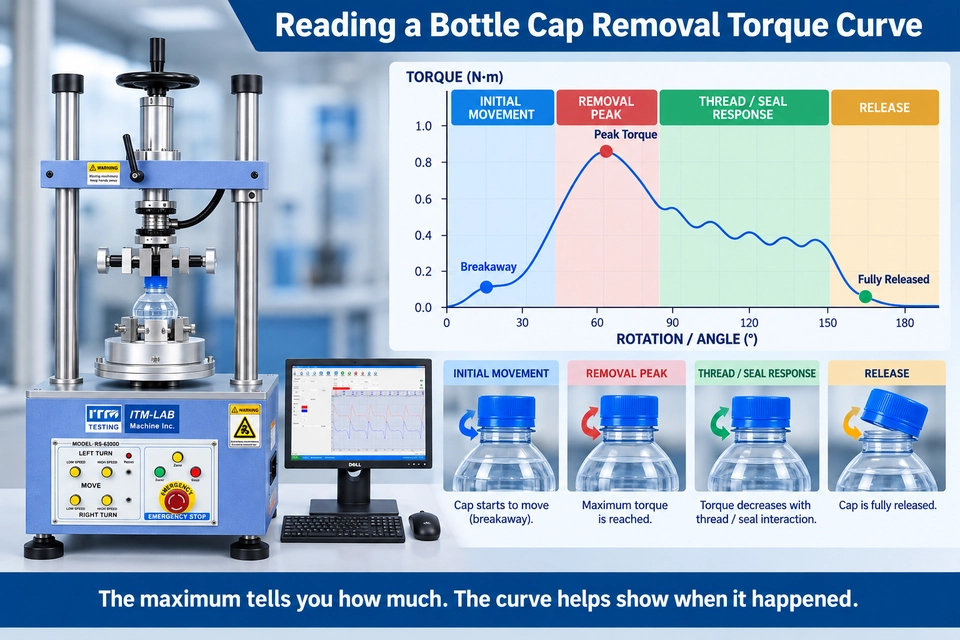
An automated cap torque tester capable of recording torque throughout the event can produce a torque-versus-rotation or torque-angle curve.
A simplified removal event might include:
INITIAL MOVEMENT
↓
REMOVAL / BREAKAWAY REGION
↓
THREAD / SEAL RESPONSE
↓
RELEASE
The exact shape depends on the closure.
Not every cap generates the same sequence, and not every local peak represents the same mechanical event. A curve should therefore be interpreted in the context of the package design rather than treated as a universal fingerprint.
Suppose two closures both produce a maximum removal torque of 0.60 N·m.
The first rises to a clear initial peak and then rotates smoothly.
The second reaches the same maximum but produces several irregular peaks during opening.
A peak-only report makes them look similar.
The curves do not.
That extra information can help during comparative studies, fixture development, packaging investigations, and before/after conditioning work.
But more data is not automatically better data.
If the test specification only requires peak removal torque, adding a complicated curve does not make the test inherently superior.
The measurement output should follow the engineering question.
The maximum tells you how much. The curve helps show when it happened.
Why Bottle Cap Torque Results Vary
When two torque results disagree, it is easy to blame the sensor.
Sometimes that is justified.
Often the more important difference is elsewhere in the test.
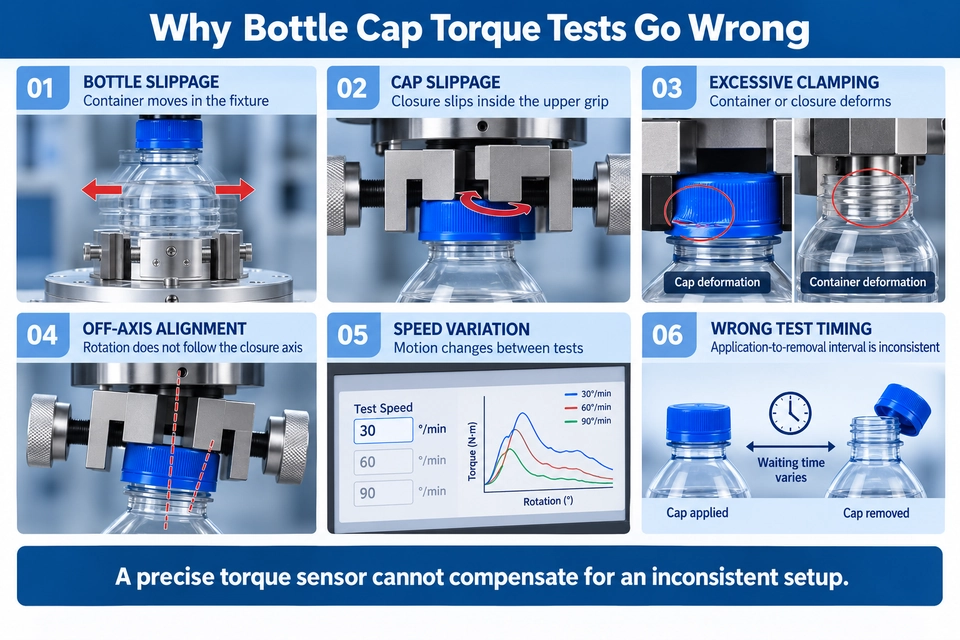
Three variables deserve particular attention: timing, fixturing, and rotational speed.
Timing
A cap tested immediately after application and one tested after 24 hours have not experienced the same mechanical history.
If one laboratory measures immediately while another waits overnight, comparing the resulting removal torque values may be misleading even if both instruments are calibrated correctly.
The procedure should state when removal torque is measured.
If samples are conditioned before testing, that history should be defined as well.
Fixturing
The bottle has to remain stationary while the cap rotates.
That sounds obvious until the container is thin, flexible, tapered, unusually shaped, or has very little surface available for clamping.
Clamp too lightly and the bottle can slip.
Clamp too aggressively and the bottle can deform.
In both cases, the tester may still produce a clean number.
The same problem exists at the closure.
If the upper fixture slips, the commanded rotation is not transferred correctly to the cap. If the fixture deforms or damages the closure, it can alter the very event being measured.
Clean data is not necessarily valid data.
Rotational Speed
Speed is another condition that can disappear from a test report even though it affects the way the measurement is generated.
One operator may remove a cap slowly. Another may rotate it much faster.
With manual testing, that variation is difficult to eliminate completely.
An automatic system can control rotational motion more consistently when the method requires it.
That does not mean one universal speed is correct for every bottle cap torque test. The appropriate condition should come from the applicable method or test procedure.
Alignment and Sample Condition
The rotational axis of the closure should align properly with the test system.
Off-axis rotation can introduce unwanted loading or irregular fixture contact.
Sample condition matters too. Temperature, material state, liner condition, moisture, storage history, and production variation can influence the mechanical response.
If samples are being compared, those conditions should be comparable as well.
What Cap Torque Means in Real Packaging Applications
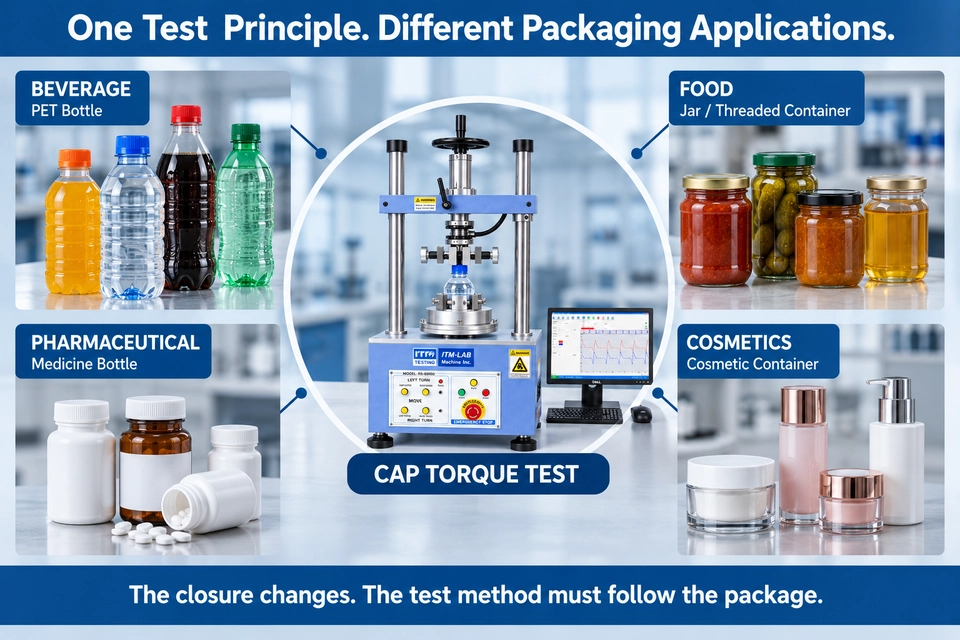
The measurement principle is similar across packaging industries.
The reason for measuring it is not.
Food and Beverage: Finding the Practical Balance
For beverage bottles, jars, sauces, edible oils, and other food packages, closure torque is often part of process control and package evaluation.
The engineering problem is a balance.
The closure needs to interact correctly with the container and sealing system, while the finished package also needs appropriate opening behavior.
Torque data can help compare capping conditions, production lots, closure configurations, storage conditions, or supplier changes.
What it cannot do by itself is prove seal integrity.
A closure can meet a torque requirement and still need separate leak, seal, or package-integrity evaluation.
Cap torque is one piece of package performance—not a substitute for every other package test.
Pharmaceutical Packaging: Control and Documentation
Pharmaceutical packaging may place greater emphasis on controlled procedures, repeatability, traceability, and package-specific requirements.
Application and removal torque can provide useful mechanical information for threaded medicine bottles and other closure systems.
Special closures need more careful interpretation.
For example, torque data can be relevant to certain child-resistant closure mechanisms or engineering investigations, but:
A torque result by itself does not establish child-resistant package performance.
Applicable regulatory, package-performance, pharmacopeial, customer, or internal requirements still need to be followed.
Cosmetics and Household Packaging: The Fixture Becomes the Challenge
Cosmetic containers, personal-care products, pump closures, and household chemical packages often create a different problem.
The expected torque may be straightforward.
Holding the product correctly may not be.
Decorative surfaces, tapered containers, irregular geometry, thin walls, smooth closures, and small gripping areas can make a standard fixture unsuitable.
For these packages, fixture design can become as important as the torque range itself.
ASTM Methods for Continuous-Thread Closure Torque Testing
For continuous-thread closures, two ASTM methods are especially relevant when discussing torque retention.
ASTM D7860 addresses automated torque measurement for continuous-thread closure torque retention.
ASTM D2063/D2063M addresses the corresponding non-automated approach.
| ASTM D7860 | ASTM D2063/D2063M | |
|---|---|---|
| Approach | Automated | Non-automated |
| Motion | System controlled | More operator dependent |
| Measurement | Automated transducer-based system | Non-automated measurement approach |
| Typical Use | Automated torque-retention testing | Non-automated torque-retention testing |
These methods should not be treated as generic labels for every closure torque test.
The package, procedure, and required result still need to be confirmed before equipment is selected.
For a detailed method discussion, see:
ASTM D7860 Automated Closure Torque Testing Guide
That dedicated guide can address method scope, test sequence, automated motion, torque data, and equipment considerations without duplicating them here.
Manual or Automatic: How Much Control Does the Test Need?
The useful question is not whether automatic testing is “better.”
It is how much control the method requires.
| Requirement | Manual | Automatic |
|---|---|---|
| Rotational Speed | Operator dependent | Controlled / programmable |
| Direction | Operator controlled | System controlled |
| Torque Curve | Often limited | Available with a suitable system |
| Operator Influence | Higher | Lower |
| Repeated Testing | More labor intensive | Better suited |
For a simple, occasional peak-removal check, a manual cap torque tester may be completely appropriate.
Automatic testing becomes more useful when the project requires controlled speed, repeatable forward/reverse motion, application and removal sequences, torque-versus-rotation data, or larger numbers of repeated tests.
Automation reduces one source of variation: operator-controlled motion.
It does not eliminate poor alignment, inappropriate sensor range, bad fixturing, inconsistent conditioning, or an incorrectly defined test.
Automation improves control. It does not rescue a bad setup.
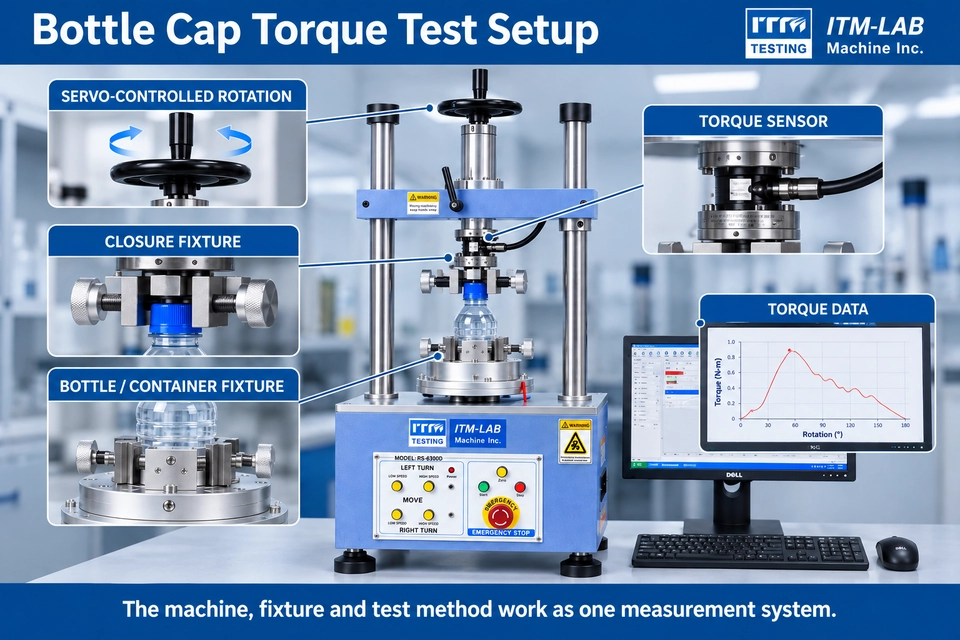
The Fixture Is Part of the Measurement
A bottle cap torque tester is only one part of the measurement system.
The torque sensor measures the rotational load that reaches it.
The fixtures determine how that load reaches the package.
The lower fixture needs to restrain the container without unwanted rotation or excessive deformation. The upper fixture needs to transfer motion to the closure without slipping or changing the cap geometry more than necessary.
That makes fixture selection a mechanical problem, not simply a diameter check.
A thin PET bottle may need different support from a rigid glass jar.
A deeply ribbed plastic cap may be easy to grip. A smooth metal or decorative closure may not be.
An irregular cosmetic container may require a custom holding arrangement even when its torque range is modest.
A complete closure torque system is better thought of as:
Torque Sensor + Rotation + Closure Fixture + Container Fixture + Package + Data
The machine measures torque.
The entire setup determines whether that number represents the intended closure event.
How to Select a Cap Torque Tester
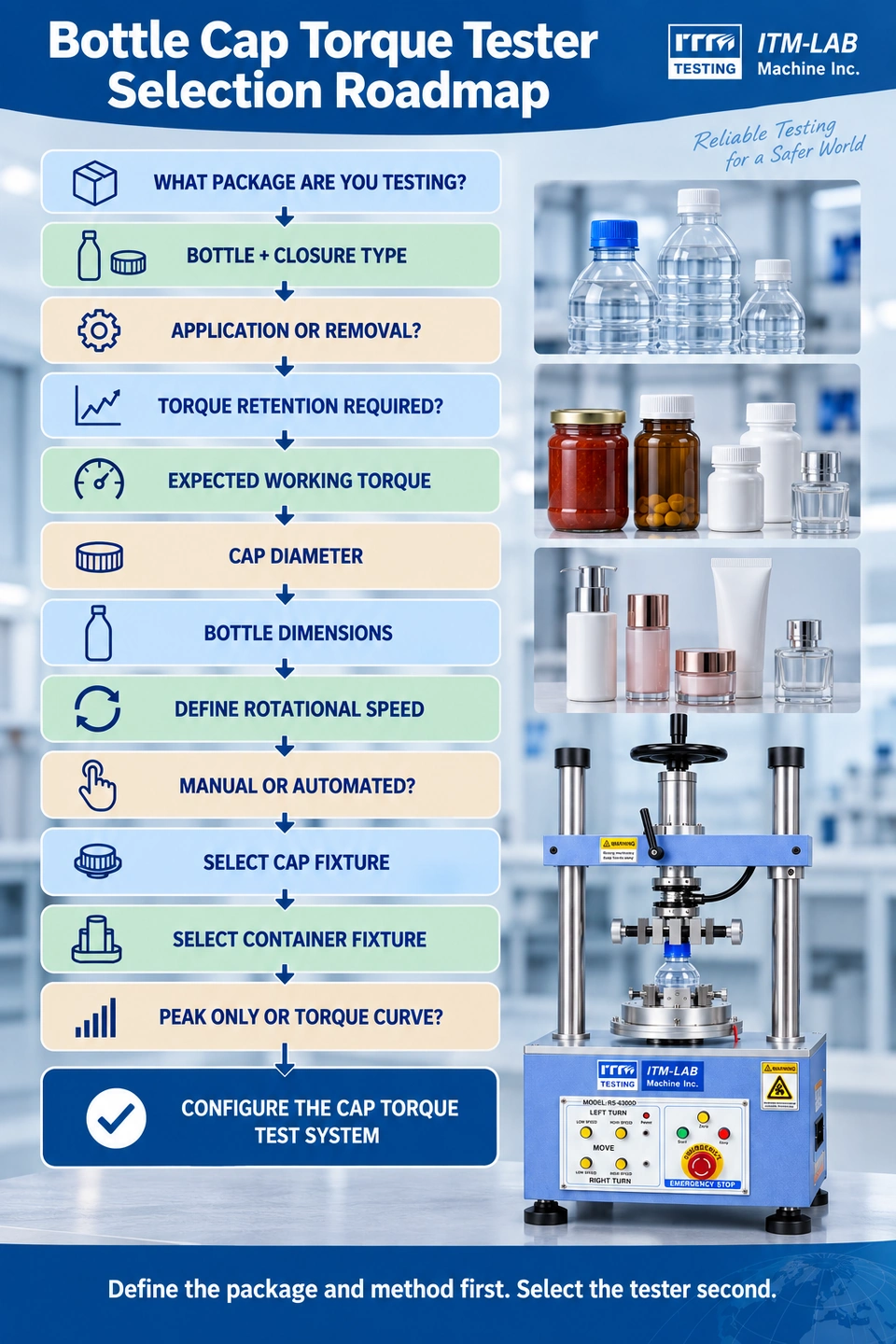
Start with the package.
Not the machine capacity.
A small pharmaceutical vial, a PET beverage bottle, and a large threaded food container may all need torque measurement, but they do not automatically need the same sensor, fixture, or motion setup.
First, define the expected working torque.
The selected range should suit the torque the test is actually expected to measure. A much larger maximum capacity is not automatically an advantage.
Next comes package geometry.
Bottle height and diameter affect the container fixture. Cap diameter and surface geometry affect the closure fixture. Irregular packages may require custom supports.
Then define the event:
Application? Removal? Both? Torque retention?
After that, define the motion.
Does the method require a particular rotational speed? One direction or both? Controlled application followed by removal? Is rotation angle or a complete torque curve needed?
Finally, define the data.
A production check may only need:
Peak Removal Torque
An engineering program may require:
Application Torque + Removal Torque + Torque Curve + Before/After Comparison
The equipment configuration should follow those requirements.
What to Send Before Equipment Selection
Before recommending a system, enough information is needed to understand both the package and the test.
The most useful details are:
- Bottle / container: material, shape, photos and available drawings
- Closure: type, cap diameter and gripping geometry
- Dimensions: bottle height, diameter and relevant fixture surfaces
- Expected torque: application and/or removal range
- Method: ASTM D7860, ASTM D2063/D2063M, customer specification, or internal procedure
- Timing: immediate removal, defined waiting period, or conditioned testing
- Data: peak only, application/removal values, or complete torque curve
Representative samples are particularly useful when the package requires a custom fixture.
These details allow the sensor range, rotation, fixture, and data requirements to be evaluated together instead of treating the tester as a standalone instrument.
FAQ
What is a bottle cap torque test?
A bottle cap torque test measures rotational resistance during a defined closure event. Depending on the procedure, the result may describe application torque, removal torque, peak removal torque, torque retention, or torque throughout rotation.
The test condition—including timing, speed, fixture, and package condition—should be defined together with the torque value.
What is the difference between application torque and removal torque?
Application torque is the torque used while tightening a closure onto the container. Removal torque is measured later when the closure is loosened or opened.
They are different mechanical events. Material relaxation, liner or seal behavior, thread interaction, temperature, and storage time can change the package between application and removal.
What is bottle cap torque retention?
Torque retention describes closure torque behavior after a defined time or conditioning history following application.
The exact calculation or reporting method should follow the applicable test procedure; torque retention should not be assumed to mean one universal percentage formula.
Why does bottle cap removal torque change over time?
The closure system continues to interact after application. Polymer relaxation, liner compression, seal seating, thread friction, temperature, and storage history can influence later removal behavior.
A change in removal torque shows that the mechanical condition changed. It does not, by itself, identify the root cause.
How do I choose a cap torque tester?
Define the package first: bottle dimensions, cap type and diameter, expected torque, and available gripping surfaces.
Then define the test: application or removal, timing, rotational speed, applicable method, fixture requirements, and whether you need a peak result or a complete torque curve.
Choose the tester around those requirements rather than maximum torque capacity alone.
Final Thoughts
Bottle cap torque testing becomes much easier to understand when it is treated as a sequence rather than a single number:
APPLICATION
↓
CLOSURE SEATING
↓
TIME / CONDITIONING
↓
REMOVAL
↓
RETENTION / COMPARISON
For routine quality control, one peak removal value may be enough.
For torque-retention work, packaging investigations, automated test methods, or engineering comparisons, timing, controlled motion, fixturing, and more detailed torque data can become just as important as the peak itself.
Three principles are worth keeping:
Application torque and removal torque are different mechanical events.
Time between application and removal is part of the test condition.
A precise torque sensor cannot compensate for an inconsistent fixture or test method.
Define those conditions first.
Then select the cap torque tester.
Need to Configure a Bottle Cap Torque Test?
Send ITM-LAB your bottle and closure information, expected torque range, application/removal requirement, test timing, applicable method, and available photos or drawings.
From those details, the torque range, motion control, closure fixture, container fixture, and data requirements can be evaluated before configuring the test system.
Discuss Your Cap Torque Test →
