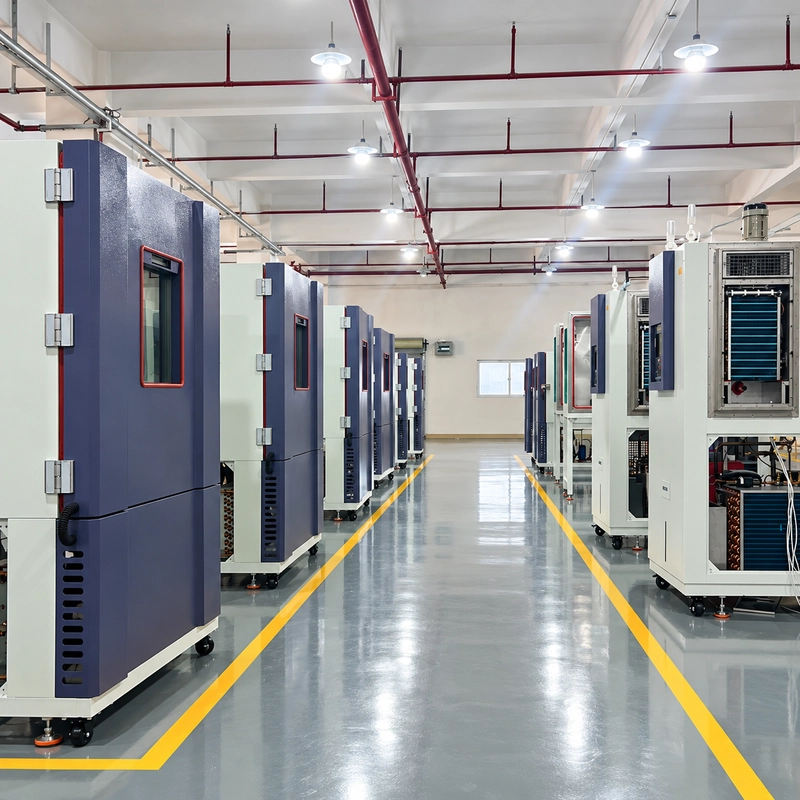
How to verify a manufacturer, compare technical quotations, and reduce sourcing risks before placing an international order.
China offers a wide range of environmental testing equipment, from standard temperature and humidity chambers to thermal shock systems and customized environmental simulation solutions.
For overseas buyers, finding suppliers is rarely the difficult part. The challenge is determining whether a manufacturer can deliver the required performance, document it under agreed conditions, and support the equipment after installation.
Two chambers may share the same advertised temperature range and internal capacity while differing in usable working space, cooling performance, specimen-load capability, verification procedures, and service arrangements.
This guide is written for procurement managers, reliability engineers, laboratory managers, and quality teams evaluating environmental test chamber manufacturers in China.
It focuses on the evidence and technical information needed to make a defensible purchasing decision—not simply on comparing catalogue specifications.
Quick Answer: How Do You Choose an Environmental Test Chamber Manufacturer in China?
Start by verifying the supplier's actual manufacturing operations, engineering capabilities, and experience with the required chamber type. Compare equipment specifications under equivalent test conditions, including specimen load, temperature and humidity requirements, and acceptance criteria. Before placing an order, confirm the factory acceptance test (FAT), technical documentation, commercial responsibilities, and international after-sales arrangements.
Define the test first. Verify the manufacturer second. Select the machine configuration last.
Why Source Environmental Test Chambers from China?
China has a broad supplier base for environmental testing equipment, covering standard laboratory chambers and application-specific industrial systems.
International buyers may find manufacturers offering different chamber capacities, temperature configurations, humidity control, cooling arrangements, and customization options.
However, supplier availability should not be confused with technical suitability.
A successful sourcing project depends on three factors:
Equipment fit. The chamber must support the actual test procedure, specimen dimensions, operating conditions, and required performance.
Manufacturing capability. The supplier must be able to explain the proposed configuration and demonstrate appropriate production and verification processes.
Project accountability. Delivery, installation, documentation, warranty, and technical support responsibilities must be established before the order is confirmed.
These considerations are especially important when purchasing equipment for automotive electronics, battery components, aerospace applications, material evaluation, or other reliability testing programs.
When Does Direct Manufacturer Sourcing Make Sense?
Working directly with a manufacturer can be particularly useful when a project involves:
-
Non-standard chamber dimensions
-
Powered devices under test (DUTs)
-
Additional cable or sensor feedthroughs
-
Specific heating or cooling requirements
-
Customized fixtures or monitoring interfaces
-
Defined factory acceptance procedures
-
Installation and operator training requirements
The advantage is not automatically a lower price. It is the opportunity to resolve technical questions with the team responsible for the proposed equipment.
How to Verify a Chinese Environmental Chamber Manufacturer
Before comparing quotations, establish who will actually manufacture the equipment.
A supplier may be a direct manufacturer, an authorized distributor, or a trading company coordinating production through another factory.
Each model can serve legitimate procurement needs. What matters is understanding who controls engineering decisions, production, performance verification, and after-sales support.
Manufacturer vs Trading Company
| Evaluation Area | Direct Manufacturer | Trading Company |
|---|---|---|
| Production | Operates its own manufacturing facilities | Typically sources from production partners |
| Engineering communication | May provide direct access to technical teams | May coordinate with an external engineering team |
| Customization | Depends on internal engineering capabilities | Depends on manufacturing partners |
| Factory inspection | Can arrange access to its production facility | Requires coordination with the producing factory |
| Service responsibility | Defined by the manufacturer's service arrangements | Must be clarified between the parties |
A trading company is not necessarily an unsuitable supplier. However, additional parties can make responsibility boundaries more important.
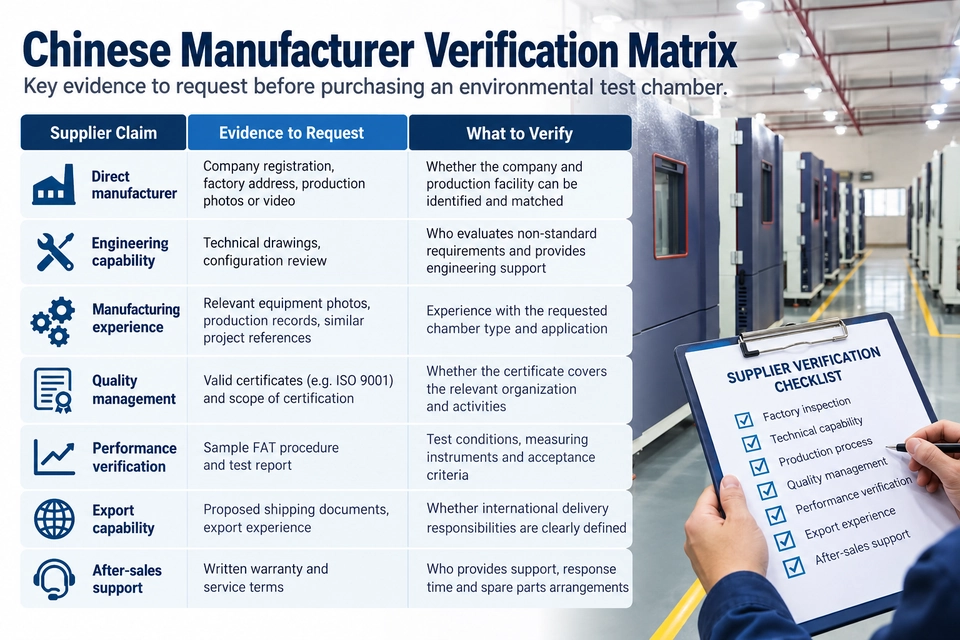
Chinese Manufacturer Verification Matrix
Do not rely on promotional statements alone. Ask for evidence that relates to the specific equipment category you intend to purchase.
| Supplier Claim | Evidence to Request | What to Verify |
|---|---|---|
| Direct manufacturer | Company registration, factory address, production footage | Whether the company and production facility can be identified |
| Engineering capability | Technical drawings and configuration review | Who evaluates non-standard requirements |
| Manufacturing experience | Relevant equipment photographs and production records | Experience with the requested chamber type |
| Quality management | Applicable, valid certification and scope | Whether the certificate covers the relevant organization and activities |
| Performance verification | Sample test procedure and report | Test conditions, measuring instruments, and acceptance criteria |
| Export capability | Proposed shipping documents and delivery scope | Whether international responsibilities are clearly defined |
| After-sales support | Written warranty and service terms | Who provides support and how spare parts are handled |
For higher-value projects, request a live factory walkthrough or arrange an inspection where practical.
A company catalogue can show what a supplier offers. It does not, by itself, demonstrate how the equipment is manufactured or verified.
What Technical Specifications Should Buyers Compare?
The most common quotation mistake is treating nominal specifications as proof of equivalent performance.
For example, two manufacturers may offer a chamber with a temperature range of −40°C to +150°C and the same nominal capacity. This does not establish that the chambers will perform identically under actual testing conditions.
The following parameters should be reviewed before selecting a supplier.
Temperature Performance
Request separate values for:
-
Temperature range
-
Temperature fluctuation
-
Temperature deviation
-
Temperature uniformity
-
Heating rate
-
Cooling rate
-
Specified performance measurement conditions
These terms describe different aspects of chamber behavior.
Ask whether the published values apply to an empty chamber or a defined loaded condition, and whether they cover the complete operating range or specified measurement points.
Humidity Operating Envelope
For temperature and humidity chambers, the nominal relative humidity range should not be interpreted as achievable at every temperature.
Request the manufacturer's temperature-humidity operating envelope and confirm the combinations required by your test procedure.
This is particularly important for damp heat applications.
Chamber Capacity and Working Space
Internal volume alone is not sufficient for sizing a chamber.
Provide the DUT's dimensions, quantity, fixture arrangement, specimen weight, and required airflow clearance.
A specimen that physically fits inside a chamber may still occupy too much of the usable working space for the intended test.
Related Reading: How to Size an Environmental Test Chamber.
Powered DUTs and Heat Load
An operating specimen may release heat into the chamber.
This can affect cooling requirements, temperature stability, recovery time, and equipment selection.
If your DUT generates heat during testing, provide the expected heat load or sufficient operating information for an engineering review.
Heating and Cooling Rates
A nominal temperature change rate should always be considered together with its measurement interval and load conditions.
For example, a stated 10°C/min rate does not necessarily apply throughout the entire chamber operating range or with every specimen load.
Request the conditions associated with the quoted performance.
Related Reading: 5°C/min vs 10°C/min vs 15°C/min Rapid Temperature Change Chambers.
Which Environmental Test Chamber Type Fits Your Application?
Not every environmental testing project requires the same chamber configuration.
Before requesting quotations, identify the environmental conditions and test method that the equipment must reproduce.
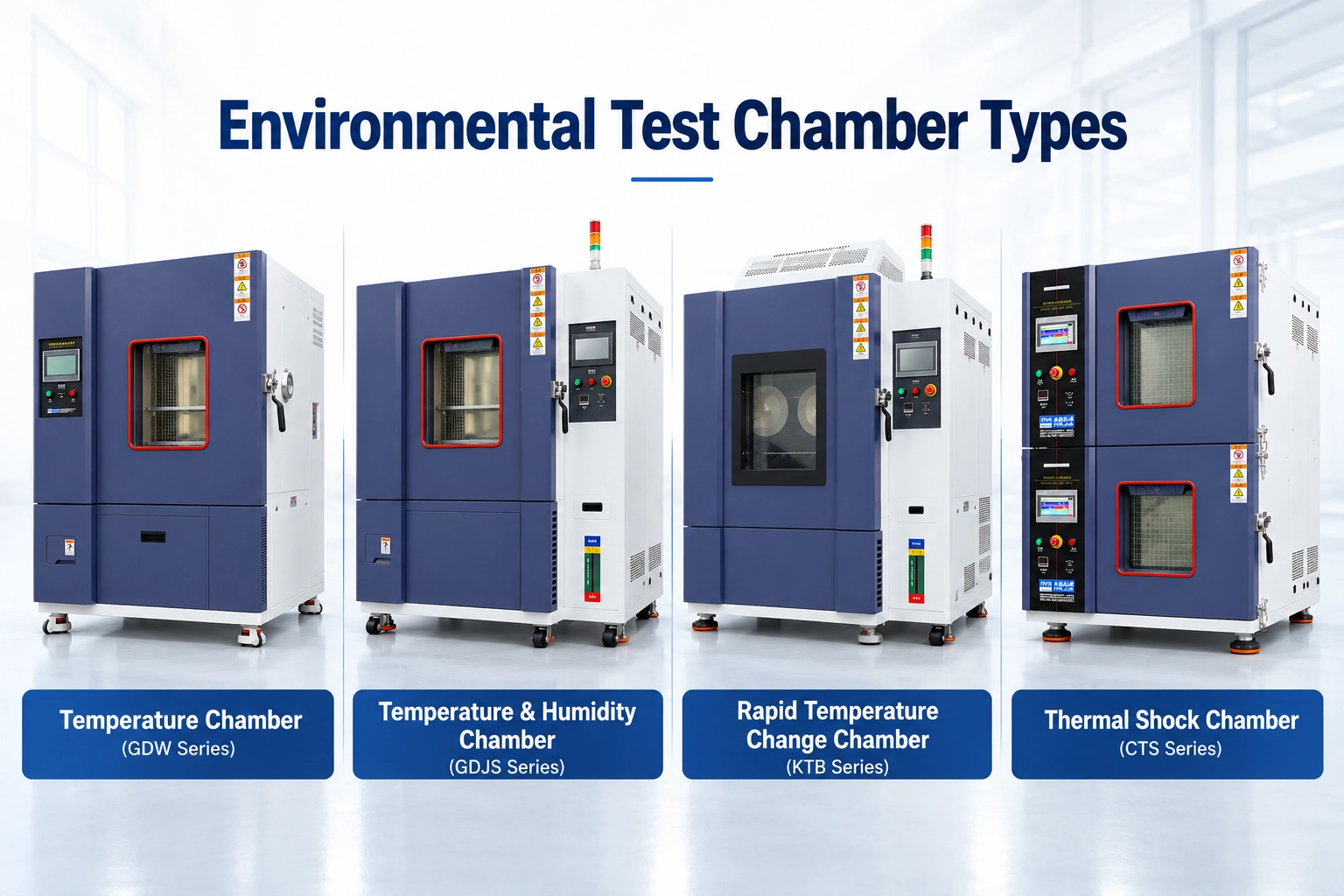
| Chamber Type | Typical Purpose | Key Selection Question |
|---|---|---|
| Temperature Chamber | High and low temperature exposure | What temperature range and performance are required? |
| Temperature & Humidity Chamber | Climatic and damp heat testing | Which temperature-humidity combinations are needed? |
| Rapid Temperature Change Chamber | Controlled rapid temperature cycling | What rate is required, over which interval and under what load? |
| Thermal Shock Chamber | Exposure to contrasting temperature environments | What transfer and recovery conditions does the procedure require? |
| Temperature & Low-Pressure Chamber | Combined temperature and altitude simulation | What pressure-temperature profile must be achieved? |
| Customized Environmental Chamber | Application-specific testing | What additional interfaces, safety features, or dimensions are required? |
A thermal shock chamber and a rapid temperature change chamber should not be treated as interchangeable simply because both involve temperature extremes.
Likewise, a temperature-only chamber may be the more appropriate configuration when the test does not require controlled humidity.
Manufacturing, Performance Verification and FAT: What Evidence Matters?
A reliable procurement decision requires more than a technical datasheet.
Buyers should establish how the manufacturer reviews requirements, assembles the equipment, verifies performance, and documents the final configuration.
Manufacturing and Engineering Review
For a customized chamber, ask the supplier to confirm:
-
The approved technical specification
-
Chamber dimensions and fixture requirements
-
Electrical and cooling arrangements
-
Controller and monitoring requirements
-
Feedthroughs and additional interfaces
-
Safety requirements associated with the DUT
-
Responsibility for approving design changes
The agreed configuration should be documented before production proceeds.
Performance Verification
Ask how chamber performance is measured, which instruments are used, and whether relevant calibration documentation is available.
For temperature and humidity chambers, IEC 60068-3-6:2018 addresses confirmation of performance without specimens. Buyers should distinguish this type of empty-chamber verification from additional measurements or demonstrations needed for their actual loaded application.
The applicable test procedure, standard edition, and acceptance method should be agreed for the specific project.
A generic statement that a chamber is “IEC certified” does not replace a technical review of the required testing conditions.
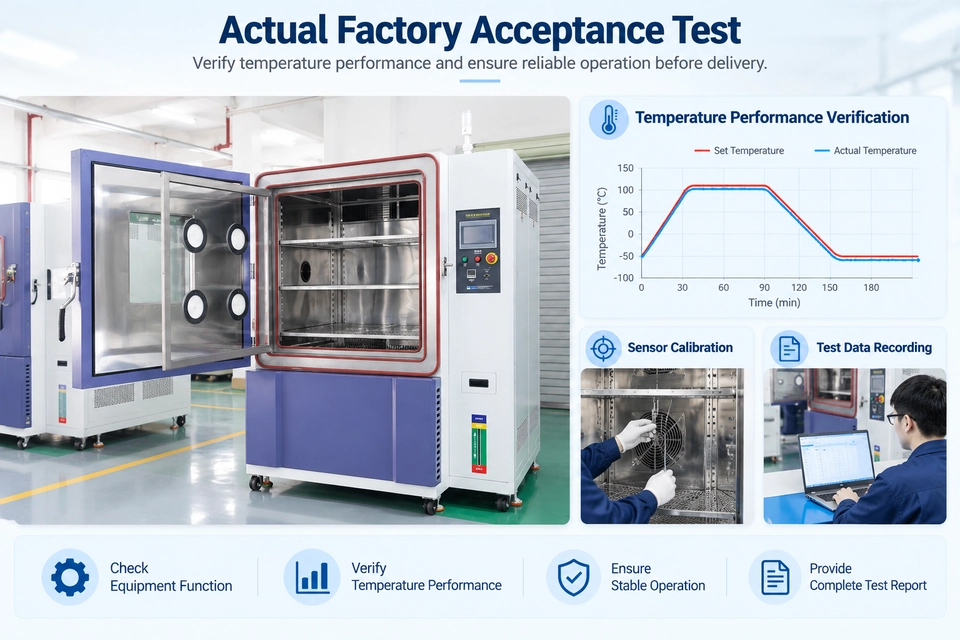
What Should an FAT Include?
A factory acceptance test should be defined before the purchase order is finalized.
Depending on the chamber and project, the agreed scope may include:
| FAT Item | What to Check |
|---|---|
| Visual inspection | Equipment condition and approved configuration |
| Mechanical inspection | Doors, seals, fixtures, and installed accessories |
| Controller operation | Program settings, alarms, and user functions |
| Temperature verification | Performance at agreed measurement points |
| Humidity verification | Performance at agreed operating conditions, where applicable |
| Safety functions | Specified alarms and protective functions |
| Data recording | Required monitoring and export functions |
| Documentation | Reports, manuals, drawings, and agreed certificates |
For customized projects, the FAT should also address the approved interfaces and any project-specific acceptance requirements.
Important: A factory test video is useful supporting evidence, but it should not automatically replace an agreed performance verification report.
Procurement Example: Two Chambers with the Same Temperature Range
Consider an illustrative purchasing scenario.
An automotive electronics laboratory needs a temperature and humidity chamber for reliability testing of a powered electronic module.
The requested temperature range is −40°C to +150°C. The laboratory also requires humidity testing within a defined operating envelope.
Two suppliers submit quotations with the same nominal temperature range.
However, their proposals contain different levels of technical detail.
| Evaluation Item | Supplier A | Supplier B |
|---|---|---|
| Temperature range | −40°C to +150°C | −40°C to +150°C |
| Performance basis | Empty-chamber specifications | Measurement conditions identified |
| DUT heat load | Not discussed | Engineering review requested |
| Humidity envelope | Not supplied | Documented |
| Usable working space | Nominal volume only | DUT and fixture dimensions reviewed |
| FAT | General demonstration | Proposed acceptance procedure |
This is a hypothetical example illustrating quotation evaluation. It does not represent actual supplier quotations or test results.
Supplier B has provided a more complete basis for technical evaluation, but that alone does not establish superior equipment performance.
Supplier A may still offer a suitable chamber once the missing information is clarified.
The procurement team should request comparable technical submissions before evaluating price.
What Should the Buyer Do Next?
-
Send both suppliers the same DUT and test information.
-
Request performance values under clearly defined conditions.
-
Confirm the humidity operating envelope.
-
Clarify the required FAT and documentation.
-
Compare the revised quotations on an equivalent technical and commercial basis.
This approach helps prevent a purchasing decision based on specifications that appear similar but were established under different assumptions.
Environmental Test Chamber RFQ Checklist
A complete request for quotation reduces uncertainty for both the buyer and the manufacturer.
Rather than sending only a catalogue model number, describe the test application and the conditions the equipment must achieve.
Use the following checklist when contacting environmental test chamber manufacturers in China.
| RFQ Requirement | Information to Provide |
|---|---|
| Application | Product or component being tested |
| Test procedure | Applicable standard, edition, or customer specification |
| Temperature | Minimum and maximum temperatures |
| Humidity | Required RH values and associated temperatures |
| DUT dimensions | Width, depth, height, and quantity |
| Specimen weight | Total expected load, including fixtures |
| DUT heat load | Expected heat generation, if applicable |
| Test profile | Ramp rate, dwell time, cycles, and duration |
| Performance | Required fluctuation, deviation, uniformity, or recovery criteria |
| Interfaces | Feedthroughs, sensors, monitoring, and data recording |
| Installation | Power supply, ambient conditions, ventilation, and cooling requirements |
| Acceptance | FAT, documentation, and calibration requirements |
| Delivery | Destination country and project schedule |
If the DUT contains batteries, hazardous materials, pressurized components, or other potentially hazardous elements, disclose the relevant operating and safety conditions before equipment configuration.
Specialized safety engineering may be required.
Buyer Tip: A technically complete RFQ makes it easier to compare competing manufacturers and reduces the risk of receiving quotations based on different assumptions.
International Procurement: What to Confirm Before Paying a Deposit
International equipment sourcing involves technical, commercial, and logistical responsibilities.
Before placing an order, review the following points with the supplier.
Confirm the Contracting and Payment Entities
Check the legal identity of the contracting company and the designated payment recipient.
Where the manufacturing company, exporter, and payment recipient are different entities, request a clear explanation and supporting documentation.
Attach the Final Technical Specification
The approved chamber configuration should form part of the agreed order documentation.
This is especially important for customized equipment.
Do not rely exclusively on informal messages or an early-stage quotation if the project requirements have changed.
Define FAT and Payment Milestones
Confirm whether an FAT is required, what acceptance criteria apply, and how the agreed inspection or approval process relates to payment and shipment milestones.
These arrangements should be documented in the contract.
Clarify Delivery Responsibilities
Review the applicable Incoterms and agreed version, shipping method, packaging, destination, and responsibilities for import procedures.
For larger chambers, confirm unloading arrangements, site access, and installation space in advance.
Review Installation and Training
Determine whether the quotation includes remote guidance, on-site commissioning, operator training, or other technical services.
Ask for the installation requirements before shipment so the receiving facility can prepare its utilities and workspace.
Confirm Warranty and After-Sales Support
Request written information covering warranty terms, exclusions, technical support channels, spare parts, and responsibilities for international service or component shipping.
The total project cost should account for these arrangements—not only the initial equipment price.
ITM-LAB: Environmental Test Chamber Manufacturer in China
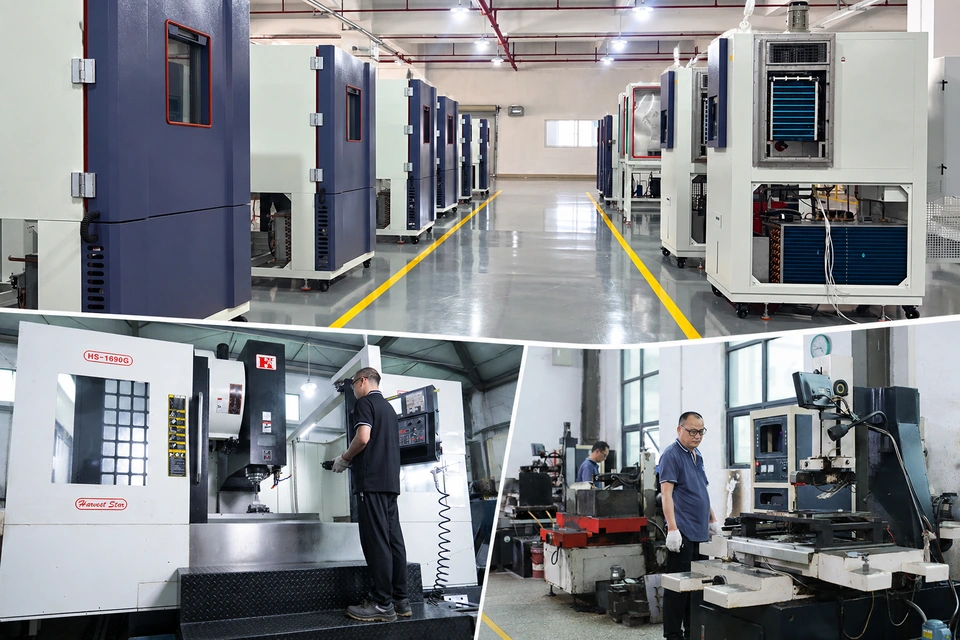
Founded in 1998, ITM-LAB has 28 years of manufacturing experience in testing equipment.
The company supplies environmental testing solutions for applications including electronics, automotive components, batteries, aerospace, and industrial reliability testing.
Its environmental testing portfolio includes several equipment categories designed for different test requirements.
 ,至少大于150KB,保证图片质量.webp)
Environmental Testing Equipment Portfolio
GDW Series — High and Low Temperature Test Chambers
For controlled high and low temperature testing, with available configurations selected according to application requirements.
GDJS Series — Temperature and Humidity Test Chambers
For environmental testing requiring controlled temperature and humidity conditions within the specified operating envelope.
KTB Series — Rapid Temperature Change Chambers
For applications requiring defined rapid heating and cooling profiles.
CTS Series — Thermal Shock Test Chambers
For thermal shock testing involving exposure to contrasting temperature environments.
Customized Environmental Testing Solutions
For projects requiring application-specific dimensions, interfaces, monitoring arrangements, or equipment configurations.
Engineering and Project Support
ITM-LAB supports customers with equipment configuration, technical consultation, and operator training according to the project scope.
For overseas buyers, the recommended starting point is to provide the actual test procedure, DUT dimensions, environmental requirements, and installation conditions.
This allows the proposed chamber configuration to be reviewed before the commercial quotation is finalized.
Explore: ITM-LAB Environmental Test Chambers
FAQ
- Are there direct environmental test chamber manufacturers in China?
Yes. China has companies manufacturing temperature chambers, climatic chambers, thermal shock systems, and other environmental testing equipment.
Buyers should verify each supplier's actual production operations, engineering capabilities, and responsibility for the equipment being quoted.
- How can I verify whether a supplier is a manufacturer or a trading company?
Request the company's legal information, factory address, relevant production photographs, engineering documentation, and performance verification procedures.
A live factory walkthrough or inspection may provide additional evidence for larger projects.
- Are Chinese environmental test chambers suitable for IEC testing?
Suitability depends on the specific equipment configuration and the applicable test method.
The manufacturer should demonstrate that the proposed chamber can achieve the required conditions under the agreed measurement and specimen-load assumptions.
A general claim of IEC compliance is not a substitute for reviewing the actual technical requirements.
- Can a Chinese manufacturer customize an environmental test chamber?
Some manufacturers offer customized dimensions, monitoring interfaces, feedthroughs, fixtures, and application-specific configurations.
Customization capability should be confirmed through an engineering review and documented in the final specification.
- What should I request before approving shipment?
Depending on the agreed project scope, request the FAT results, approved equipment configuration, relevant technical documentation, manuals, packing information, and other contractually required records.
- What information is needed for an accurate quotation?
At minimum, provide the test procedure, required temperature and humidity conditions, DUT dimensions, specimen load, test profile, and installation location.
Powered specimens should also be reviewed for heat generation and relevant safety requirements.
Final Checklist: Select the Manufacturer, Not Just the Catalogue Model
Choosing an environmental test chamber manufacturer in China should be based on verifiable technical information and clearly defined project responsibilities.
Before confirming a supplier, ask three final questions:
Technical Fit: Can the proposed chamber reproduce the required environmental conditions with the actual specimen?
Verification: Are performance claims, measurement conditions, and acceptance criteria documented?
Project Support: Are manufacturing, delivery, installation, warranty, and after-sales responsibilities clearly agreed?
A low initial quotation cannot compensate for an incomplete technical specification or an undefined acceptance process.
The strongest purchasing decision is one that can be supported by engineering requirements, comparable supplier evidence, and clear contractual documentation.
Request an Environmental Test Chamber Configuration from ITM-LAB
Planning to source an environmental test chamber from China?
Share your test requirements with ITM-LAB. Our team can review your application and recommend a suitable equipment configuration.
To help us evaluate your project, please provide:
-
Applicable test standard or procedure
-
Required temperature and humidity conditions
-
DUT dimensions and specimen quantity
-
Expected heat load, if applicable
-
Required test profile
-
Destination country and installation requirements
Contact ITM-LAB for Technical Consultation & Quotation