
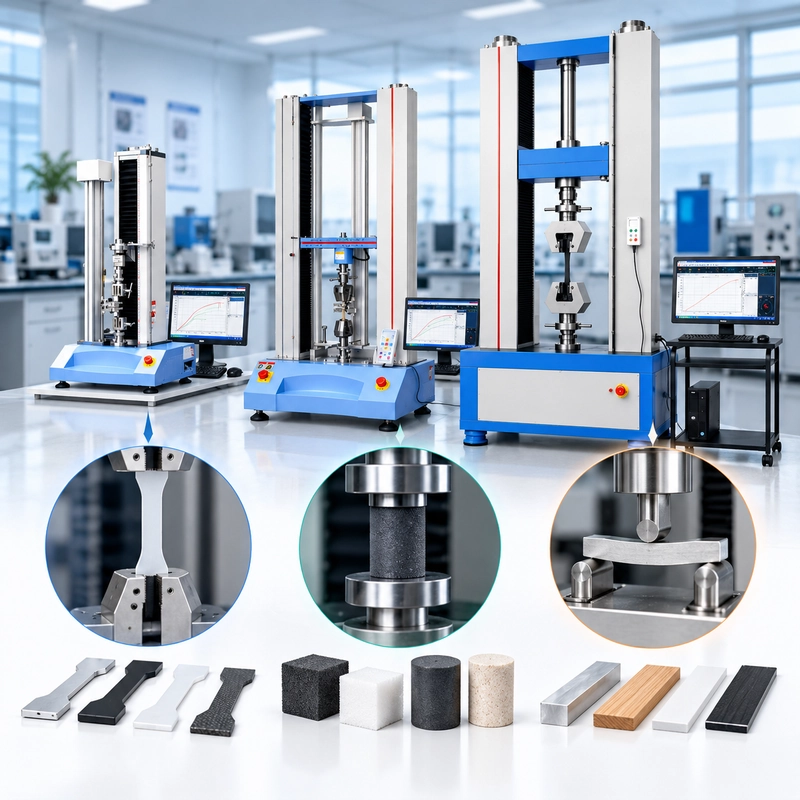
A 50 kN universal testing machine is not a specification.
It is a starting point.
Two manufacturers can quote a 50 kN frame for the same project and deliver very different test systems. One may include a single load cell and basic grips. Another may add a lower-capacity load cell, extensometer, application-specific fixtures, standard-based software methods, installation, and calibration.
Both quotations may say "50 kN UTM" at the top.
They are not necessarily equivalent.
That is why comparing universal testing machine manufacturers takes more than putting capacity, speed, and price into a spreadsheet.
For this 2026 guide, we reviewed ten manufacturers with active materials-testing product lines and publicly available technical information. They are not ranked from best to worst. Different manufacturers serve different force ranges, applications, levels of automation, and support requirements.
The more useful question is not "Who makes the biggest UTM?"
It is:
Who can configure the right system for the test you actually need to run?
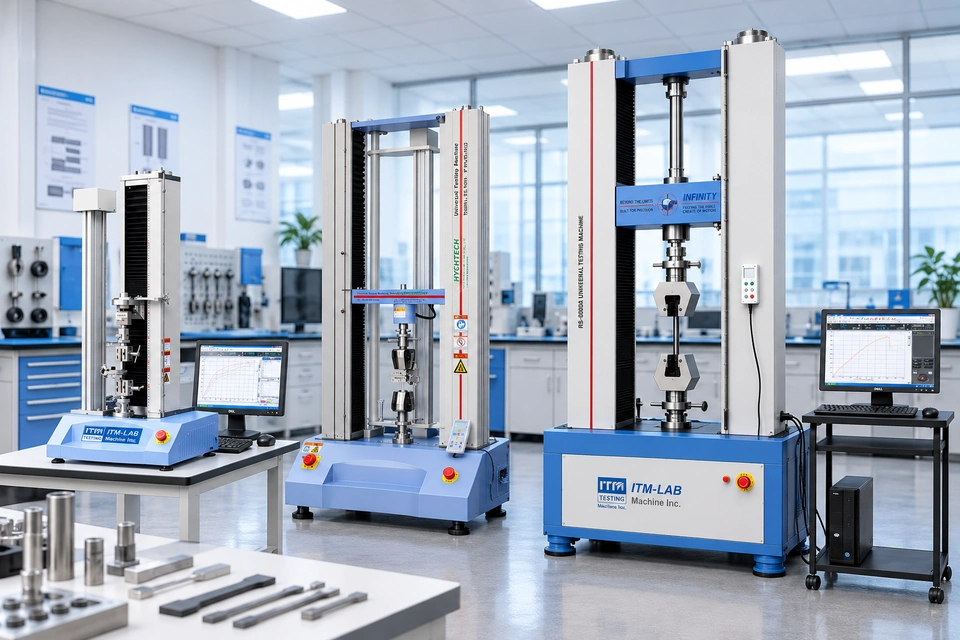
At a Glance: 10 Universal Testing Machine Manufacturers
| Manufacturer | Headquarters | Product Scope | Representative Platforms | Main Area to Investigate |
|---|---|---|---|---|
| Instron | USA | Low- to high-force materials testing | 3400 / 6800 | Broad testing ecosystem |
| ZwickRoell | Germany | 200 N–2,500 kN UTM portfolio | zwickiLine / ProLine / AllroundLine | Integrated systems and automation |
| Shimadzu | Japan | Compact to high-force materials testing | EZ Test / AGS / AGX-V2 | Precision instrumentation |
| MTS | USA | Static and advanced mechanical testing | Criterion / high-force systems | Advanced mechanical testing |
| Tinius Olsen | USA | Electromechanical and hydraulic systems | ST / SL Series | Industrial materials testing |
| ADMET | USA | Configurable materials testing systems | eXpert Series | Application-specific configuration |
| Hegewald & Peschke | Germany | Low- to very-high-force systems | inspekt Series | Modularity and automation |
| TestResources | USA | Static and custom mechanical testing | Universal Test Machines | Custom test applications |
| Mark-10 | USA | Compact lower-force testing | Universal Testing Systems | Force and product testing |
| ITM-LAB | China | 50 N–300 kN static UTM range | RS-8010A / RS-8000 / RS-8000A | Custom configurations and factory engineering |
Research note: Product information was reviewed against publicly available manufacturer information in September 2026. Exact specifications, configurations, accessories, regional availability, and service options should be confirmed with each manufacturer before procurement.
How We Selected These Manufacturers
This is not a market-share ranking.
We looked for manufacturers that currently offer universal or materials testing machines under their own brands, provide identifiable product platforms, and publish enough technical information for an engineer or procurement team to investigate the system beyond a generic sales description.
The shortlist intentionally covers different parts of the market.
Some companies offer broad global materials-testing ecosystems. Others extend into fatigue, automation, or very high forces. Some are particularly relevant to compact force testing or custom component applications.
That distinction matters.
A medical-device laboratory measuring 20 N and a metals laboratory pulling specimens at 200 kN may both search for a "universal testing machine." They do not have the same purchasing problem.
The comparison has to start with the test.
1. Instron
Instron is one of the most established names in mechanical materials testing, with systems used across plastics, metals, composites, medical devices, electronics, aerospace, automotive, and research laboratories.
Its current 6800 Series spans low-force single-column systems through dual-column tabletop and floor-standing configurations. The series reaches 300 kN, while different load-cell options extend the usable measurement capability far below maximum frame capacity. Instron specifies ±0.5% of reading down to 1/1000 of load-cell capacity with its 2580 Series load cells.
That detail is more useful than the 300 kN headline alone.
Instron also has an extensive surrounding ecosystem of grips, fixtures, extensometers, environmental accessories, and Bluehill software. A laboratory can therefore configure one platform for substantially different applications rather than treating the load frame as a standalone machine.
If you are comparing an Instron quotation with another manufacturer, compare the complete measurement chain—not only the frame.
A 100 kN frame tells you what the machine can mechanically handle.
It does not tell you how well your 150 N test will be measured.
2. ZwickRoell
ZwickRoell currently lists universal testing machines covering approximately 200 N to 2,500 kN, giving it one of the broadest static force ranges in this group.
But force range is only part of the story.
ZwickRoell develops and manufactures the major components around its testing systems, including load frames, load cells, extensometers, electronics, testing software, specimen grips, and test tools.
That level of integration matters when the complete measurement chain is important.
Automation is another area to investigate. A laboratory testing five specimens per day probably does not need automated specimen handling. A high-throughput metals laboratory processing hundreds of standardized specimens may reach a very different conclusion.
This introduces a selection factor that basic UTM comparison tables often miss:
Throughput can be a machine specification too.
If operator time is already the laboratory bottleneck, comparing only capacity and crosshead speed leaves part of the problem unsolved.
3. Shimadzu
Shimadzu approaches materials testing from a broader precision-instrumentation background.
Its universal testing portfolio includes compact systems for lower-force laboratory work and higher-performance platforms such as the AGX series.
This makes Shimadzu worth investigating when measurement workflow, laboratory instrumentation, operator interaction, and data processing are important alongside mechanical performance.
There is another useful lesson here.
UTM size should not be selected from force alone.
A low-force elastomer may require considerable vertical test space because of its elongation. A much stronger metal specimen may fail after relatively little extension.
The strongest specimen does not always need the tallest machine.
4. MTS
MTS Systems becomes particularly relevant when a mechanical-testing program may extend beyond straightforward static tensile and compression work.
A production QC requirement might simply be:
Pull the specimen once, record the curve, calculate the result, and stop.
An R&D program can develop differently.
The next requirement may involve cyclic loading, fatigue, component durability, more advanced control, or structural testing.
That changes the procurement discussion.
It does not mean a laboratory should pay for capabilities it may never use. It means the likely direction of the test program deserves consideration before a platform is selected.
If today's static test is expected to become tomorrow's fatigue or durability program, tell the supplier before the first quotation is prepared.
5. Tinius Olsen
Tinius Olsen has a long history in materials testing and continues to offer both electromechanical and hydraulic testing systems.
Its broader portfolio includes universal testing machines, grips, extensometers, software, impact systems, and other materials-testing equipment.
This brings up a question that remains relevant:
Electromechanical or hydraulic?
There is no universal answer.
For many plastics, rubber, films, adhesives, textiles, and moderate-force component tests, an electromechanical UTM is practical and flexible.
Higher-force metals and structural applications can create different requirements.
The decision should come from force, speed, control mode, specimen behavior, maintenance environment, and the applicable test method—not from the assumption that one drive technology is always superior.
6. ADMET
ADMET currently offers the eXpert 2600 platform in tabletop and floor-standing configurations from 5 to 600 kN for tension, compression, bending, flexural, shear, and related applications.
For standard coupons, selecting a system may be relatively straightforward.
For finished components, the fixture can become the project.
Compare these two RFQs:
Need a 10 kN tensile tester.
and:
Need to pull an assembled component axially until separation while recording peak force and force-displacement data. Maximum expected load is 1.2 kN. Drawing attached.
The second request gives an applications engineer something useful to work with.
When the specimen is unusual, fixture-engineering capability deserves as much attention as the frame.
7. Hegewald & Peschke
Hegewald & Peschke develops the inspekt family of universal testing systems.
Its product approach is strongly modular, with systems that can be combined with different grips, extensometers, environmental equipment, and application-specific fixtures.
That is worth considering when the machine is expected to evolve.
A laboratory may buy a UTM for ambient tensile testing today and add elevated-temperature testing later. Another may add a second load cell or a custom component fixture.
You do not need to buy every future accessory on day one.
You do need to know whether the platform can accommodate it.
A UTM often becomes a laboratory platform rather than remaining a single-test machine.
8. TestResources
TestResources supplies universal and mechanical testing systems for tensile, compression, bend, shear, puncture, and component applications.
The company is particularly relevant to investigate when the specimen does not look like a conventional standardized coupon.
For a finished product or proprietary component, load capacity may be the easiest part of the specification.
Alignment, mounting, access, fixture stiffness, starting position, and the definition of test completion can require more engineering.
For custom product testing, do not stop at the manufacturer's standard grip catalog.
Ask what information its engineering team needs before it can confidently define the fixture.
9. Mark-10
Mark-10 occupies a useful position in lower-force testing.
Its background includes force and torque measurement, test stands, sensors, grips, attachments, and compact testing systems.
Not every application needs a large dual-column UTM.
Connector pull-out, small springs, medical products, packaging components, buttons, and small assemblies can operate at relatively low forces.
There is also a measurement reason not to oversize automatically.
If the entire test happens below 100 N, the important question is how the proposed system performs around 100 N—not whether its frame can survive 50,000 N.
Bigger is not automatically more accurate.
10. ITM-LAB
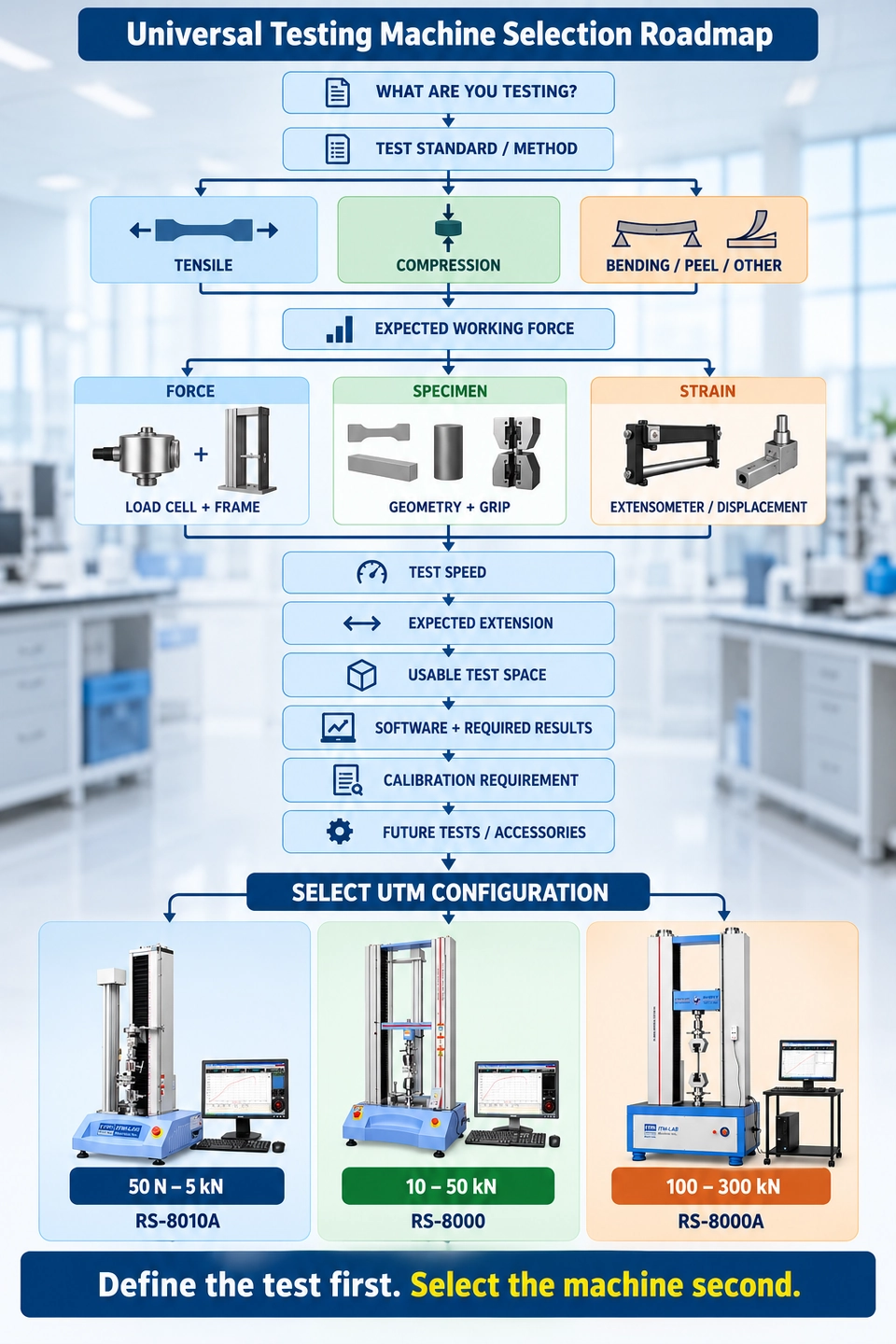
ITM-LAB structures its static universal testing machine range around low-, medium-, and higher-force applications rather than using one frame for every test.
The RS-8010A covers 50 N to 5 kN and is intended for lower-force tensile, compression, bending, peel, tear, and related testing of plastics, rubber, films, adhesives, textiles, packaging materials, and smaller components.
The RS-8000 moves into the 10–50 kN range for general-purpose materials testing.
For higher-force applications, the RS-8000A covers 100–300 kN.
The separation is practical.
A film peel test and a 200 kN metal tensile test can both be performed on equipment called a universal testing machine, but they do not need the same frame, load cell, grip, travel, or strain-measurement configuration.
ITM-LAB also supports application-specific fixtures, test-method configuration, and systems for mechanical testing under controlled temperature conditions.
A useful project inquiry therefore starts with:
Here is the test standard. Here is the specimen. Here is the expected force and deformation. These are the results we need.
Not simply:
We need a 20 kN UTM.
What Actually Separates One UTM From Another?
Once you have shortlisted several universal testing machine manufacturers, the brand comparison becomes less important.
Now compare the proposed systems.
Frame Capacity Is Not the Measurement Range
This distinction is fundamental.
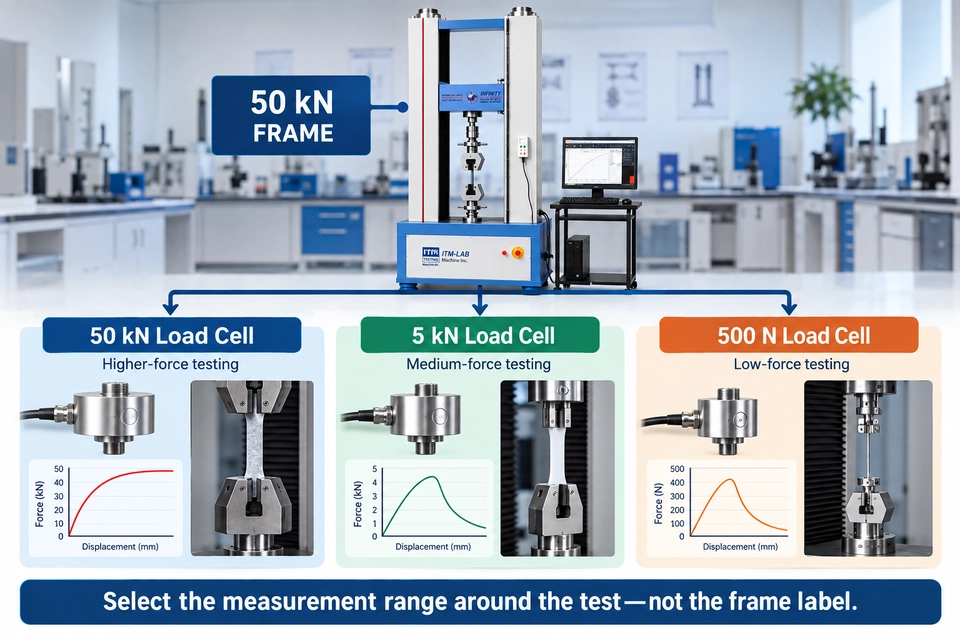
Frame capacity is the maximum mechanical load of the machine. It is not the same as the useful measurement range of the installed load cell.
Suppose a supplier proposes a 50 kN frame.
Your normal test force is 300 N.
The question is not whether the frame can handle 300 N. Obviously it can.
The useful questions are:
-
What load cell is installed?
-
Over what range does it meet the required accuracy?
-
Would a lower-capacity load cell improve the setup?
-
What does the applicable calibration or verification requirement specify?
-
Will future tests require a different load range?
Instron's current 6800 specifications illustrate the distinction clearly: the frame family extends to 300 kN, while load measurement accuracy is specified separately according to load-cell configuration and range.
Nominal Travel Is Not Usable Specimen Extension
A specification sheet may list 800 mm or 1,000 mm of crosshead travel.
You do not automatically get all of it for specimen extension.
The load cell takes space.
The upper grip takes space.
The lower grip takes space.
Adapters take space.
Then you still need the required starting grip separation.
Nominal crosshead travel is not the same as usable specimen extension.
This matters especially for rubber, textiles, films, and other high-elongation materials.
A specimen can fit between the columns and still not fit the actual test configuration.
The Grip Is Part of the Measurement
Thin film can tear at a jaw edge.
Coated fabric can slip.
Rubber can pull out of an unsuitable grip.
Wire can break at the clamping point.
A brittle specimen can be damaged before the test even starts.
When that happens, a more accurate load cell does not fix the test.
The load cell only measures the force produced by the mechanical setup.
Bad gripping can produce very precise bad data.
Crosshead Displacement Is Not Always Specimen Strain
A UTM knows how far the crosshead moved.
That does not always tell you exactly how far the specimen gauge length stretched.
Movement elsewhere in the load train—including machine compliance, grips, adapters, and specimen regions outside the gauge length—can contribute to the recorded displacement.
For some tests, crosshead displacement is sufficient.
For others, particularly when modulus, yield, or accurate strain behavior is required, an extensometer may be necessary.
The test method should decide this—not the desire to reduce the quotation price.
Software Is More Than a Curve on a Screen
Almost any modern UTM can plot force against displacement.
The useful question is what happens after the curve appears.
Depending on the method, the software may need to calculate tensile strength, modulus, yield, proof stress, elongation at break, average peel force, flexural strength, compression properties, batch statistics, or pass/fail limits.
Ask the supplier to demonstrate the method you actually intend to run.
"ASTM/ISO compatible software" is too vague by itself.
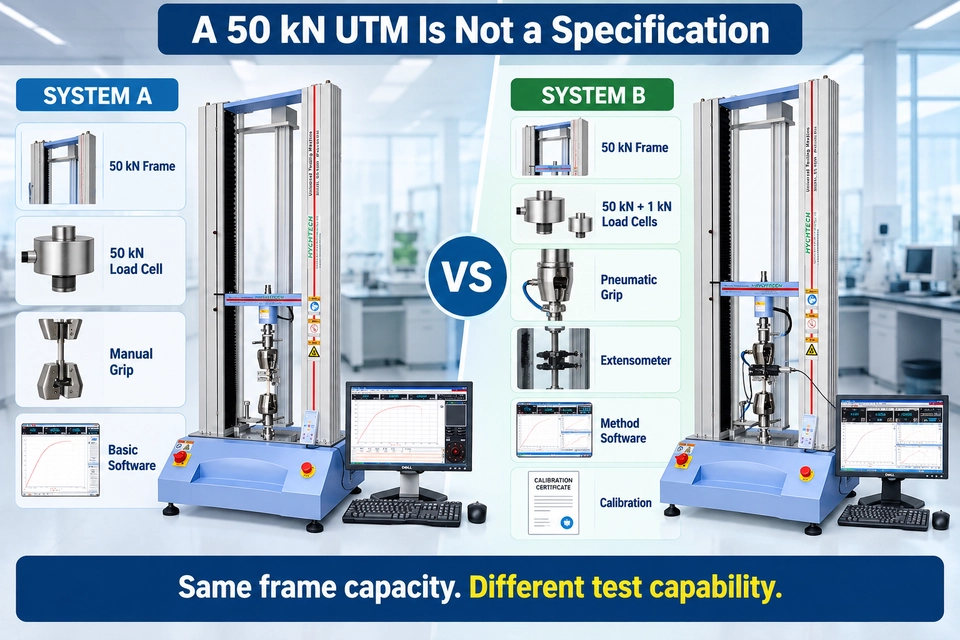
A 50 kN UTM Is Not a Specification
Consider two hypothetical quotations.
Both are titled:
50 kN Universal Testing Machine
| Configuration | System A | System B |
|---|---|---|
| Frame capacity | 50 kN | 50 kN |
| Primary load cell | 50 kN | 50 kN |
| Secondary load cell | — | 1 kN |
| Crosshead travel | 800 mm | 1,100 mm |
| Tensile grips | Manual wedge | Pneumatic |
| Compression platens | Included | Included |
| Extensometer | — | Included |
| Software | Basic force/displacement | Standard-specific methods |
| Calibration | Factory | Traceable on-site |
| Training | Remote/manual | On-site |
| Future fixture integration | Not specified | Included in scope |
System B may cost substantially more.
That does not mean its frame is overpriced.
Both quotations say "50 kN universal testing machine." They do not describe equivalent test systems.
Normalize the technical scope before comparing price.
Why a 50 kN UTM Can Still Be the Wrong Machine
Consider a rubber tensile test.
Expected maximum force: 450 N
Initial gauge length: 25 mm
Expected elongation: 600%
Required outputs: tensile properties and elongation
Someone sees 450 N and says:
We already have a 50 kN machine. Use that.
Maybe.
But 50 kN is almost the least interesting number in this test.
First, check whether the installed load cell provides the required measurement performance around 450 N.
Then check the usable travel after the grips are installed.
At 600% elongation, deformation—not maximum force—may become the more important mechanical requirement.
Next comes gripping. Can the specimen be held without slipping or failing at the jaw?
Then strain measurement. Does the test method require direct specimen strain?
Finally, software: can it produce the required calculations?
A smaller frame with the correct load cell, sufficient travel, suitable grips, and appropriate strain measurement may be a much better system.
The frame capacity was never the real selection problem.
Why UTM Quotes Are Hard to Compare
Procurement teams often receive three quotations with three very different totals.
Do the technical normalization before putting the prices side by side.
A UTM quotation may include:
Machine frame, load cell, additional load cells, tensile grips, compression platens, bending fixtures, peel fixtures, extensometer, safety enclosure, software, standard-specific methods, environmental accessories, installation, calibration, training, freight, and spare parts.
One supplier may include most of these items.
Another may quote a frame, one load cell, and one grip set.
The second quotation will look cheaper.
It may not be.
A more useful question is:
What will it cost to get from delivery to a valid test result?
Then ask:
What will it cost to keep producing valid results over the next five years?
That is a better basis for comparing total system cost.
Manufacturer, Distributor, or Trading Company?
"UTM supplier" can describe very different businesses.
A manufacturer designs or builds the testing system under its own product line.
An authorized distributor represents a manufacturer in a particular market and may provide valuable local installation, calibration, training, and service.
A trading company or general supplier may source machines from one or several factories.
None of these models is automatically unsuitable.
The important point is knowing who is responsible when an engineering or service issue appears.
Ask who handles:
-
machine engineering;
-
software support;
-
custom fixtures;
-
installation;
-
calibration;
-
training;
-
warranty;
-
spare parts;
-
long-term technical support.
For a routine standardized machine, strong local distributor support can be valuable.
For a highly customized component test, direct access to the manufacturer's applications or fixture engineer may matter more.
Red Flags When Comparing UTM Suppliers
Capacity Is Given, but the Measurement Range Is Not
"50 kN capacity" tells you the mechanical limit.
It does not tell you whether the proposed measurement system is appropriate for your actual working force.
Ask for force accuracy and the applicable verified range.
"Standard Grips" Are Selected Before the Specimen Is Reviewed
Standard for what?
Film, rubber, metal, textile, wire, and adhesive specimens can require very different gripping methods.
If a supplier selects the fixture before seeing the specimen, ask what assumptions were made.
Crosshead Travel Is Presented as Available Specimen Extension
It is not the same thing.
Ask for usable test space with the proposed load cell, adapters, and grips installed.
Dozens of ASTM and ISO Numbers Appear, but the Configuration Never Changes
A UTM may support many test methods.
One grip, one speed, and one strain-measurement setup will not satisfy all of them.
The proposed configuration should connect the standard to specimen geometry, speed, grips, extensometry, and calculations.
"Extensometer Included" Without Explaining Which One or Why
Ask about gauge length, strain range, contact or non-contact measurement, and compatibility with the specimen.
An extensometer should solve a measurement requirement, not simply increase the accessory count.
A Custom Fixture Is Quoted Without a Specimen Drawing
For unusual components, loading direction, mounting, alignment, available space, and expected failure mode all matter.
Calibration Ends at "Factory Calibrated"
Ask what happens next year.
Who performs recalibration? What is traceable? What documentation is supplied? Can the service be performed in your region?
Which UTM Configuration Should You Investigate?
These are starting points, not selection rules.
| Application | Main Selection Challenge | System Direction |
|---|---|---|
| Thin film / foil | Low force + gripping | Low-force precision UTM |
| Adhesive peel | Low force + fixture geometry | Low-force UTM + peel fixture |
| Rubber / elastomer | High elongation | Long-travel system + suitable grips |
| Plastics | Force + strain + multiple methods | General-purpose electromechanical UTM |
| Foam | Compression geometry | Appropriate load cell + platens |
| Textile | Slippage / grip damage | UTM + textile grips |
| Wire / cable | Gripping + gauge length | Application-specific grips |
| Metal tensile | Higher force + extensometry | Dual-column / floor-standing UTM |
| Finished component | Fixture + alignment | Custom test configuration |
A material name alone is not enough to select capacity.
"Plastic" can describe a thin film breaking below 20 N or a reinforced component requiring tens of kilonewtons.
Questions to Answer Before Requesting a Quote
Before contacting a manufacturer, answer these questions as far as you can.
What are you testing?
Provide the material, product, and a drawing or photograph for unusual specimens.
Which test method applies?
Include the standard and revision where applicable.
What force do you expect?
If unknown, provide material strength, cross-section, previous data, or a sample.
How much will the specimen deform?
This can determine travel requirements before frame capacity becomes a problem.
How will the specimen be held?
"Tensile grips" is not enough for every material.
How must strain or displacement be measured?
Crosshead, contact extensometer, and non-contact measurement solve different problems.
What results must appear in the report?
Peak force, strength, modulus, yield, elongation, peel average, or something else?
These answers usually reveal more about the required machine than the requested capacity does.
What to Include in a UTM RFQ
A useful RFQ does not need to be long. It needs the right information.
Material / product: Plastic, rubber, metal, film, adhesive, textile, component, etc.
Test standard and revision: If applicable.
Test type: Tensile / compression / flexural / peel / shear / other.
Expected working force: Not just requested frame capacity.
Specimen dimensions: Attach a drawing where possible.
Test speed: Or provide the standard.
Starting grip separation: Important for many tensile tests.
Expected extension / required travel: Especially for elastomers, films, and textiles.
Strain measurement: Crosshead / contact extensometer / non-contact / unsure.
Grip or fixture requirement: Include photographs for nonstandard specimens.
Test environment: Ambient / high temperature / low temperature / controlled environment.
Required outputs: Force, strength, modulus, elongation, yield, average peel, etc.
Test volume: Tests per shift, day, or week.
Calibration requirement: State any laboratory, customer, or accreditation requirement.
A useful RFQ describes the test.
The manufacturer can then configure the machine.
Common Standards Used With Universal Testing Machines
Keep two categories separate.
Standards such as ISO 7500-1 and ASTM E4 address testing-machine or force-measurement verification.
Material test methods define how the specimen itself is tested.
Common examples include ASTM D638 and ISO 527 for plastics, ASTM D412 for elastomers, ASTM D790 for flexural testing, ASTM D695 and ISO 604 for compression, and ASTM E8/E8M and ISO 6892-1 for metallic tensile testing.
The method can affect specimen geometry, test speed, preload, grips, strain measurement, calculations, and reporting.
A long list of supported standard numbers is therefore less useful than confirmation that the proposed system can reproduce the specific method you need.
FAQ
What is a universal testing machine?
A universal testing machine applies controlled mechanical loading to a specimen while measuring force, displacement, and, where required, strain. With the appropriate fixtures and sensors, one frame can support tensile, compression, bending, peel, shear, and other mechanical tests.
"Universal" does not mean every machine performs every test out of the box. The configuration determines what it can actually do.
Is a universal testing machine the same as a tensile testing machine?
The terms often overlap.
A tensile testing machine is primarily associated with pulling specimens, while a universal testing machine can normally be configured for tension as well as compression, bending, and other mechanical tests.
Many modern tensile testing machines are therefore UTMs in practical use.
What capacity UTM do I need?
Start with the expected maximum test force, then consider the required measurement range, mechanical margin, fixture loads, travel, and future applications.
Do not choose capacity from the material name alone.
A low-force, high-elongation specimen can create a more demanding travel requirement than a much stronger short-extension specimen.
How should I compare universal testing machine manufacturers?
Compare the proposed test systems, not just the brand names.
Look at the usable force measurement range, frame capacity, test space, travel, grips, extensometry, software, calibration, service, fixture engineering, and future expandability.
Two machines with the same nominal capacity are not necessarily equivalent.
What should I include in a UTM RFQ?
At minimum, provide the specimen or material, test standard, expected force, specimen dimensions, test type, required travel or expected elongation, required results, and any strain-measurement requirement.
For components or nonstandard specimens, attach a drawing or photograph.
Final Selection Notes
A UTM should be selected from the test outward—not from the frame capacity inward.
Define the specimen, method, expected force, deformation, gripping, and strain measurement first. Then compare manufacturers on how well their proposed systems can reproduce that test.
The lowest-priced frame is not necessarily the lowest-cost testing system.
And the highest-capacity machine is not automatically the better machine.
Define the test first. Select the machine second.
Need Help Configuring a UTM?
Send ITM-LAB your test standard, specimen dimensions, expected working force, required travel, test speed, and required results.
For nonstandard products or components, include a drawing or photograph.
ITM-LAB can then evaluate the appropriate load frame, load cell, grips or custom fixture, extensometry, software, and test space for the application.
