
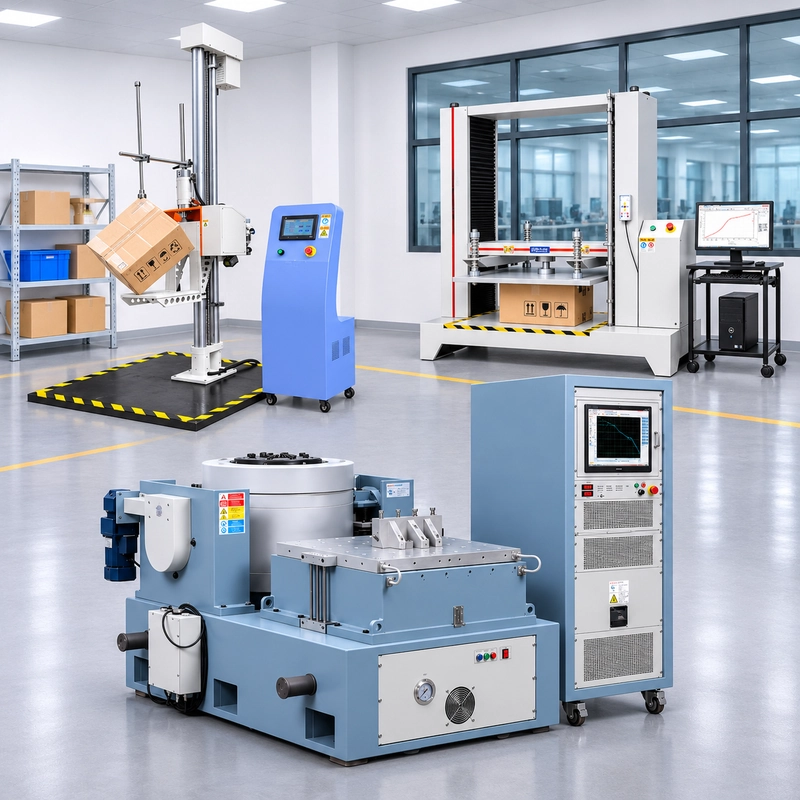
ISTA 2A testing is a partial-simulation performance test procedure for individual packaged products weighing 150 lb (68 kg) or less. It combines atmospheric conditioning, compression, vibration, and shock testing to evaluate how a complete packaged product performs under a defined sequence of stresses.
Unlike a standalone drop test, ISTA 2A includes two vibration stages separated by a shock stage. This sequence helps packaging engineers investigate potential weaknesses that may develop as the package experiences successive mechanical exposures.
This guide explains the ISTA 2A test sequence, equipment selection requirements, practical laboratory setup considerations, and common testing mistakes.
ISTA 2A at a Glance
| Item | Key Information |
|---|---|
| Test Procedure | ISTA 2A |
| Test Category | Partial Simulation Performance Test |
| Packaged-Product Weight | 150 lb (68 kg) or less |
| Test Specimen | Complete packaged product |
| Main Test Categories | Atmospheric conditioning, compression, vibration, shock |
| Vibration Stages | Two |
| Shock Options | Free-fall drop or permitted alternatives |
| Primary Purpose | Packaging performance evaluation and design screening |
Important: ISTA 2A evaluates performance against defined acceptance criteria under specified laboratory conditions. Passing the procedure does not guarantee that damage will never occur during transportation.
Official ISTA Procedure 2A information
Understanding ISTA 2A and Its Applications
ISTA Procedure 2A belongs to the International Safe Transit Association's 2-Series Partial Simulation Performance Tests.
The procedure combines selected distribution-related stresses to evaluate the protective performance of an individual packaged product.
It can be useful during packaging development, design verification, and investigations into recurring transportation damage.
Typical applications include packaged consumer electronics, industrial instruments, automotive components, medical equipment, and other products within the procedure's weight range.
Unlike ISTA 3A, which specifically addresses parcel delivery distribution, ISTA 2A is not limited to one particular parcel delivery network.
What Packaging Failures Can ISTA 2A Help Identify?
Compression damage may appear as carton wall buckling, permanent deformation, or reduced protective clearance.
Vibration damage can involve product movement, surface abrasion, loosening of internal components, or deterioration of cushioning support.
Shock damage may include product breakage, crushed package corners, or cushioning bottom-out.
The interaction between these stresses is particularly important. A package that initially performs well during vibration may respond differently after compression or impact.
ISTA 2A provides a structured laboratory procedure for investigating these potential weaknesses.
How the ISTA 2A Test Sequence Works
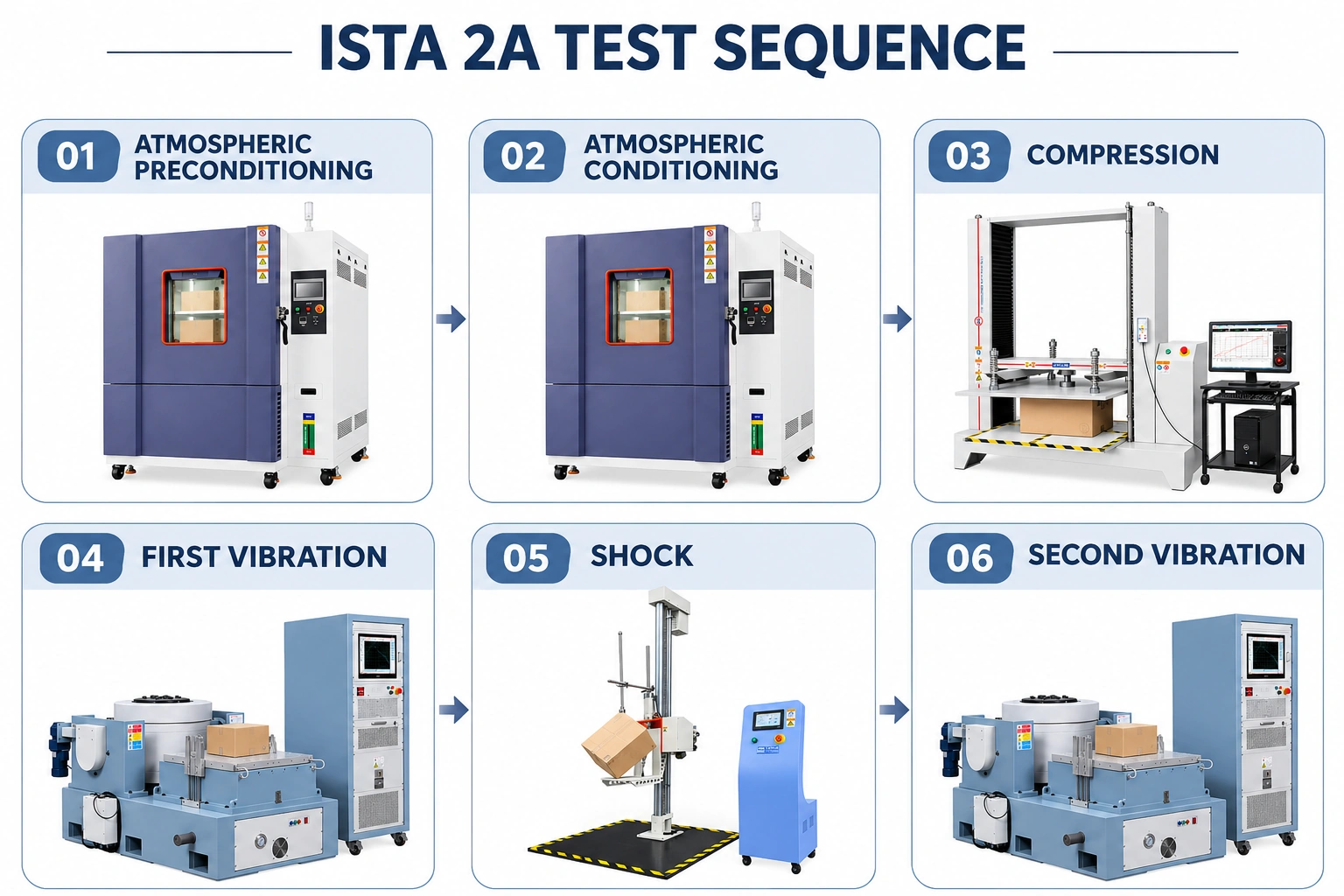
The publicly available ISTA 2A procedure overview identifies six stages, beginning with atmospheric preconditioning and ending with a second vibration exposure.
The order matters because earlier tests may change the mechanical condition of the packaging before subsequent exposures.
| Test Stage | Test Category | Engineering Purpose |
|---|---|---|
| Initial | Atmospheric Preconditioning | Establish initial specimen conditions |
| Conditioning | Atmospheric Conditioning | Apply specified environmental exposure |
| Compression | Compression Testing | Evaluate response to compressive loading |
| First Vibration | Vibration Testing | Evaluate vibration response before shock |
| Shock | Drop or Permitted Impact Method | Evaluate response to prescribed impacts |
| Final Vibration | Vibration Testing | Evaluate vibration response after shock |
Why Two Vibration Stages Matter
The first vibration stage evaluates the packaged product before the prescribed shock exposure.
During the shock stage, an impact may permanently deform cushioning, shift internal components, or change the relationship between the product and its protective packaging.
The second vibration stage evaluates the package in this post-impact condition.
Consider an electronic assembly protected by molded foam end caps. Before impact, the foam may hold the product securely. After a drop, permanent deformation could create additional clearance, allowing greater movement during subsequent vibration.
This illustrates why a standalone drop test followed by an unrelated vibration test does not necessarily reproduce the complete ISTA 2A procedure.
The selected methods, durations, and test levels must follow the applicable official procedure edition.
Environmental Conditioning and Packaging Performance
Temperature and relative humidity can significantly influence the mechanical behavior of packaging materials.
Corrugated board, adhesives, paper-based materials, and certain cushioning systems may respond differently after environmental exposure.
For example, moisture absorption can reduce the compression strength of some corrugated packaging structures. This may affect how the package performs during subsequent mechanical testing.
ISTA 2A includes atmospheric preconditioning and controlled atmospheric conditioning before the mechanical test stages.
The laboratory should confirm the required temperature, relative humidity, exposure duration, and specimen preparation conditions from the applicable procedure.
Selecting an Environmental Test Chamber
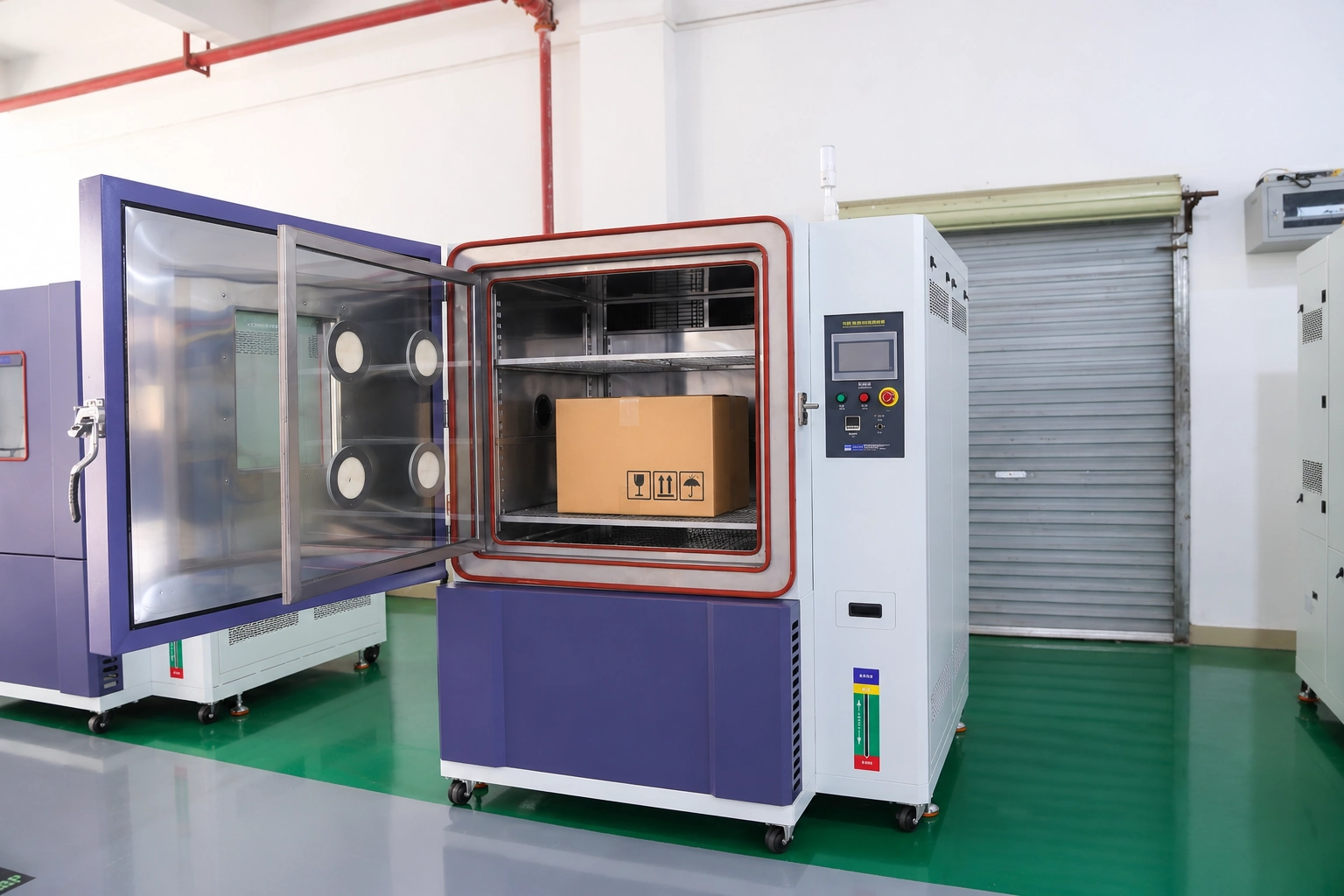
A temperature and humidity chamber must accommodate the complete packaged product while maintaining the specified environmental conditions.
Usable internal dimensions are more important than nominal chamber volume alone.
Engineers should consider airflow distribution, specimen clearance, loading arrangement, and the chamber's validated operating envelope.
There is no universal 50 mm airflow clearance or 800 L minimum chamber volume specified by ISTA 2A.
ITM-LAB equipment: GDJS Temperature & Humidity Chamber
The GDJS series provides controlled temperature and humidity testing capabilities. The selected configuration should be evaluated against the required conditioning conditions and packaged-product dimensions.
Compression Testing: Beyond Maximum Load Capacity
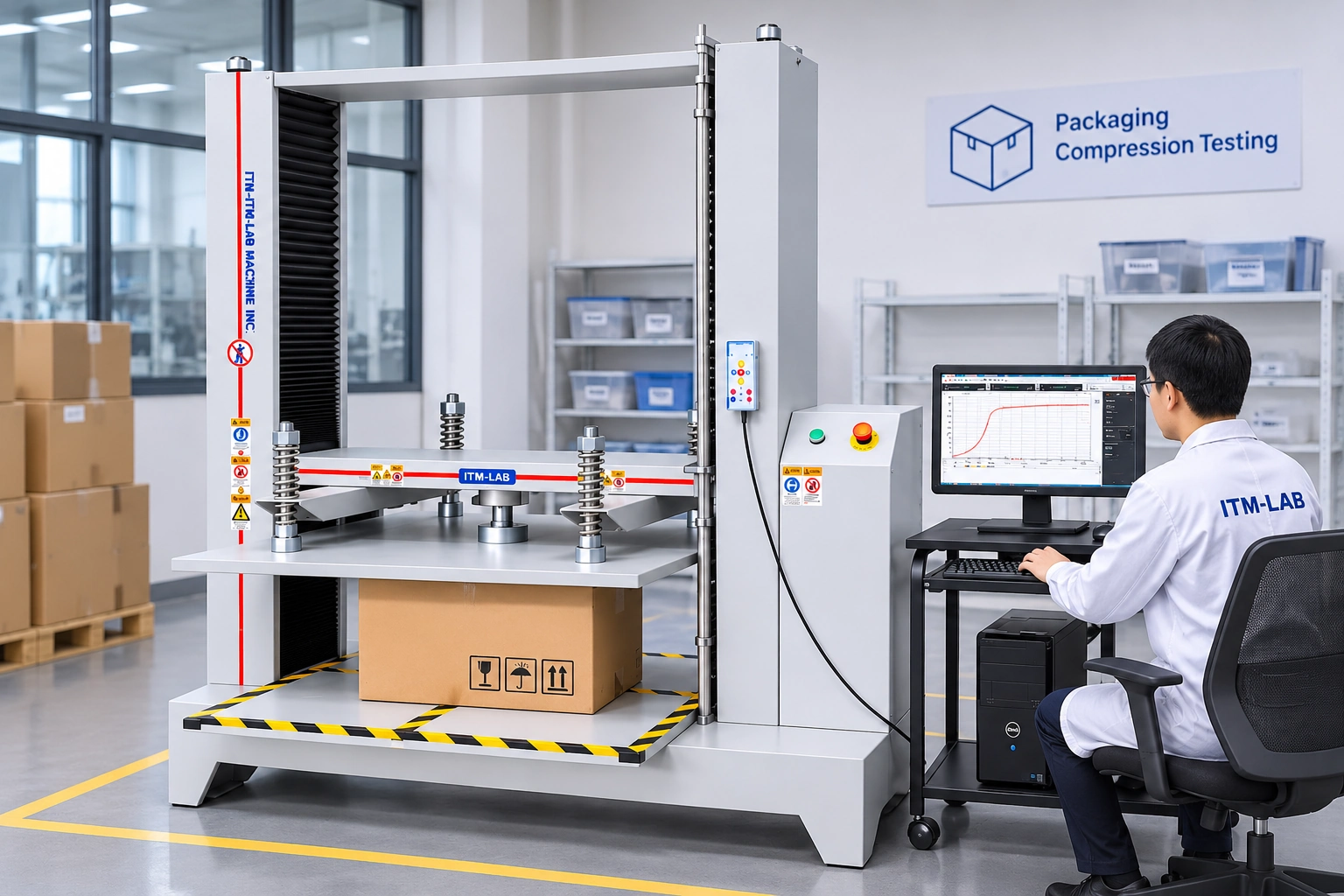
Compression testing evaluates how a packaged product responds to prescribed compressive loading.
For corrugated shipping cartons, compressive loads may produce wall deformation, loss of protective clearance, or permanent changes in packaging geometry.
The publicly available ISTA 2A overview identifies alternative compression methods, including machine-applied compression and static loading arrangements.
The selected method determines the required apparatus and operating conditions.
What Matters When Selecting a Compression Tester?
Maximum force capacity is only one consideration.
Engineers should also verify the required loading method, measurement range, platen dimensions, specimen height, and relevant loading or holding functions.
A compression tester with a high maximum force rating may still be unsuitable if it cannot reproduce the specified loading conditions.
Likewise, a machine with sufficient force capacity may have inadequate working space for a large shipping carton.
The required compression load should be determined using the applicable ISTA 2A procedure rather than estimated solely from carton dimensions.
ITM-LAB equipment: RS-8401 Packaging Compression Tester
The RS-8401 series is available in configurations for packaging compression applications. The appropriate force capacity, loading functions, and platen dimensions should be confirmed against the project requirements.
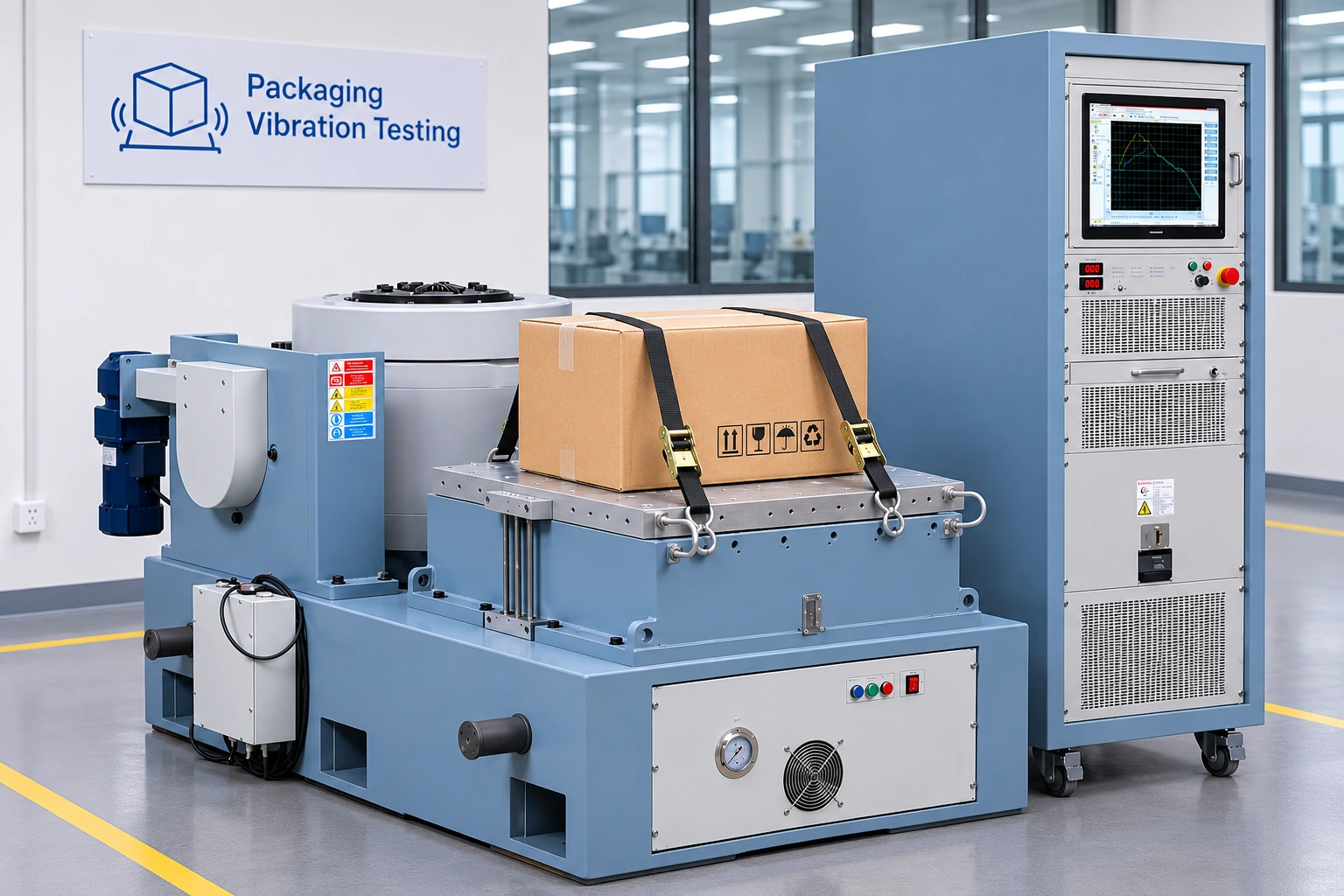
Vibration Testing: Matching the Method to the Machine
Vibration testing is a central component of ISTA 2A.
The procedure includes vibration exposure before and after the shock stage.
The publicly available ISTA 2A overview identifies fixed-displacement and random vibration methods as alternatives.
These methods require different equipment capabilities.
Fixed-Displacement Vibration
Fixed-displacement testing uses a platform operating under prescribed displacement and frequency conditions.
An older publicly available ISTA 2A overview identifies a nominal displacement of approximately 1 in (25 mm) peak-to-peak for the fixed-displacement method.
This historical overview should not be used as a substitute for the test levels in the applicable official edition.
For equipment selection, engineers should verify displacement capability, operating frequency, platform dimensions, payload, and the required specimen arrangement.
Random Vibration
Random vibration testing uses a defined vibration spectrum to reproduce a specified dynamic environment.
The vibration system and controller must be capable of reproducing the required power spectral density profile and overall vibration intensity.
Critical parameters include frequency range, acceleration, displacement, dynamic payload, table dimensions, and controller functionality.
A system capable of general-purpose random vibration testing is not automatically suitable for the selected ISTA 2A method.
Why Vibration Equipment Compatibility Matters
Two vibration systems may have similar payload ratings but very different operating capabilities.
One may be suitable for fixed-displacement package vibration, while another may be designed for controlled random vibration.
For this reason, equipment selection should begin with the prescribed method rather than the machine's maximum rated force.
ITM-LAB equipment: RS-V Vibration Test System
The RS-V series may be considered for relevant vibration testing applications. Compatibility with the selected ISTA 2A method must be confirmed through the system's actual controller, displacement, frequency, payload, and platform specifications.
Shock and Drop Testing Requirements
The shock stage evaluates how a packaged product responds to prescribed handling impacts.
Free-fall drop testing is a commonly used method. The applicable procedure also provides specified alternative impact methods.
For free-fall testing, the engineer must confirm the required drop height, packaged-product weight, impact orientations, specimen dimensions, and release mechanism.
Drop Height and Impact Orientation
The required drop height depends on the applicable procedure conditions, including packaged-product weight.
Different impact orientations can produce different failure modes.
A corner impact may concentrate the load over a relatively small contact area. A face impact distributes contact across a larger surface, potentially producing a different response in the cushioning system.
The selected drop tester must accommodate the required face, edge, and corner orientations without introducing unintended rotation during release.
Exact impact counts, sequences, and heights should be obtained from the official procedure rather than assumed from another packaging test standard.
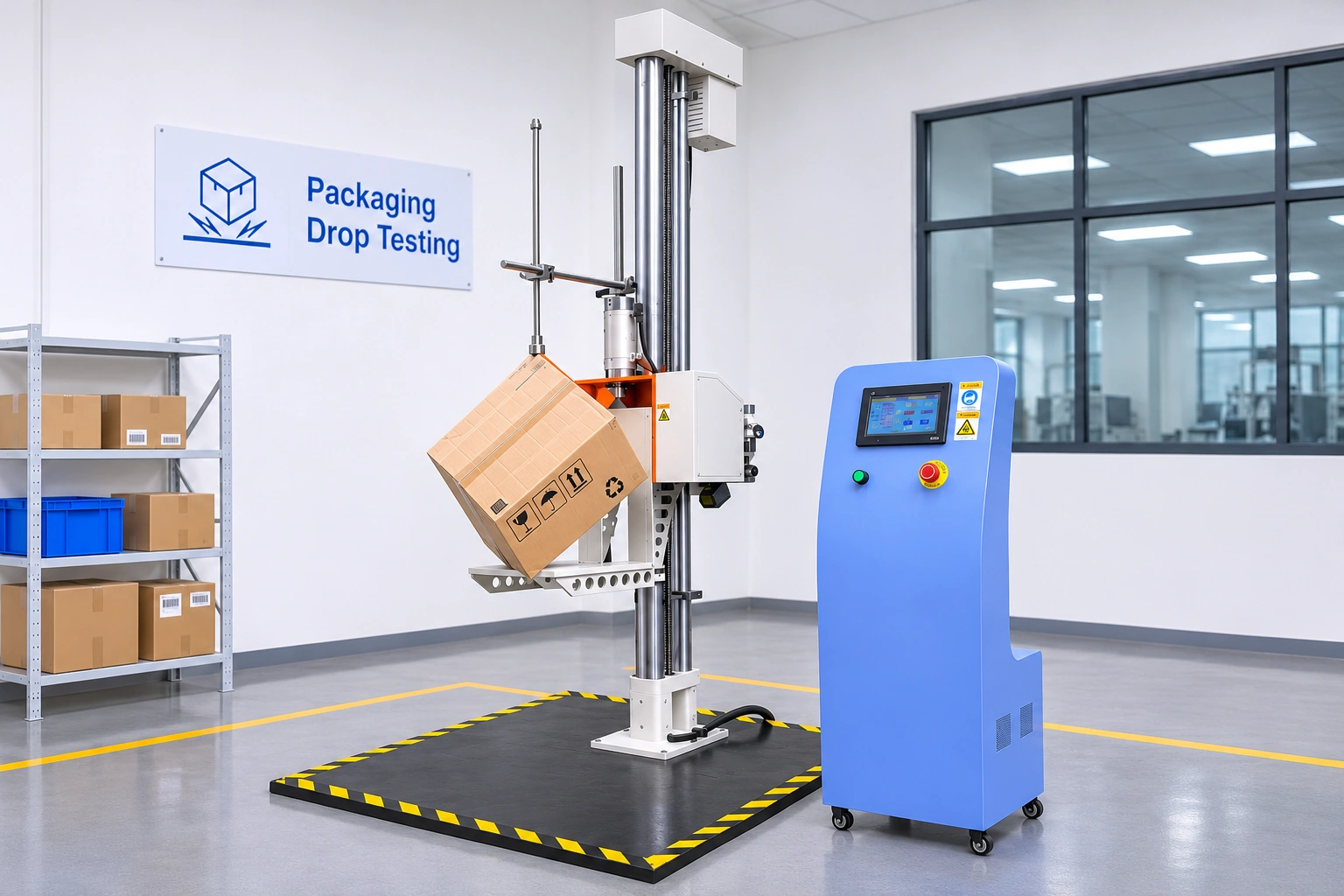
Selecting a Packaging Drop Tester
An appropriate drop tester should provide:
-
Sufficient payload capacity
-
The required drop-height range
-
Adequate specimen working space
-
Controlled release and orientation capability
-
An impact surface meeting the selected test requirements
A machine with sufficient payload capacity may still be unsuitable if the required drop height or specimen orientation cannot be achieved.
ITM-LAB equipment: RS-315 / RS-320 Packaging Drop Testers
The RS-315 / RS-320 series is designed for controlled free-fall testing of packaged products. Model selection depends on the required height, specimen dimensions, payload, and release configuration.
Choosing the Right ISTA 2A Testing Equipment
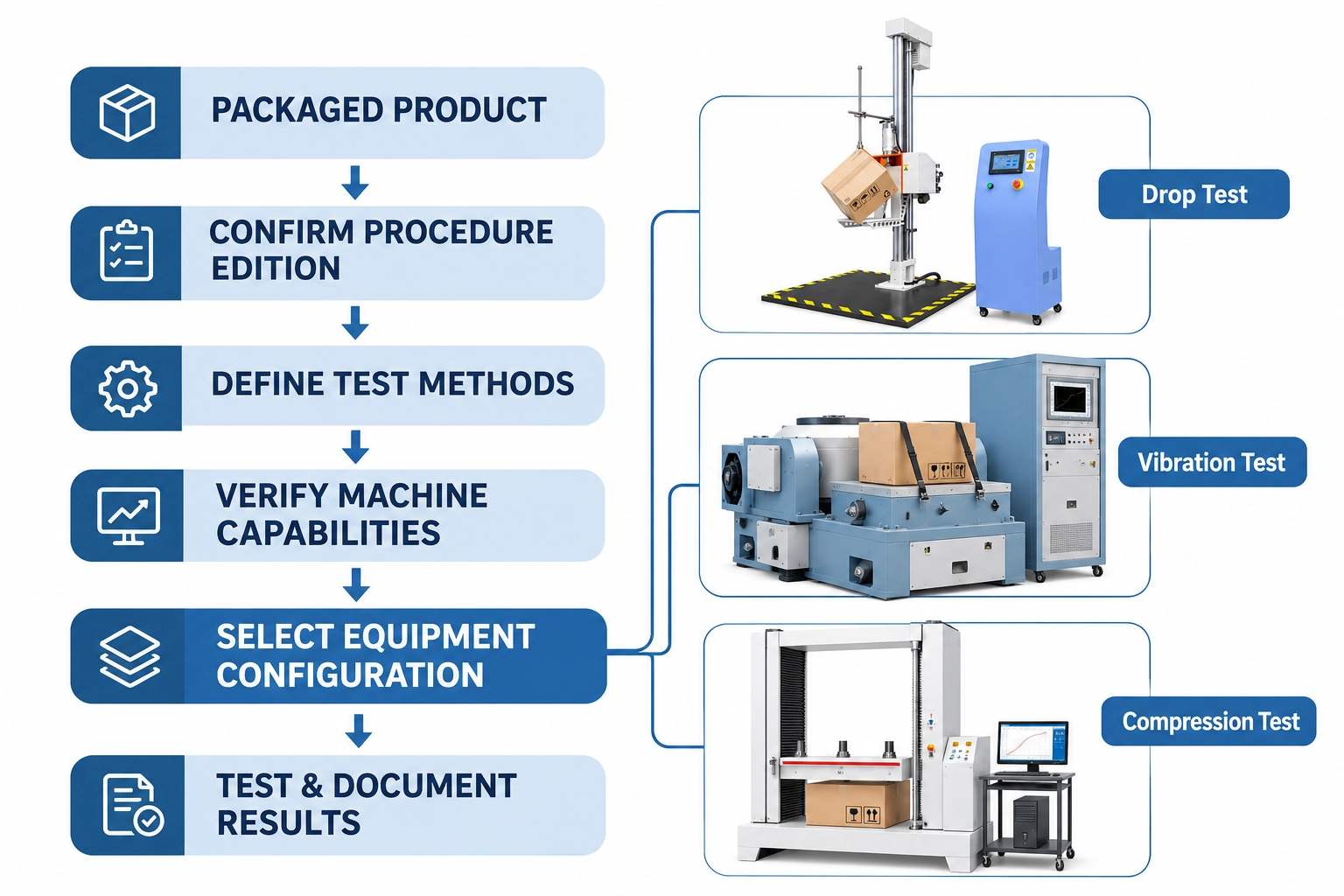
A complete ISTA 2A laboratory requires the capabilities to perform the prescribed environmental and mechanical test methods.
The appropriate equipment configuration depends on the selected procedure edition, permitted methods, specimen dimensions, and operating conditions.
Equipment Selection Matrix
| Test Category | Equipment | Critical Selection Parameters | ITM-LAB Candidate |
|---|---|---|---|
| Atmospheric Conditioning | Temperature & Humidity Chamber | Environmental conditions, usable space, airflow | GDJS Series |
| Compression | Packaging Compression Tester | Force range, loading method, platen dimensions | RS-8401 |
| Vibration | Vibration Testing System | Method, frequency, displacement, controller, payload | RS-V — verification required |
| Shock | Packaging Drop Tester | Drop height, payload, specimen dimensions, release method | RS-315 / RS-320 |
The listed machines are potential equipment configurations. Their inclusion does not establish that every available model or configuration meets all ISTA 2A requirements.
Define the test first. Select the machine second.
This approach reduces the risk of purchasing equipment that has adequate headline capacity but lacks a required operating function.
Need to Verify Your ISTA 2A Equipment Configuration?
ITM-LAB can help review packaged-product dimensions, selected test methods, equipment capabilities, and suitable laboratory configurations.
Contact ITM-LAB / Request Equipment Configuration
A Practical Laboratory Configuration Example
Consider a packaging engineering team evaluating an electronic assembly shipped in a corrugated carton with molded EPE foam end caps.
The following example illustrates equipment selection logic. It is not an actual customer project or a prescribed ISTA 2A test configuration.
Example Package Specifications
| Parameter | Example |
|---|---|
| Product | Electronic assembly |
| Packaged Weight | 25 kg |
| Package Dimensions | 600 × 400 × 350 mm |
| Outer Packaging | Corrugated carton |
| Internal Cushioning | Molded EPE foam end caps |
| Objective | Packaging performance evaluation |
The 25 kg package falls within the 68 kg procedure weight limit.
However, the package weight alone does not determine the correct laboratory equipment.
Environmental Chamber Sizing
The example carton measures 600 × 400 × 350 mm, giving a geometric volume of approximately 84 L.
This does not mean that an 84 L chamber would be suitable.
The chamber must accommodate the package while allowing sufficient space for airflow and maintaining the required environmental performance.
For illustration, allowing 50 mm of clearance on every side would produce an envelope of approximately 700 × 500 × 450 mm, or 157.5 L.
This clearance is an engineering assumption for the example, not an ISTA 2A requirement.
The final chamber selection must be based on actual internal dimensions, airflow design, loading guidelines, and the specified conditioning environment.
Compression Tester Sizing
The package footprint is 600 × 400 mm.
The compression tester must provide adequate platen dimensions and working space for the selected test method.
The required compression force must be established using the applicable procedure.
Once that value is known, the engineer can verify force capacity, measurement range, and loading control.
Selecting a machine solely because it has the highest available force capacity is not necessarily the best approach.
Vibration System Sizing
The vibration platform must accommodate the complete 25 kg packaged product and any relevant additional loading.
If random vibration is selected, the controller and shaker must reproduce the required vibration profile.
If fixed-displacement vibration is selected, the equipment must achieve the specified platform motion.
Platform dimensions, operating range, payload, and specimen arrangement should be reviewed together.
Drop Tester Sizing
The drop tester must support the packaged product and provide the required drop height and impact orientations.
The RS-315 / RS-320 series has an 80 kg rated payload capacity, exceeding the example package's 25 kg weight.
Nevertheless, the engineer must confirm the selected model's drop-height range, specimen dimensions, and release configuration before making a recommendation.
Common Testing Mistakes and Acceptance Criteria
Even a well-equipped laboratory can produce unreliable results if the test sequence, equipment configuration, or acceptance criteria are incorrect.
Treating ISTA 2A as a drop-only procedure
ISTA 2A includes environmental conditioning, compression, vibration, and shock. Performing only a drop test does not complete the full procedure.
Omitting the second vibration stage
The second vibration exposure is part of the defined sequence. Skipping it changes the testing program and removes the opportunity to evaluate post-impact vibration response.
Selecting machines by maximum capacity
A drop tester may support the required weight but lack the necessary drop height.
A compression tester may have sufficient force capacity but lack the required loading control.
A vibration system may support the specimen weight but not the specified vibration method.
Using an incorrect impact method
Not every mechanical shock machine is equivalent to a packaging free-fall drop tester. The apparatus must perform a method permitted by the applicable procedure.
Defining acceptance criteria after testing
Acceptance criteria should be established before testing begins.
Otherwise, decisions may become subjective and difficult to reproduce.
How Should ISTA 2A Results Be Evaluated?
Test results should be evaluated against the predefined product and packaging acceptance criteria.
Packaging inspection may include carton deformation, closure damage, cushioning displacement, and loss of containment.
Product inspection may include cosmetic condition, mechanical integrity, electrical performance, or functional testing.
An intact outer carton does not necessarily mean that the product passed.
Similarly, limited carton damage does not automatically constitute failure if it remains within the agreed acceptance criteria.
A useful report should document both packaging observations and product performance.
ISTA 2A vs. ISTA 1A vs. ISTA 3A
ISTA procedures are designed for different packaging evaluation objectives.
Selecting the appropriate procedure requires understanding the distribution environment, test purpose, and customer requirements.
| Feature | ISTA 1A | ISTA 2A | ISTA 3A |
|---|---|---|---|
| Series | 1-Series | 2-Series | 3-Series |
| Classification | Non-Simulation Integrity | Partial Simulation | General Simulation |
| Primary Focus | Basic packaged-product integrity | Combined-stress packaging evaluation | Parcel delivery simulation |
| Weight Scope | 150 lb (68 kg) or less | 150 lb (68 kg) or less | Subject to 3A package categories and limits |
| Vibration | Included | Two stages | Included |
| Shock | Included | Included | Included |
| Main Distinction | Basic integrity screening | Conditioning, compression, vibration and shock sequence | Distribution-focused parcel testing |
ISTA 1A is commonly considered for basic packaging integrity screening.
ISTA 2A combines multiple stress categories in a partial-simulation procedure.
ISTA 3A addresses the distribution environment associated with parcel delivery systems.
The most appropriate procedure depends on the actual distribution requirements and test objectives.
Related reading: [Insert verified internal link — ASTM D7386 Packaging Testing Solutions for Single Parcel Delivery]
Frequently Asked Questions
What is the maximum package weight for ISTA 2A?
ISTA 2A applies to individual packaged products weighing 150 lb (68 kg) or less. The weight includes the product and its complete shipping packaging.
What tests are included in ISTA 2A?
The procedure includes atmospheric preconditioning, atmospheric conditioning, compression, first vibration, shock, and second vibration. Specific test methods and levels must follow the applicable official edition.
Does ISTA 2A require drop testing?
ISTA 2A includes a shock stage. Free-fall drop testing is one permitted method, while specified alternative impact methods may also be used.
Why does ISTA 2A require two vibration stages?
The first vibration stage evaluates the package before shock exposure. The second evaluates it after impact, when cushioning or package geometry may have changed.
Can an electrodynamic vibration shaker perform ISTA 2A testing?
It may be suitable for a permitted random vibration method if the controller, shaker, platform, payload, and operating capabilities meet the applicable requirements. Compatibility must be verified for the specific system.
Can one machine perform the entire ISTA 2A procedure?
A complete ISTA 2A program requires several distinct environmental and mechanical test functions. Laboratories typically use multiple equipment types or an appropriately equipped external testing facility.
Does passing ISTA 2A guarantee safe transportation?
No. Passing indicates that the packaged product met its predefined acceptance criteria under the specified laboratory conditions. It does not guarantee protection against every possible distribution hazard.
ITM-LAB Packaging Testing Equipment and Engineering Support
ITM-LAB manufactures packaging, environmental, and mechanical reliability testing equipment for laboratory and industrial applications.
For ISTA 2A projects, relevant equipment categories include:
RS-315 / RS-320 Packaging Drop Testers
Designed for controlled free-fall testing of complete packaged products. Model selection depends on the required drop height, payload, specimen dimensions, and impact orientations.
[Insert verified product link — RS-315 / RS-320 Packaging Drop Tester]
RS-8401 Packaging Compression Tester
Suitable for packaging compression applications where the selected machine configuration provides the necessary force measurement, loading method, and specimen working space.
[Insert verified product link — RS-8401 Packaging Compression Tester]
GDJS Temperature & Humidity Chambers
Provide controlled environmental conditions for packaged-product conditioning applications within the chamber's specified operating envelope.
[Insert verified product link — GDJS Temperature & Humidity Chamber]
RS-V Vibration Test Systems
Available for relevant vibration testing applications. Compatibility with the selected ISTA 2A method must be verified against the controller, frequency, displacement, payload, and platform specifications.
[Insert verified product link — RS-V Vibration Test System]
Planning an ISTA 2A Testing Laboratory?
Whether you are establishing a new packaging testing facility or upgrading existing equipment, selecting the correct configuration begins with understanding the packaged product and the required test methods.
ITM-LAB can help review equipment capacity, usable test space, controller capabilities, and application requirements.
For an engineering assessment and quotation, please provide:
-
Packaged-product weight and external dimensions
-
Product and packaging photographs or drawings
-
Required ISTA 2A procedure edition
-
Selected test methods and required levels
-
Existing testing equipment, if applicable
-
Product acceptance criteria
-
Installation location and electrical supply
Contact ITM-LAB to discuss your packaging testing requirements and request a suitable equipment configuration.
[Insert verified internal link — Contact ITM-LAB / Request a Quote]
Technical References
International Safe Transit Association (ISTA)
ISTA Required Equipment for Testing
Related Packaging Test Methods
ASTM D5276 — Standard Test Method for Drop Test of Loaded Containers by Free Fall.
ASTM D4169 — Standard Practice for Performance Testing of Shipping Containers and Systems.
These ASTM documents provide related packaging testing context. They are not substitutes for the ISTA 2A procedure.
Technical note: This article provides engineering guidance for packaging testing and equipment selection. It does not replace the official ISTA 2A procedure. The applicable edition must be consulted for required test levels, permitted alternatives, specimen preparation, apparatus requirements, and reporting details.
