
Choose wire and cable testing equipment by matching the required mechanical movement, specimen dimensions, fixture design, test speed, cycle count, and electrical monitoring requirements. Cable bending, flexing, torsion, conical rotation, and abrupt pulling involve different test arrangements. Before selecting a machine, confirm the applicable test method, specimen mounting conditions, electrical failure criteria, and required test records.
What Types of Wire & Cable Testing Equipment Are Used for Durability Testing?
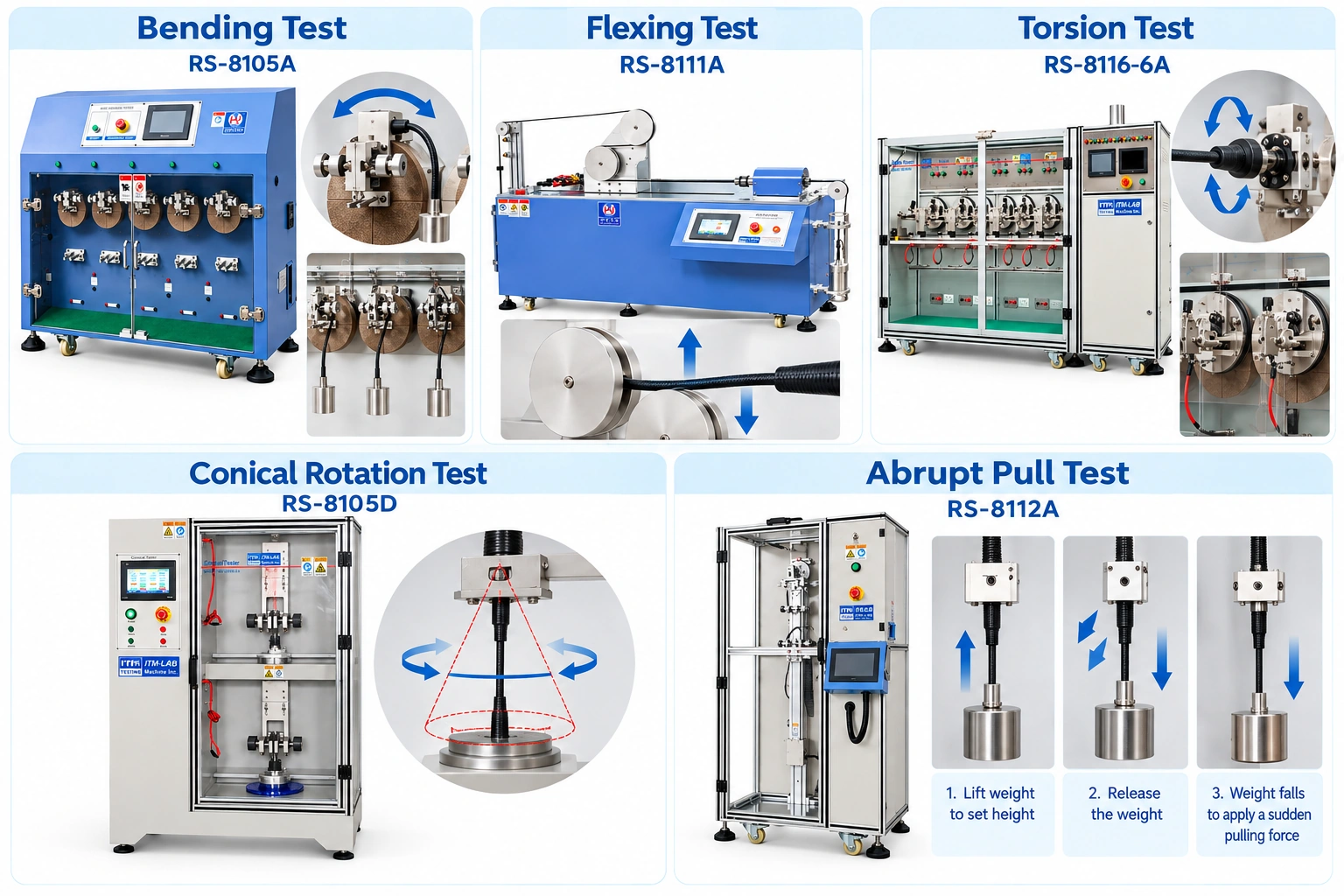
Wire and cable durability testing equipment reproduces mechanical movements or loads that cable assemblies experience during operation, handling, and repeated use.
The main categories include cable bending testers, flexing testers, torsion testers, conical rotation testers, and abrupt pull testers.
| Equipment Type | Test Movement | Typical Applications | Key Selection Factors |
|---|---|---|---|
| Cable bending tester | Repeated angular bending | USB cables, earphone cables, signal cables | Angle, fixture, load, cycles |
| Cable flexing tester | Repeated flexing movement | Flexible cords and cable assemblies | Movement path, bending geometry, speed |
| Cable torsion tester | Rotational deformation | Cables subjected to twisting | Rotation axis, angle, specimen length |
| Conical rotation tester | Movement around a defined mounting point | Portable-device power cords | Rotation geometry, mounting, load |
| Abrupt pull tester | Repeated sudden pulling | Power cords and cable connections | Pulling movement, load, fixture |
| Electrical cable tester | Electrical measurements | Cable assemblies and wiring harnesses | Measurement type, channels, limits |
An electrical cable tester and a mechanical cable durability tester serve different purposes. Electrical testing equipment should not be assumed to reproduce mechanical fatigue conditions.
Equipment selection begins with the test movement, not the machine name.
How Do You Match a cable testing machine to the Required Test Movement?
The correct testing machine must reproduce the movement defined by the product specification, customer requirement, or approved test procedure.
For a USB cable, the procedure may require repeated angular bending near the connector or strain relief.
For a cable exposed to twisting during service, rotational deformation may be the relevant test condition.
For a portable-device power cord, the specified method may involve conical rotation or abrupt pulling.
Before comparing machines, confirm:
-
Which part of the assembly remains fixed
-
Which part moves during testing
-
The movement axis and starting position
-
The required bending or rotation angle
-
Whether a weight, force, or tension is applied
-
The definition of one completed test cycle
-
The required failure criteria
Machines with similar product names may use different mechanical arrangements.
A cable bending tester should not automatically be considered suitable for torsion testing, and a torsion tester may not reproduce the movement required for a flexing test.
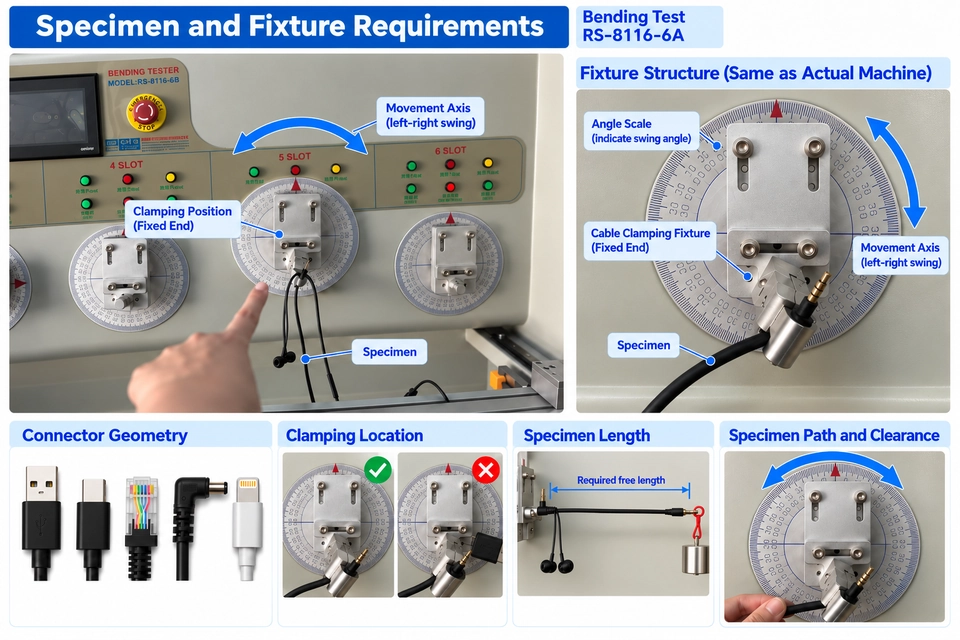
How Do Cable Dimensions and Fixtures Affect Equipment Selection?
Cable diameter alone does not determine whether a specimen can be tested.
The complete assembly may include connectors, housings, strain reliefs, mounting features, and cable sections that affect fixture selection.
For an assembled electronic product, the fixture may need to hold the device housing while allowing the cable to move.
The clamping position can also influence the location of the applied mechanical stress.
Specimen and Fixture Selection Checklist
| Selection Factor | Information to Confirm | Equipment Implication |
|---|---|---|
| Cable diameter | Minimum and maximum outer diameter | Clamp compatibility |
| Specimen length | Total and usable test length | Test space and mounting |
| Connector dimensions | Width, height, and geometry | Fixture clearance |
| Strain-relief position | Location relative to the housing | Bending point |
| Movement axis | Required rotation or bending center | Fixture alignment |
| Applied loading | Weight, force, or tension | Loading arrangement |
| Electrical connections | Number and location of connections | Monitoring interface |
A fixture should hold the specimen without introducing unintended movement or interference.
For equipment selection, provide a specimen drawing that identifies the mounting position and movement path.
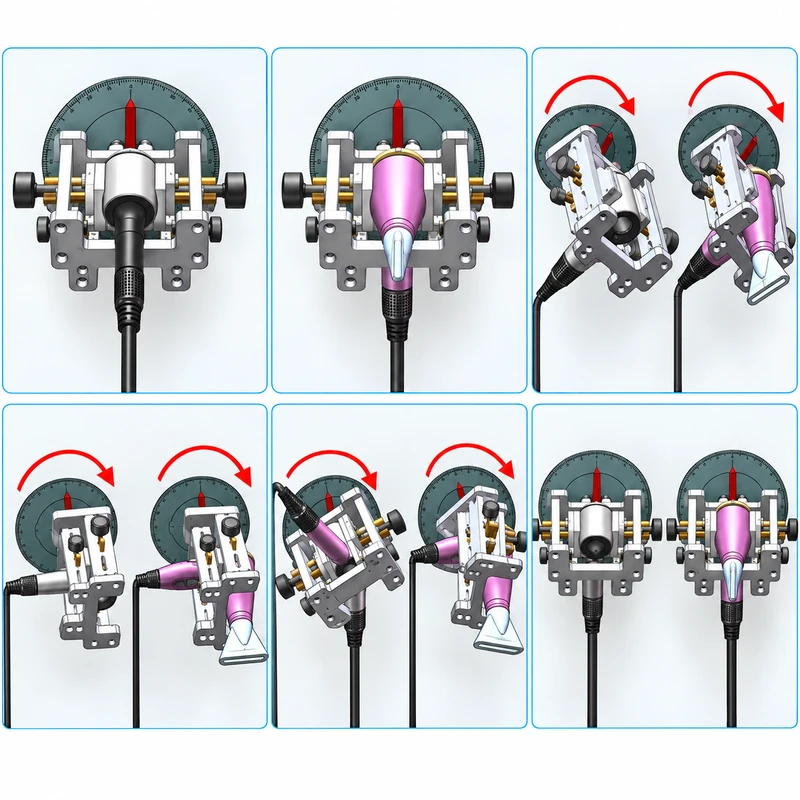
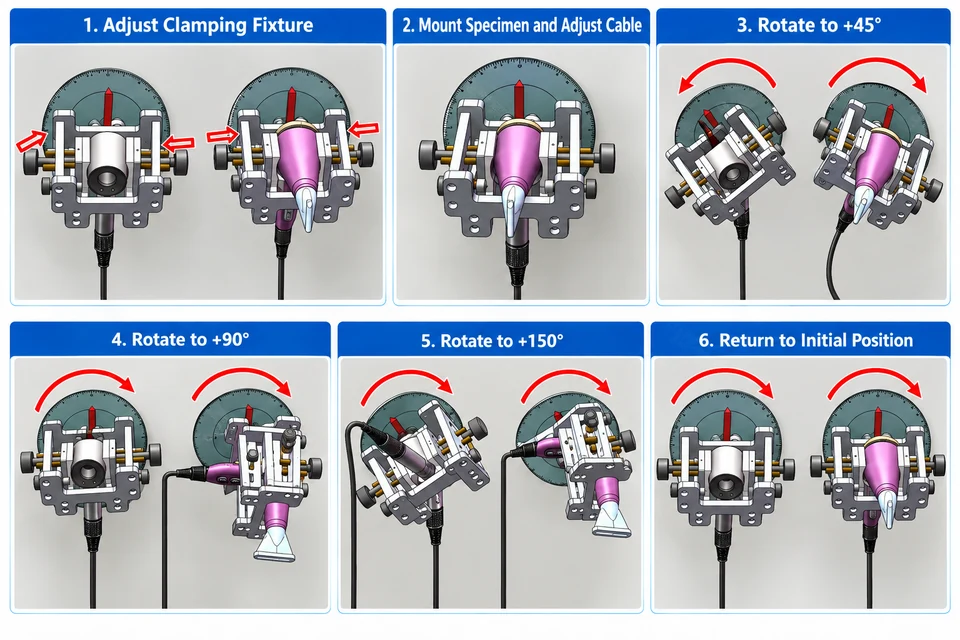
Example: RS-8115A-3 Hair Dryer Bending Tester
The ITM-LAB RS-8115A-3 is a product-specific bending test configuration for hair dryer assemblies.
Its documented technical configuration includes:
-
Three synchronized test stations
-
Product-specific specimen fixtures
-
Adjustable movement angle: 0 to ±150°
-
Test speed: 5–60 cycles/min
-
Cable test height: 1 m
-
Electrical break detection with station stop
The fixture accommodates the hair dryer assembly rather than treating the specimen as an unattached cable.
This illustrates why complete-product dimensions and mounting conditions should be evaluated before machine selection.
What Test Angle, Speed, and Cycle Count Should You Specify?
Test angle, speed, cycle count, and loading conditions should come from the applicable test procedure.
These values describe different parts of the test and should not be compared independently.
| Parameter | What to Specify | Why It Matters |
|---|---|---|
| Test angle | Starting position and movement range | Defines angular displacement |
| Test speed | Value and unit | Defines movement rate |
| Cycle count | Required cycles and cycle definition | Determines test duration |
| Dwell time | Pause at specified positions | Affects movement timing |
| Batch pause | Scheduled pauses between cycle groups | Affects elapsed time |
| Applied load | Weight, force, or tension | Defines mechanical loading |
Test Angle
A stated angle should be interpreted together with the starting position and movement direction.
For example, a procedure specifying movement from −90° to +90° is not necessarily equivalent to a procedure specifying a single 180° rotation.
The fixture and controller must reproduce the required movement.
Test Speed
Cable testing speed may be expressed in revolutions per minute, cycles per minute, or another unit.
These values cannot be compared directly without knowing how the machine defines one cycle.
Acceleration, deceleration, and dwell time may also affect the test duration.
Test Cycle Count
The number of cycles defines the required repeated movement, but it does not establish the complete test severity.
A test specification must also describe the movement, angle, loading, speed, and relevant operating conditions.
How Is Cable Bending Test Duration Calculated?
For a test requiring 30,000 completed cycles at 30 cycles per minute:
Test duration = 30,000 ÷ 30 = 1,000 minutes
The calculated movement time is approximately 16.7 hours.
This calculation excludes dwell time, scheduled pauses, specimen installation, and interruptions.
It also assumes the specified speed refers to completed test cycles rather than motor revolutions.
When Is Electrical Monitoring Needed During Cable Durability Testing?
Electrical monitoring is needed when the acceptance criteria include conductor continuity, an electrical measurement limit, or another electrical failure condition.
Mechanical fatigue may produce an electrical failure before visible damage appears.
However, a mechanical testing machine does not automatically include electrical monitoring.
Continuity Monitoring
Continuity monitoring checks whether an electrical path remains connected under the configured detection conditions.
It may be used to identify an open circuit during repeated movement.
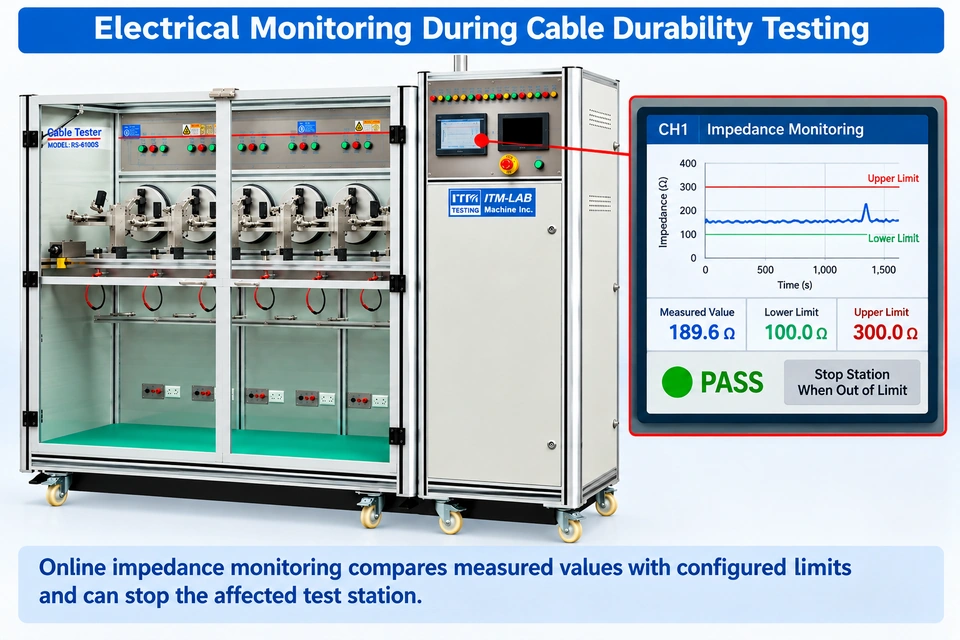
Impedance Monitoring
Impedance monitoring compares measured electrical values with configured limits.
Depending on the machine configuration, an out-of-range condition may trigger an alarm, stop the affected station, and retain the current cycle count.
The measurement range, channel arrangement, and detection conditions should be confirmed with the manufacturer.
Example: RS-8116-6A Ear Hook Twist Tester
The ITM-LAB RS-8116-6A is designed for TWS earphone ear-hook twist testing.
Its documented configuration includes:
-
Six independently controlled stations
-
Panasonic AC servo motors
-
OMRON touchscreen and Mitsubishi PLC
-
THINGET touchscreen for online impedance monitoring
-
Configurable upper and lower impedance limits
-
Automatic stop of the affected station when the monitored value exceeds the configured limits
The documented test speed is 1–60 rpm, and the cycle-setting range is 1–999,999 cycles.
The RS-8116-6A demonstrates how mechanical movement and electrical monitoring can be combined in one test system.
Its suitability for other cable assemblies must be confirmed against the specimen and test procedure.
How Do You Choose Between Independent and Synchronized Test Stations?
The number of stations determines how many specimens can be installed, but it does not establish whether they operate independently.
Synchronized stations follow a shared movement program.
Independent stations can operate or stop separately when supported by the control system.
For example, the RS-8115A-3 uses three synchronized stations, while the RS-8116-6A has six independently controlled stations.
Before selecting a multi-station tester, confirm:
-
Number of stations
-
Independent or synchronized movement
-
Individual cycle counting
-
Electrical monitoring per station
-
Automatic stop behavior
-
Fixture compatibility
-
Available test records
The appropriate configuration depends on the test procedure and the required laboratory workflow.
Wire & Cable Testing Machine Comparison: Applications and Selection Criteria
ITM-LAB manufactures different testing machines for cable bending, flexing, torsion, abrupt pulling, and product-specific durability applications.
The following comparison helps buyers identify which equipment category should be evaluated.
| ITM-LAB Model | Equipment Type | Typical Specimens | Test Movement | Selection Considerations |
|---|---|---|---|---|
| RS-8105A | Cable Bending Tester | Earphone, USB, communication, and signal cables | Repeated bending | Angle, loading, fixture |
| RS-8105D | 45° Cable Conical Tester | Portable-device power cords | Conical rotation | Rotation geometry and mounting |
| RS-8116-6B | Bending Tester | Headphone, USB, data, and charging cables | Repeated bending | Six-station test configuration |
| RS-8111A | Cable Flexing & Torsion Tester | Flexible wire and cable assemblies | Flexing and torsion | Movement type and specimen geometry |
| RS-8112A | Automatic Abrupt Pull Tester | Power cords and cable connections | Abrupt pulling | Load and fixture arrangement |
| RS-8116-6A | Ear Hook Twist Tester | TWS earphone ear hooks | Controlled angular/twist movement | Independent stations and impedance monitoring |
| RS-8115A-3 | Hair Dryer Bending Tester | Hair dryer cable assemblies | Product-specific angular bending | Custom fixture and synchronized stations |
These models are grouped by application rather than ranked by performance.
For cable bending, evaluate the RS-8105A or RS-8116-6B. For flexing and torsion, review the RS-8111A. For TWS ear-hook testing with online impedance monitoring, consider the RS-8116-6A. Final selection depends on the specimen, fixture, and test procedure.
Cable Bending Applications
For USB, earphone, and signal cable bending, review the RS-8105A and RS-8116-6B according to the required movement and fixture configuration.
Cable Flexing and Torsion Applications
For test procedures requiring flexing or rotational deformation, evaluate the RS-8111A against the specified movement.
TWS Ear Hook Twist Testing
For ear-hook applications requiring independent station control and online impedance monitoring, evaluate the RS-8116-6A.
Product-Specific Bending Applications
For assembled products such as hair dryers, the fixture and movement may need to be configured around the complete product.
The RS-8115A-3 provides an example of this arrangement.
Which Standards Apply to Wire & Cable Mechanical Durability Testing?
The applicable standard depends on the product type, intended use, and required test method.
Cable bending, torsion, flexing, and pulling tests may have different apparatus and procedure requirements.
Relevant specifications may come from published IEC, UL, ASTM, or ISO standards, customer procedures, or OEM test methods.
Before selecting a machine, confirm:
-
Standard number and edition
-
Applicable test clause
-
Specimen preparation
-
Fixture and apparatus requirements
-
Required movement and loading
-
Test speed and duration
-
Electrical monitoring requirements
-
Failure and acceptance criteria
A machine capable of producing a specified movement does not automatically comply with every standard involving that movement.
The proposed equipment and fixture must be evaluated against the complete applicable procedure.
What Should You Send to a Wire & cable testing machine manufacturer?
A quotation request should define the required test rather than only naming a machine type.
The following information allows the manufacturer to evaluate the required equipment configuration.
| RFQ Item | Information to Provide |
|---|---|
| Specimen | Cable type and complete assembly |
| Drawing | Dimensions, connector, housing, strain relief |
| Test procedure | Standard, edition, OEM SOP, or internal method |
| Movement | Bending, flexing, torsion, conical rotation, abrupt pull |
| Test angle | Movement range and starting position |
| Test speed | Speed, unit, and cycle definition |
| Test cycles | Required count, dwell time, and pauses |
| Loading | Weights, force, or tension |
| Stations | Quantity and control requirements |
| Electrical monitoring | Continuity, impedance, and failure limits |
| Acceptance criteria | Mechanical and electrical failure conditions |
| Installation | Power supply and available space |
Example RFQ for a Cable Bending Tester
“We need a cable bending tester for USB cable assemblies. The procedure requires repeated angular movement, a defined cycle count, and electrical continuity monitoring. We can provide the specimen drawing, clamping position, test method, and acceptance criteria. Please recommend a suitable machine and fixture configuration.”
A request containing these details allows the manufacturer to compare the test requirements with the machine's actual capabilities.
What Mistakes Should Buyers Avoid When Selecting Cable Testing Equipment?
Selecting by machine name alone. Equipment described as bending, flexing, or torsion testers may use different movement mechanisms. Confirm the actual test motion.
Ignoring connector geometry. Cable diameter alone does not establish fixture compatibility. Include the connector, housing, and strain relief.
Comparing different speed units. Confirm whether a specification refers to rpm, cycles per minute, or another movement rate.
Assuming independent station control. Verify whether multiple stations operate independently or synchronously.
Assuming electrical monitoring is included. Confirm the measurement hardware, channel configuration, limits, and stop logic.
Selecting equipment before confirming the test procedure. Verify the apparatus and method requirements before finalizing the configuration.
Frequently Asked Questions
How do I choose a cable bending tester for USB charging cable durability testing?
Confirm the USB cable assembly dimensions, connector geometry, required bending angle, movement rate, cycle count, loading, and electrical monitoring requirements. Select a machine whose fixture and movement reproduce the specified test procedure.
What is the difference between a cable bending tester and a cable torsion testing machine?
A bending tester changes the cable's curvature or angular position. A torsion tester applies rotational deformation. The required equipment depends on the test movement, fixture arrangement, and expected failure mode.
Can one wire testing machine perform bending, flexing, and torsion tests?
Only if its movement mechanism, fixtures, and controls support the required procedures. A machine capable of bending a cable should not automatically be considered suitable for torsion or conical rotation testing.
How many test stations are needed for cable durability testing?
Station count depends on the number of specimens and laboratory workflow. Confirm whether stations operate independently or synchronously, whether cycle counts are recorded separately, and whether an individual station can stop after a detected failure.
Can a cable bending tester detect an internal conductor break during testing?
A cable bending tester can detect an electrical failure only when it includes a suitable monitoring system. Detection depends on the electrical measurement method, configured limits, and response conditions.
What test parameters should be included in a cable bending machine quotation request?
Provide the specimen drawing, test procedure, bending angle, movement speed, cycle count, loading conditions, fixture requirements, station quantity, electrical monitoring needs, and acceptance criteria.
How do I determine whether a cable testing machine meets an IEC or UL test requirement?
Identify the applicable standard, edition, and test clause. Compare the required apparatus, movement, loading, monitoring, and procedure with the proposed equipment configuration. A general claim of compatibility does not establish conformity.
When should a manufacturer design a custom fixture for cable durability testing?
A custom fixture may be needed when the specimen includes a housing, connector, strain relief, or mounting arrangement that cannot be accommodated by the standard fixture. Provide drawings and the required movement for evaluation.
Request a Wire & Cable Testing Equipment Configuration
Wire and cable testing equipment should be selected according to the required mechanical movement, specimen geometry, test parameters, and electrical monitoring conditions.
ITM-LAB manufactures cable bending, flexing, torsion, and other mechanical durability testing equipment for electronics manufacturers, cable producers, and testing laboratories.
To request an equipment configuration, provide your specimen drawing, test procedure, required movement, cycle count, and monitoring requirements.
Explore ITM-LAB Wire & Cable Testing Equipment
Contact ITM-LAB to Discuss Your Test Requirements and Request a Quotation.
