
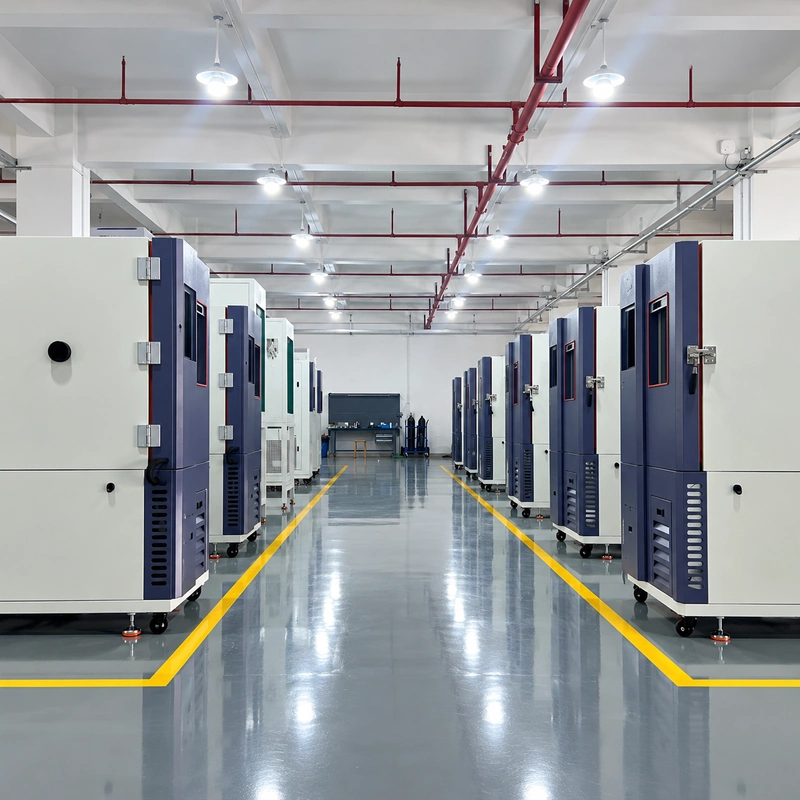
A closer look at how ITM-LAB approaches environmental chamber design, manufacturing, system integration, and equipment verification.
When sourcing an environmental test chamber, buyers often begin by comparing temperature ranges, chamber capacities, and quotations. These specifications matter, but they do not tell the complete story of how the equipment is designed, manufactured, and prepared for testing applications.
An environmental test chamber is an integrated system. Its performance depends on the interaction between the test compartment, refrigeration and heating systems, airflow, sensors, electrical controls, and the product being tested.
Understanding the manufacturing process can help buyers assess whether a supplier has the engineering resources and production capabilities needed for their application.
At ITM-LAB, environmental chamber manufacturing involves application review, mechanical construction, electrical assembly, system integration, and project-specific inspection. The factory photographs and production documents presented here offer a view of these activities and the engineering considerations behind them.
What should buyers look for in an environmental test chamber factory?
A reliable environmental chamber manufacturer should be able to explain how test requirements are translated into equipment specifications, how the chamber is manufactured and assembled, and how the agreed functions and performance requirements are verified. Buyers should also confirm the manufacturer's customization capabilities, documentation, delivery arrangements, and technical support.
Environmental Chamber Manufacturing Starts with the Test Application
Before selecting components or defining the chamber structure, the manufacturer needs to understand what the customer intends to test.
Two environmental chambers with similar published specifications may require different configurations because their specimens, loading conditions, and test procedures are different.
For example, a chamber used to test small electronic components may require relatively simple specimen supports. A chamber intended for a large electronic assembly may need additional internal clearance, cable access, and an evaluation of the specimen's heat dissipation.
The engineering review typically begins with the specimen dimensions, weight, required environmental conditions, and applicable test method.
The customer may also need to define heating and cooling profiles, humidity requirements, operating loads, internal fixtures, and installation conditions.
These details influence the chamber configuration before manufacturing begins.
Temperature Range Is Only One Part of the Specification
A specified temperature range identifies the environmental conditions the equipment is designed to reach. It does not fully describe temperature stability, uniformity, heating and cooling performance, or behavior under load.
These characteristics must be considered separately.
For example, a chamber may reach a target temperature when empty but respond differently when loaded with a large specimen that absorbs or generates heat.
Likewise, internal fixtures and specimen placement can influence airflow within the test space.
This is why equipment selection should begin with the test application rather than nominal chamber capacity alone.
Temperature Chambers and Temperature-Humidity Chambers
Not every environmental test requires humidity control.
High- and low-temperature chambers are used for procedures involving controlled cold, dry heat, or temperature cycling.
Temperature-humidity chambers provide additional humidity-control capability within a defined temperature-humidity operating region.
ITM-LAB manufactures both types of equipment.
Selected GDJS temperature-humidity chamber configurations provide a temperature range of −40°C to +150°C and humidity capability of 20–98% RH within the specified operating envelope.
The humidity range must not be interpreted as being available at every temperature. The applicable operating region and performance conditions should be confirmed for the proposed configuration.
Engineering Design and Production Planning
Once the testing requirements are established, they must be translated into an equipment configuration that can be manufactured.
Engineering considerations include the usable test space, cabinet dimensions, thermal system requirements, electrical supply, access ports, internal accessories, and service arrangements.
For customized chambers, small details can have significant consequences.
A cable port must be positioned to suit the specimen and its connections. An internal fixture must fit within the usable workspace without unnecessarily restricting airflow. The chamber's external dimensions must also be compatible with the customer's installation site.
These requirements are easier to address during design review than after equipment assembly.
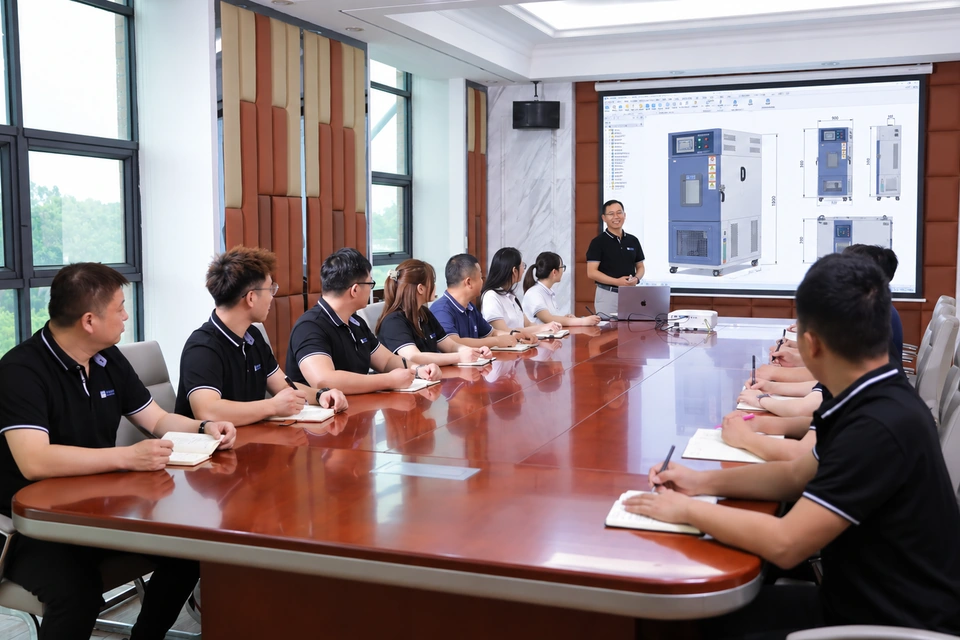
ITM-LAB's engineering and production documentation provides examples of how technical specifications and manufacturing requirements are recorded.
Mechanical Manufacturing and Chamber Construction
The mechanical structure of an environmental chamber must provide a suitable test compartment while accommodating insulation, airflow passages, environmental-control components, and maintenance access.
The construction depends on the chamber type and intended application.
Important considerations include the usable internal dimensions, door arrangement, sealing, structural support, and access to mechanical components.
For larger or customized chambers, specimen handling and installation space may become especially important.
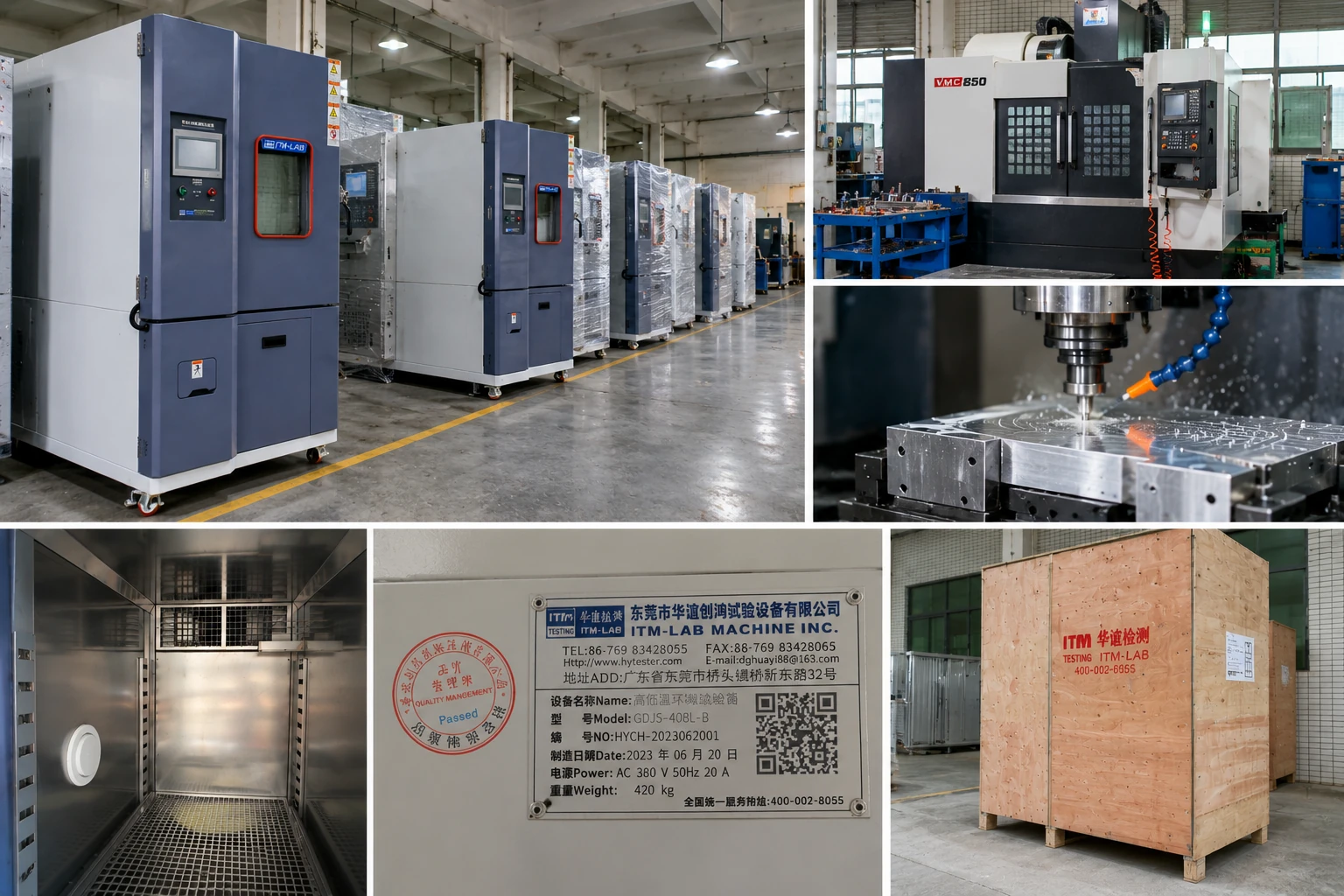
ITM-LAB's manufacturing facilities include mechanical processing equipment and production personnel working on testing-machine components.
Why Usable Chamber Space Matters
A chamber's nominal volume does not always indicate whether it can accommodate a particular specimen.
A large product may physically fit inside the test compartment but leave insufficient space for circulation or access.
Shelves, fixtures, cables, and specimen orientation can further reduce the usable workspace.
Buyers should therefore review the actual internal dimensions and proposed loading arrangement rather than relying on the volume figure alone.
Electrical Control System Assembly
The electrical system coordinates the operation of the chamber's installed heating, cooling, sensing, and control functions.
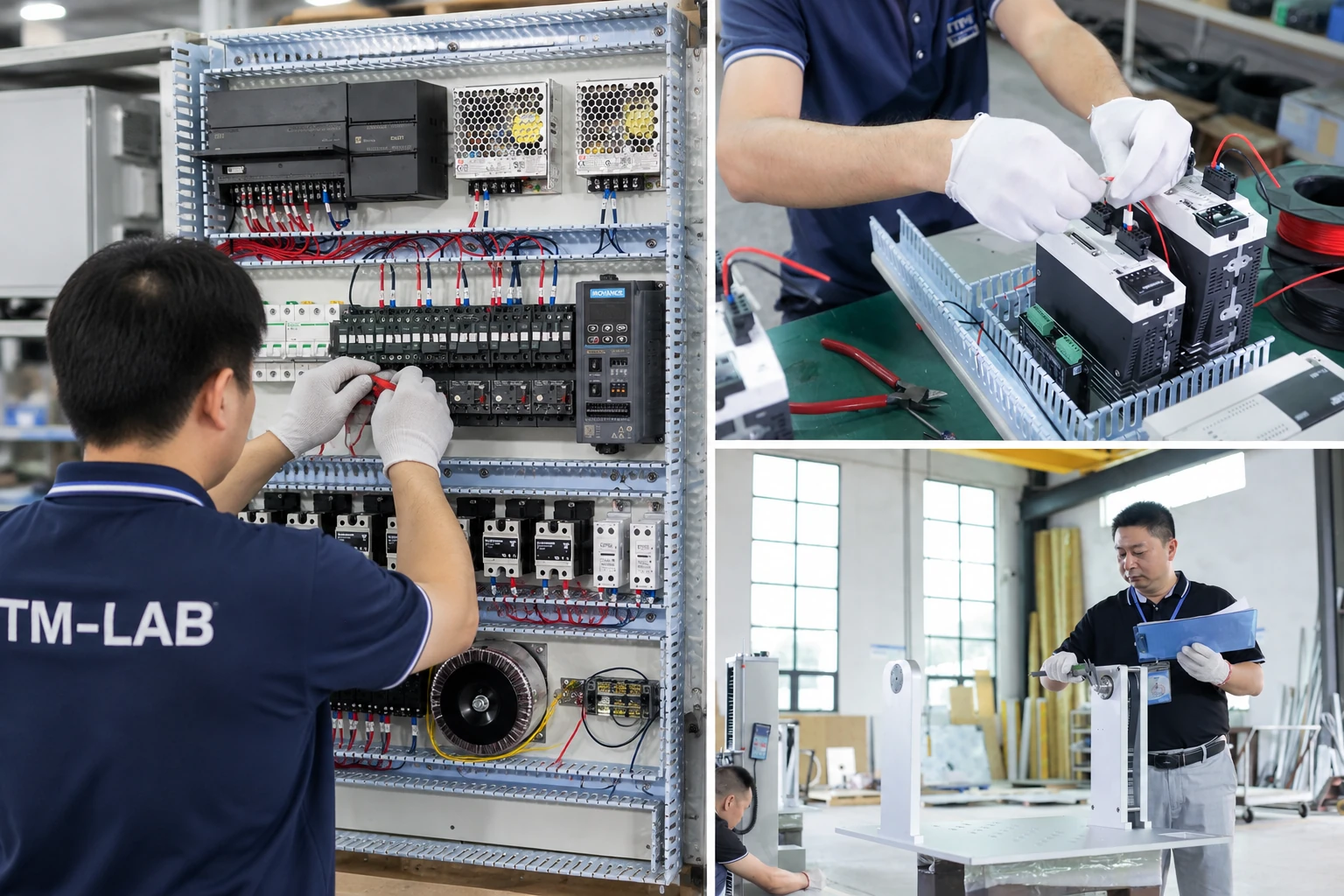
Depending on the configuration, the electrical cabinet may contain controllers, power supplies, switching devices, protective components, terminal connections, and associated wiring.
The control arrangement must be compatible with the approved equipment design.
Control Accuracy Depends on the Complete System
A controller displaying the requested setpoint does not necessarily mean that every location within the test space is at the same temperature.
Actual environmental conditions depend on sensor placement, airflow, thermal loading, and the behavior of the integrated heating and refrigeration systems.
Where a test procedure requires defined temperature uniformity or stability, those characteristics should be evaluated using the applicable measurement conditions and acceptance criteria.
Environmental Chamber Assembly and System Integration
After mechanical and electrical components are prepared, they must be integrated into a complete environmental testing system.
For a temperature chamber, this involves coordinating the insulated test compartment, air circulation, heating, refrigeration, sensors, and control functions.
Temperature-humidity chambers also require the appropriate humidity-control components and associated systems.
The exact arrangement varies according to the chamber model.
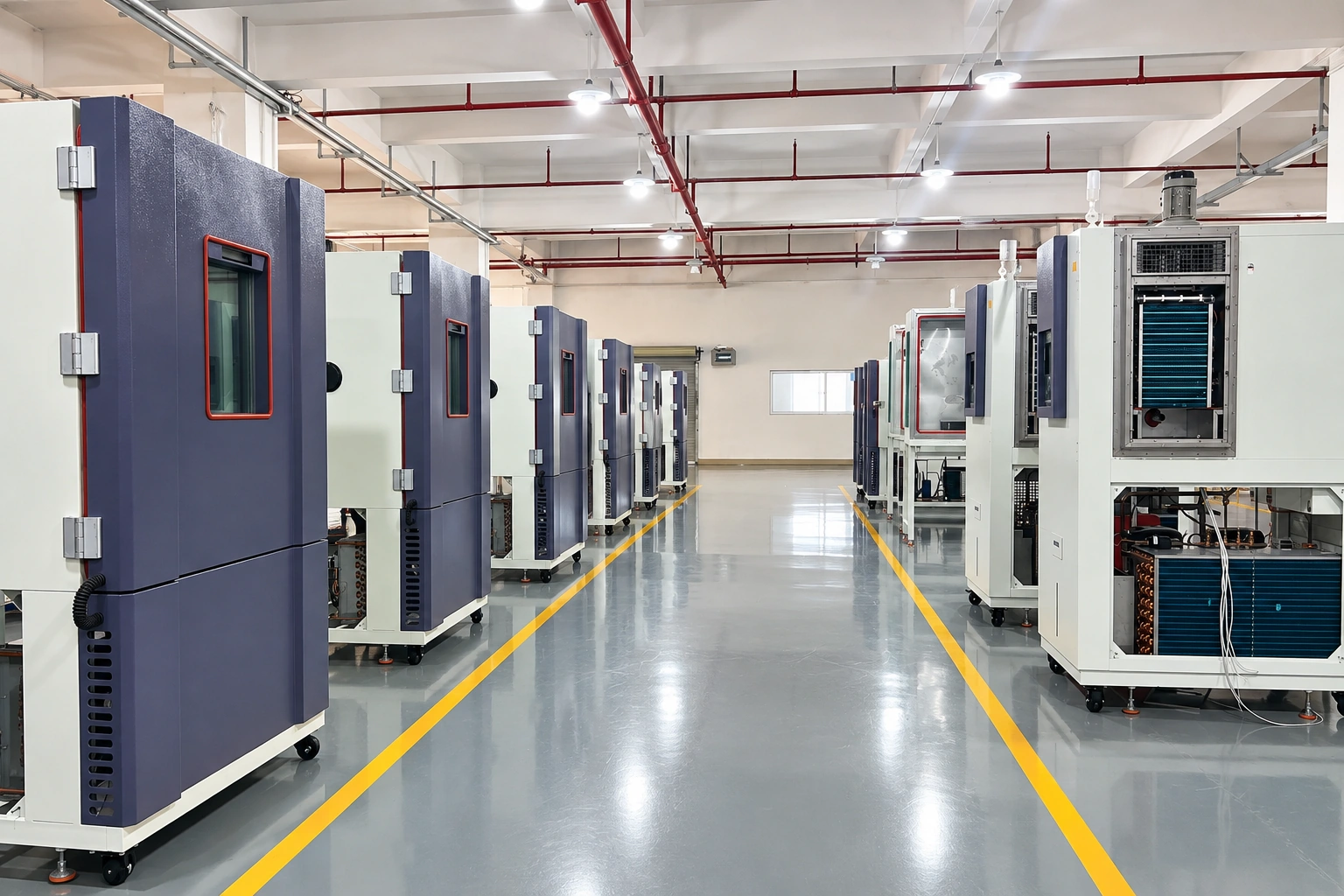
[IMAGE 6 — ACTUAL ITM-LAB ENVIRONMENTAL CHAMBER ASSEMBLY]
Caption: Environmental test chambers in the ITM-LAB production area, showing different equipment sizes and visible assembly configurations.
Alt text: Environmental test chambers undergoing assembly in the ITM-LAB manufacturing workshop.
The production photographs show multiple environmental chambers, including units with accessible equipment compartments and visible mechanical components.
These images provide evidence of manufacturing activity and equipment configurations within the workshop.
They do not independently establish the performance specifications or inspection results of individual machines.
Why System Integration Matters
Environmental chamber performance cannot be evaluated from component specifications alone.
The refrigeration system, heating elements, circulation system, sensors, and controller must operate together under the intended conditions.
A chamber designed for an empty test space may require further evaluation when used with a large or heat-generating specimen.
For this reason, the manufacturer should understand the expected loading conditions before confirming the final configuration.
Quality Control and Performance Verification
Quality control is an important part of environmental chamber manufacturing.
Inspection may take place at different stages of production, while final performance verification should be based on the approved technical specification and agreed acceptance criteria.
The appropriate scope depends on the chamber type, configuration, and customer requirements.
Mechanical and Electrical Inspection
Mechanical inspection may address cabinet construction, door operation, specimen space, component installation, and customized features.
Electrical checks may address wiring connections, protective arrangements, controller functions, and other installed electrical systems.
The actual procedures should follow the approved equipment design and applicable requirements.
Temperature Performance Verification
Temperature performance involves several different characteristics.
Temperature fluctuation describes variation over time at a measurement location.
Temperature deviation describes the difference between a measured value and the specified reference condition.
Temperature uniformity concerns temperature differences between measurement positions within the defined working space.
Heating and cooling performance may also be evaluated where specified.
These characteristics should not be treated as interchangeable.
A chamber reaching its target setpoint does not automatically demonstrate compliance with every required performance parameter.
Humidity Performance Verification
For temperature-humidity chambers, humidity performance should be considered within the specified temperature-humidity operating region.
Measurement conditions and acceptance criteria are important because humidity capability is not independent of temperature.
The applicable test procedure should identify the required conditions and how the results are evaluated.
Factory Acceptance Testing
Factory Acceptance Testing (FAT) is a structured pre-delivery process for checking equipment against agreed functional or performance requirements.
Depending on the project, it may include operational checks, selected environmental performance measurements, inspection of customized features, and documentation review.
Not every project requires the same FAT procedure.
The scope of factory inspection and acceptance testing depends on the approved technical specification and purchase agreement. Any customer-specific FAT requirements, including measurement conditions, acceptance criteria, and documentation, should be confirmed before delivery.
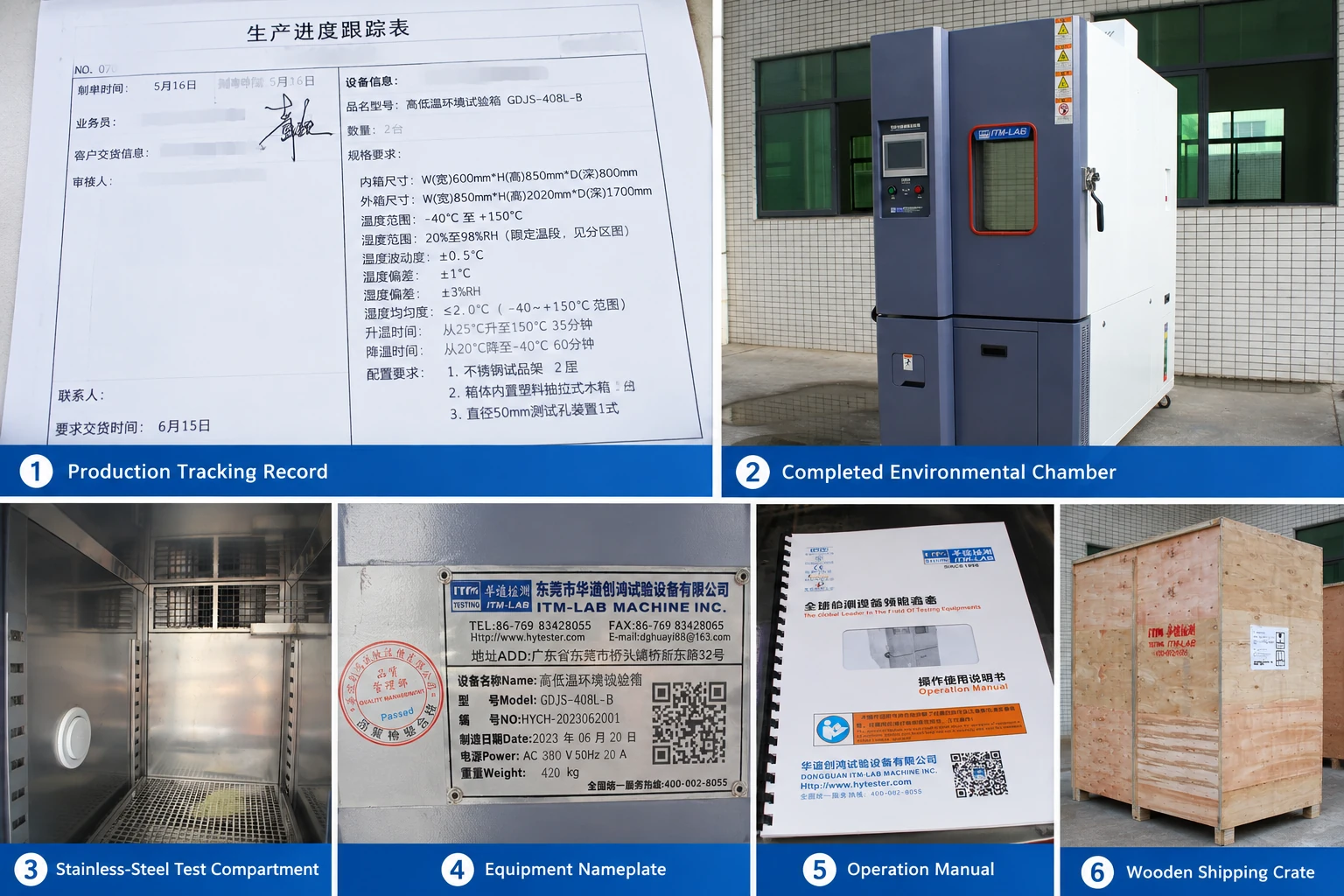
From Production Planning to Delivery: A Real GDJS-408L-B Project
A real ITM-LAB GDJS-408L-B project demonstrates how customer requirements are translated into finished environmental testing equipment.
The production tracking record covers two temperature-humidity chambers with a −40°C to +150°C temperature range, humidity requirements, specified dimensions, and customized features.
Photos from the same project show the completed chamber, stainless-steel test compartment, equipment nameplate, operation manual, and wooden shipping crate.
Together, these records provide a practical example of ITM-LAB's manufacturing documentation and delivery preparation.
Note: The inspection mark shown on the nameplate does not replace a detailed performance test report.
Environmental Chamber Project Documentation in Practice
Manufacturing capability is easier to evaluate when factory photographs are supported by project documentation.
ITM-LAB's environmental chamber records provide examples of how equipment requirements, production activities, and delivery-related information can be documented.
A GDJS-series production planning record identifies chamber dimensions, environmental specifications, and manufacturing coordination requirements.
Separately, GDJS equipment delivery and installation records illustrate the use of equipment checklists and acceptance documentation.
These records represent different aspects of the project workflow. They should not be interpreted as a continuous manufacturing history for one individual chamber unless the corresponding project identifiers have been verified.
What Buyers Can Learn From Project Records
A production record can help show how technical requirements are communicated to manufacturing personnel.
An equipment checklist can help identify supplied items and accessories.
An installation acceptance document may record activities completed after delivery.
These documents serve different purposes and should be labeled accordingly.
In particular, an installation acceptance record should not be presented as a factory temperature performance report unless it contains the relevant measurements and test conditions.
For buyers, the most useful documentation is the material that directly supports the equipment specification and agreed acceptance requirements.
Custom Environmental Test Chambers for Different Applications
Standard chamber configurations are suitable for many applications, but some projects require modifications to the equipment.
Customization may involve chamber dimensions, cable ports, specimen supports, environmental-control requirements, or other application-specific features.
For example, an electronic assembly undergoing powered temperature testing may require cable access and an assessment of internal heat dissipation.
A larger specimen may require additional usable space and a different loading arrangement.
A customer-specific procedure may also introduce particular operating or acceptance requirements.
ITM-LAB can review these requirements and discuss suitable equipment configurations, subject to engineering feasibility.
Customization should be defined through an approved specification rather than assumed from a model designation alone.
What Buyers Should Verify Before Choosing an Environmental Chamber Manufacturer
Factory photographs are useful, but they should be considered alongside engineering information and project documentation.
When evaluating a manufacturer, buyers should establish who is responsible for equipment design, manufacturing, inspection, customization, and technical support.
The supplier should be able to explain the proposed configuration and identify how the agreed requirements will be addressed.
A practical evaluation should cover the following areas:
| Evaluation Area | What to Confirm |
|---|---|
| Engineering capability | Can the manufacturer review the DUT and test procedure? |
| Equipment configuration | Are usable dimensions and operating conditions clearly defined? |
| Customization | Can application-specific features be evaluated? |
| Quality verification | What inspections and acceptance criteria apply? |
| Documentation | What technical and delivery records are included? |
| Technical support | What installation and after-sales arrangements are available? |
Why Factory-Direct Quotations Depend on the Application
Environmental test chamber pricing depends on the selected equipment configuration.
Chamber dimensions, temperature and humidity requirements, refrigeration design, performance specifications, accessories, and customization can all influence the final quotation.
Buying directly from a manufacturer can simplify technical communication, but it does not automatically guarantee the lowest price.
For customized equipment, a project-specific quotation is more useful than a generic price estimate.
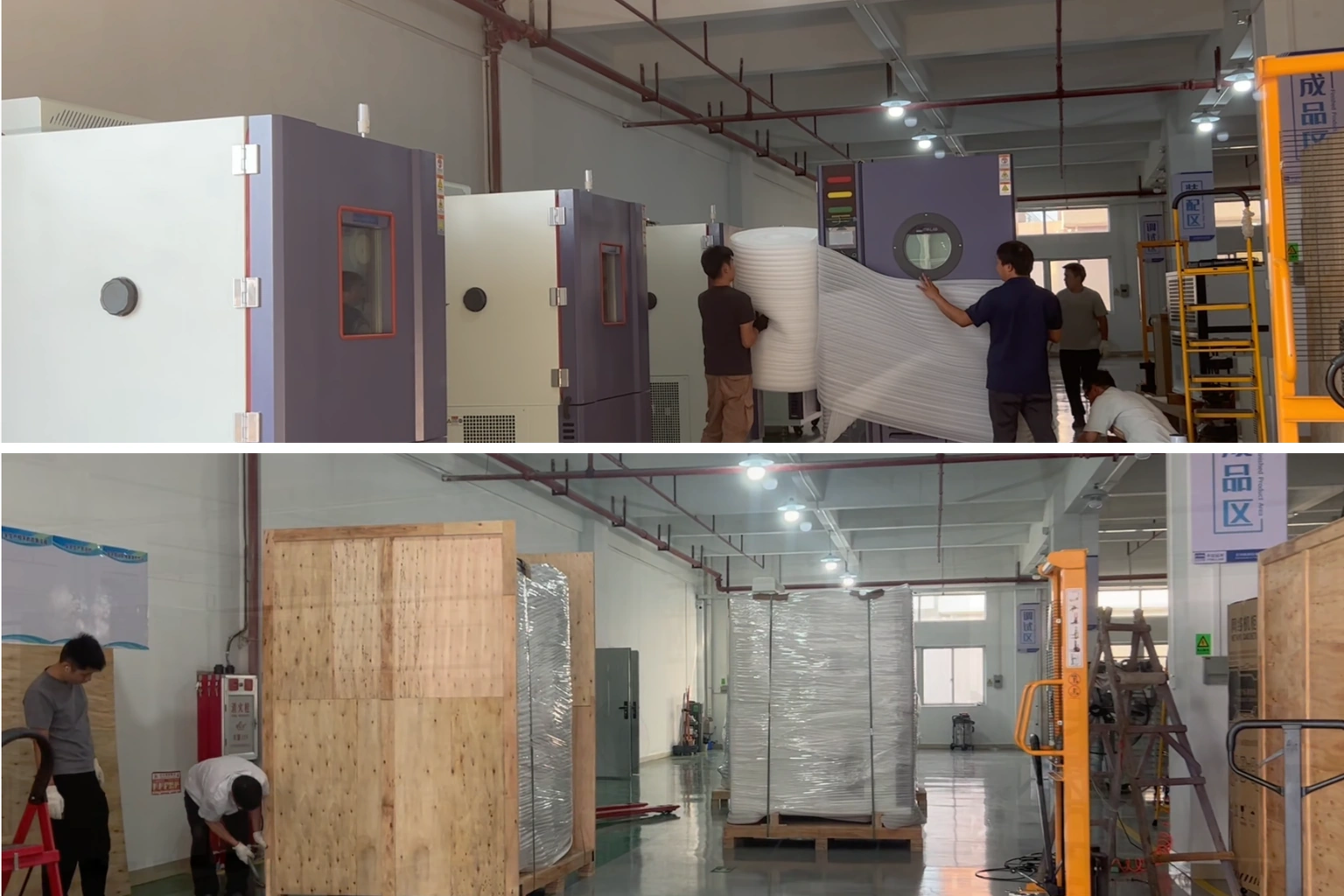
Packaging, Delivery, and Installation Preparation
After manufacturing and the applicable inspection activities, equipment must be prepared for transportation.
Packaging requirements depend on the machine dimensions, shipping method, and destination.
ITM-LAB's project photographs include environmental chambers prepared for shipment and wooden transport packaging.
Preparing an Environmental Chamber Request for Quotation
A useful quotation begins with the intended test.
Customers should provide the DUT dimensions and weight, required temperature and humidity conditions, applicable test standard, and any special configuration needs.
Where relevant, the inquiry should also identify specimen heat generation, heating and cooling profiles, internal fixtures, cable access, and installation conditions.
Photographs or drawings of the DUT can help clarify the application.
If the complete test specification is not yet available, ITM-LAB can review the existing information and discuss the next engineering steps.
Frequently Asked Questions
- Does ITM-LAB manufacture environmental test chambers?
Yes. ITM-LAB manufactures testing equipment, including environmental chambers. The factory photographs and production records presented here show environmental chamber manufacturing activities, electrical assembly, and equipment delivery preparation.
- Can environmental test chambers be customized?
Yes. Customization may include chamber dimensions, environmental conditions, cable ports, internal fixtures, and other application-specific requirements. The final configuration depends on engineering feasibility and the approved specification.
- How is environmental chamber quality verified?
Quality verification depends on the equipment configuration and agreed acceptance criteria. It may include mechanical and electrical inspection, functional checks, temperature or humidity performance measurements, and project-specific FAT procedures.
- What is the difference between a temperature chamber and a temperature-humidity chamber?
A temperature chamber provides controlled temperature conditions. A temperature-humidity chamber also provides humidity control within its specified operating envelope. The correct choice depends on the test procedure.
- Can an environmental chamber maintain its specified temperature with a powered specimen inside?
That depends on the specimen's heat output, dimensions, loading arrangement, and the chamber's thermal capacity. Empty-chamber performance specifications should not automatically be treated as loaded performance guarantees.
- How much does a customized environmental test chamber cost?
The cost depends on chamber size, environmental performance requirements, accessories, and customization. A manufacturer can prepare a more accurate quotation after reviewing the intended application.
- What information should I provide when requesting a quotation?
The most useful information includes DUT dimensions, weight, test standard, temperature and humidity requirements, specimen loading conditions, and any special configuration or installation needs.
Discuss Your Environmental Testing Requirements With ITM-LAB
An environmental test chamber is an integrated system, and its suitability depends on more than the specifications shown in a catalog.
Engineering review, manufacturing quality, system integration, and performance verification all contribute to the final equipment configuration.
ITM-LAB combines testing equipment manufacturing with application-oriented engineering support to help customers evaluate suitable environmental chamber solutions.
Whether you require a standard temperature chamber, a temperature-humidity chamber, or a customized environmental testing system, our team can review your requirements and discuss the appropriate configuration.
Request a Factory-Direct Environmental Chamber Quotation
Share your DUT dimensions, test standard, required temperature and humidity conditions, and any special configuration needs.
Related Reading
How to Size an Environmental Test Chamber for Your DUT
Learn how specimen dimensions, loading conditions, and airflow clearance influence chamber selection.
Environmental Test Chamber Manufacturers in China: A Buyer's Guide
Explore the factors that matter when evaluating manufacturing capability and supplier support.
IEC 60068-2-30 Damp Heat Cyclic Testing Guide
Understand the purpose and application of cyclic damp heat testing.
IEC 60068-2-78 Damp Heat Steady-State Testing Guide
Learn how steady-state damp heat testing differs from cyclic environmental exposure.
