
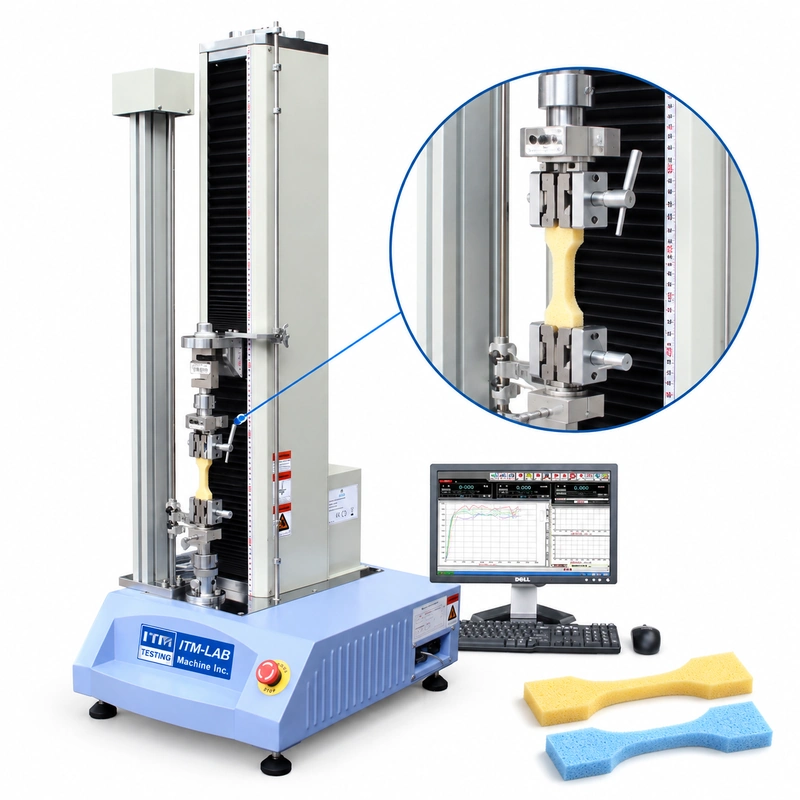
Flexible polyurethane foam is used in automotive seating, mattresses, furniture, and industrial cushioning. These materials are designed to deform, but they must also withstand tensile forces during manufacturing, assembly, and service.
Measuring their tensile properties is not always straightforward. A poorly cut specimen, excessive gripping pressure, or incorrect elongation measurement can affect the result before the material's actual tensile behavior is established.
ISO 1798:2008 specifies a method for determining the tensile strength and elongation at break of flexible cellular polymeric materials. The method uses a prepared specimen extended at a controlled rate until rupture.
This guide covers the key test requirements, specimen preparation, test procedure, common errors, and how to select a suitable foam tensile testing machine.
ISO 1798 Test Requirements at a Glance
ISO 1798:2008 is intended for flexible cellular polymeric materials, including suitable flexible polyurethane foams.
The test determines two material properties: tensile strength and elongation at break.
| Test Parameter | ISO 1798:2008 Requirement |
|---|---|
| Test method | Tensile testing to specimen rupture |
| Specimen type | Type 1 or Type 1A dumbbell specimen |
| Specimen thickness | 10–15 mm |
| Test speed | 500 ± 50 mm/min |
| Force measurement | Class 0.5 or Class 1 under ISO 7500-1:2004, over the loading range used |
| Valid results | Normally five specimens breaking within the marked gauge length |
| Standard conditioning | At least 16 hours under one of the specified temperature/humidity atmospheres |
| Test results | Tensile strength (kPa) and elongation at break (%) |
The applicable standard edition and any customer-specific test requirements should be confirmed before testing.
Source: ISO 1798:2008, Clauses 4–7. See Standards and Technical References below.
What Does ISO 1798 Measure?
Tensile Strength
Tensile strength describes the maximum tensile force sustained by a foam specimen relative to its original cross-sectional area.
The result is calculated using the maximum recorded force and the specimen's initial cross-sectional area.
Tensile strength (kPa) = Maximum force (N) × 1,000 / Original cross-sectional area (mm²)
For example, if a specimen has an initial cross-sectional area of 130 mm² and reaches a maximum force of 20 N:
Tensile strength = 20 × 1,000 / 130 = 153.8 kPa
This is an illustrative calculation, not an actual test result.
Tensile strength is useful for comparing foam formulations, monitoring production consistency, and investigating material failures.
Elongation at Break
Elongation at break measures the increase in the defined gauge length immediately before the specimen ruptures.
Elongation at break (%) = [(Gauge length at break − Original gauge length) / Original gauge length] × 100
If a specimen has an initial gauge length of 40 mm and reaches 120 mm immediately before rupture, the calculated elongation at break is 200%.
A foam may have relatively low tensile strength but still extend considerably before breaking.
For this reason, tensile strength and elongation at break should be evaluated together.
Which Foam Materials Can Be Tested?
Typical applications include flexible polyurethane foam used in:
-
Automotive seating and interior cushioning
-
Mattresses and upholstered furniture
-
Flexible packaging and protective cushioning
-
Industrial foam components
-
Other flexible cellular polymeric products
ISO 1798 should not automatically be used for rigid cellular plastics or solid rubber. These materials may require other test methods, such as ISO 1926 for rigid cellular plastics or ISO 37 for vulcanized and thermoplastic rubber.
ISO 1798 Specimens: Shape, Preparation and Conditioning
Specimen preparation is a major source of variation in flexible foam tensile testing.
Unlike solid plastic specimens, flexible foam can be compressed or damaged during cutting, handling, and gripping. Small defects along the specimen edge may become the location of premature fracture.
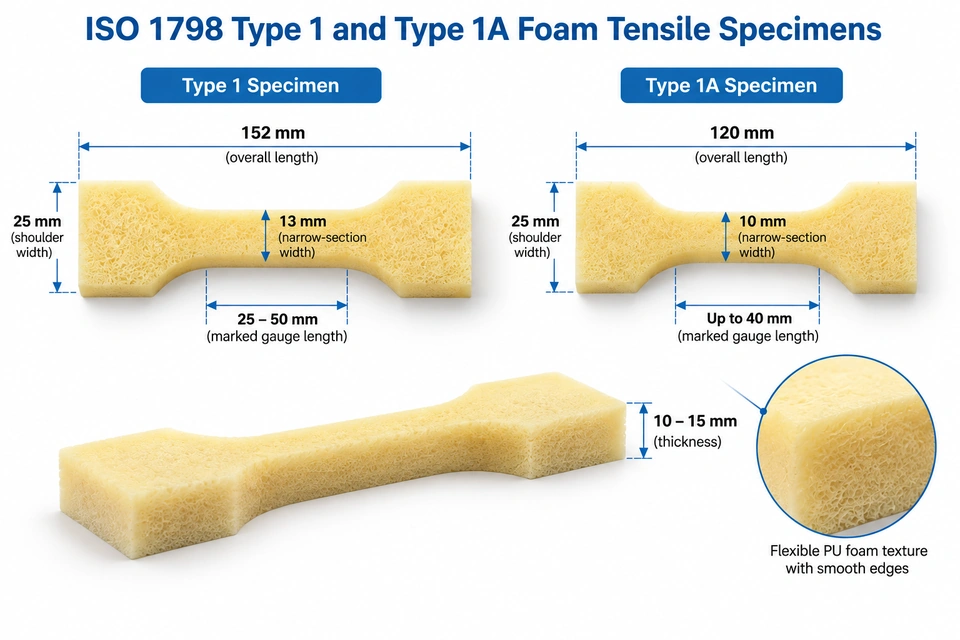
Type 1 and Type 1A Specimens
ISO 1798:2008 specifies two dumbbell-shaped specimen configurations.
| Dimension | Type 1 | Type 1A |
|---|---|---|
| Overall length | 152 mm | 120 mm |
| Shoulder width | 25 mm | 25 mm |
| Narrow-section width | 13 mm | 10 mm |
| Thickness | 10–15 mm | 10–15 mm |
| Marked gauge length | 25–50 mm | Up to 40 mm |
The dimensions refer to the specified cutting geometry and specimen preparation requirements. Laboratories should consult the official standard drawing for the complete cutter profile, radii, and tolerances.
Cutting Quality and Sampling Direction
The specimen edges should be smooth and free from visible damage.
A blunt cutting tool may compress the foam or produce small tears along the narrow section. These defects can create local stress concentrations and cause the specimen to break prematurely.
Cell orientation can also affect tensile behavior.
Where a predominant cellular orientation exists, ISO 1798 specifies the sampling direction relative to that orientation. If the required orientation cannot be achieved, the actual direction must be reported.
For comparative testing, specimens should be prepared consistently from one material batch to another.
Conditioning Before Testing
Under the standard procedure, materials are generally not tested until at least 72 hours after manufacture, subject to the exceptions specified in ISO 1798.
Before testing, specimens or the material from which they are cut are normally conditioned for at least 16 hours in one of the following atmospheres:
-
23 ± 2°C and 50 ± 5% relative humidity
-
27 ± 2°C and 65 ± 5% relative humidity
ISO 1798 also provides specific provisions for earlier testing and quality-control applications. These exceptions should not be treated as the default procedure.
The test itself should be conducted under the same temperature and humidity conditions used for conditioning.
Source: ISO 1798:2008, Clauses 5.1–5.4 and 6.4.
How to Perform an ISO 1798 Foam Tensile Test
A reliable test begins with the specimen and the required measurement method, not simply with pressing the start button.
Step 1 — Prepare and Inspect the Specimens
Prepare Type 1 or Type 1A specimens using the appropriate cutting tool.
Check for visible defects, irregular edges, and damage caused during specimen removal.
Prepare enough specimens to obtain the required number of valid results. Under the normal ISO 1798 procedure, testing continues until five satisfactory breaks within the gauge length have been obtained, unless otherwise agreed.
Step 2 — Measure Thickness and Mark the Gauge Length
After conditioning, determine specimen thickness in accordance with the standard and the referenced dimensional measurement method.
ISO 1798 requires thickness measurements at five evenly distributed locations in the relevant material area, with specified limits on variation.
Mark the original gauge length using two reference lines.
The distance between these lines must be determined accurately because it is used to calculate elongation at break.
Step 3 — Install the Specimen in the Grips
Position the specimen symmetrically so that the tensile force is distributed as uniformly as possible across its cross-section.
The grips must prevent slipping without damaging the foam.
Avoid twisting the specimen or creating uneven tension between the two sides.
The standard permits a limited preload, but this should be applied according to the specified procedure and accounted for when establishing the elongation measurement reference.
Step 4 — Set the Test Speed
Set the machine to the required jaw-separation rate:
500 ± 50 mm/min
Confirm that the selected equipment configuration can maintain the required speed under the intended test conditions.
Step 5 — Extend the Specimen Until Rupture
Start the test and record the maximum tensile force.
Determine the gauge length immediately before rupture using a measurement method that satisfies the applicable requirements.
Observe the specimen during testing, especially for visible slipping, abnormal deformation, or failure near the grips.
Step 6 — Check Result Validity
A specimen that breaks outside the defined gauge length must be rejected under the ISO 1798 procedure.
Continue testing until the required number of satisfactory results has been obtained.
Do not automatically accept every force curve simply because the machine recorded a maximum force.
Step 7 — Calculate and Report the Results
Calculate tensile strength and elongation at break for each valid specimen.
For the standard test report, ISO 1798 specifies reporting requirements that include the median tensile strength and median elongation-at-break results, along with relevant material, specimen, and test-condition information.
If customers also require averages, standard deviations, or individual force-extension curves, these can be included as supplementary information.
Source: ISO 1798:2008, Clauses 6–8.
Common Foam Tensile Testing Errors and How to Identify Them
Flexible foam tensile testing can produce inconsistent results even when the testing machine operates normally.
The following problems should be investigated before attributing unexpected results to the material itself.
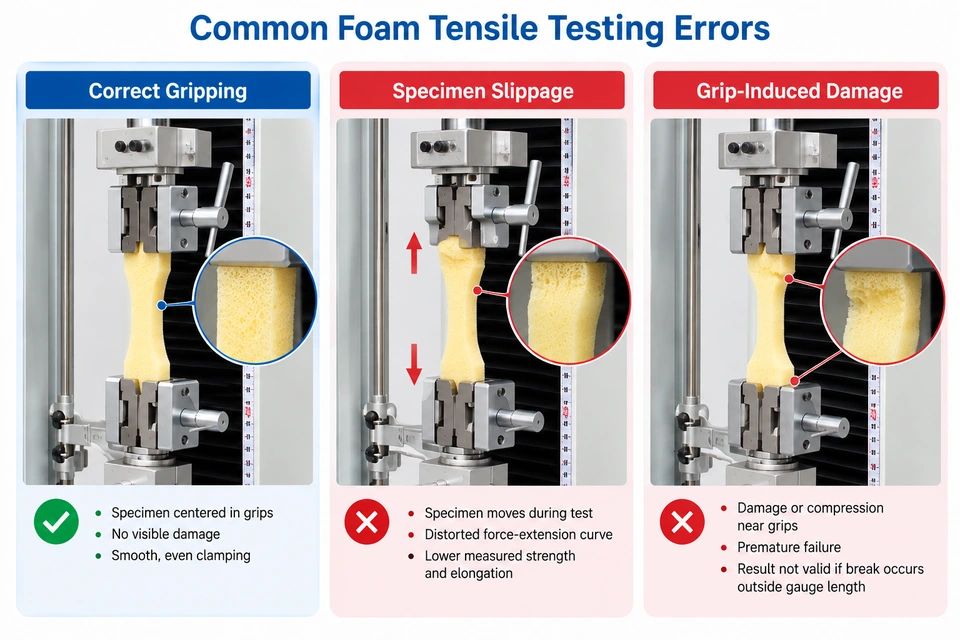
Specimen Slippage
If the grips do not hold the foam securely, the specimen may move during loading.
This can distort the measured relationship between force and extension, particularly when machine movement is used as part of the elongation measurement.
What to check: Grip surfaces, clamping pressure, specimen positioning, and any visible movement at the grip boundaries.
Increasing clamping force is not always the correct solution because excessive pressure can damage the material.
Premature Breakage Near the Grips
Failure near the gripping region may indicate localized stress concentration, uneven loading, or damage from the grip surfaces.
What to check: Grip alignment, contact area, jaw edges, specimen condition, and clamping arrangement.
Under ISO 1798, a specimen that breaks outside the marked gauge length is not accepted as a satisfactory result.
Incorrect Elongation Measurement
The movement of the machine crosshead does not necessarily equal the change in the specimen's marked gauge length.
Grip movement, specimen slippage, and machine compliance may affect the relationship between these measurements.
ISO 1798 requires the relevant gauge lengths to be measured within specified accuracy limits. Mechanical or optical extensometers may be used where appropriate, provided they meet the applicable requirements.
The measurement method should be selected according to the standard, the foam's expected elongation, and the physical characteristics of the specimen.
Excessive Variation Between Specimens
Large differences between results may arise from specimen thickness, cutting quality, cell orientation, conditioning, or fixture setup.
A practical troubleshooting sequence is:
-
Inspect the specimen edges and fracture locations.
-
Check specimen dimensions and sampling direction.
-
Confirm grip alignment and look for slippage.
-
Verify conditioning and test speed.
-
Review the force and elongation measurements.
Only after these factors have been assessed should the variation be interpreted primarily as a material property.
How to Select a Foam Tensile Testing Machine
A suitable foam tensile tester must provide the required test speed and reliable force measurement, while accommodating the specimen's gripping and extension requirements.
Select the Load Cell Around the Expected Force
Flexible foam specimens often produce relatively low tensile forces.
Selecting a machine only by its maximum load capacity can leave the actual testing force outside the most appropriate measurement range.
The selected load cell should provide suitable accuracy over the forces expected during the test.
For ISO 1798:2008, the force-measuring system must meet the specified ISO 7500-1 accuracy class over the loading range used.
Confirm the Required Speed
ISO 1798 uses a nominal jaw-separation rate of 500 mm/min.
The machine's rated maximum speed should be checked together with its actual configuration and the required operating conditions.
Choose Grips for Soft, Compressible Specimens
The grips must secure the specimen without causing damage or excessive compression.
Mechanical or pneumatic grips may be considered depending on specimen geometry and material characteristics.
The appropriate grip design should be confirmed using the actual foam specimen whenever possible.
Check Available Travel and Elongation Measurement
Flexible foam may extend substantially before rupture.
The machine must provide sufficient usable travel after the grips are installed.
The elongation measurement system must also accommodate the expected deformation while meeting the applicable accuracy requirements.
These considerations should be evaluated together, rather than treating stroke length and measurement range as unrelated specifications.
ITM-LAB RS-8010A for Flexible Foam Tensile Testing
The ITM-LAB RS-8010A is a servo-controlled universal testing machine for low-force mechanical testing applications.
Its available load configurations and test speed range make it a candidate for flexible foam tensile testing, subject to verification of the selected load cell, grips, elongation measurement method, and complete test setup.
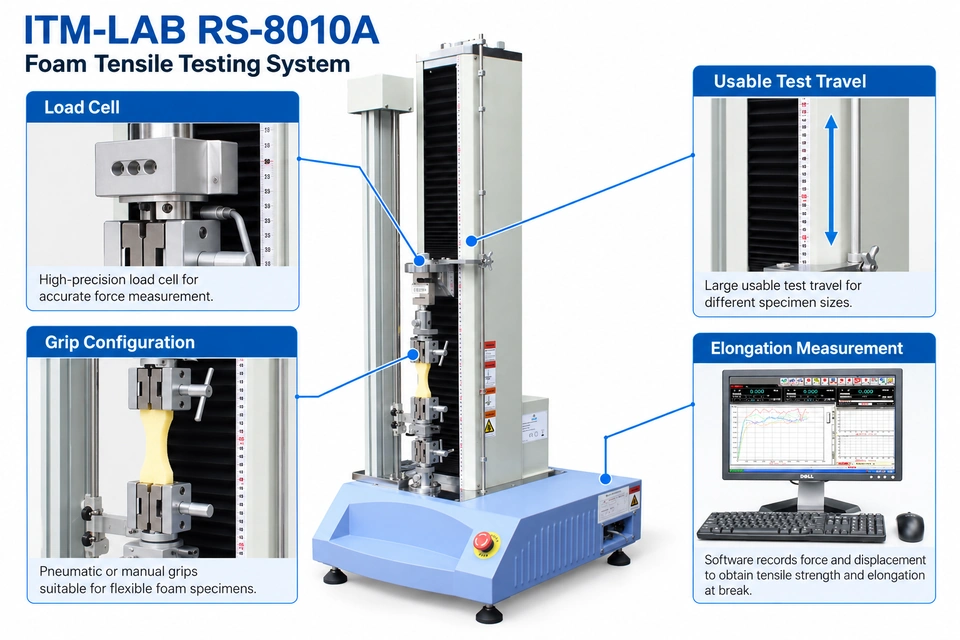
Relevant Equipment Specifications
| Parameter | RS-8010A |
|---|---|
| Equipment type | Servo-controlled universal testing machine |
| Available force capacities | 50 N–5 kN |
| Accuracy specification | ±0.25%, subject to the verified measurement range |
| Test speed range | 0.001–500 mm/min |
| Stroke configurations | 650 / 1000 mm |
| Foam tensile grips | Selected according to the specimen |
| Elongation measurement | Configuration to be confirmed for the test method |
The nominal test speed of ISO 1798 falls within the stated RS-8010A speed range.
However, machine specifications alone do not establish full compliance with ISO 1798. The force-measuring system, fixture arrangement, test speed performance, and elongation measurement method must be verified for the proposed configuration.
Example: Configuring a System for Flexible PU Foam
Consider a laboratory that needs to test flexible polyurethane foam using ISO 1798:2008.
Before recommending a machine configuration, the following questions should be answered:
What specimen will be tested?
Confirm Type 1 or Type 1A, thickness, sampling direction, and expected material behavior.
What tensile force is expected?
Use available material data or preliminary testing information to select an appropriate load cell.
How will the specimen be gripped?
Review specimen thickness, compressibility, and grip contact requirements to minimize slipping and damage.
How much extension is expected?
Check the usable machine travel and determine how the gauge length will be measured before rupture.
What documentation is required?
Confirm the standard edition, calibration requirements, test report format, and any customer-specific acceptance criteria.
This is an example of the equipment selection process, not a report of a completed customer test.
The objective is to define the testing requirements first and then configure the machine accordingly.
Frequently Asked Questions
What is ISO 1798 used for?
ISO 1798 specifies a tensile test method for determining tensile strength and elongation at break of flexible cellular polymeric materials, including suitable flexible polyurethane foams.
What is the tensile test speed for ISO 1798?
ISO 1798:2008 specifies a jaw-separation rate of 500 ± 50 mm/min.
How many specimens are required for ISO 1798?
Unless otherwise agreed, enough specimens must be tested to obtain five satisfactory results in which rupture occurs within the marked gauge length.
Can a universal testing machine perform ISO 1798 testing?
Yes, provided the complete machine configuration satisfies the applicable requirements for force measurement, test speed, gripping, specimen extension, and elongation measurement.
Is ISO 1798 the same as ASTM D3574 Test E?
No. Both address tensile properties of flexible foam, but their technical requirements differ. Results obtained using the two methods should not be assumed to be directly interchangeable.
Configure Your Foam Tensile Testing System with ITM-LAB
Reliable foam tensile testing depends on the interaction between the specimen, grips, load cell, machine movement, and elongation measurement method.
For ISO 1798 applications, selecting the right equipment begins with the test requirements rather than the machine's maximum capacity.
ITM-LAB can review your flexible foam material, specimen dimensions, expected tensile force, and required test procedure to help identify a suitable RS-8010A configuration.
Planning a flexible foam tensile testing project?
Send us your specimen photo or drawing, applicable standard, expected force range, and elongation measurement requirements.
Our team can review the proposed machine and fixture configuration before quotation.
