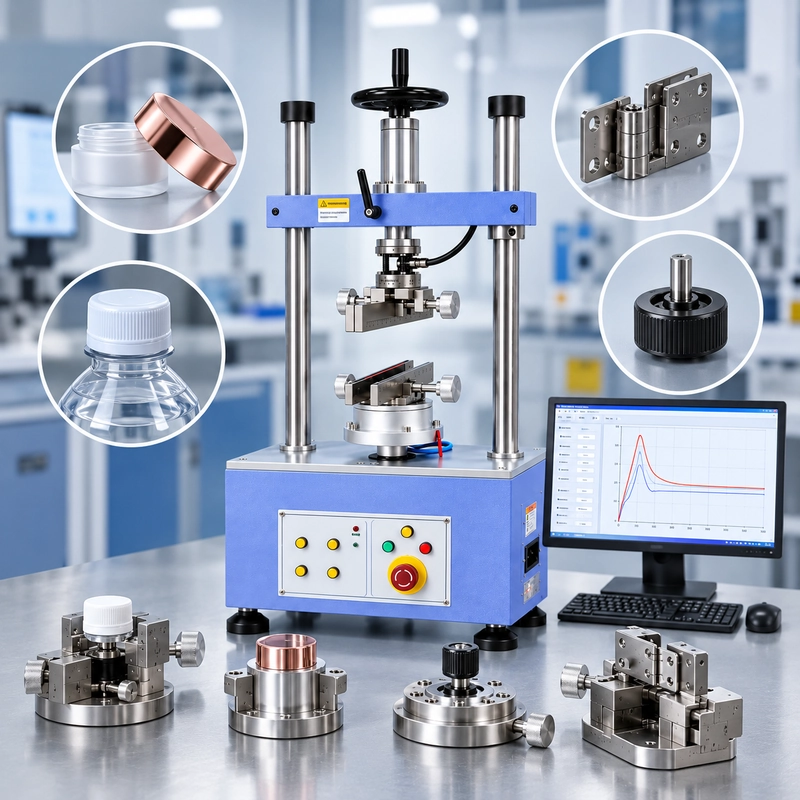
A 50 N·m torque sensor can technically measure 0.5 N·m.
That does not mean it is the right sensor for the job.
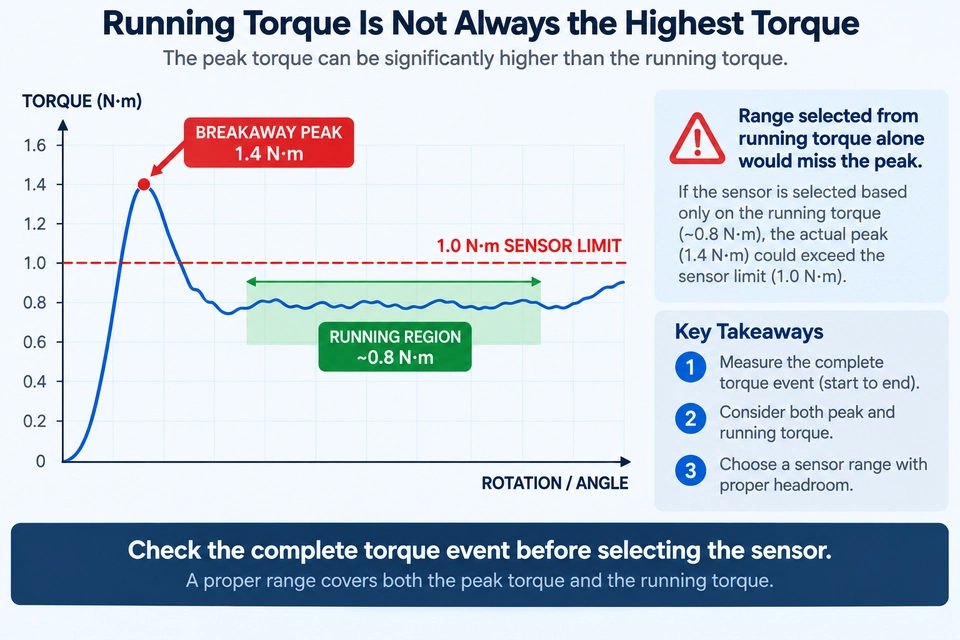
The same is true at the other end of the scale. If your product normally runs around 0.8 N·m, choosing a 1 N·m sensor may look efficient—until the same product produces a 1.3 N·m breakaway peak.
This is why torque tester range selection should not start with the largest capacity available or the nominal torque printed on a drawing.
It should start with the real mechanical event.
Where does the normal torque sit inside the sensor range? What is the highest torque the test must capture? How much headroom is needed for variation or transient peaks? And what do the sensor's accuracy and resolution specifications actually mean at that point?
Those questions matter more than one maximum N·m number.
Maximum capacity is not the same as useful measurement range.
What Torque Range Actually Means
A sensor rated:
0–5 N·m
has a full-scale capacity of 5 N·m.
That tells you the nominal span of the sensor.
It does not tell you that every torque between zero and 5 N·m will be equally useful for your test.
That distinction matters because range is only one part of measurement performance.
A torque sensor also has specifications for accuracy, resolution, repeatability, calibration, and overload behavior. The measurement system may also introduce its own display or acquisition limits.
So when one sensor is rated 2 N·m and another 20 N·m, the question is not simply:
Which one can cover the torque?
Both may.
The better question is:
Which one measures the torque event at the performance level the test actually requires?
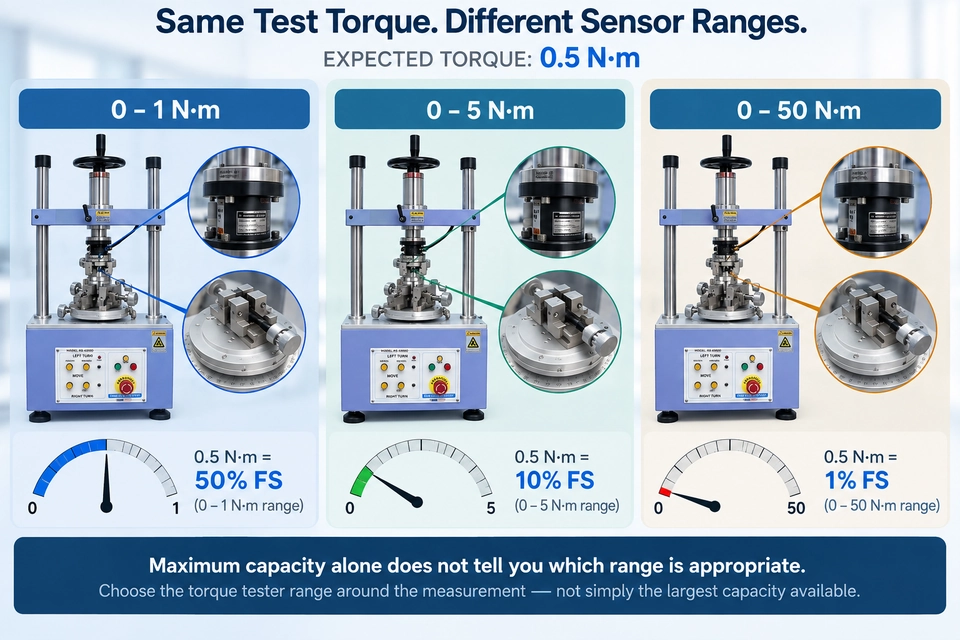
Consider an expected test value of 0.5 N·m.
On a 1 N·m sensor, that is half of full scale.
On a 5 N·m sensor, it is one-tenth.
On a 50 N·m sensor, it is one-hundredth.
The 50 N·m sensor has the most capacity.
That does not automatically give it the best low-torque measurement suitability.
At the same time, choosing a sensor with almost no headroom above 0.5 N·m may create a different problem.
The useful range has to sit between those two extremes.
Start With the Real Torque Event
A nominal torque value is only a starting point.
Before selecting a torque sensor range, define what the product actually does during the test.
A bottle closure may have a typical removal torque around 0.6 N·m.
A hinge may run at 0.4 N·m but show a higher breakaway event at the start of motion.
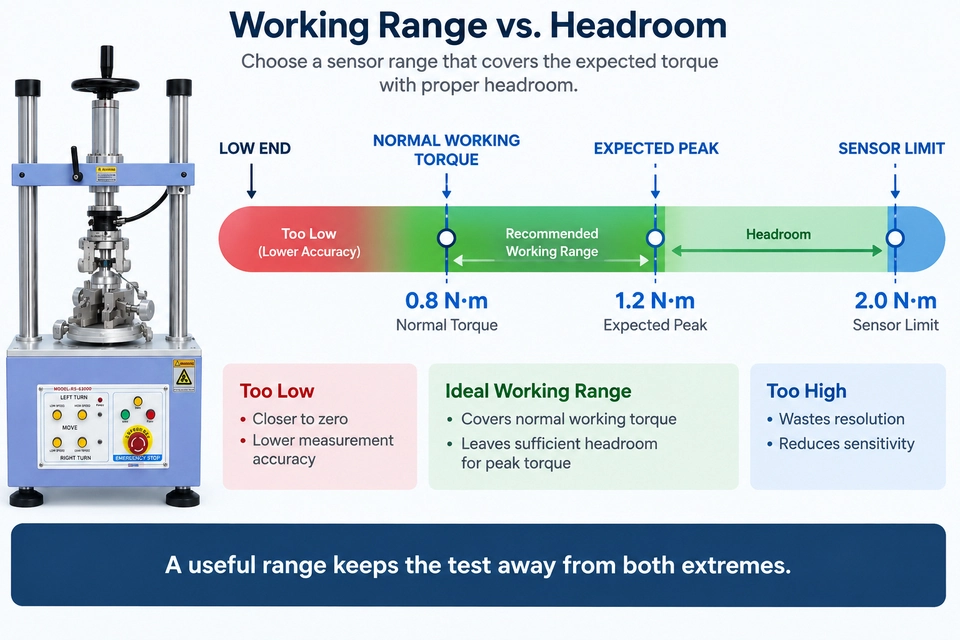
A rotary component may settle around 0.8 N·m after an initial peak of 1.2 N·m.
Those differences matter because the sensor has to capture the event you care about—not just the number that is easiest to quote.
For range selection, ask:
- What is the normal working torque?
- What is the highest expected torque?
- Is there a breakaway or transient peak?
- How much sample-to-sample variation exists?
- Is the upper pass/fail limit higher than the normal value?
- Does torque differ between CW and CCW?
- Does the value change after ageing, cycling, or conditioning?
This is the point where many range-selection errors begin.
A customer may report:
“Our torque is about 0.8 N·m.”
But what does 0.8 N·m actually mean?
Running torque?
Average torque?
Peak torque?
A target application torque?
If the test includes a 1.4 N·m breakaway peak, that peak—not the 0.8 N·m running value—may determine the required sensor capacity.
Select for the highest torque event that must actually be measured.
Why Peak Torque and Headroom Matter
A torque test rarely behaves like a perfectly steady value.
A closure can produce an initial removal peak.
A hinge can show breakaway torque before entering a more stable running region.
A knob, shaft, threaded part, or connector can do the same.
Consider:
Running torque: 0.8 N·m
Breakaway peak: 1.4 N·m
If range selection is based only on 0.8 N·m, a 1 N·m sensor might appear reasonable.
But if the test must capture the full event, it is already too small.
The curve would exceed the sensor range before the running region even begins.
That can lead to over-range data, clipped peaks, or unnecessary overload risk depending on the system.
So headroom needs to cover more than the nominal test value.
It should account for sample variation, breakaway events, transient peaks, process variation, and any upper limit the test is expected to capture.
That does not mean using a universal rule such as:
“Always add 20%.”
or:
“Always double the nominal torque.”
Those shortcuts ignore how different products and sensors behave.
A useful margin should come from the actual test.
Accuracy, Resolution and Full Scale Have to Be Read Together
Once the expected torque and peak are known, the next question is not simply:
“Which sensor has enough capacity?”
It is:
“How well does the sensor measure where my test actually occurs?”
This is where the accuracy specification matters.
A number such as:
±0.5%
is not enough by itself.
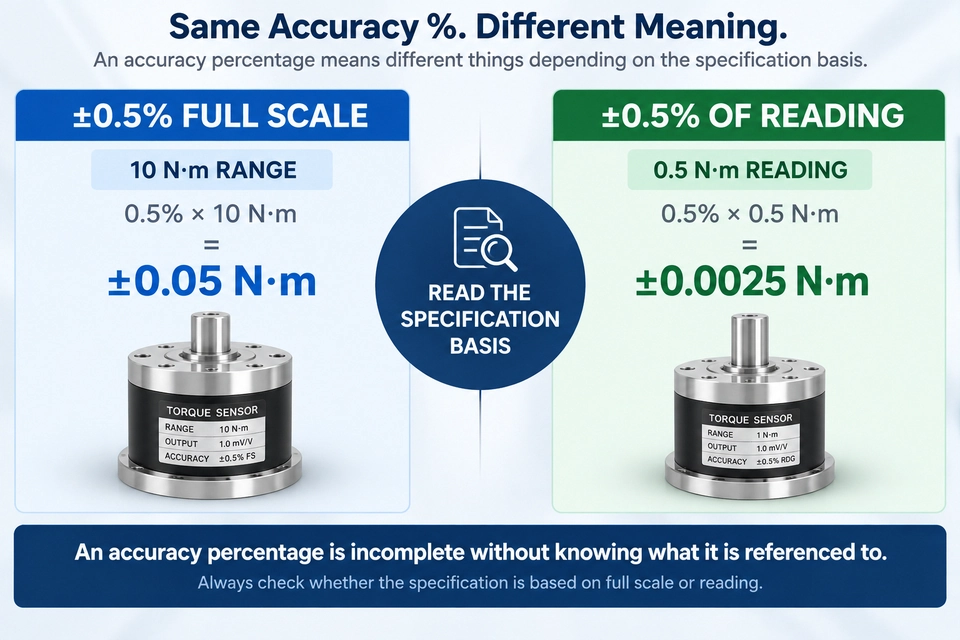
Two sensors can both say ±0.5% and still behave very differently at the same test torque.
The first question is:
0.5% of what?
Common specification formats include:
±% of Full Scale
and
±% of Reading
These are not interchangeable.
Consider a purely illustrative example.
A sensor has:
Range: 0–10 N·m
Accuracy: ±0.5% FS
Then:
0.5% × 10 N·m = 0.05 N·m
Now imagine using that sensor for a 0.2 N·m measurement.
The full-scale-based contribution of 0.05 N·m is large relative to the actual torque being measured.
By comparison, an illustrative:
±0.5% of reading
at:
0.5 N·m
corresponds to:
±0.0025 N·m
These are illustrative calculations, not specifications for a particular ITM-LAB torque sensor. They show why a percentage cannot be interpreted without its reference basis.
An accuracy percentage is incomplete until you know what it is referenced to.
Resolution adds another part of the picture.
If you want to distinguish:
0.42 N·m
from:
0.45 N·m
the system needs enough resolution to show a meaningful difference at that scale.
But resolution is not the same as accuracy.
A display can show many decimal places without making every digit accurate.
That is why torque sensor selection should consider range, accuracy basis, resolution, and repeatability together.
A Practical Torque Range Selection Example
Now put those ideas together.
Assume a customer needs to test a bottle closure.
The available information is:
Typical removal torque: 0.6 N·m
Highest observed normal torque: 0.9 N·m
Possible transient peak: 1.1 N·m
Required result: Peak removal torque + torque curve
Three sensor ranges are being considered.
0–1 N·m
At first glance, this looks close to the application.
The typical value of 0.6 N·m sits comfortably inside the range.
But the possible 1.1 N·m peak exceeds full scale.
If that peak must be measured, this range is too small.
0–2 N·m
The typical 0.6 N·m value sits at 30% of full scale.
The possible 1.1 N·m peak sits at 55%.
There is useful headroom above the expected event without making the sensor excessively large.
From a range perspective, this is the stronger candidate.
0–10 N·m
This sensor easily covers the test.
The typical 0.6 N·m value, however, occupies only 6% of full scale.
That does not automatically make the sensor unsuitable.
But it does mean the buyer should check how the actual accuracy, resolution, and repeatability specifications perform around 0.6–1.1 N·m.
This is the key distinction:
Capacity confirms that the sensor can cover the event. Measurement specifications confirm whether it is appropriate for the event.
Based on range alone, the 0–2 N·m option would be the stronger candidate.
Final selection still depends on the actual sensor specification, test method, fixture, motion, and data requirements.
What Happens When the Range Is Poorly Matched?
A range that is too large and a range that is too small create different problems.
| Range Too Large | Range Too Small |
|---|---|
| Test torque occupies a small part of full scale | Peak torque can exceed capacity |
| Resolution may become more important | Data may clip or go over-range |
| Small changes may be harder to distinguish | Overload risk increases |
| Much of the rated capacity is unused | Full torque event may not be captured |
That leads to a more useful selection principle:
Choose the smallest appropriate range that still provides enough headroom for the complete event.
The word appropriate matters.
It prevents range selection from becoming a race toward the smallest possible sensor.
When One Torque Range Is Not Enough
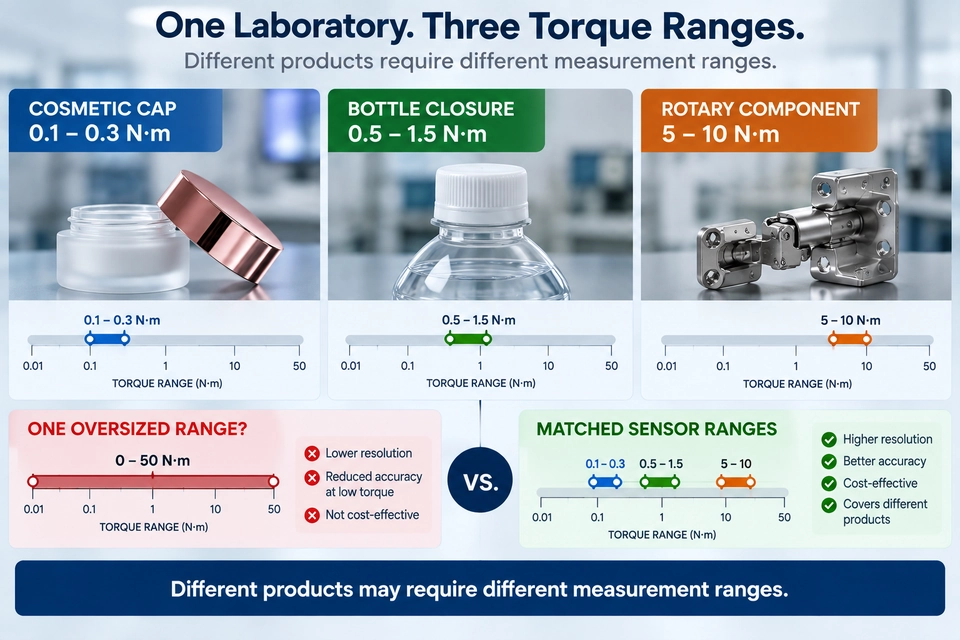
Some laboratories do not have one torque application.
They have many.
For example:
Cosmetic closure: 0.1–0.3 N·m
Beverage closure: 0.5–1.5 N·m
Rotary component: 5–10 N·m
One large sensor could theoretically cover all three.
But that does not automatically make it the best measurement solution for the low-torque products.
Depending on the test system, the better approach may involve interchangeable sensors, multiple measurement ranges, different tester configurations, or dedicated systems for very different torque classes.
This is especially important when the low-torque result is not simply a pass/fail number but a small change that needs to be compared accurately.
One oversized sensor may simplify purchasing.
It may not simplify measurement.
Range Is Only One Part of the Test System
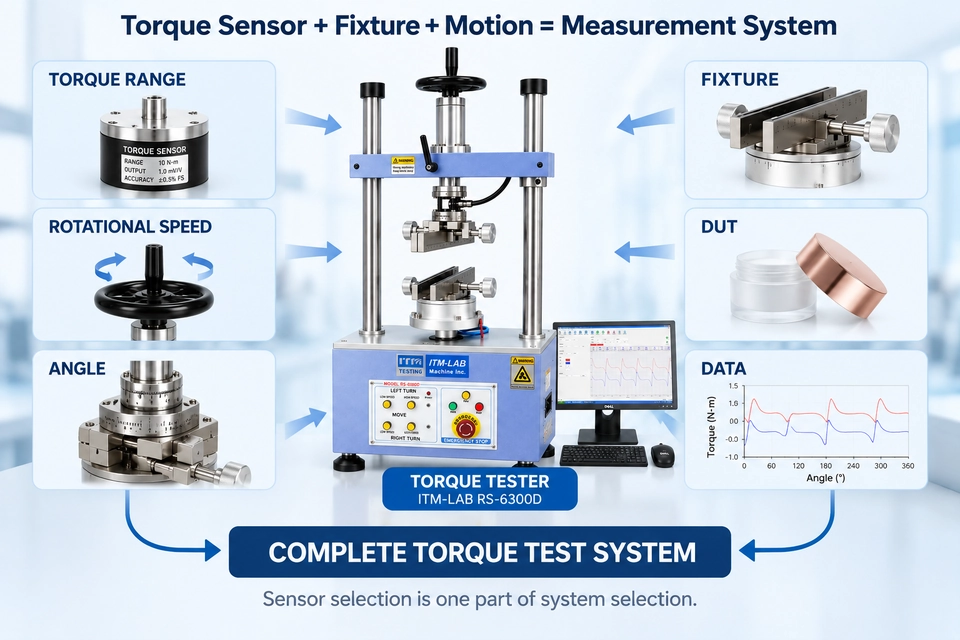
Once the sensor range is right, the next question is whether the machine can reproduce the required motion and hold the DUT correctly.
A good range does not fix a bad fixture.
It does not create the correct rotational speed.
It does not guarantee the required angle or direction.
And it does not tell you whether the system can record the torque curve you actually need.
The complete configuration still has to account for rotational speed, angle, CW/CCW direction, fixture design, DUT dimensions, torque-angle acquisition, and durability requirements.
For example, a 2 N·m sensor might be an excellent match for the torque.
But if the fixture slips on the bottle cap, the test is still wrong.
The same applies to hinge or rotary-component testing.
A correctly sized sensor on the wrong fixture is still the wrong test system.
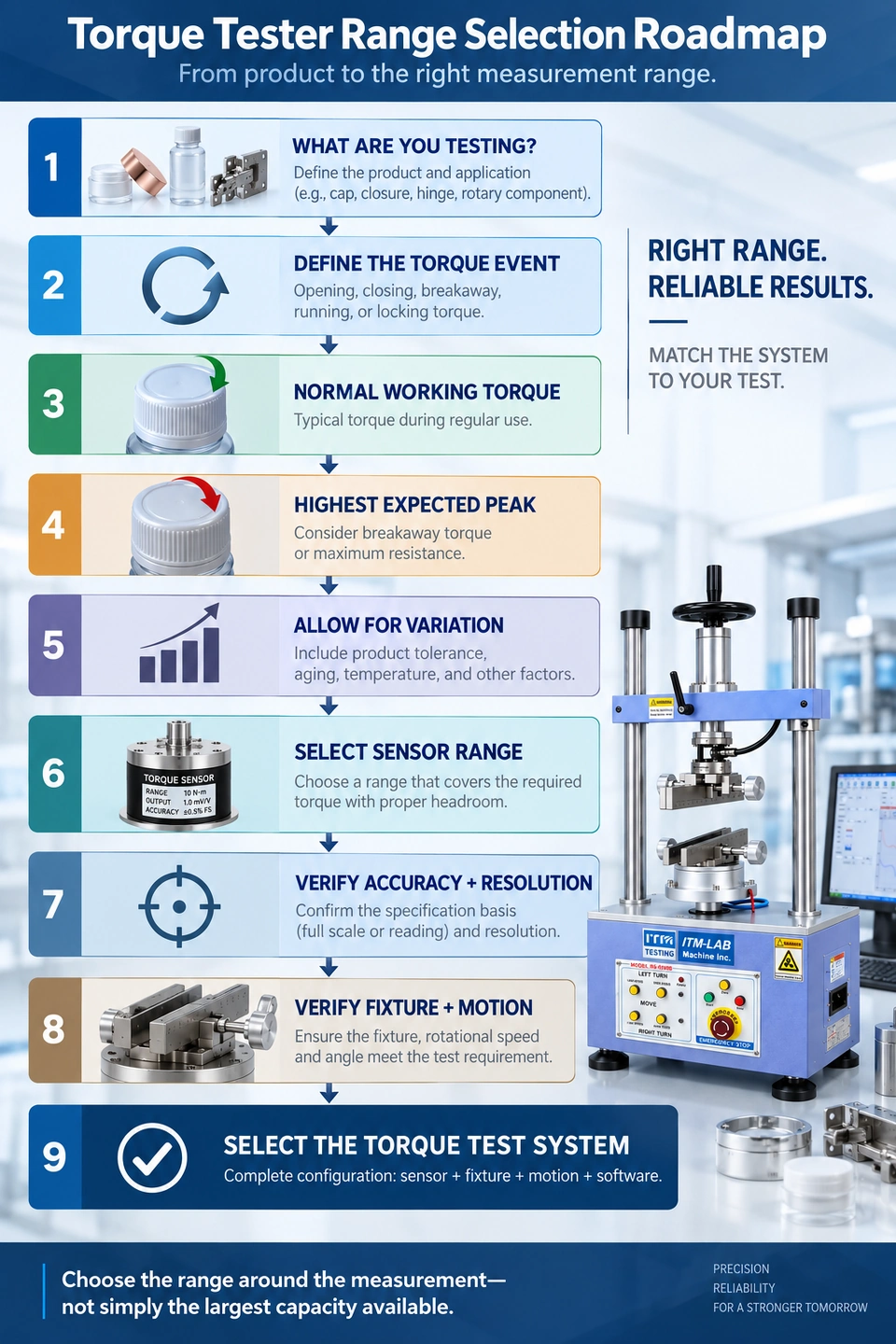
Torque Tester Range Selection Roadmap
A practical selection sequence can be kept simple.
Start with the product.
Then define the torque event.
Only after that should the sensor range be selected.
What to Send Before Equipment Selection
A message that says:
“We need a 5 N·m torque tester.”
is useful, but it may be based on the wrong range assumption.
Before recommending a system, it is more helpful to know:
- DUT or product type
- normal expected torque
- highest observed torque
- peak, breakaway, or running torque
- CW / CCW requirement
- rotational angle
- rotational speed
- DUT dimensions
- fixture requirement
- peak only or torque-angle curve
- applicable standard or internal method
If the range is still uncertain, existing test data, torque curves, product drawings, photos, or representative samples can help define the real requirement.
The clearer the torque event is, the easier it is to match the sensor.
Frequently Asked Questions
What torque range should I choose for a 1 N·m test?
First determine what 1 N·m represents.
If it is the normal operating torque but the product can produce a 1.4 N·m breakaway peak, a 1 N·m sensor would be too small for the complete event.
The correct range should cover the highest torque that must be measured while still providing suitable measurement performance around the normal working value.
Should I choose the smallest torque sensor possible?
No.
A smaller range can make better use of full scale, but the sensor still needs enough headroom for real product variation and peak torque.
The goal is the smallest appropriate range, not simply the smallest number.
Is a higher-capacity torque tester more accurate?
Not necessarily.
Higher capacity means the system can cover a larger torque.
It does not automatically mean better performance at lower torque.
Accuracy basis, resolution, repeatability, calibration, and the actual working point inside the sensor range all matter.
What is the difference between torque range and torque resolution?
Torque range describes the span of torque the sensor is designed to measure.
Resolution describes how finely the measurement system can distinguish or display changes within that range.
Resolution does not by itself define accuracy.
Can one torque tester cover multiple torque ranges?
That depends on the test system.
Some systems can use different sensors or configurations. Others use a fixed measurement range.
If the laboratory tests products across very different torque levels, define the complete application range before choosing the system.
Final Thoughts
The highest N·m rating is not automatically the safest choice.
And the smallest sensor that covers the nominal value is not automatically the best choice either.
A useful torque tester range starts with the mechanical event.
What is the normal torque?
What is the highest peak?
How much product variation exists?
How much headroom is needed?
Then the sensor specification has to be read properly.
What does the accuracy percentage reference?
Is the resolution suitable?
Can the system actually distinguish the changes that matter?
Only after those questions are answered should the fixture, speed, angle, direction, and data requirements complete the system selection.
Four principles summarize the process:
Maximum capacity is not the same as useful measurement range.
Select for the highest torque event that must actually be measured.
Accuracy, resolution and full-scale range must be read together.
The best range is not the largest range available. It is the range that fits the test.
What to Send When Requesting a Torque Testing Solution
Instead of sending:
“We need a 5 N·m torque tester.”
send:
Product / DUT: _____
Normal Working Torque: _____ N·m
Highest Expected Torque: _____ N·m
Peak / Breakaway Torque: _____ N·m
Rotation Direction: CW / CCW / Both
Rotation Angle: _____ °
Rotational Speed: _____
DUT Dimensions: _____
Fixture Requirement: _____ / Recommend
Required Result: Peak Torque / Torque-Angle Curve / Both
Test Method / Standard: _____
Test Volume: _____ specimens / cycles per day
That information allows the supplier to configure:
Torque Range → Sensor → Fixture → Motion → Data → Machine
If the torque range is still uncertain, send an existing torque curve, product drawing, sample photo, or previous test data. The range can then be evaluated from the actual test requirement rather than selected from a nominal torque value alone.
