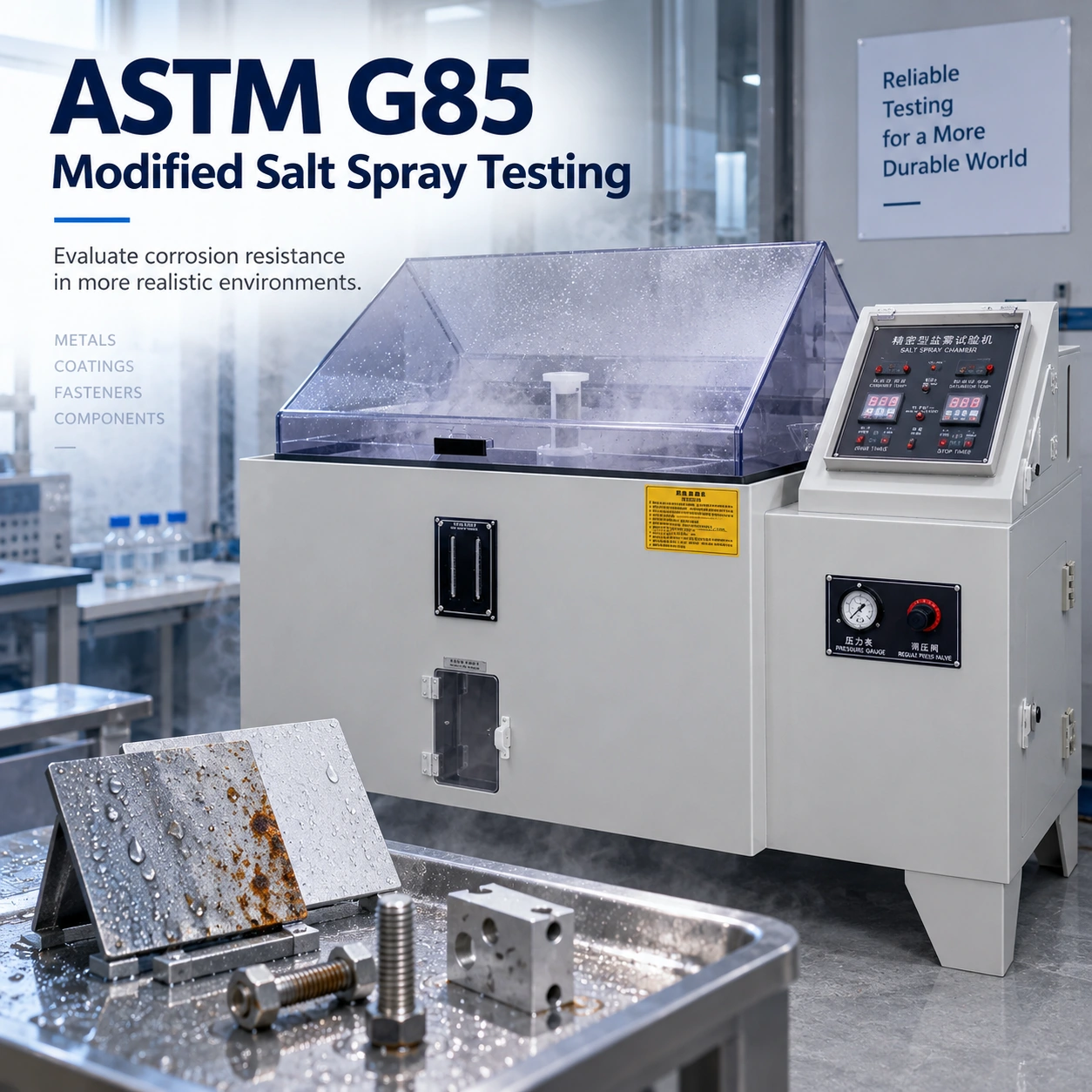
A salt spray chamber can generate fog. That does not automatically make it the right chamber for ASTM G85.
ASTM G85 covers five modified salt spray practices, and the differences between them are not minor. One uses continuous acidified salt fog. Others introduce cyclic exposure, synthetic seawater, sulfur dioxide, or repeated fog/dry conditions.
That changes the way the test should be specified—and the way the chamber should be selected.
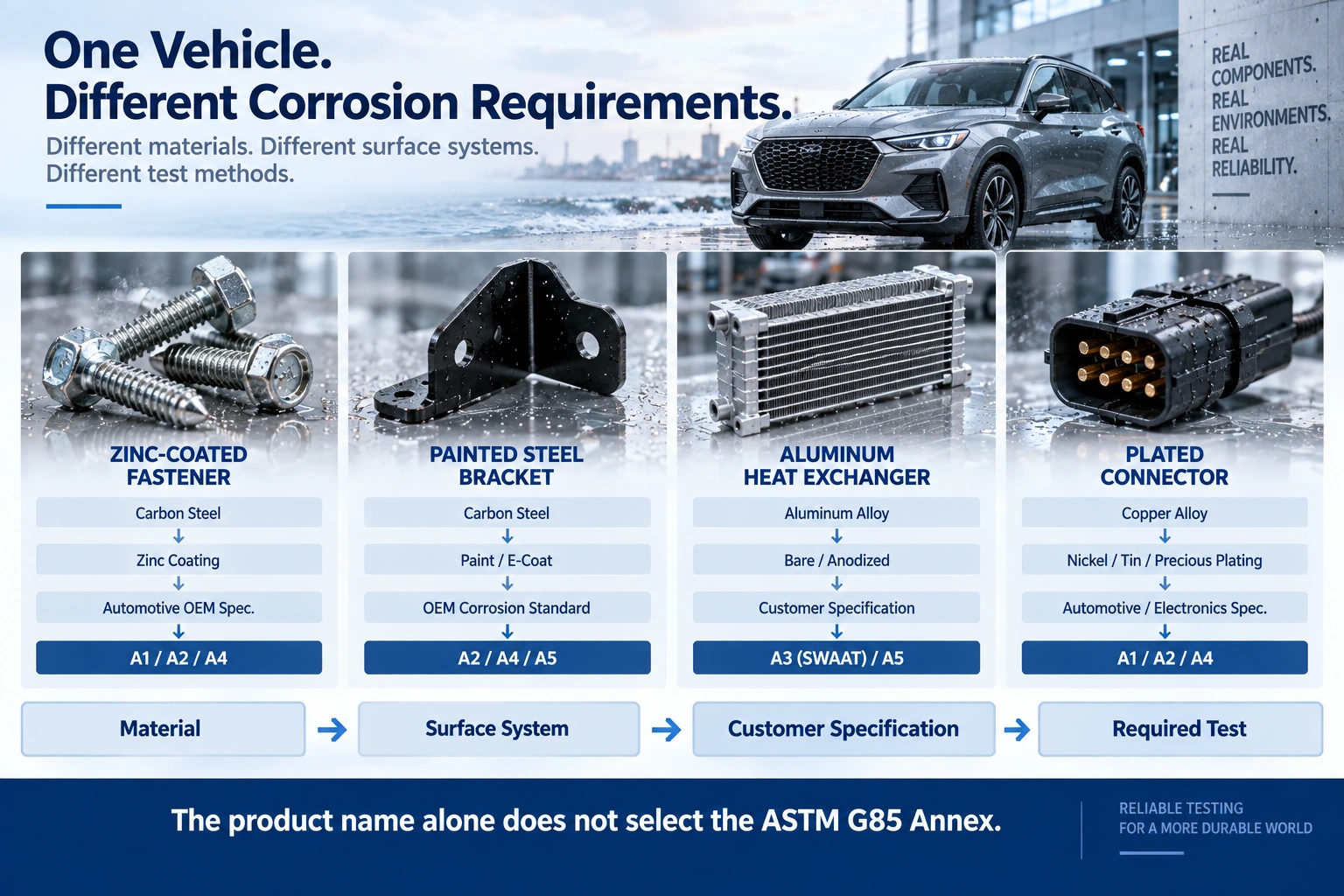
A zinc-coated fastener, an aluminum heat exchanger component and a painted steel bracket can all appear in the same automotive program, yet they may not belong under the same ASTM G85 Annex.
The better starting point is therefore not:
“Which salt spray chamber should we buy?”
It is:
“Which ASTM G85 method applies, what environment does it require, and what must the chamber actually control?”
This guide follows that decision in the order engineers usually need it:
standard → method → product → chamber configuration
What ASTM G85 Actually Covers
ASTM G85 is the Standard Practice for Modified Salt Spray (Fog) Testing.
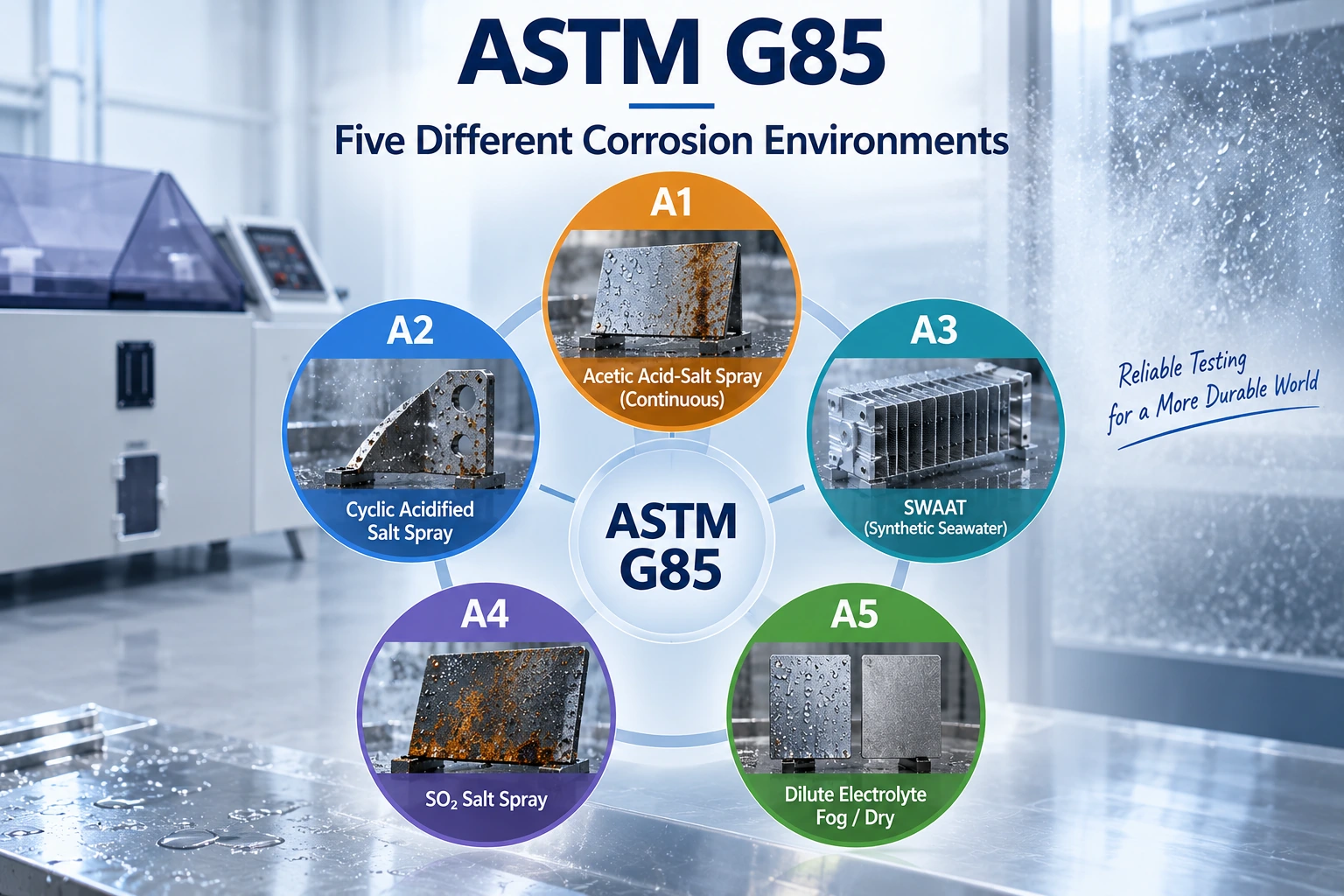
It applies to corrosion testing of ferrous and nonferrous metals, as well as organic and inorganic coatings. ASTM currently lists five separate modifications under Annex A1 through A5.
Those five methods are:
| Annex | Method | Exposure Character |
|---|---|---|
| A1 | Acetic Acid-Salt Spray | Continuous |
| A2 | Cyclic Acidified Salt Spray | Cyclic |
| A3 | Seawater Acidified Test (SWAAT) | Cyclic |
| A4 | SO₂ Salt Spray | Cyclic |
| A5 | Dilute Electrolyte Cyclic Fog/Dry | Cyclic fog/dry |
ASTM G85 is therefore best understood as a family of corrosion exposure practices, not one single salt spray test.
That distinction matters because chemistry and exposure sequence can both change the corrosion response.
A coating that performs well in one environment should not automatically be assumed to behave the same way in another.
ASTM G85 vs ASTM B117
The difference is often oversimplified as:
ASTM B117 = normal salt spray
ASTM G85 = harsher salt spray
That is not quite right.
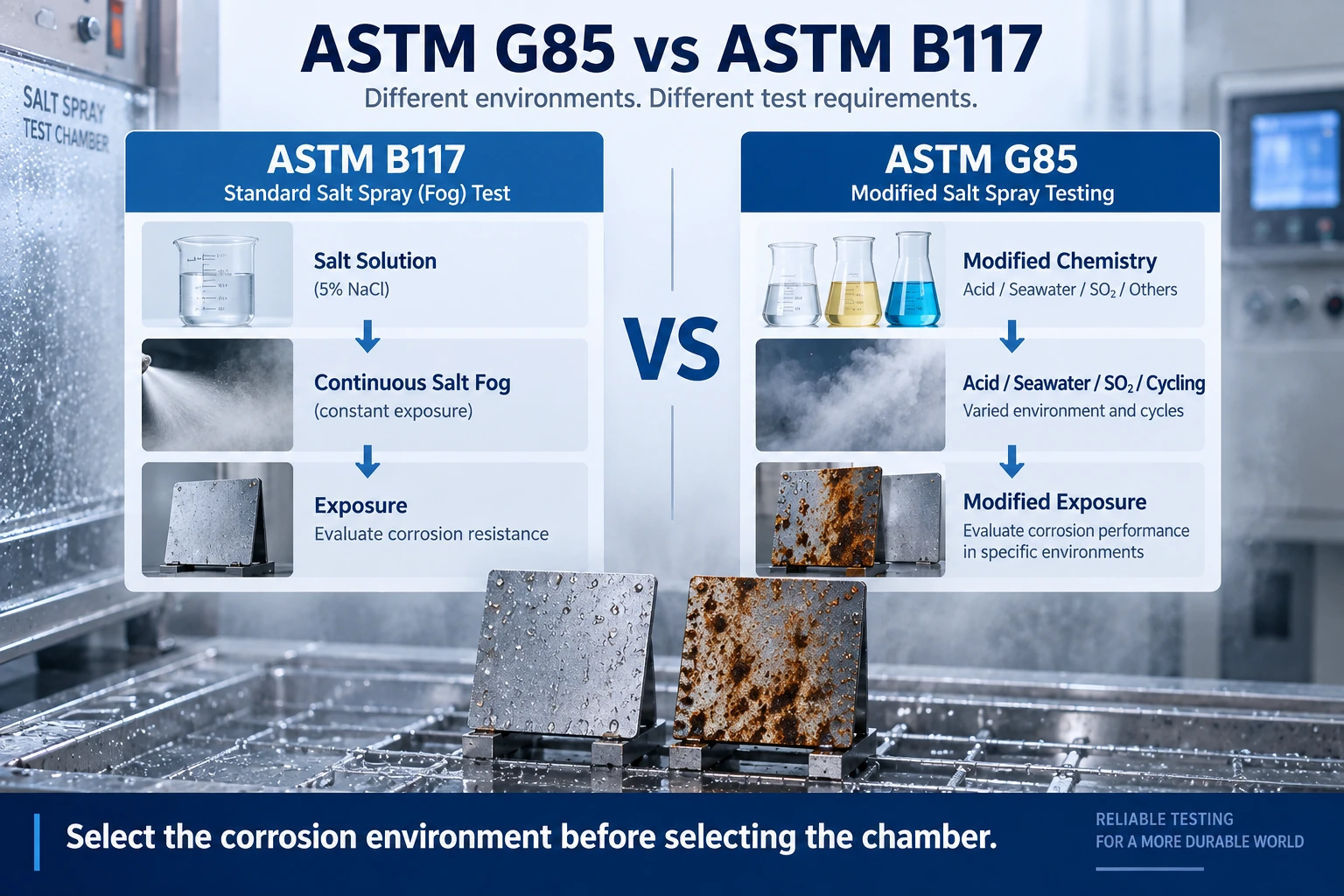
ASTM B117 is built around a controlled continuous salt fog environment. ASTM G85 modifies that environment through acidification, cyclic exposure, synthetic seawater, SO₂, dilute electrolyte, or combinations of those conditions. ASTM itself notes that G85 provides modifications for situations where an environment different from, or more corrosive than, the salt fog of B117 is desired.
That means the first engineering question should be:
What environment is the product supposed to see during the test?
Not:
Which standard number appears on the chamber brochure?
A basic fog cabinet may be entirely suitable for one corrosion program and unsuitable for another.
How the Five ASTM G85 Methods Differ
The five methods are easier to understand if you focus on what changes from one to the next.
A1 changes the chemistry but keeps the exposure continuous.
A2 adds cyclic exposure to an acidified salt environment.
A3 uses acidified synthetic seawater and is commonly known as SWAAT.
A4 introduces sulfur dioxide, which changes both the corrosion environment and the equipment safety requirements.
A5 uses a dilute electrolyte with controlled fog/dry cycling.
For equipment planning, this is the practical summary:
| Method | Main Change | What the Chamber Must Be Able to Do |
|---|---|---|
| A1 | Acetic acid added | Handle acidified solution and maintain stable fog |
| A2 | Acidified cyclic exposure | Repeat the required cycle consistently |
| A3 | Acidified synthetic seawater | Support SWAAT chemistry and cycling |
| A4 | SO₂ introduced | Control gas safely and manage exhaust/sealing |
| A5 | Dilute electrolyte + fog/dry | Control both wet and dry stages |
Use this as an engineering overview only. The actual procedure should always be checked against the current standard and the applicable product specification.
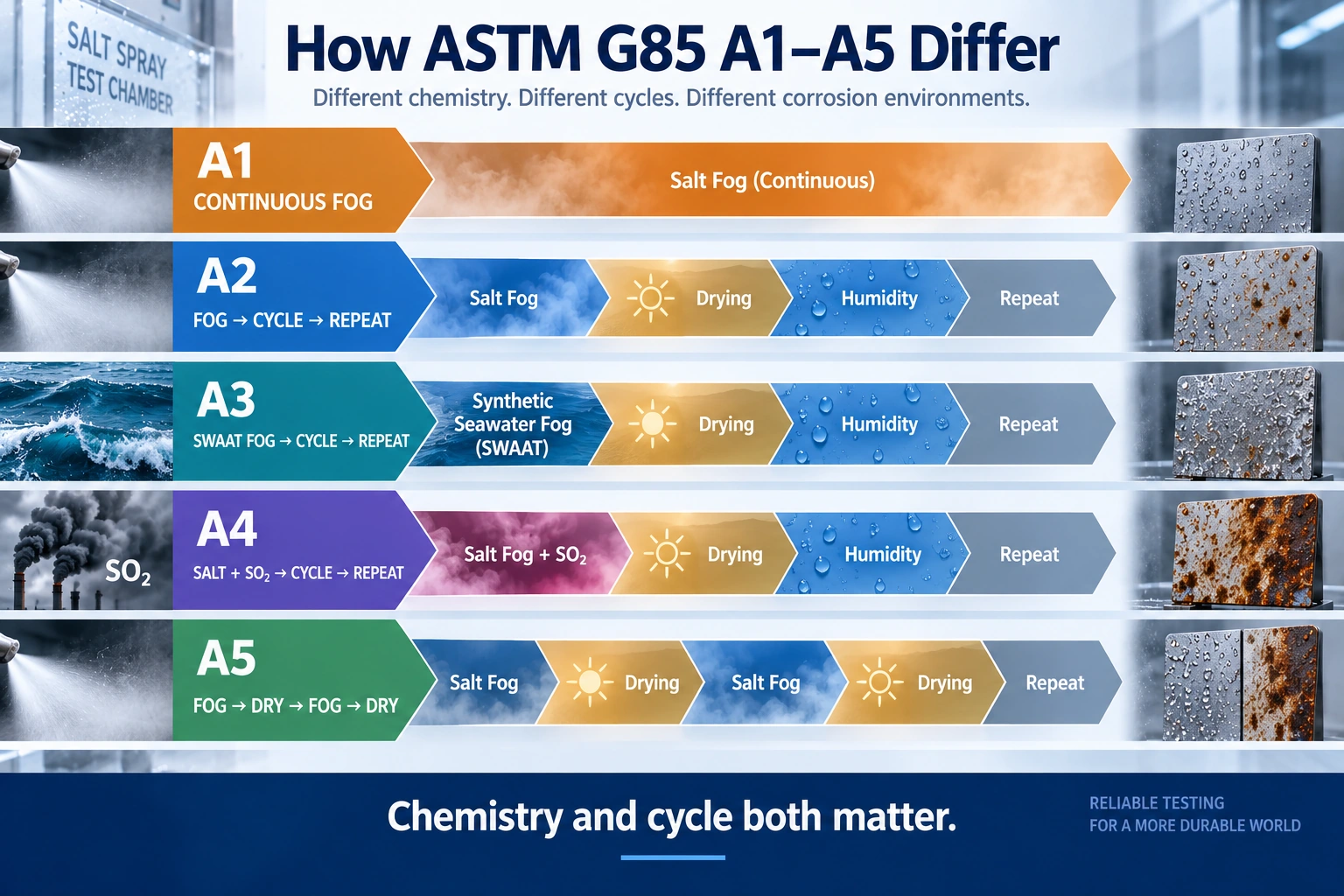
A1: Continuous Acidified Salt Fog
A1 is the exception within ASTM G85: it is continuous, not cyclic.
The salt solution is acidified with acetic acid, creating a corrosion environment different from neutral salt fog.
The test itself is conceptually simple:
prepare the specified solution, establish the acidified fog environment, maintain the exposure, then evaluate the specimen.
Typical applications may include plated components, decorative finishes, metallic coatings, coated metal parts and surface-treated products.
For chamber selection, the main concern is chemical compatibility rather than cycle programming.
The reservoir, piping, atomization system, chamber liner, racks and drainage system all need to tolerate the required test chemistry.
A chamber that performs well with neutral salt fog should not automatically be assumed to be equally suitable for acidified exposure.
A2: When the Cycle Becomes Part of the Test
A2 adds cyclic exposure.
That changes the equipment requirement more than it may seem at first.
Now the chamber is not just creating corrosive fog. It must also reproduce the required sequence repeatedly and predictably.
A useful way to think about A2 is:
fog stage → defined environmental stage → transition → repeat
The transition matters because a test can run through many cycles. If the chamber drifts from one cycle to the next, the exposure itself becomes inconsistent.
Potential DUTs include coated steel parts, fasteners, brackets, aluminum components and other surface-treated metal parts.
For A2, the chamber should be reviewed for:
- automatic cycle programming,
- temperature control,
- fog stability,
- environmental transition capability,
- repeatability over long-duration cycling.
This is where a cyclic corrosion chamber begins to offer a clear advantage over a simple fog-only cabinet.
A3 SWAAT: More Than “Salt Spray for Aluminum”
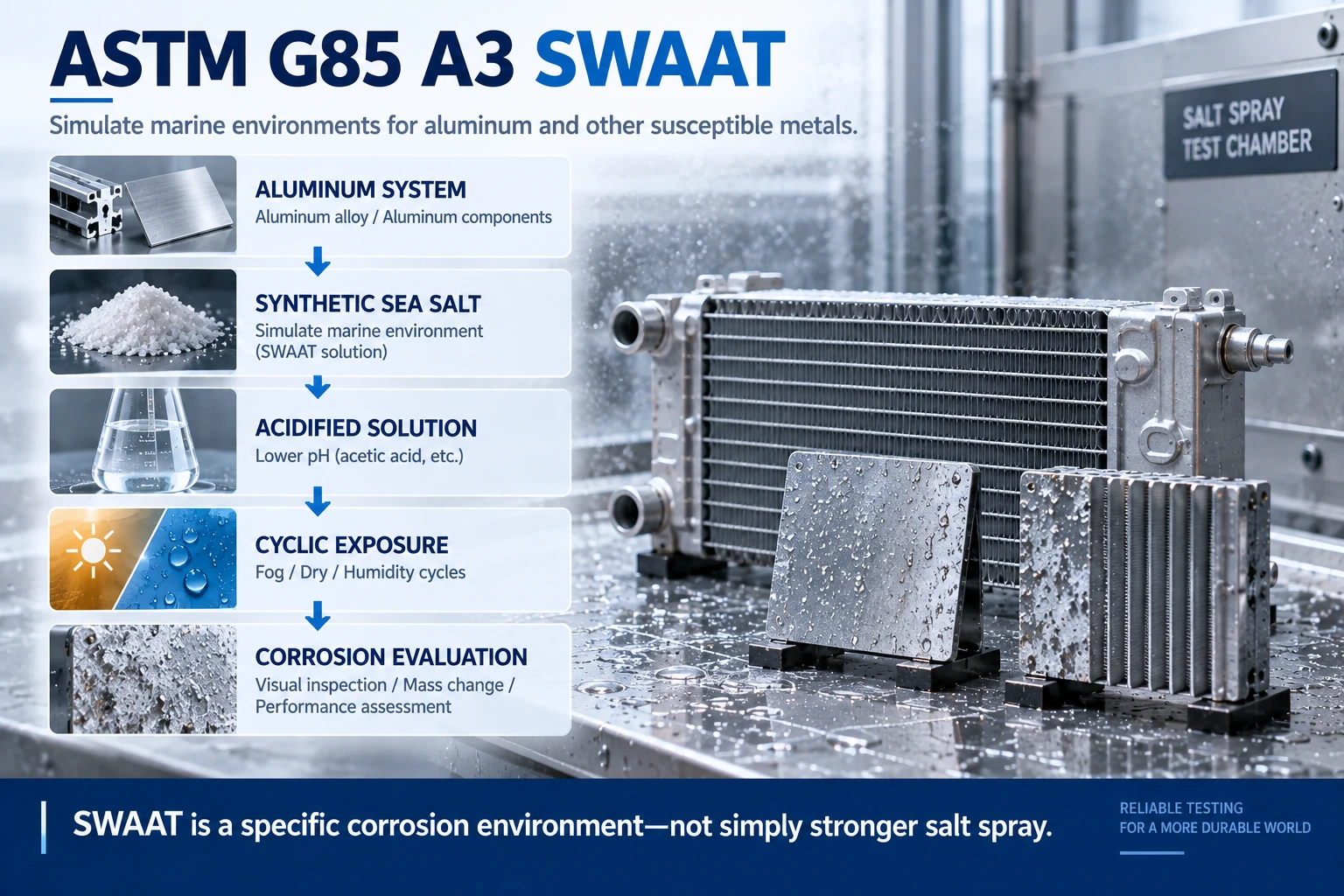
ASTM G85 Annex A3 is the Seawater Acidified Test, commonly referred to as SWAAT. ASTM identifies A3 as a cyclic modified corrosion exposure using acidified synthetic seawater.
SWAAT is often associated with aluminum, but this shortcut can be misleading:
aluminum ≠ automatically A3
Before selecting SWAAT, an engineer still needs to know:
- which alloy is involved,
- whether the surface is bare or coated,
- what surface treatment has been applied,
- what customer or OEM specification governs the product,
- whether A3 is actually required.
That distinction is important for aluminum heat exchanger materials, coated aluminum panels, automotive aluminum parts, aerospace material specimens and marine-related components.
The chamber must support both the required chemistry and the required environmental sequence.
For laboratories doing repeated SWAAT work, solution preparation and chemical compatibility become just as important as chamber volume.
A4: SO₂ Changes the Equipment Category
A4 introduces sulfur dioxide.
This is the method where it becomes especially dangerous to treat “ASTM G85 capable” as a generic product claim.
A chamber designed for salt spray, humidity and drying is not automatically suitable for A4.
SO₂ brings additional requirements that may include:
- controlled gas introduction,
- gas metering,
- chamber sealing,
- gas-resistant internal materials,
- exhaust handling,
- operator protection,
- safety interlocks.
ASTM identifies A4 as the cyclic SO₂ salt spray modification.
For ITM-LAB, I would position A4 as a special configuration review rather than a standard default capability.
That is more technically responsible and gives the customer a clearer understanding of what needs to be specified before quotation.
A5: “No Spray” Is Not the Same as a Dry Stage
A5 uses a dilute electrolyte with cyclic fog and dry exposure.
This is a good example of why a basic salt fog cabinet and a cyclic corrosion chamber are not the same machine.
Simply switching off the spray does not necessarily create a controlled dry environment.
If the test requires a defined dry stage, the chamber may need to manage air exchange, temperature, drying behavior and stage transition in a controlled way.
That makes the key equipment question very simple:
Can the chamber reproduce the required dry stage, or can it only stop spraying?
Those are not equivalent.
Potential applications include coated steel, automotive components, painted panels, fasteners, protective coating systems and outdoor metal assemblies.
Where ASTM G85 Shows Up in Real Test Programs
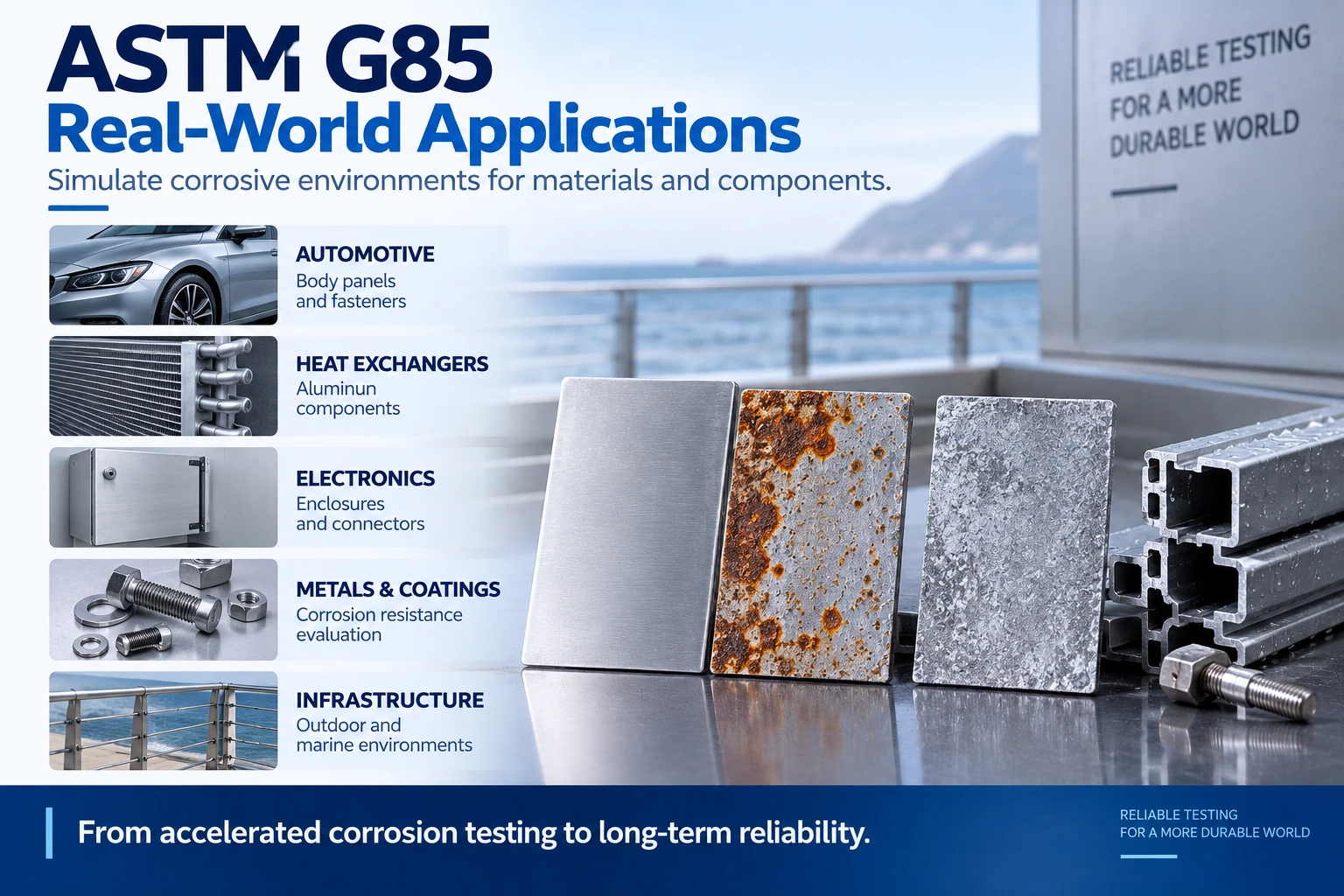
Automotive is an obvious example, but even within one vehicle the corrosion requirements can vary widely.
A zinc-coated fastener, painted steel bracket, aluminum heat exchanger and plated connector may all sit within the same assembly. They do not automatically use the same ASTM G85 Annex.
The same principle applies elsewhere.
In aerospace, aluminum alloys, fasteners and protected metallic surfaces may appear in qualification programs where modified corrosion exposure is required.
In marine and coastal equipment, salt-containing environments make corrosion testing important, but the laboratory method still has to match the actual requirement rather than simply “simulate the sea.”
In electronics, even small amounts of corrosion can affect contact resistance, grounding, shielding or connector performance long before severe visible rust develops.
In coatings and surface treatment, ASTM G85 may be used to compare paint systems, plating, conversion coatings, pretreatments and protective finishes under controlled exposure.
The common theme is not the industry name.
It is:
material + surface system + applicable requirement
One Product Category Does Not Equal One Annex
This is one of the easiest mistakes to make.
An aluminum component does not automatically mean A3.
A coated steel component does not automatically mean A5.
A fastener does not automatically belong under one fixed corrosion method.
The correct sequence is:
What is the product?
Then:
What is the base material?
Then:
What coating or surface treatment is present?
Then:
What customer, OEM or product specification applies?
Only after that should the ASTM G85 Annex be selected.
The product name alone is not enough.
ASTM G85 Defines Exposure, Not PASS/FAIL
This point deserves more attention than it usually gets.
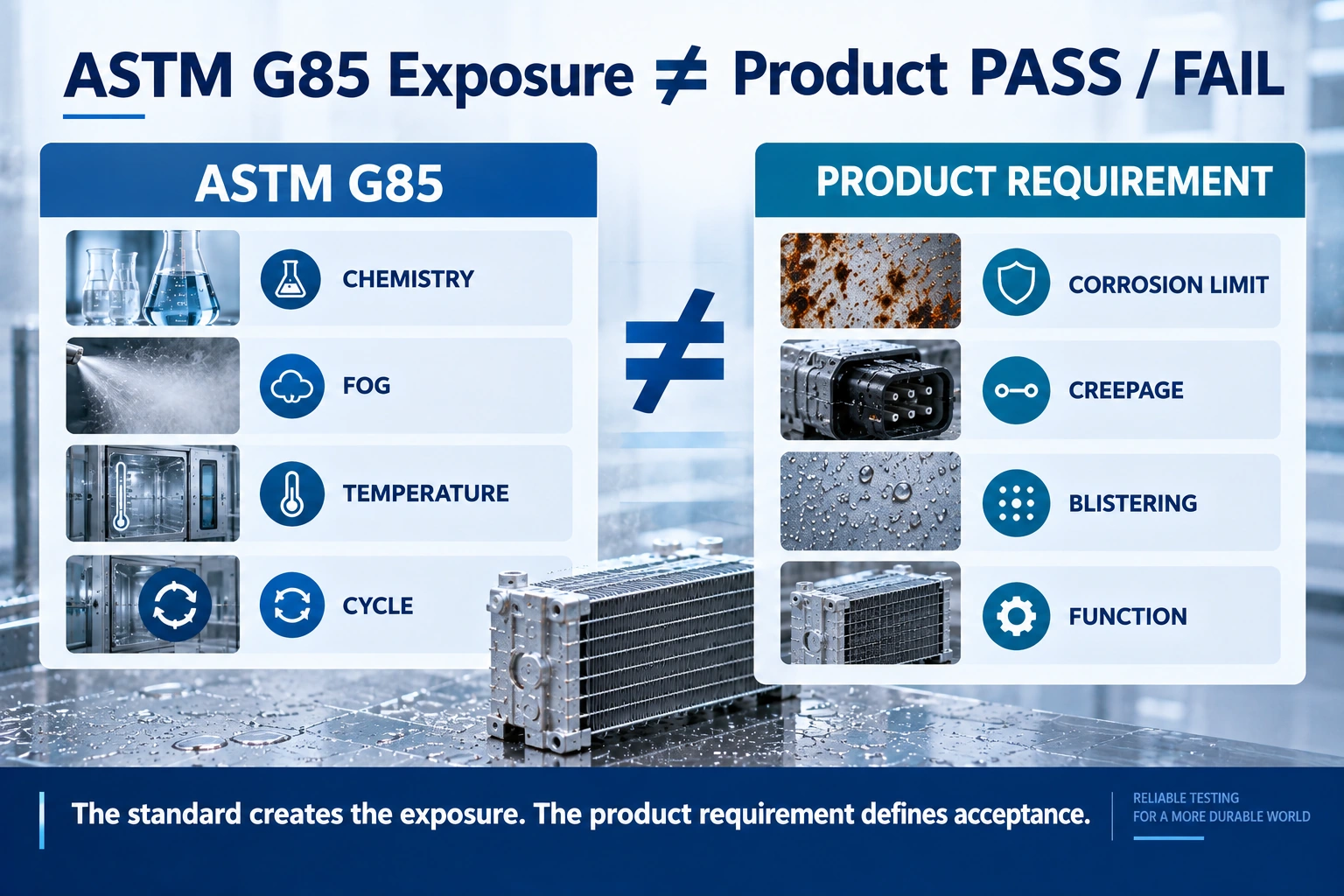
ASTM G85 defines the exposure practice. It does not universally define what level of corrosion is acceptable for a specific product. ASTM explicitly notes that product-specific interpretation of the results is outside the scope of the practice.
Post-exposure evaluation may involve:
- red rust,
- white corrosion products,
- blistering,
- creepage,
- pitting,
- delamination,
- discoloration,
- mass change,
- electrical performance.
But the acceptance limit comes from the applicable product specification, drawing, OEM requirement, customer requirement or separate evaluation method.
Two laboratories can run the same G85 Annex and still have different PASS/FAIL criteria because the product requirements are different.
That is normal.
What the Chamber Actually Needs to Control
Once the Annex is known, the problem becomes an equipment configuration task.
The main areas to review are chemistry, fog generation, environmental control, transition behavior, specimen loading, drying capability, special gas handling and data/control requirements.
Chemical compatibility comes first. A1, A3 and A5 do not use identical test chemistries, so the wetted parts of the system matter.
Fog generation also needs to be stable and repeatable. Nozzle performance alone is not enough; air supply, solution delivery, chamber temperature and fog distribution all affect the exposure.
For cyclic tests, the chamber must be able to move between required stages consistently. This becomes especially important during long tests where manual switching would create unnecessary operator dependency.
Specimen loading also needs to be treated as an engineering input rather than an afterthought.
A nominal 1000 L chamber does not automatically tell you how many parts can be mounted correctly.
The real questions are:
How large are the specimens? How many are tested per batch? At what angle? With what spacing?
And for A4, SO₂ handling has to be reviewed separately.
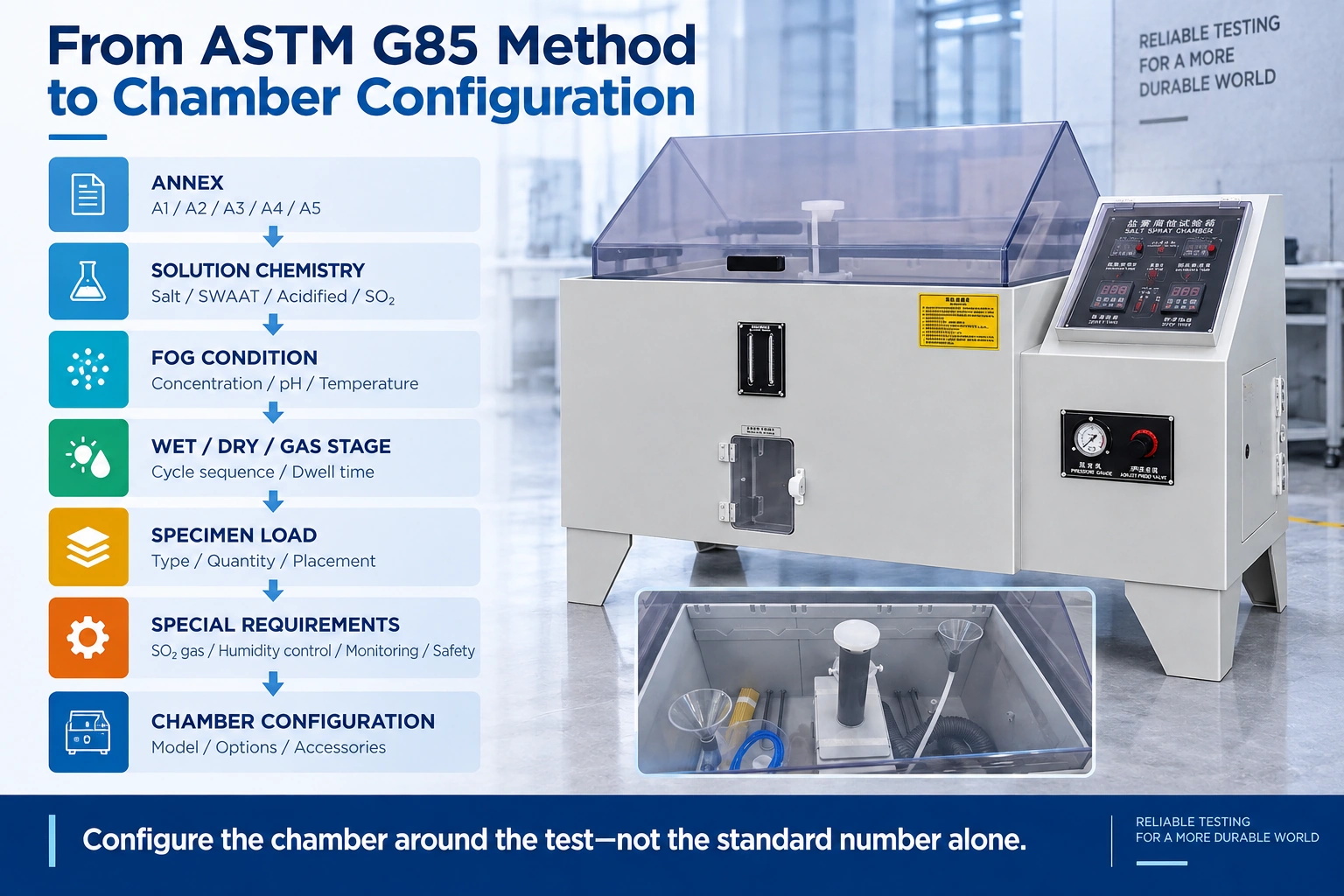
Where the ITM-LAB YWX/T Series Fits
For modified and cyclic corrosion programs, the relevant ITM-LAB platform is the YWX/T Series Compound Salt Spray Test Chamber.
The system is intended for test programs that may require combinations of:
salt spray, humidity or wet exposure, drying and programmable cycling
That makes it more suitable for cyclic corrosion programs than a basic continuous fog cabinet.
Typical DUTs include automotive parts, coated panels, aluminum components, fasteners, connectors, plated components, industrial hardware and outdoor metal products.
For ASTM G85, the chamber should still be matched to the exact Annex:
| Annex | Configuration Point to Confirm |
|---|---|
| A1 | Acidified solution compatibility and continuous fog control |
| A2 | Acidified solution plus cyclic exposure control |
| A3 | SWAAT chemistry and required cycle |
| A4 | Dedicated SO₂ handling and safety configuration |
| A5 | Dilute electrolyte compatibility and fog/dry control |
The phrase “ASTM G85 capable” is only useful when the specific Annex and hardware configuration are clear.
Before You Ask for an “ASTM G85 Chamber”
A request that says only:
“Please quote an ASTM G85 chamber.”
leaves too many engineering questions unanswered.
A better inquiry should include:
ASTM G85 Annex: A1 / A2 / A3 / A4 / A5
Test Product: ______
Base Material: ______
Surface Treatment / Coating: ______
Specimen Dimensions: ______
Quantity per Batch: ______
Required Exposure Cycle: ______
Test Solution / Chemistry: ______
Exposure Duration / Number of Cycles: ______
Evaluation Requirement: ______
Special Requirement: SWAAT / SO₂ / Fog-Dry / Other
That information allows the supplier to work through:
solution system, fog system, cycle control, rack layout, working volume, safety requirements and final chamber configuration
The standard number alone cannot do that.
Common Specification Mistakes
A few mistakes show up repeatedly.
The first is treating ASTM G85 as one test. It is not. Always identify the Annex.
The second is assuming that a more aggressive environment is automatically more appropriate. It is not. The correct environment is the one required by the governing specification.
The third is calling every G85 method cyclic. A1 is continuous.
Another common mistake is buying a fog-only chamber for a fog/dry program. Stopping the spray does not automatically create the required dry condition.
Chemistry is also easy to overlook. Acidified solution, synthetic sea salts and dilute electrolytes can affect chamber materials differently.
And finally, ASTM G85 should not be used as a universal PASS/FAIL criterion. The exposure comes from G85; acceptance comes from the product requirement.
How Long Should an ASTM G85 Test Run?
There is no single universal answer.
ASTM G85 does not prescribe one exposure duration for every product. It also does not prescribe which modification must be used for every product.
Test duration may come from an OEM specification, customer requirement, qualification program, product standard or internal validation plan.
That is why a quotation request such as:
“ASTM G85, 1000 hours”
is incomplete.
A much better request is:
“ASTM G85 A3, aluminum specimens, customer-specified cycle, total exposure ___.”
The Annex and cycle matter just as much as the number of hours.
Can ASTM G85 Hours Be Converted Into Years Outdoors?
Not as a universal rule.
Statements such as:
“500 hours equals five years outdoors”
should be treated cautiously unless a validated product-specific correlation exists.
Field corrosion depends on climate, temperature, humidity, rainfall, salt deposition, pollution, drying rate, geometry, orientation, coating damage and maintenance.
Accelerated corrosion testing is useful for controlled comparison and qualification.
It is not automatically a direct clock conversion to real service life.
FAQ
Is ASTM G85 the same as ASTM B117?
No. ASTM B117 uses a conventional continuous salt fog environment, while ASTM G85 modifies the chemistry, exposure sequence or both depending on the selected Annex.
Which ASTM G85 method is SWAAT?
A3.
Is A1 cyclic?
No. A1 is continuous.
Which method uses SO₂?
A4.
Can one chamber run every ASTM G85 Annex?
Not automatically. The installed chamber functions and materials must be checked against the selected method, especially for A4.
ASTM G85 Test Chamber Selection Roadmap
WHAT ARE YOU TESTING?
↓
METAL / COATING / PLATING / COMPLETE COMPONENT
↓
DEFINE MATERIAL + SURFACE SYSTEM
↓
CONFIRM PRODUCT / CUSTOMER REQUIREMENT
↓
IS ASTM G85 REQUIRED?
↓
WHICH ANNEX?
A1 · A2 · A3 · A4 · A5
↓
DEFINE TEST CHEMISTRY
↓
DEFINE EXPOSURE CYCLE
↓
DEFINE SPECIMEN SIZE + QUANTITY
↓
CHECK SPECIAL REQUIREMENTS
SWAAT / SO₂ / FOG-DRY
↓
VERIFY CHAMBER FUNCTIONS
↓
VERIFY WORKING VOLUME
↓
SELECT THE YWX/T CONFIGURATION
Define the corrosion program first. Select the chamber second.
Conclusion
ASTM G85 should not be treated as a single checkbox on a chamber specification.
The real selection path is:
Annex → material → surface system → chemistry → cycle → specimen load → evaluation requirement
Once those inputs are clear, the equipment can be configured around the actual test.
For ASTM G85 projects, send ITM-LAB the Annex, specimen material, surface treatment, specimen dimensions, quantity, required cycle, exposure duration and any SWAAT, SO₂ or fog/dry requirement.
That gives the engineering team enough information to recommend the correct YWX/T configuration without over- or under-specifying the system.
