
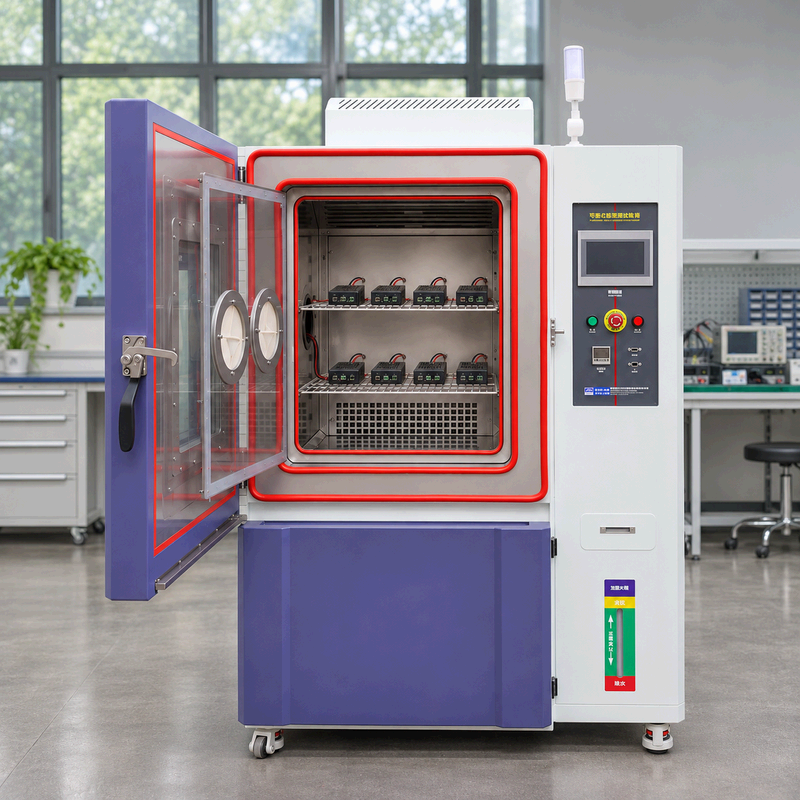
Compare environmental test chamber quotations against the same test profile, load, acceptance criteria and delivery scope. Ask each supplier to confirm what the quoted chamber can achieve with your specimens inside, how that performance will be verified, and what you will have to buy separately before running the first test. A lower equipment price can disappear once freight, commissioning and project-specific acceptance testing are included.
A supplier sends a quotation for an environmental chamber. The model, volume and temperature range match the request. One line says “performance per datasheet.” Before circulating the quote for approval, ask one question: Which values are you committing to on our test setup, and where will those values be recorded? The answer belongs in the quotation or a referenced technical annex that will be attached to the purchase order.
Put both suppliers on the same quotation revision
Send the same dated test profile and installation brief to each supplier. If a call changes a requirement, issue the revised brief to both. Ask for a line-by-line response that gives the proposed value, the conditions behind it and its status: included, optional, excluded or pending. Request a separate price and any lead-time impact for each required option. An unanswered item stays open on the comparison sheet.
Three lines are particularly easy to misread:
| Quotation line | What to ask the supplier to put in writing |
|---|---|
| “85°C / 85% RH available” | Can the offered configuration maintain that exact temperature and humidity together with your agreed specimen load? State tolerances, measurement basis and hold duration. |
| “5°C/min” | Is this heating, cooling or both? Give the measured interval, average or linear basis, sensor location and load condition. If the method is timed at the specimen, identify the specimen sensor and timing rule. |
| “Site commissioning included” | List the on-site tasks, the prerequisites the buyer must provide and the checks or records the engineer will hand over. State whether an on-site acceptance run is included. |
Read the condition behind the number
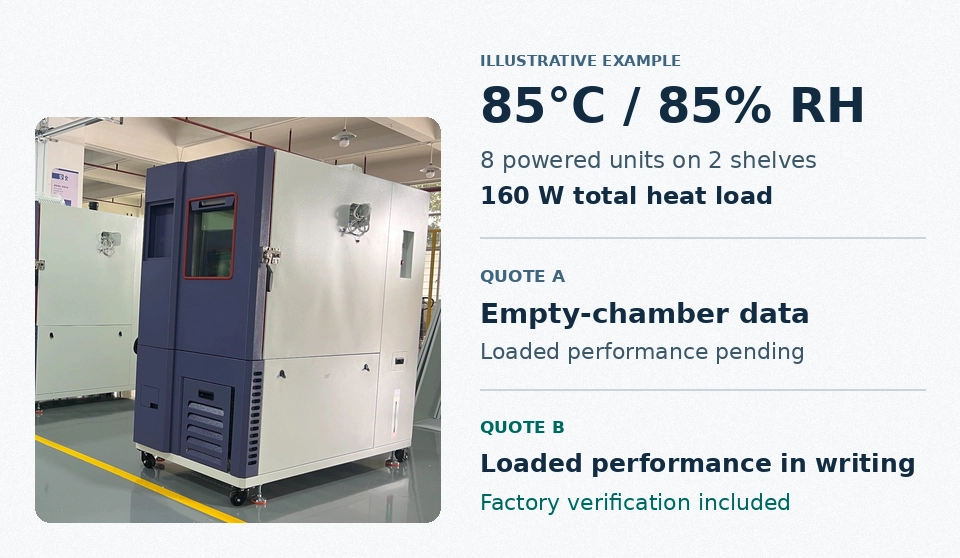
Consider a lab planning to test eight powered electronic assemblies, each dissipating an estimated 20 W into the workspace. The review basis is 160 W total at the specified operating condition, with the units arranged on two shelves. Quote A gives 85°C / 85% RH on an empty-chamber chart. Quote B commits in writing to the required point with the agreed 160 W load and shelf layout, with verification included at the factory. Quote A remains open on loaded capability. Quote B has a written commitment that the buyer can check during acceptance.
Confirm how the heat estimate was obtained. Where the supplier proposes a representative load for acceptance, agree how it will reproduce the mass, placement and heat dissipation that matter to the test. A heater can represent dissipation and still leave airflow or specimen temperature behavior unverified. For the inputs behind that estimate, see ITM-LAB’s guide to calculating DUT heat load.
Copy these columns into the procurement comparison sheet
| Requirement and revision | Supplier response and status | Evidence or quotation reference | Price adjustment | Owner and due date |
|---|---|---|---|---|
| 85°C / 85% RH at 160 W, profile Rev B | Pending loaded confirmation | Quote A, empty-chamber chart | Pending | Supplier to confirm before shortlist |
| Factory verification for profile Rev B | Included | Quote B, acceptance annex | Included | Buyer to approve the protocol |
| On-site positioning and commissioning | Separately priced | Quote B, service scope | +,100 | Site team to confirm prerequisites |
Record mandatory requirements first. If a required operating point remains open, keep that decision visible even when every commercial cell has a number.
Agree what the supplier will demonstrate before shipment
A calibration record, a generic chamber performance report and a factory acceptance test (FAT) answer different questions. Ask for a sample report early. Then attach an agreed acceptance plan to the quotation or purchase order. The plan should name the offered configuration, test profile, load or approved substitute, sensor positions, tolerances, hold start and duration, and data to be delivered. If any required result falls outside the limit, document who corrects it, when the test is repeated and what must be signed before shipment.
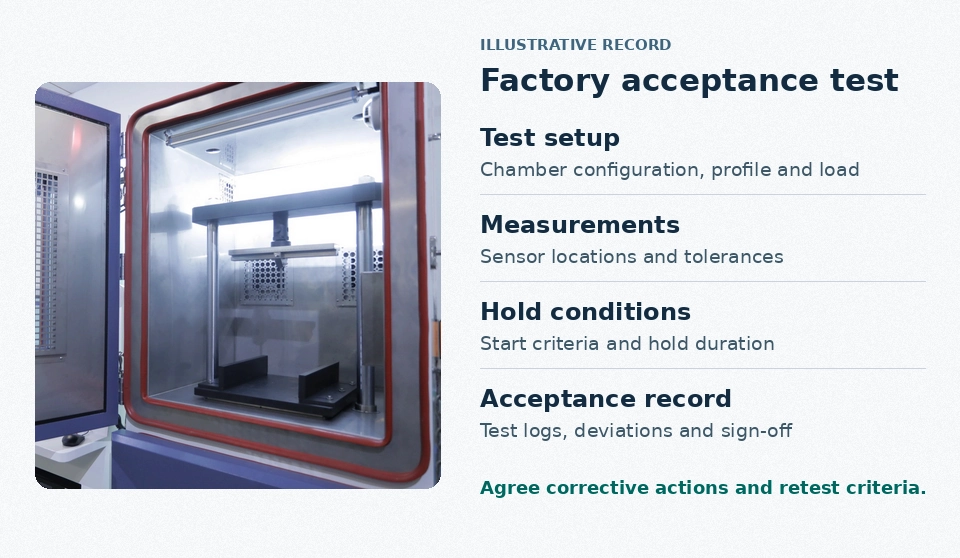
IEC 60068-3-6:2018 covers performance confirmation of temperature/humidity chambers without specimens. IEC 60068-3-7:2020 covers measurements in loaded temperature chambers for cold and dry-heat tests. For a loaded humidity requirement such as the example above, write the agreed verification setup and limits into the project acceptance plan and reference the applicable test method and edition. If a quotation cites IEC 60068-3-5:2018, ask the supplier to identify the contractual edition and test basis. The IEC catalogue lists that edition as withdrawn on 31 December 2024. See IEC 60068-3-6, IEC 60068-3-7 and the IEC withdrawal record.
For an example of production and factory documentation, see Inside an Environmental Test Chamber Factory.
Decide which checks belong at the factory and which require the buyer’s site. For example, a factory run can establish chamber performance under the agreed setup. A site acceptance test (SAT), where required, can verify the installed system with the buyer’s utilities, data connections or fixtures. Spell out the scope and price for each location.
Bring both prices to the point where the lab can run its first test
Use the same currency, destination and readiness milestone. Ask each supplier to specify the Incoterms® rule, named place and edition, then itemize unloading, rigging, site work, commissioning, training and acceptance according to the actual quotation. A named delivery point helps define the transport scope. Installation and the work needed to release the equipment for testing deserve their own lines. See the ICC’s Incoterms® guidance.
Here is how the price order can change after the missing lines are filled in. All figures are illustrative USD amounts. The calculation assumes Quote A can be revised to meet the same technical requirements and acceptance scope.
| Cost to reach the same readiness milestone | Quote A | Quote B |
|---|---|---|
| Quoted package price | ,000 | ,500 |
| Additional freight and handling to the agreed delivery point | ,000 | Included |
| Additional positioning and commissioning | ,200 | ,100 |
| Additional project-specific FAT | ,600 | Included |
| Comparable ready-to-test subtotal | ,800 | ,600 |
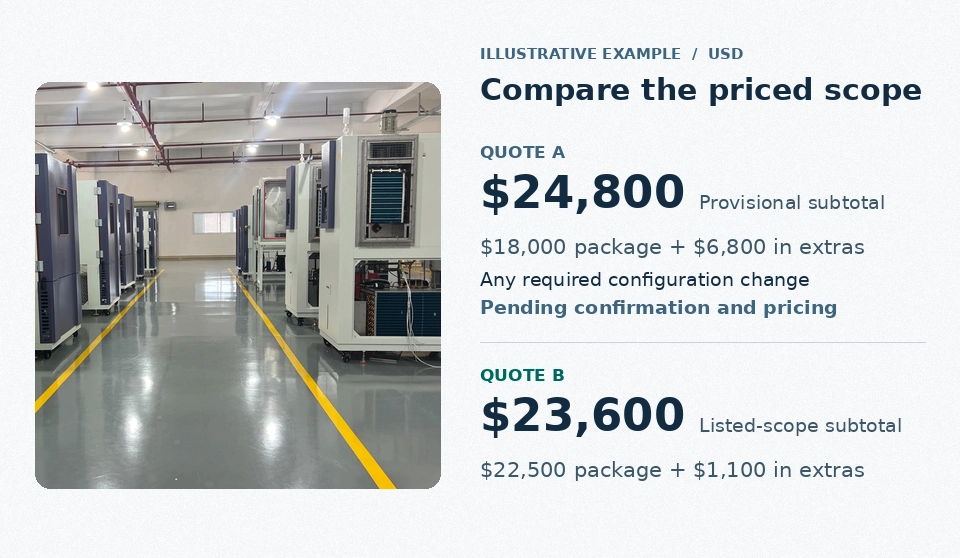
Quote A starts ,500 lower. Once those three items are priced, its subtotal is ,200 higher. The purchase decision still depends on A closing the loaded-performance item in writing. Check quotation validity, payment milestones, when lead time starts, and whether the warranty starts at shipment, delivery or commissioning. For sites that will depend on a single chamber, ask who handles service locally and how critical spares would be supplied.
Ask for the evidence that fits the ITM-LAB chamber series
The performance line to verify depends on the project. Use these questions when requesting a quotation for the relevant series.
| ITM-LAB series | Ask the quotation to confirm |
|---|---|
| GDW — high and low temperature | The required cold and hot points, plus any timed transitions with the specified specimen load. |
| GDJS — temperature and humidity | The required temperature/RH pairs and the basis for performance with your powered or unpowered setup. |
| KTB — rapid temperature change | Heating and cooling commitments by interval, measurement location and load condition. |
| CTS — thermal shock | The exposure sequence, transfer or switching time, and recovery definition under the agreed load. |
| GDJZ — temperature and low pressure | The required temperature and absolute-pressure pairs during the same hold, plus the timing and measurement basis. |
See ITM-LAB environmental test chambers.
Send the profile with your request for a quotation
Send the test method or cycle, the number and dimensions of the devices under test, their operating state and estimated heat dissipation, and the installation destination. A fixture drawing, specimen photo or existing comparison sheet helps identify gaps in the scope. Tell us which checks you need at the factory and which you need at your site. Request an environmental test chamber quotation from ITM-LAB.
Frequently asked questions
Can I compare two quotations if one gives empty-chamber data?
Yes. Keep the empty-chamber figure in the comparison and mark loaded performance as pending. Ask the supplier to confirm performance for your load and give a verification method before you approve the quotation on that basis.
Does an included factory acceptance test cover my actual profile?
Only if the agreed FAT scope names that profile and specifies the load, measurements and pass limits. Ask the supplier to identify the relevant quotation line or attach the acceptance plan.
Which quotation price should procurement use?
Use the price for the same technical scope and the same delivery and installation milestone. Carry mandatory extras with confirmed prices into the subtotal. Track open costs separately until the supplier or site team can price them.
