
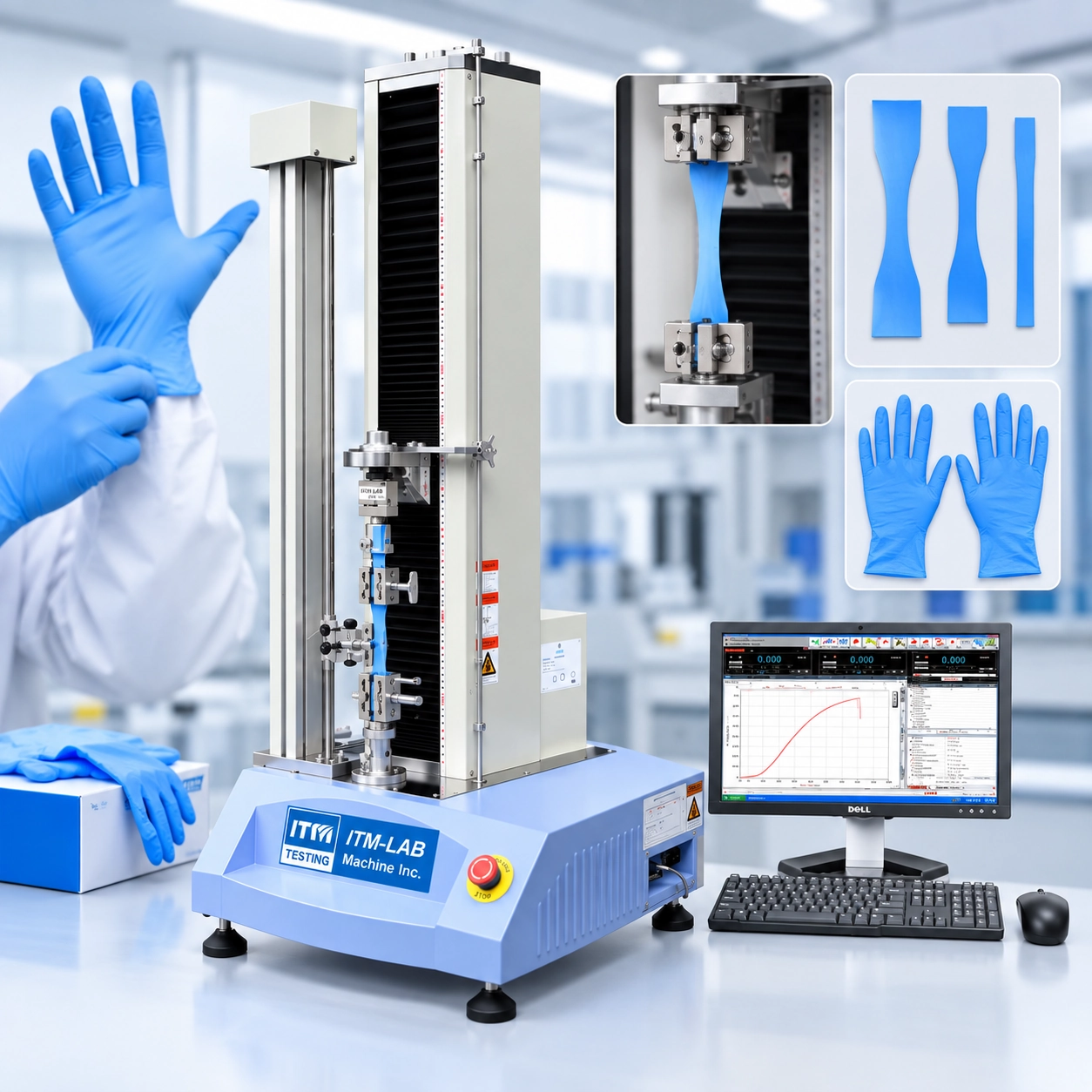
A nitrile examination glove can look perfectly acceptable and still fail its physical-property requirements.
Under ASTM D6319, the question is not simply how many newtons it takes to break a glove. Tensile strength depends on the specimen cross-section. Ultimate elongation depends on how far a prepared specimen stretches before rupture. Both properties also need to be evaluated after aging.
That makes glove tensile testing a measurement-system problem, not just a tensile-machine problem.
The load cell has to work in the right force range. The grips must hold a thin elastomer without cutting it. The machine needs enough usable travel for a specimen that may stretch several times its original gauge length. Thickness measurement also matters because it directly affects the calculated tensile strength.
This guide looks at ASTM D6319 from that practical laboratory perspective: what the specification covers, where tensile testing fits, what can distort the result, and how to configure a universal testing machine for nitrile examination gloves.
What ASTM D6319 Actually Covers
ASTM D6319-19(2023), Standard Specification for Nitrile Examination Gloves for Medical Application, covers nitrile rubber gloves used in medical examinations and diagnostic and therapeutic procedures.
It includes gloves designed to fit either hand, paired and sized gloves, and products supplied sterile, nonsterile or bulk nonsterile.
For a testing laboratory, the important distinction is simple:
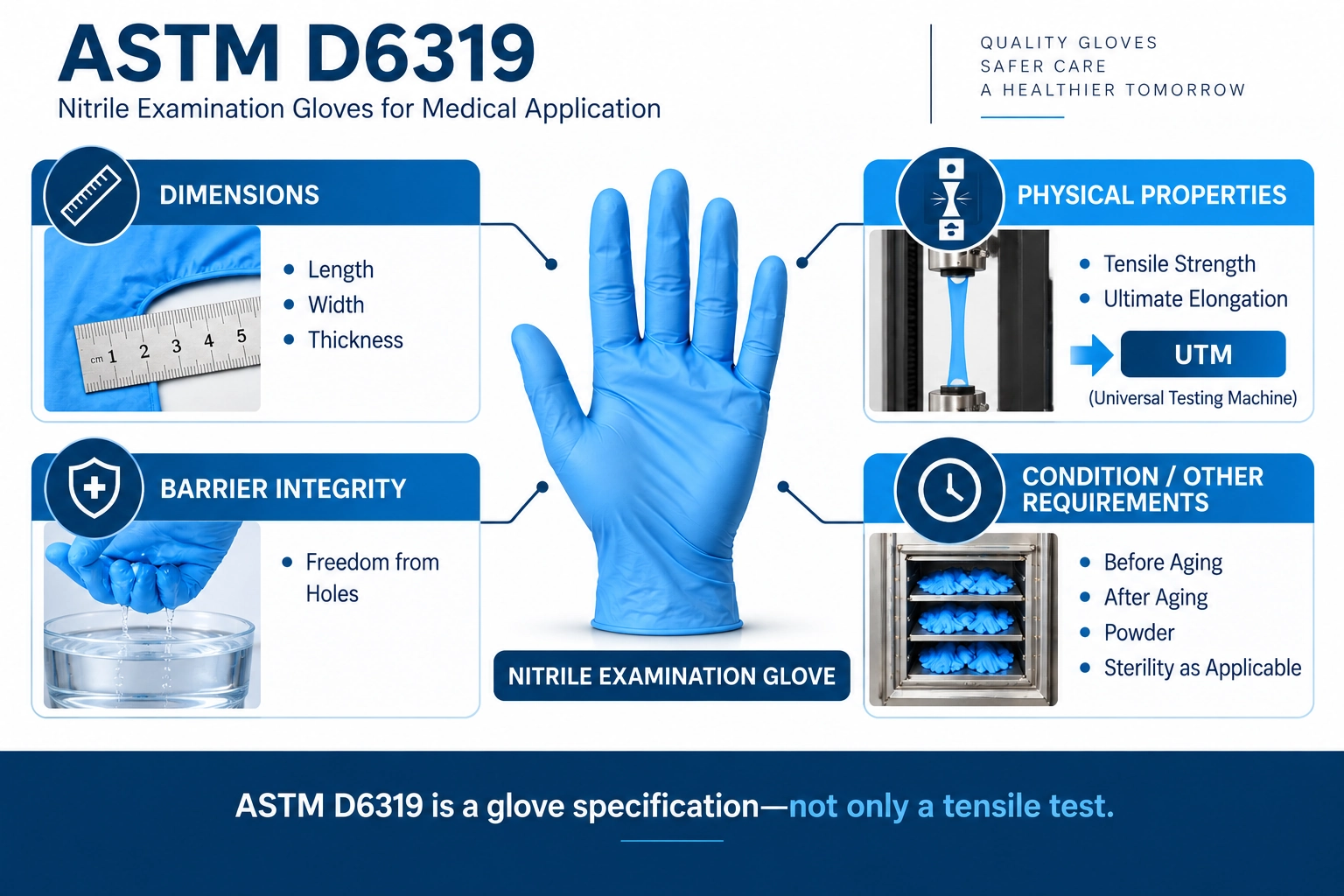
ASTM D6319 is a finished-glove specification, not just a tensile test method.
Its requirements extend beyond mechanical testing.
| Requirement Area | What Is Checked | Typical Laboratory Equipment |
|---|---|---|
| Dimensions | Length, width, thickness | Dimensional tools / thickness gauge |
| Freedom from holes | Barrier integrity | Water leak test setup |
| Physical properties | Tensile strength, ultimate elongation | Universal testing machine |
| Aging | Physical properties after aging | Aging oven + UTM |
| Powder | Residual powder where applicable | Applicable laboratory equipment |
| Sterility | Products identified as sterile | Appropriate sterility test system |
So when a customer asks for an “ASTM D6319 testing machine,” the first question should be:
Which part of ASTM D6319 do you need to test?
A universal testing machine handles the mechanical-property portion. It is not, by itself, a complete ASTM D6319 test system.
Tensile Strength and Elongation: Two Different Measurements
For the mechanical-property evaluation, two results matter in particular:
Tensile strength describes the stress the material can withstand.
Ultimate elongation describes how far the specimen stretches before rupture relative to its original reference length.
For ASTM D6319-19, the commonly documented minimum physical-property requirements for nitrile examination gloves are:
| Physical Property | Before Aging | After Aging |
|---|---|---|
| Tensile Strength | ≥14 MPa | ≥14 MPa |
| Ultimate Elongation | ≥500% | ≥400% |
These values reveal something important about the equipment requirement.
Glove specimens are generally a low-force, high-extension application.
Force capacity alone is therefore a poor way to select the UTM.
A machine may have more than enough force capacity and still be poorly configured because the load cell range is too large, the grips damage the specimen, or there is not enough usable travel.
Same Breaking Force Does Not Mean the Same Tensile Strength
The testing machine directly measures force.
Tensile strength is calculated from force and the specimen's original cross-sectional area:
Tensile Strength = Force / Original Cross-Sectional Area
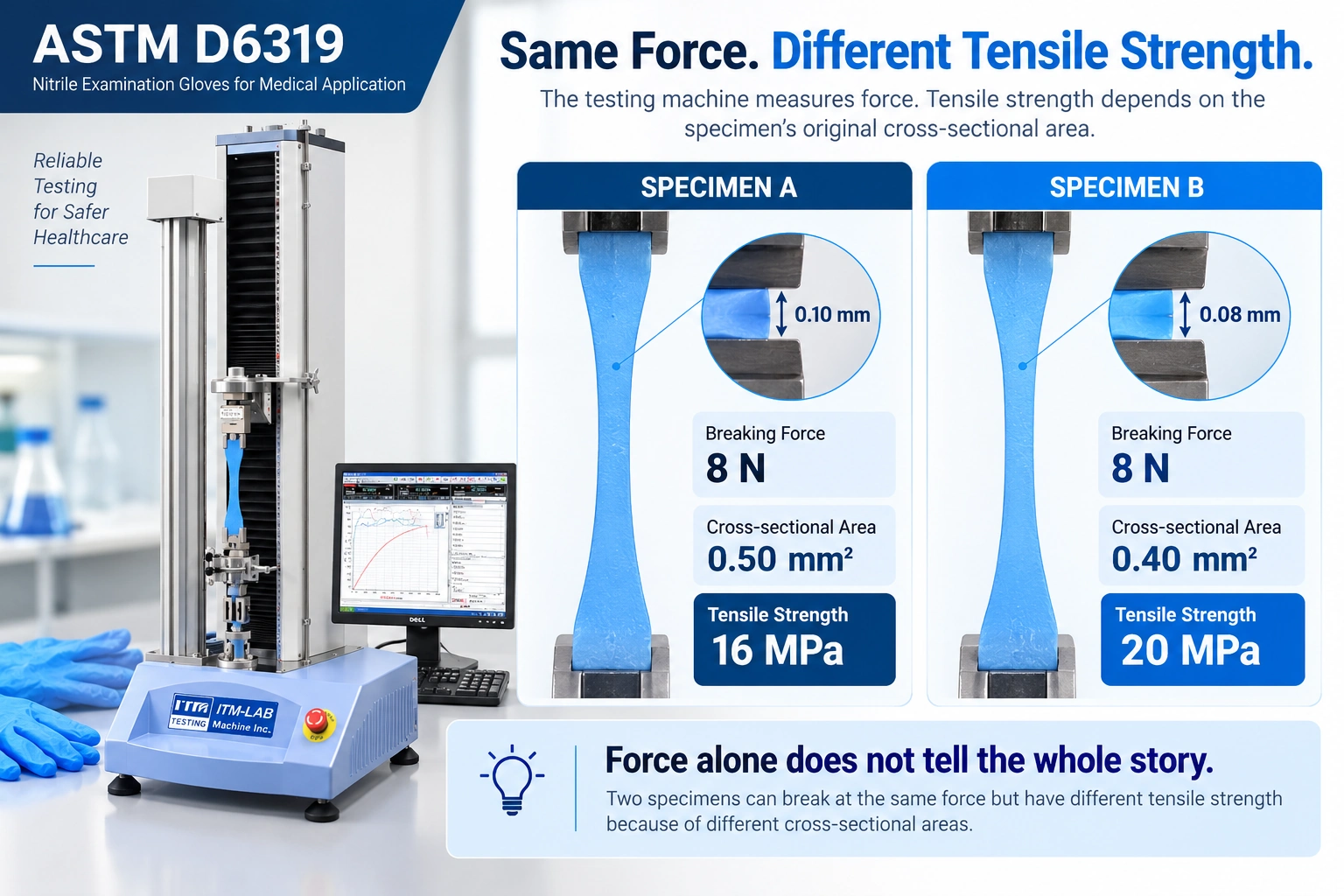
Consider two simplified specimens that both break at 8 N.
For Specimen A:
Cross-sectional area = 0.50 mm²
8 N / 0.50 mm² = 16 MPa
For Specimen B:
Cross-sectional area = 0.40 mm²
8 N / 0.40 mm² = 20 MPa
The breaking force is identical.
The tensile strength is not.
This is why thickness measurement should not be treated as a minor preparation step. A force channel can be working correctly while the final stress value is wrong because an incorrect specimen dimension was entered into the calculation.
From a Glove to a Tensile Result
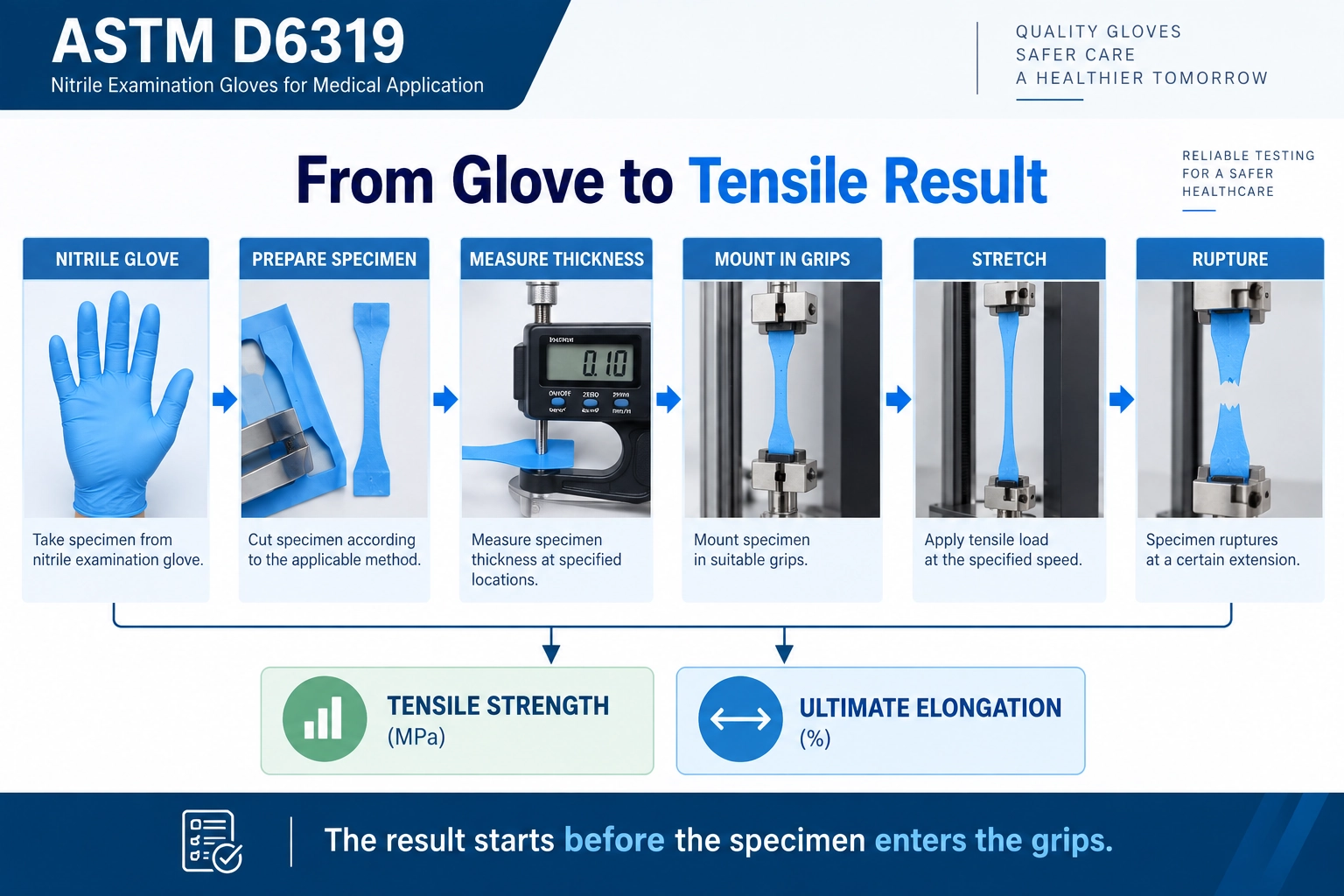
A complete glove is not simply clamped between two jaws and pulled until it breaks.
A defined tensile specimen is prepared from the glove and tested according to the applicable procedure.
From the laboratory floor, the sequence looks more like this:
Glove → Specimen → Thickness Measurement → Mounting → Extension → Rupture → Calculation
The quality of the result starts before the specimen enters the grips.
A nick or irregular cut along the specimen edge can become a premature failure point. An incorrect thickness value changes the calculated tensile strength. Poor alignment introduces uneven loading.
Then there is the gripping problem.
The jaws need enough holding force to stop the nitrile specimen from slipping, but not so much that they cut or damage the material at the grip edge.
That balance is one of the practical differences between testing a thin medical glove and testing a conventional rigid plastic specimen.
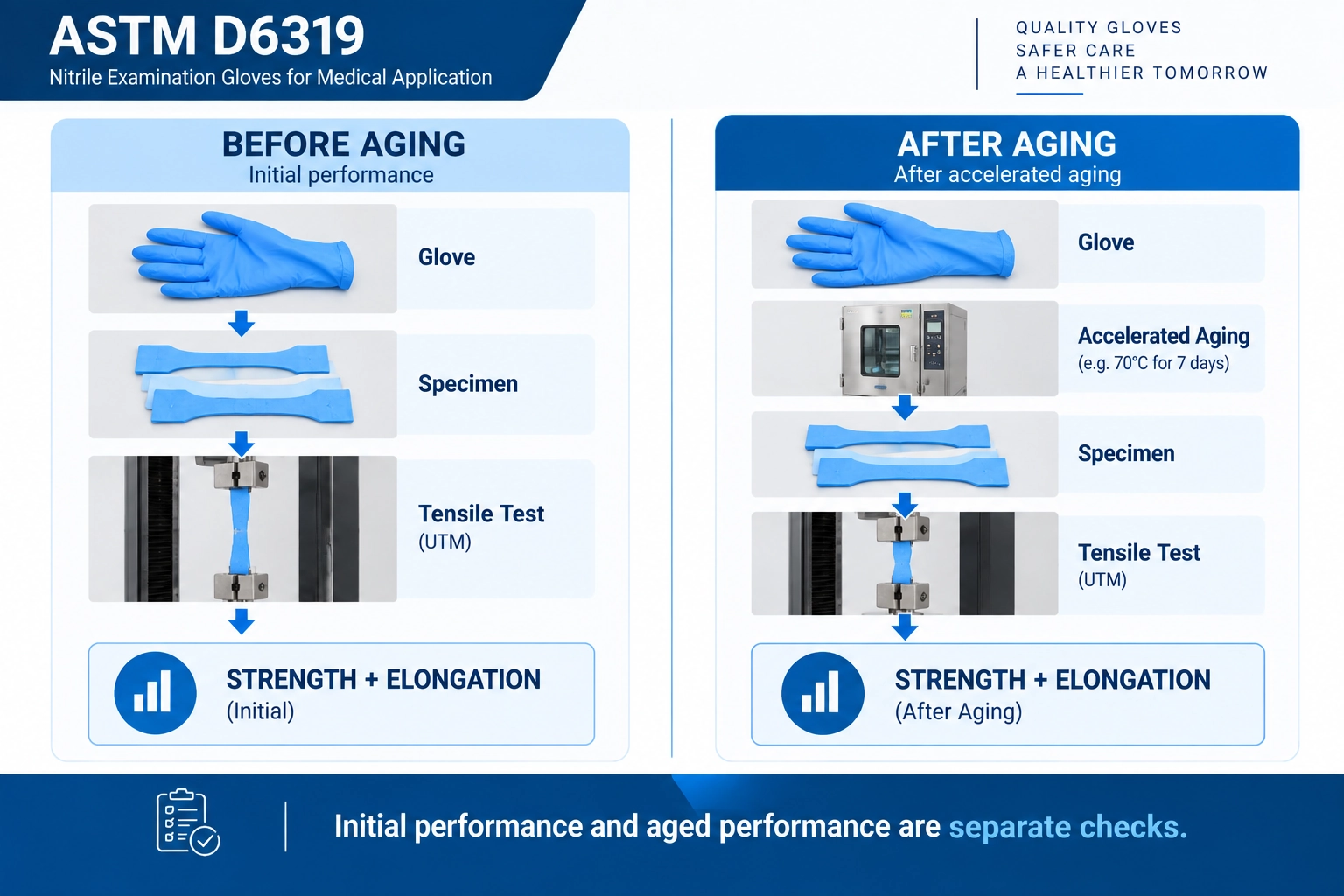
Why Test Before and After Aging?
Fresh material does not necessarily behave the same way after storage.
Polymeric materials can change with time and temperature, affecting strength, elasticity and the ability to stretch before rupture. ASTM D6319 therefore includes physical requirements before and after aging.
For the laboratory, these are two related but separate evaluations.
Before aging:
Prepare the required specimens → tensile test → determine tensile strength and ultimate elongation.
After aging:
Apply the required aging procedure → condition as required → tensile test → determine tensile strength and ultimate elongation again.
The objective is not simply to calculate how much the numbers changed. The aged material still has to satisfy the applicable requirements.
For the commonly documented ASTM D6319-19 criteria, minimum tensile strength remains 14 MPa, while minimum ultimate elongation changes from 500% before aging to 400% after aging.
A strong initial result therefore does not replace the post-aging evaluation.
ASTM D6319 vs ASTM D412 vs ASTM D5151
These numbers often appear in the same glove-testing project, but they do different jobs.
ASTM D6319 is the product specification for nitrile examination gloves.
ASTM D412 provides methods for determining tensile properties of vulcanized rubber and thermoplastic elastomers and is relevant to the mechanical-property testing used for medical glove evaluation.
ASTM D5151 is a different test altogether: it addresses the detection of holes in medical gloves.
In practical terms:
D6319 → Does the finished nitrile examination glove meet the required specification?
D412 → How are rubber tensile properties determined?
D5151 → Does the medical glove contain detectable holes under the specified test?
That distinction matters when specifying equipment.
A purchase request that says only “ASTM D6319 machine” does not contain enough information to select a UTM configuration.
The equipment supplier still needs to know what specimen will be tested, its expected force and elongation, the required grips, available travel and the data that need to be reported.
Low Force Does Not Mean an Easy Test
A thin nitrile specimen does not require much machine capacity compared with engineering plastics, metals or structural components.
But low force combined with very high elongation creates a different set of measurement challenges.
Using a large-capacity tensile frame does not automatically solve them.
The more useful questions are:
How much force will the specimen actually generate?
Can the selected load cell resolve that range appropriately?
How far might the specimen extend before it finally ruptures?
How much usable travel remains after the grips are installed?
Can the jaws hold the material without slip or jaw-edge failure?
Can the test software calculate and report the required properties?
This is why glove testing should be configured around the specimen and measurement range, not simply around the maximum capacity printed on the machine.
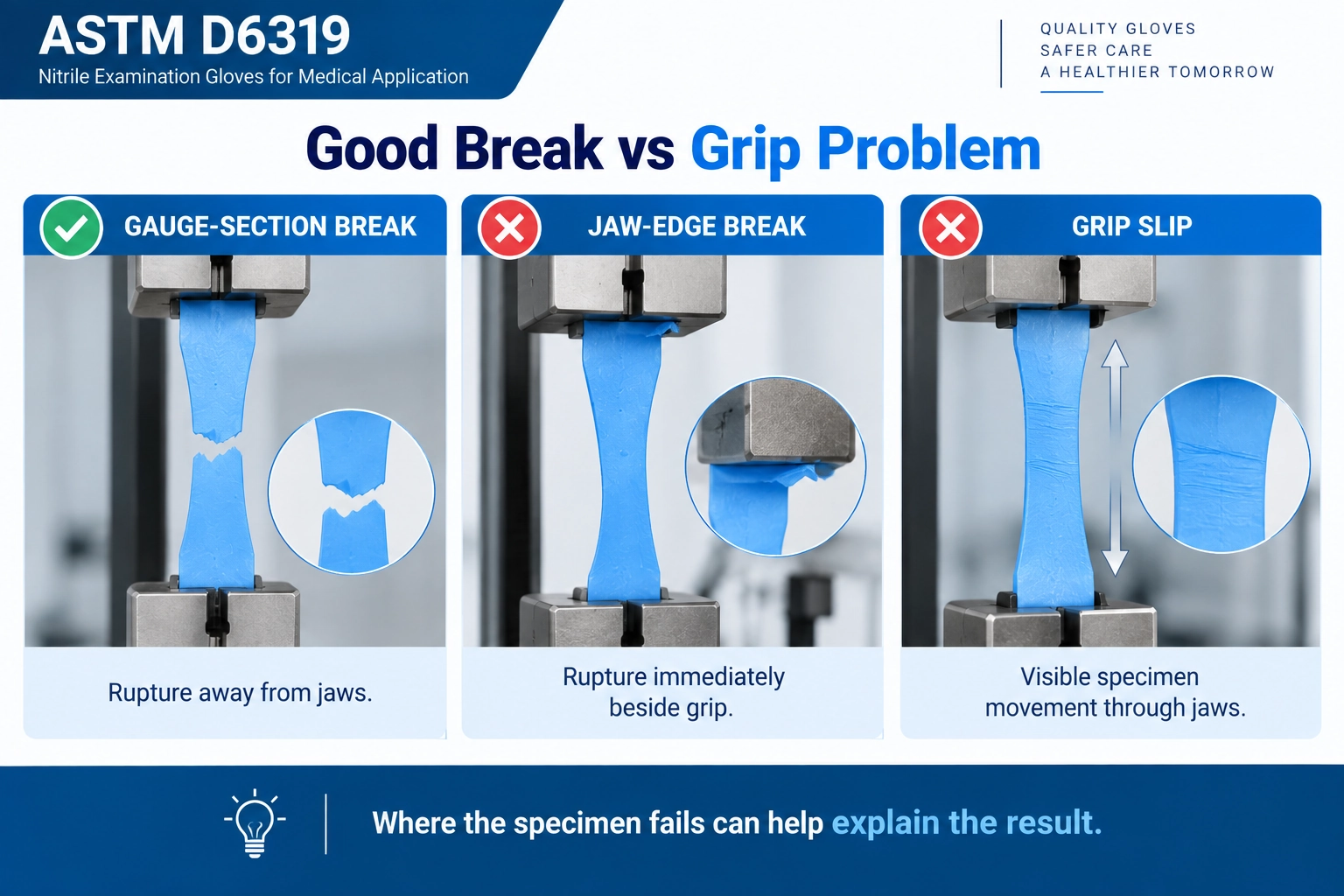
Watch Where the Specimen Breaks
The final number is only part of the test.
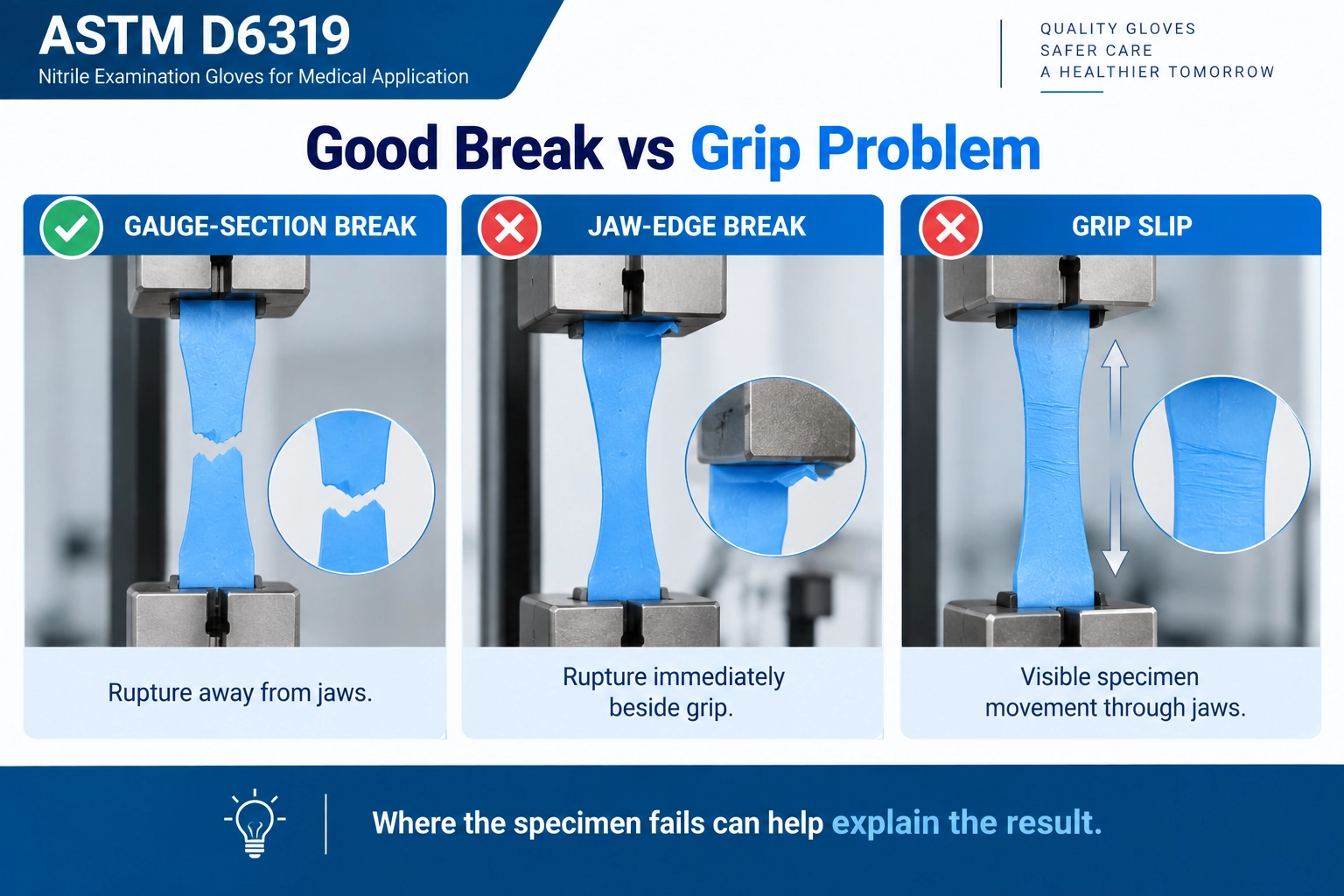
Suppose several specimens repeatedly rupture immediately beside the upper jaw. That pattern deserves investigation before concluding that the glove material itself is weak.
Possible causes include excessive clamping pressure, a sharp jaw edge, poor alignment, specimen damage or an unsuitable grip surface.
Slippage creates a different problem.
If the specimen moves through the jaws during the test, some of the recorded crosshead movement comes from movement at the grip rather than deformation of the specimen. That can distort the interpretation of elongation.
A useful troubleshooting habit is therefore to look at the specimen before looking at the report.
Where did it break?
Did it slip?
Was it centered?
Was there visible damage near the jaw?
Was the specimen already under tension when the test began?
Those observations can explain an unusual result or curve surprisingly quickly.
Do Not Forget Machine Travel
For nitrile gloves, available travel can matter as much as force capacity.
Take a simplified example with an original gauge length of 25 mm.
An elongation of 500% corresponds to an increase in length equal to five times the original gauge length—125 mm of extension in this simplified example.
That does not mean a machine with exactly 125 mm of available travel is sufficient.
The specimen may stretch beyond the minimum acceptance requirement before it ruptures. The machine also has to accommodate the actual test geometry, fixture dimensions, initial separation and appropriate operating clearance.
The acceptance threshold should therefore not be treated as the machine's design limit.
A better rule is:
Size the available travel for the specimen you expect to test, not merely for the minimum elongation required to pass.
This is one of the reasons expected elongation should be discussed before a UTM is configured.
Configuring a UTM for ASTM D6319 Tensile Testing
For the physical-property portion of the specification, the complete measurement system matters more than the tensile frame alone.
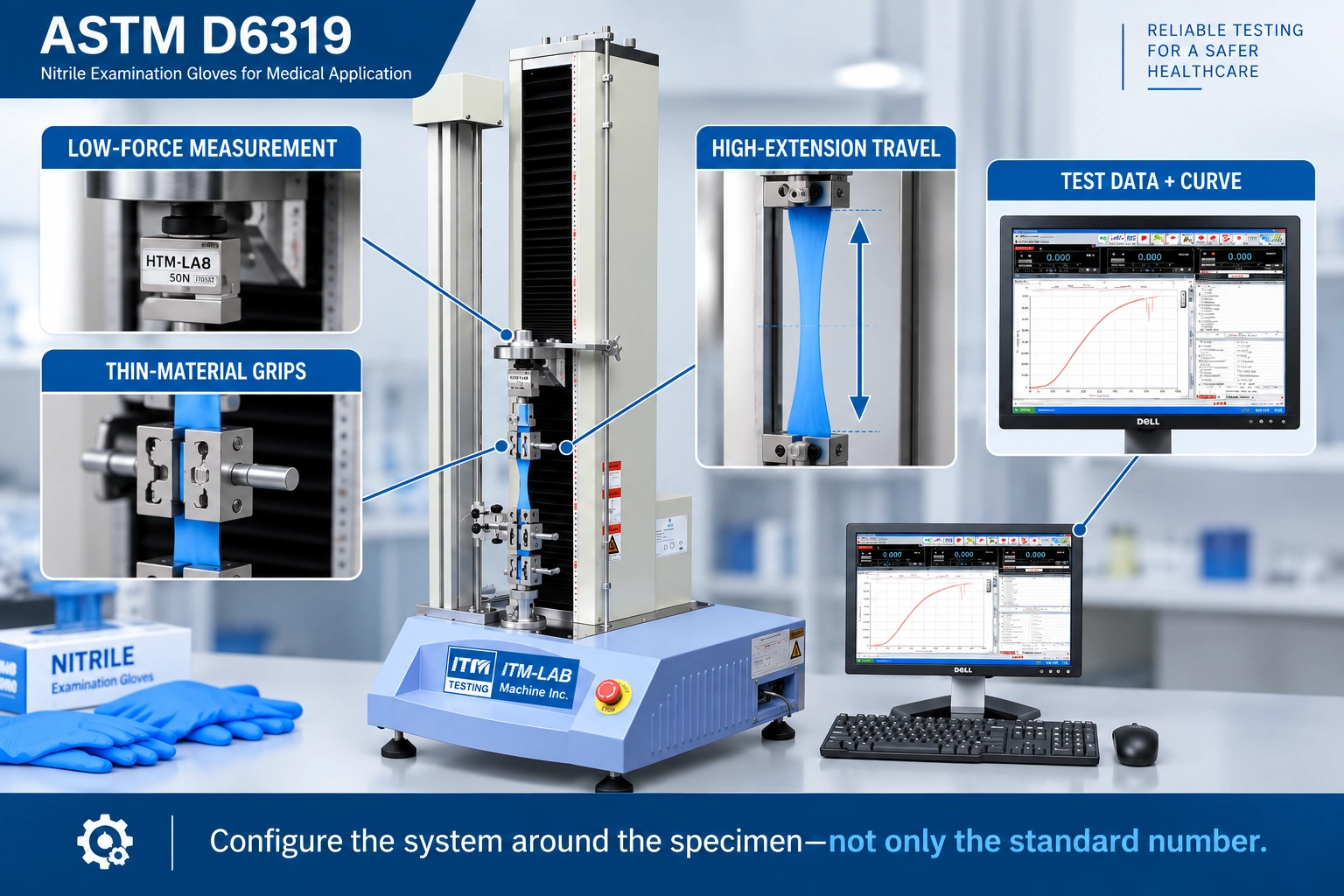
The ITM-LAB RS-8010A Universal Testing Machine can be configured for low-force, high-extension material testing. Available capacity configurations cover 50 N to 5 kN, allowing the measurement range to be selected around the actual specimen.
For nitrile examination gloves, four parts of the system deserve particular attention.
Load Cell
Start with the expected specimen force.
The selected range needs adequate capacity and margin, but using the largest available load cell provides no inherent advantage for a low-force specimen.
Grips
Thin elastomeric specimens need to be held securely without being cut, crushed or allowed to slip.
Grip type, jaw surface and clamping condition should therefore be considered together.
Available Travel
Check travel with the actual fixture arrangement installed.
For high-elongation materials, usable travel can become the limiting factor before frame capacity does.
Software and Results
The system should record the test curve and process the measurements required by the laboratory's test method.
Depending on the configured procedure, useful outputs can include maximum force, tensile strength, ultimate elongation, individual specimen results, averages and test curves.
Six Problems That Can Distort Glove Tensile Results
1. Poorly Matched Load Range
A load cell selected for much larger forces may be a poor match for a low-force glove specimen.
Define the expected force before selecting the measurement range.
2. Grip Slip
If the specimen moves through the jaws, grip movement can become mixed with specimen extension.
Watch the specimen during trial runs rather than relying only on the final curve.
3. Jaw-Edge Failure
More clamping pressure is not always better.
Repeated failures close to a jaw are a reason to inspect the grip surface, alignment and clamping condition.
4. Thickness Error
Correct force data can still produce an incorrect tensile-strength result if the specimen cross-sectional dimensions are wrong.
Thickness measurement is part of the measurement chain.
5. Poor Alignment
A specimen mounted at an angle does not experience clean, uniform tensile loading.
Repeatable centering matters.
6. Insufficient Travel
A machine can have more than enough force capacity and still reach its travel limit before a highly extensible specimen ruptures.
Check usable travel with the intended grips installed.
ASTM D6319 and Other Medical Glove Standards
Manufacturers serving multiple markets may encounter ASTM D6319 alongside ISO 11193-1 and EN 455-2.
They should not be treated as interchangeable simply because each includes physical-property requirements for medical gloves.
ASTM D6319 is specifically focused on nitrile examination gloves. ISO 11193-1 addresses single-use medical examination gloves more broadly, while EN 455-2 covers requirements and testing for physical properties of single-use medical gloves in the European framework.
A suitably configured UTM may support testing for more than one of these standards, but specimen preparation, conditioning, test procedures, calculations and acceptance criteria should follow the applicable document.
For a multi-standard glove laboratory, it is usually better to configure the hardware around the complete specimen and force range, then maintain the required test methods separately in the software.
Related Guide: Medical Glove UTM Testing — ISO 11193-1, EN 455-2 and ASTM D6319
Related Standard Guide: ISO 11193-1 Medical Examination Glove Testing
What to Send the Equipment Manufacturer
“ASTM D6319” tells us the application, but not enough to configure the complete tensile system.
For a more useful equipment recommendation, provide:
Standard: ASTM D6319 + applicable edition
Product: Nitrile examination glove
Specimen: Geometry / cutter type
Thickness: Expected range
Expected Force: N
Expected Elongation: %
Test Speed: mm/min
Initial Gauge Length / Grip Separation: mm
Daily Volume: Tests per day
Required Results: Tensile strength / elongation / curves / statistics
Reporting: Individual specimen or batch report
If expected force is unknown, representative specimens or existing test data can help define the appropriate measurement range.
The objective is not to select the load cell, grips and frame independently.
They need to work as one measurement system.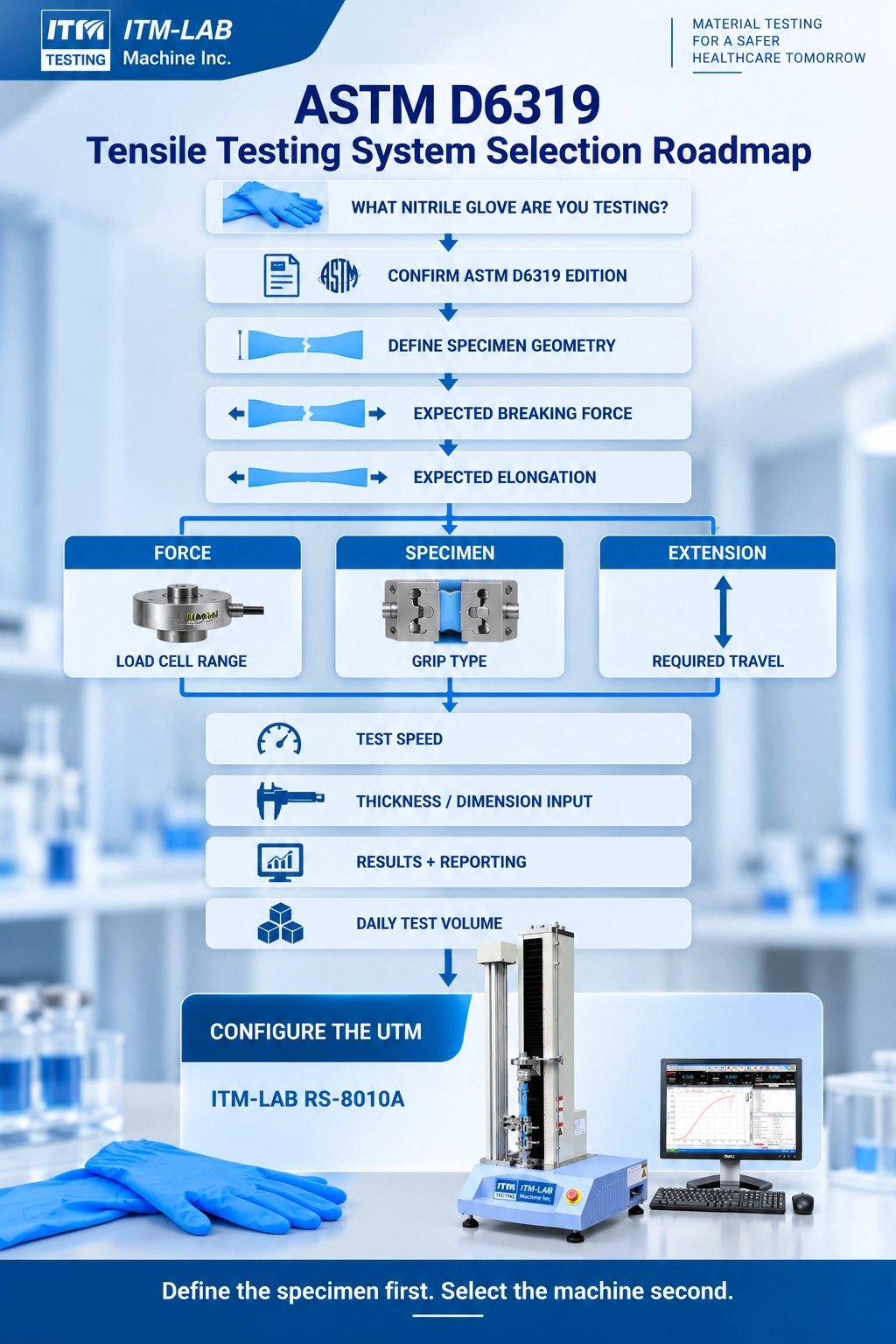
Common Questions About ASTM D6319 Testing
Is ASTM D6319 a tensile test standard?
Not exactly. ASTM D6319 is a specification for nitrile examination gloves. Tensile strength and ultimate elongation are part of its physical-property requirements, alongside other requirements such as dimensions and freedom from holes.
What tensile strength is required?
For ASTM D6319-19, the commonly documented minimum tensile strength is 14 MPa before aging and 14 MPa after aging.
The applicable standard edition should always be confirmed for the product and regulatory program.
What ultimate elongation is required?
Commonly documented ASTM D6319-19 minimum values are 500% before aging and 400% after aging.
Why can't I evaluate a glove by breaking force alone?
Because breaking force and tensile strength are different quantities.
Tensile strength accounts for the specimen's original cross-sectional area. Two specimens can therefore break at the same force while producing different tensile-strength values.
Does nitrile glove testing require a high-capacity UTM?
Maximum frame force is usually not the main selection issue.
The combination of relatively low force and high extension makes load-cell range, gripping and usable travel particularly important.
Can the same UTM test ASTM D6319 and ISO 11193-1?
Potentially, yes.
The machine still needs suitable force measurement, grips, travel, speed control and software for each applicable method. The test conditions and acceptance criteria should not be assumed to be identical.
Select the Measurement System, Not Just the Machine
ASTM D6319 tensile testing looks straightforward: prepare the specimen, stretch it to rupture and determine tensile strength and ultimate elongation.
Reliable results depend on considerably more than pressing Start.
A thickness error changes calculated stress. Grip slip affects extension. An aggressive jaw can move the failure point. Poor alignment changes the loading condition. An unsuitable load range leaves the measurement system poorly matched to the specimen. Insufficient travel can stop the test before rupture.
That is why we recommend defining five things before selecting the UTM:
specimen geometry, expected force, expected elongation, grip requirement and usable travel.
Once those are known, machine configuration becomes much more straightforward.
For nitrile glove physical-property testing, the ITM-LAB RS-8010A can be configured with an appropriate low-force measurement range, grips for thin elastomeric specimens and software for tensile and elongation analysis.
Configuring a UTM for nitrile glove testing?
Send us the applicable standard, specimen dimensions, expected force range, required elongation and daily test volume.
We can check the load-cell range, grip configuration and travel requirement before recommending a system.
