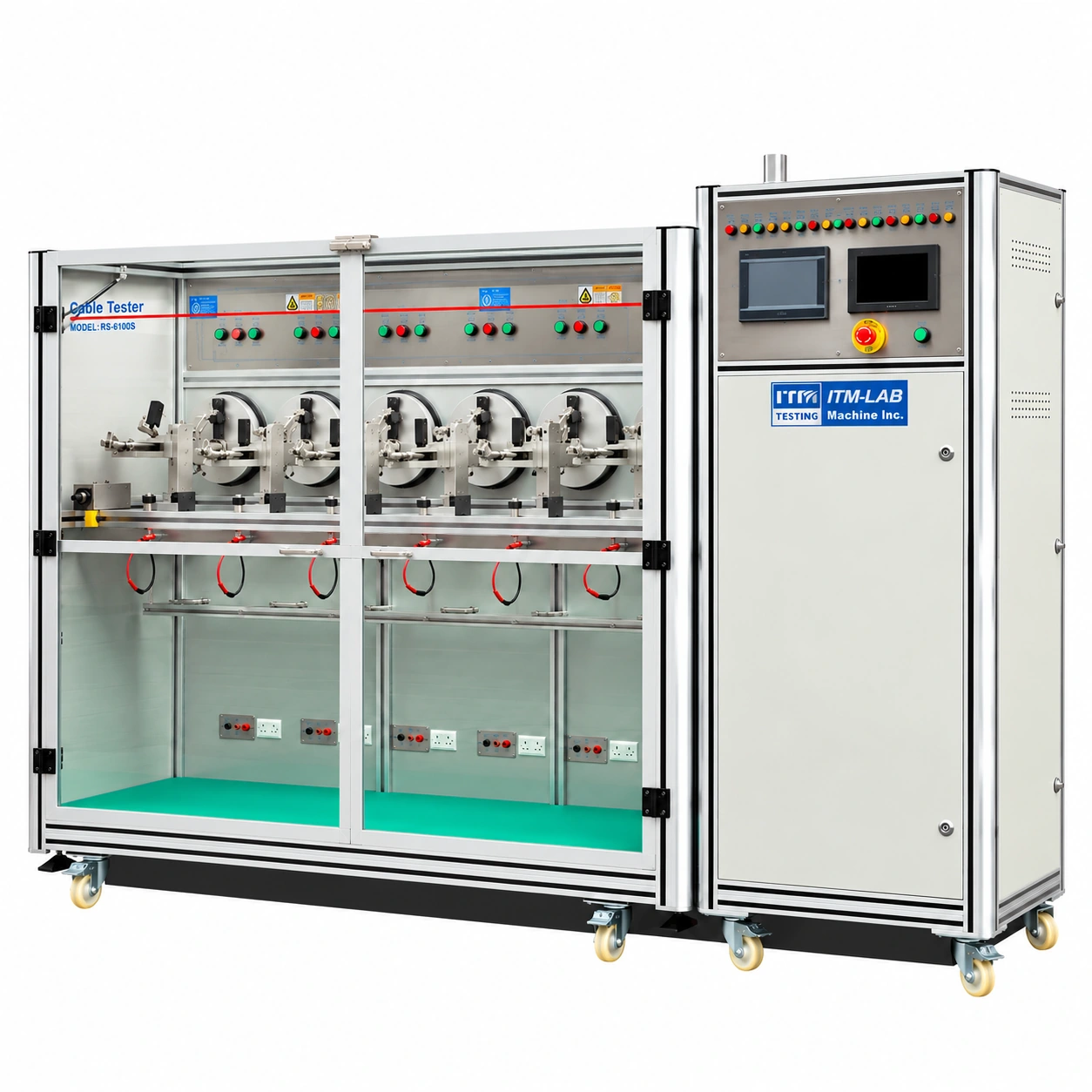
The ITM-LAB RS-8116-6A Wire Bending Tester is a six-station system for repeated angular durability testing of wire-related components, including TWS earphone ear hooks. Each station uses an independent servo drive. Programmable test conditions and online impedance monitoring allow operators to evaluate mechanical cycling and electrical changes during testing.
Typical Applications
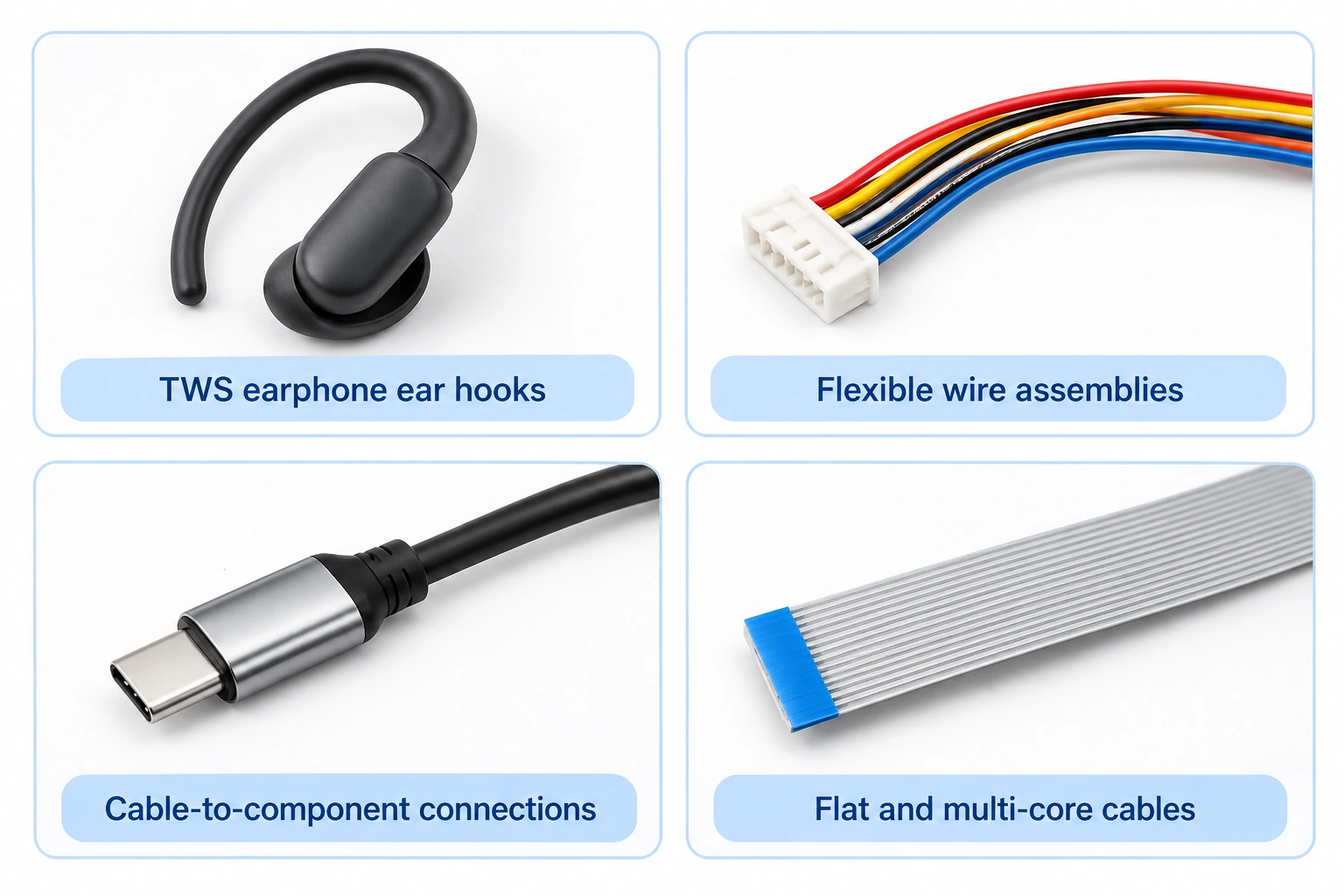
The RS-8116-6A is documented for repeated twist testing of TWS earphone ear hooks. Other wire-related components may be tested when their dimensions, fixtures and required movement are compatible with the machine.
Applications for configuration review include:
-
TWS Earphone Ear Hooks: Repeated angular movement and electrical monitoring.
-
Flexible Wire Assemblies: Durability testing under defined bending or rotational conditions.
-
Cable-to-Component Connections: Evaluation of electrical changes during repeated movement.
-
Custom Electronic Components: Fixture-based angular cycling according to an OEM procedure.
For USB cables, flat cables and multi-core cables, the required test movement and fixture arrangement must be confirmed before selecting this model.
![Wire bending tester applications for TWS earphone ear hooks and flexible electronic assemblies]()
Key Features of the RS-8116-6A
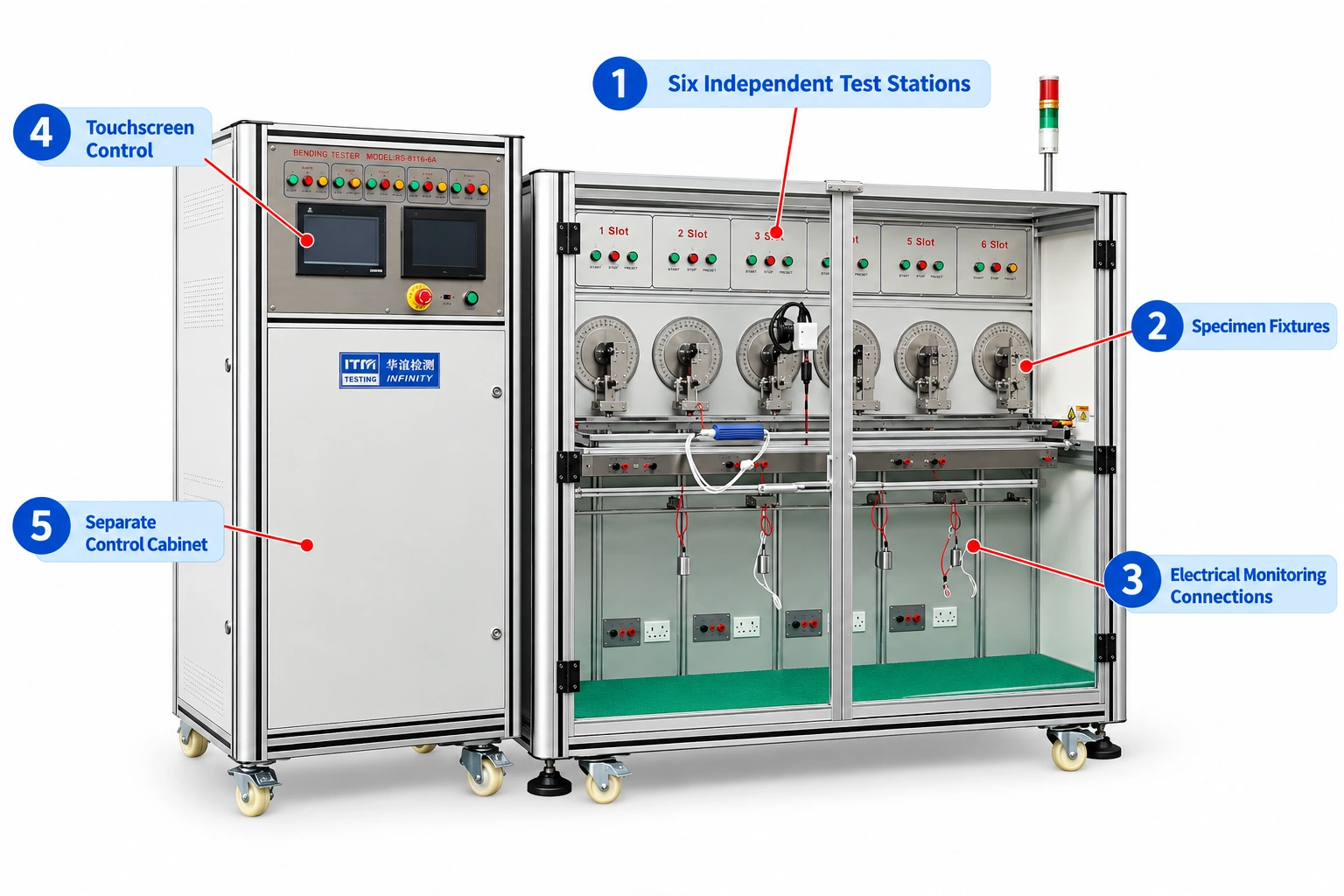
- Six Independent Test Stations
Six Panasonic AC servo motors and Shimpo planetary reducers provide independent movement control for each station.
- Programmable Test Conditions
Operators can configure test angle, rotational speed, target cycles and pause conditions through the touchscreen.
- Online Impedance Monitoring
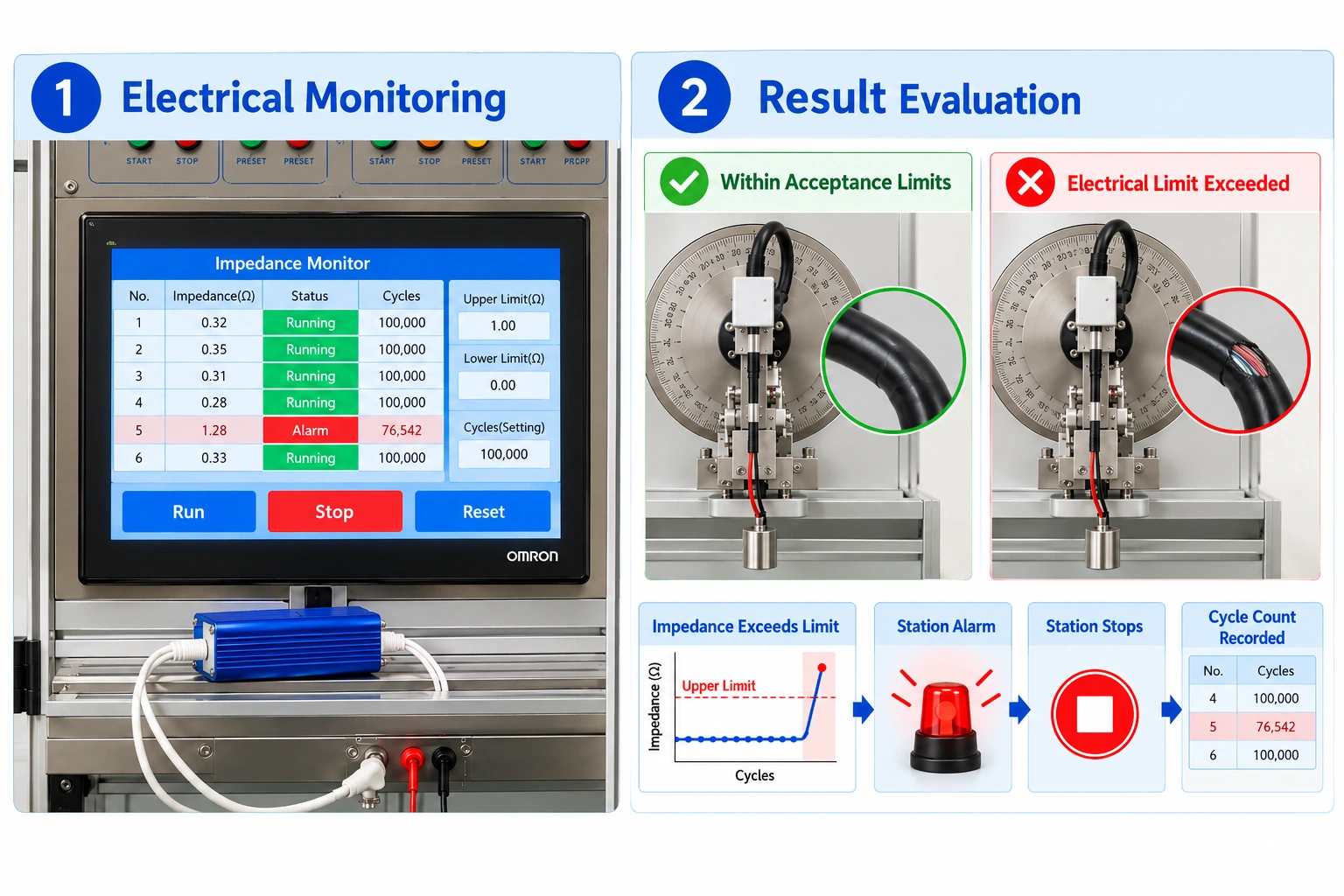
The monitoring system measures electrical impedance during testing. When a value exceeds its configured limits, the corresponding station stops and indicates the event.
- Touchscreen and PLC Control
An OMRON touchscreen and MITSUBISHI PLC control the test process. A THINGET touchscreen supports impedance monitoring and limit settings.
Equipment Structure and Control System
The RS-8116-6A consists of a six-station testing unit and a separate control cabinet.
The main testing unit includes independent rotary stations, specimen fixtures, electrical monitoring connections and an enclosed testing area.
The control cabinet houses the touchscreen interfaces, station controls and emergency stop.
The test fixture determines how the programmed angular movement is applied to the specimen. Fixture selection must therefore follow the specimen drawing and required test procedure.
![RS-8116-6A six-station wire bending tester with independent servo drives and separate control cabinet]()
How Does the Wire Bending Tester Work?
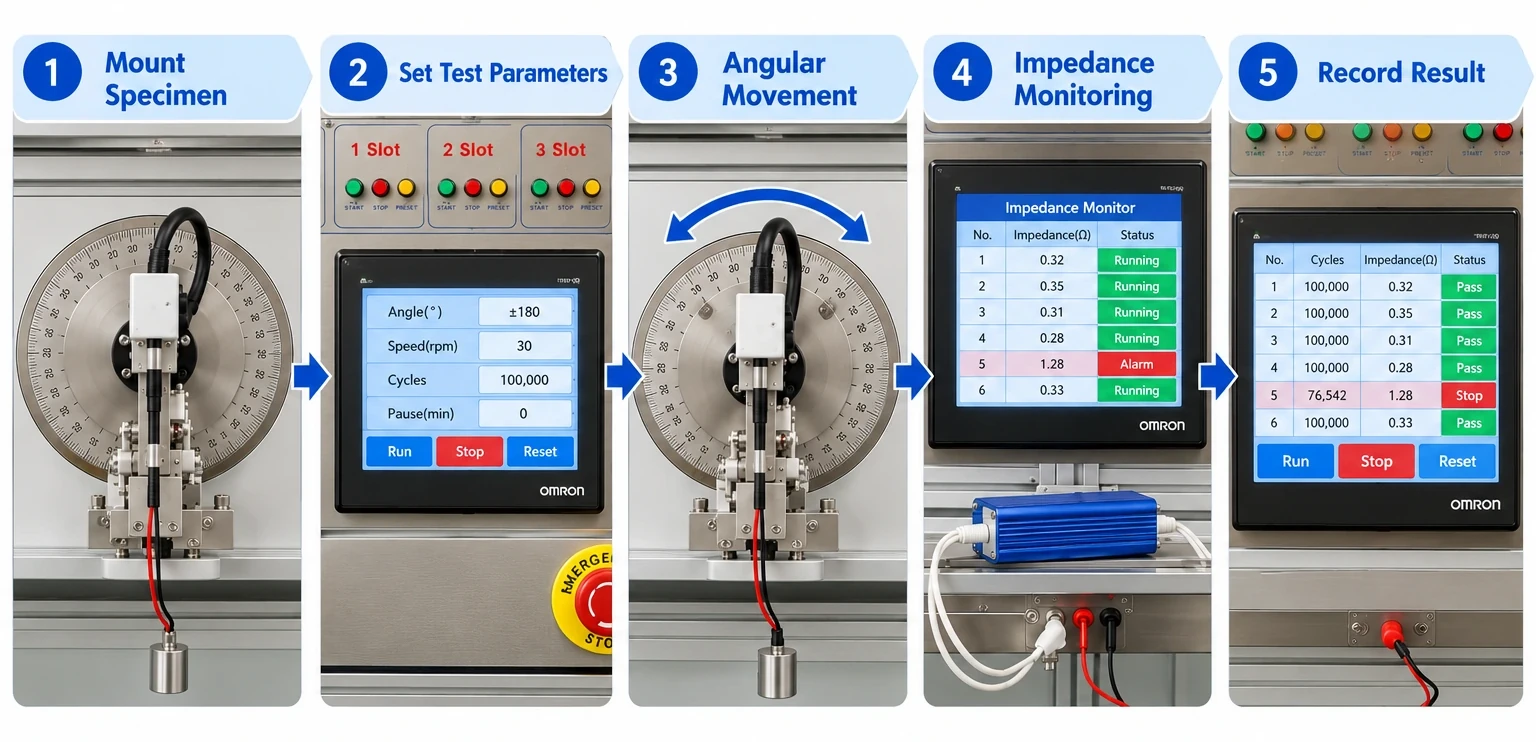
The RS-8116-6A applies repeated angular movement to a mounted specimen while monitoring its electrical condition.
Step 1 — Mount the Specimen
Secure the specimen in the appropriate fixture and connect the required electrical monitoring leads.
Step 2 — Set the Test Parameters
Enter the movement angle, rotational speed, target cycle count and pause conditions.
Step 3 — Start Repeated Movement
The servo-driven station performs the programmed angular motion.
Step 4 — Monitor Electrical Response
The impedance monitoring system compares measured values with the configured upper and lower limits.
Step 5 — Record the Test Result
If a monitored value exceeds the limits, the corresponding station stops and indicates the event. The completed cycle count can be recorded for evaluation.
![]()
Technical Specifications
| Parameter |
Specification |
| Model |
RS-8116-6A |
| Test Stations |
6 independent stations |
| Control System |
OMRON touchscreen + MITSUBISHI PLC |
| Impedance Monitoring |
THINGET touchscreen and impedance monitoring module |
| Drive System |
6 Panasonic AC servo motors |
| Gear Reduction |
6 Shimpo planetary reducers |
| Test Speed |
1–60 rpm ±0.5 rpm |
| Test Angle |
Common configurations: 0 to ±95° or 0 to ±180° |
| Minimum Angle Display |
1° |
| Test Cycle Range |
1–999,999 cycles |
| Batch Pause Interval |
1–10 minutes |
| Rotary Disk Diameter |
Ø210 mm |
| Supplied Weights |
6 each of 113 g, 227 g and 454 g |
| Main Unit Dimensions |
W1780 × D860 × H1600 mm |
| Control Cabinet Dimensions |
W720 × D500 × H1700 mm |
| Machine Weight |
Approximately 555 kg |
| Power Supply |
AC 220 V, 50 Hz, 10 A |
Note: Specifications are based on the RS-8116-6A technical document. Confirm the required test angle, fixture configuration and electrical monitoring requirements before ordering.
What Failures Can Wire Bending Testing Detect?
Repeated angular movement can affect the electrical and mechanical condition of a wire-related component.
A conductor or electrical connection becomes open during repeated movement.
Measured electrical impedance exceeds the configured acceptance limits.
Repeated movement affects a conductor termination or connection area.
Cracking, deformation or other visible damage develops in the specimen.
The RS-8116-6A monitors electrical impedance and indicates limit-exceeding events. Mechanical damage must be assessed through specimen inspection or additional measurements.
![]()
Wire bending, cable flexing and cable torsion tests apply different forms of mechanical movement. The equipment should be selected according to the specimen and required test method.
| Comparison |
RS-8116-6A Wire Bending Tester |
Cable Flexing Tester |
Cable Torsion Tester |
| Test Movement |
Repeated angular movement |
Repeated cable flexing |
Twisting around an axis |
| Typical Specimen |
Ear hooks and compatible assemblies |
Flexible cables |
Torsion-resistant components |
| Test Fixture |
Angular movement fixture |
Bending fixture |
Rotational clamps |
| Electrical Monitoring |
Online impedance monitoring |
Model-dependent |
Model-dependent |
| Test Stations |
6 independent stations |
Model-dependent |
Model-dependent |
| Selection Factors |
Angle, fixture, impedance limits |
Bend radius, load, cycles |
Twist angle, torque, cycles |
This table compares test methods rather than claiming identical performance between equipment models.
Which Testing Standards Apply?
The RS-8116-6A technical document identifies an Apple Inc. test SOP as the design basis for TWS earphone ear-hook twist testing.
Customer / OEM Test Procedures
Define the specimen, movement angle, speed, test cycles, electrical limits and acceptance criteria.
Cable and Connector Test Standards
May specify particular bending or torsion methods, fixtures and loading conditions. Applicability must be verified against the actual test arrangement.
Confirm the required standard and revision before selecting the machine. Repeated angular movement alone does not establish compliance with a specific cable testing standard.
How to Select the Right Wire Bending Tester Configuration
Configuration selection begins with the specimen and test procedure.
Before requesting a quotation, confirm:
-
Specimen: Product type, dimensions and drawing
-
Test Movement: Bending or twisting direction and angle
-
Test Speed: Required rotational speed
-
Test Cycles: Target repetitions and counting definition
-
Electrical Monitoring: Number of circuits and impedance limits
-
Fixture: Clamping positions and specimen mounting requirements
-
Test Quantity: Number of specimens tested per run
-
Acceptance Criteria: Electrical and mechanical failure conditions
For example, a TWS earphone ear hook and a USB cable assembly may require different fixtures and movement definitions.
ITM-LAB can review the specimen drawing and required procedure before confirming the RS-8116-6A configuration.
Request an RS-8116-6A Test Configuration
ITM-LAB manufactures wire and cable testing equipment for product development and quality-control applications.
Send your specimen drawing, test procedure and electrical monitoring requirements. Our engineering team can review the required movement, fixture arrangement and machine configuration before quotation.
Contact ITM-LAB: https://www.itm-lab.com/contact.html