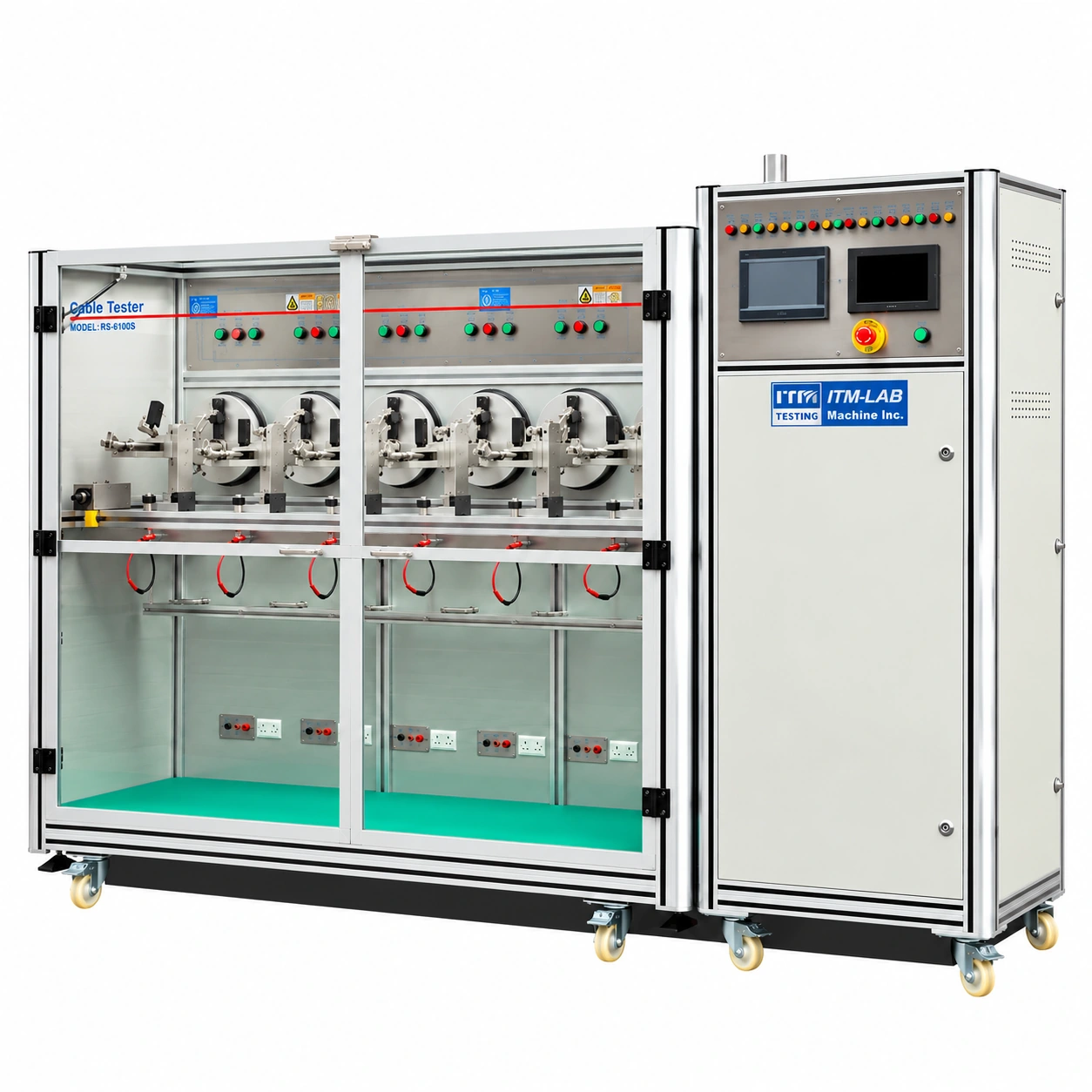
The RS-8116-6B Cable Bending Tester is equipped with a 6-station impedance monitoring system, designed for bending durability and conduction tests of earphone, USB, multi-core and communication cables. Adopting premium Japanese components, it supports independent station operation, real-time impedance monitoring and data export, widely used in electronics, telecom and industrial cable QC and R&D
Share:
Servo-Controlled Cable Flex Life Testing with Real-Time
TheRS-8116-6B Cable Bending Tester is designed to evaluate the bending durability and electrical reliability of cables, wires, connectors, and cable assemblies under repeated flexing.
With six independent test stations, servo-controlled bending, and real-time impedance monitoring, the system can detect electrical changes during the flex test rather than relying only on manual inspection after testing.
It is suitable for USB cables, charging cables, earphone cables, data cables, signal cables, multi-core cables, and other flexible cable assemblies used in electronics and electrical products.
The RS-8116-6B Cable Bending Tester is designed for repeated flex-life and electrical reliability testing of cables that experience frequent bending during everyday use.
Typical Test Specimens
Earphone Cables
USB Cables
Charging Cables
Flex-life testing around cable ends and connectors.
Mechanical durability and electrical continuity testing.
Repeated bending evaluation for charging cable assemblies.
Data Cables
Multi-Core Cables
Signal & Communication Cables
Monitor electrical performance during repeated flexing.
Evaluate conductor fatigue and internal wire breakage.
Verify mechanical durability and connection reliability.
From consumer electronics cables to multi-core assemblies, the RS-8116-6D combines repeated bending with real-time electrical monitoring.
How Does a Cable Bending Test Work?
Cable bending testing simulates the repeated flexing a cable experiences during everyday use. The RS-8116-6B combines controlled mechanical bending with real-time electrical monitoring to evaluate both flex life and conductor reliability.
Test Process
01 — FIX & LOAD
02 — SET PARAMETERS
03 — REPEATED BENDING
04 — MONITOR IMPEDANCE
05 — DETECT & RECORD
Secure the cable and apply the specified load.
Set angle, speed, cycles and electrical limits.
Servo-controlled left/right bending begins.
Continuously monitor electrical resistance.
Detect abnormal conditions and record failure cycles.
What Does the Test Tell You?
The test determines not only how many bending cycles the cable can withstand, but also when its electrical performance begins to deteriorate.
Mechanical Flexing → Electrical Monitoring → Failure Detection → Test Data
Real-Time Impedance Monitoring
Detect Electrical Failure During the Flex Test
Mechanical appearance alone does not always reveal cable failure.
Repeated bending may cause internal conductor fatigue, partial strand breakage, unstable electrical contact, or eventually complete conductor failure while the external cable jacket still appears intact.
The RS-8116-6B combines mechanical bending with real-time electrical monitoring.
Depending on the configured test method, operators can define electrical monitoring criteria such as:
Reference resistance
Upper resistance limit
Lower resistance limit
Allowed resistance change
Failure threshold
During testing, the system continuously monitors the electrical condition of the specimen.
When a configured failure condition is reached, the corresponding station can be identified and the abnormal test condition recorded.
Why This Matters
A conventional flex-life test may tell you:
“The cable completed 50,000 bending cycles.”
Electrical monitoring helps answer the more important question:
“Was the cable still electrically reliable after those 50,000 cycles?”
This makes the RS-8116-6B particularly useful for cable assemblies where electrical continuity and mechanical durability must be evaluated together.
Six Independent Test Stations
The RS-8116-6B features six test stations for simultaneous cable durability testing. Each station operates independently, allowing multiple specimens to be evaluated under controlled test conditions without unnecessary interruption.
Built for Higher Test Efficiency
R&D Validation
Quality Control
Compare cable designs, materials, connectors and test conditions.
Test multiple production samples efficiently and consistently.
Supplier Comparison
Reliability Testing
Compare cable assemblies from different suppliers under the same conditions.
Collect flex-life and electrical failure data across multiple specimens.
Six Stations. More Test Data. Less Waiting.
Run multiple specimens in parallel instead of testing cables one by one—helping laboratoriesincrease throughput while maintaining controlled and repeatable test conditions.
Programmable Cable Flex Test Conditions
Different cables require different flex test conditions. The RS-8116-6B allows operators to configure the test according to the specimen, test method, and required failure criteria.
Configure the Test Around Your Cable
Bending Angle
Bending Speed
Test Cycles
Set the required flexing angle.
Control the repeated bending rate.
Define the required flex-life cycles.
Dwell Time
Electrical Limits
Failure Criteria
Configure dwell conditions where required.
Set resistance limits for real-time monitoring.
Define when electrical abnormality is considered a failure.
Flexible Test Setup for Different Requirements
Adjust mechanical test conditions and electrical failure criteria to support different cable designs, test procedures, and internal quality-control requirements.
Technical Specifications
Parameter
Specification
Model
RS-8116-6B
Product Type
Cable Bending / Cable Flex Tester
Number of Test Stations
6
Test Motion
Repeated Left / Right Bending
Drive System
AC Servo Drive
Station Control
Independent
Electrical Monitoring
Real-Time Impedance Monitoring
Failure Detection
Automatic
Bending Angle
According to actual RS-8116-6B specification
Test Speed
According to actual RS-8116-6B specification
Cycle Setting
According to actual RS-8116-6B specification
Test Load
According to actual RS-8116-6B specification
Control Interface
Touchscreen Control
Data Output
Available
Typical Specimens
USB, charging, earphone, data, signal and multi-core cables
Power Supply
According to actual RS-8116-6B specification
Machine Dimensions
According to actual RS-8116-6B specification
Note: Test fixtures, loads, electrical monitoring configuration, and test parameters should be selected according to the specimen and required test procedure.
Cable Flex Testing for Different Reliability Requirements
Cable bending requirements vary significantly depending on the product.
A thin earphone cable and a multi-core industrial signal cable may require completely different:
Fixture configurations
Bending angles
Applied loads
Test speeds
Cycle counts
Electrical failure criteria
For this reason, cable flex testing equipment should be configured around the actual cable construction and test objective, rather than selected by cycle count alone.
Where an industry standard, customer specification, or internal QC procedure is required, ITM-LAB can configure the test setup according to the applicable test conditions.
How to Select the Right Cable Bending Tester
Before selecting a cable flex tester, define the following test conditions.
1 — Cable Type
USB, charging, earphone, data, signal, multi-core, or another cable assembly?
↓
2 — Cable Diameter
What is the cable diameter and construction?
↓
3 — Connector / Termination
Where should the cable be held and where is the fatigue point?
↓
4 — Bending Angle
What left/right bending angle is required?
↓
5 — Applied Load
What load should be applied to the cable during testing?
↓
6 — Bending Speed
What test speed is specified?
↓
7 — Test Cycles
How many bending cycles are required?
↓
8 — Electrical Failure Criteria
Should conductor resistance or continuity be monitored during testing?
↓
SELECT TEST CONFIGURATION
The correct cable bending tester configuration should reproduce the required mechanical loading and electrical failure criteria as closely as possible.
Why Choose ITM-LAB for Cable Testing Equipment?
From specimen evaluation to test setup and after-sales support, ITM-LAB helps laboratories and manufacturers build the right cable reliability testing solution.
Cable Evaluation
Fixture Configuration
Test Setup
Custom Requirements
Technical Support
Review cable size, connector structure and fatigue points.
Select or customize fixtures for different cables and connectors.
Configure angle, speed, load, cycles and electrical monitoring.
Support customer-specific reliability and internal QC procedures.
Installation, operation, training and after-sales technical support.
From Test Requirement to Complete Configuration
Cable → Fixture → Test Conditions → Electrical Monitoring → Test Solution
Tell us what you need to test, and our engineers will help configure the appropriate machine, fixture and test conditions for your application.
Custom Test Requirements
Support customer-specific reliability and internal QC test procedures.
Technical Support
Provide installation, operation, test setup, and after-sales technical support.
Tell Us About Your Cable Test
Send us your cable and test requirements. Our engineers will recommend the appropriate machine configuration, fixture, load, and test setup.
Test Information
Your Requirement
Cable / Product Type *
USB / Charging / Earphone / Data / Signal / Multi-Core / Other
Cable Diameter
______ mm
Connector Type
__________________
Bending Angle *
______ °
Applied Load
______ g / N
Test Speed
______ cycles/min
Required Test Cycles *
______ cycles
Electrical Monitoring
☐ Continuity ☐ Resistance / Impedance ☐ Not Sure
Cable Drawing / Photo
Upload File
Additional Requirements
______________________________
What types of cables can be tested?
The tester is suitable for USB cables, Type-C cables, charging cables, earphone cables, communication cables, power cords, automotive wires, medical cables, ribbon cables, flat cables, and other flexible multi-core cables.
Can each testing station run independently?
Yes. Each of the six stations operates independently and can be configured with different testing parameters.
How is cable failure detected?
The machine continuously monitors impedance using a four-wire bridge measurement system. Once the preset resistance limit is exceeded, the corresponding station automatically stops and records the failure.
Can the machine perform continuous rotation?
Yes. Unlimited rotation is available when equipped with the optional concentric fixture.
Is customized fixture design available?
Yes. We provide customized fixtures for different cable sizes and testing requirements.
Can testing data be exported?
Yes. Test records can be stored and exported via USB for quality analysis and reporting.
Which standards can the tester comply with?
The machine can be configured according to IEC, UL, customer specifications, and internal factory testing standards.
Do you provide overseas technical support?
Yes. We provide online technical support, installation guidance, operator training, and lifetime after-sales service.