Product Overview
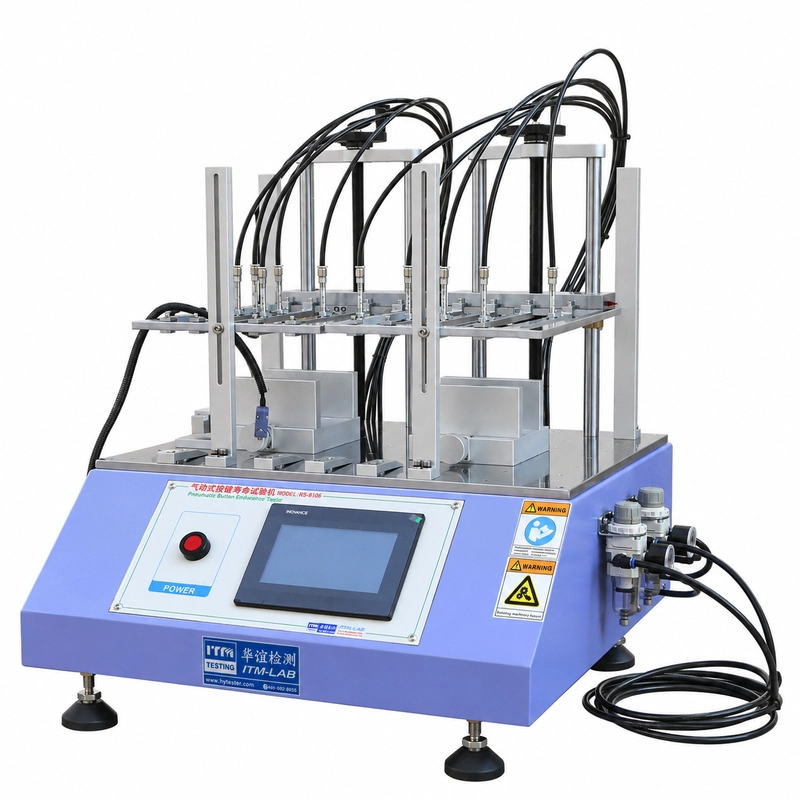
The ITM-LAB RS-8330A-2 Pneumatic Button Life Tester is designed for repeated durability testing of buttons and switches in electronic components and finished devices.
With 2 independent stations and 10 pneumatic test heads, the system supports simultaneous multi-point cycling with controlled force and programmable timing. Each test channel can monitor switch continuity; when a failure is detected, the corresponding cylinder stops and retains the cycle count.
Performance
| 10 Test Heads | 0.5–1.5 kgf | Up to 150 cycles/min | 999,999 Cycles |
|---|---|---|---|
| 2 Independent Stations | Pressing Force | Maximum Test Speed | Programmable Count |
Built for Parallel Button Life Testing
- 10-Head Simultaneous Testing
Two independent stations with five test heads per station allow multiple buttons or test points to be cycled simultaneously.
- Independent Failure Detection
Each test channel monitors switch continuity during cycling. If a button fails, the corresponding cylinder stops and retains the failure cycle count.
- Controlled & Calibrated Force
Precision pneumatic regulation provides 0.5–1.5 kgf pressing force. A dedicated load-cell calibration system allows the force of individual cylinders to be checked before testing.
- Flexible DUT Configuration
Adjustable test-head height and spacing accommodate different button locations, while customized fixtures support components and finished electronic devices.
How the RS-8330A-2 Works
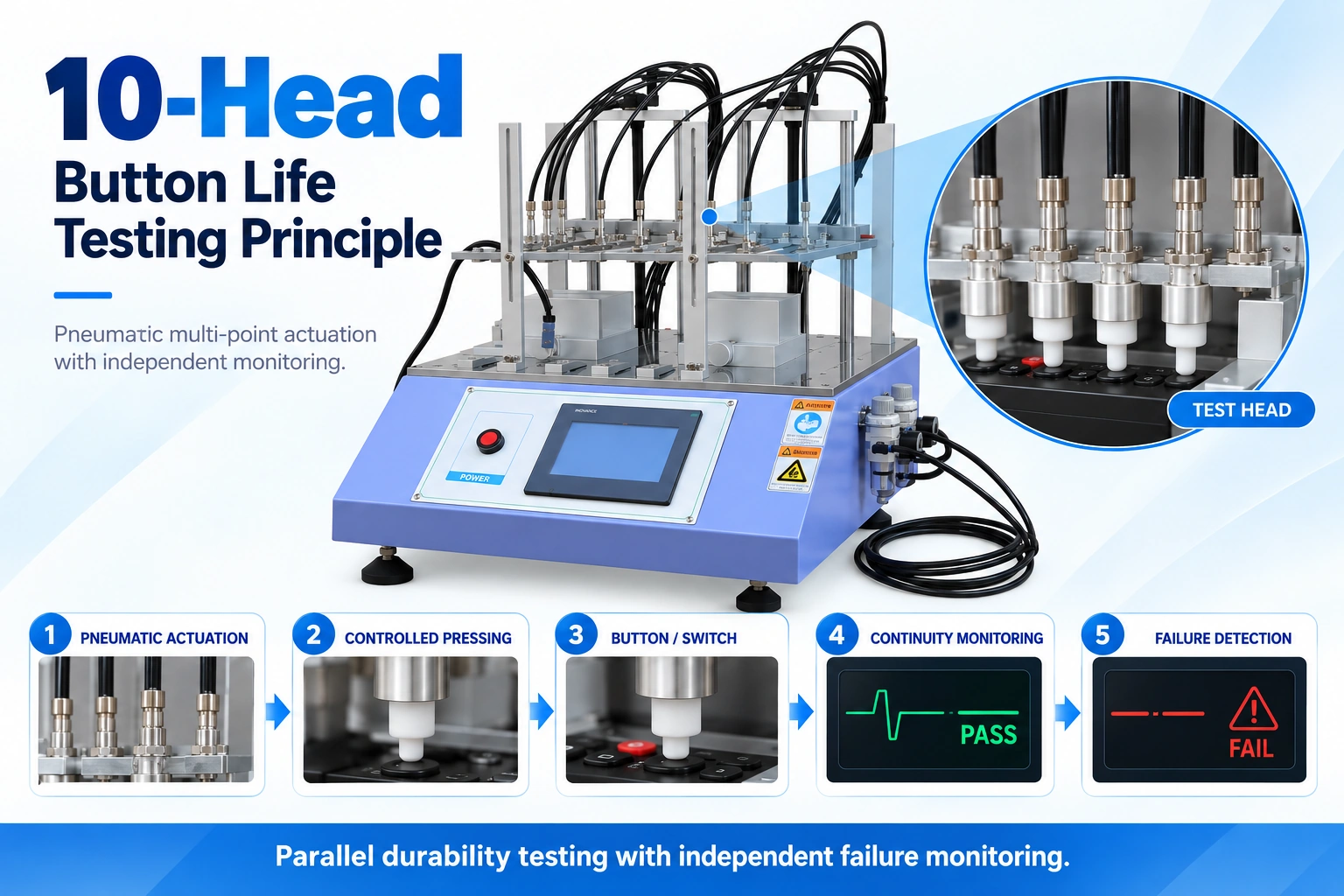
The DUT is secured in the fixture and each test head is aligned with the required button position. Pressing force, press/release time and target cycles are then configured for the test.
Pneumatic cylinders repeatedly actuate the buttons while the system counts each cycle and monitors switch continuity. If a monitored button fails, its corresponding cylinder stops and the failure cycle count is retained.
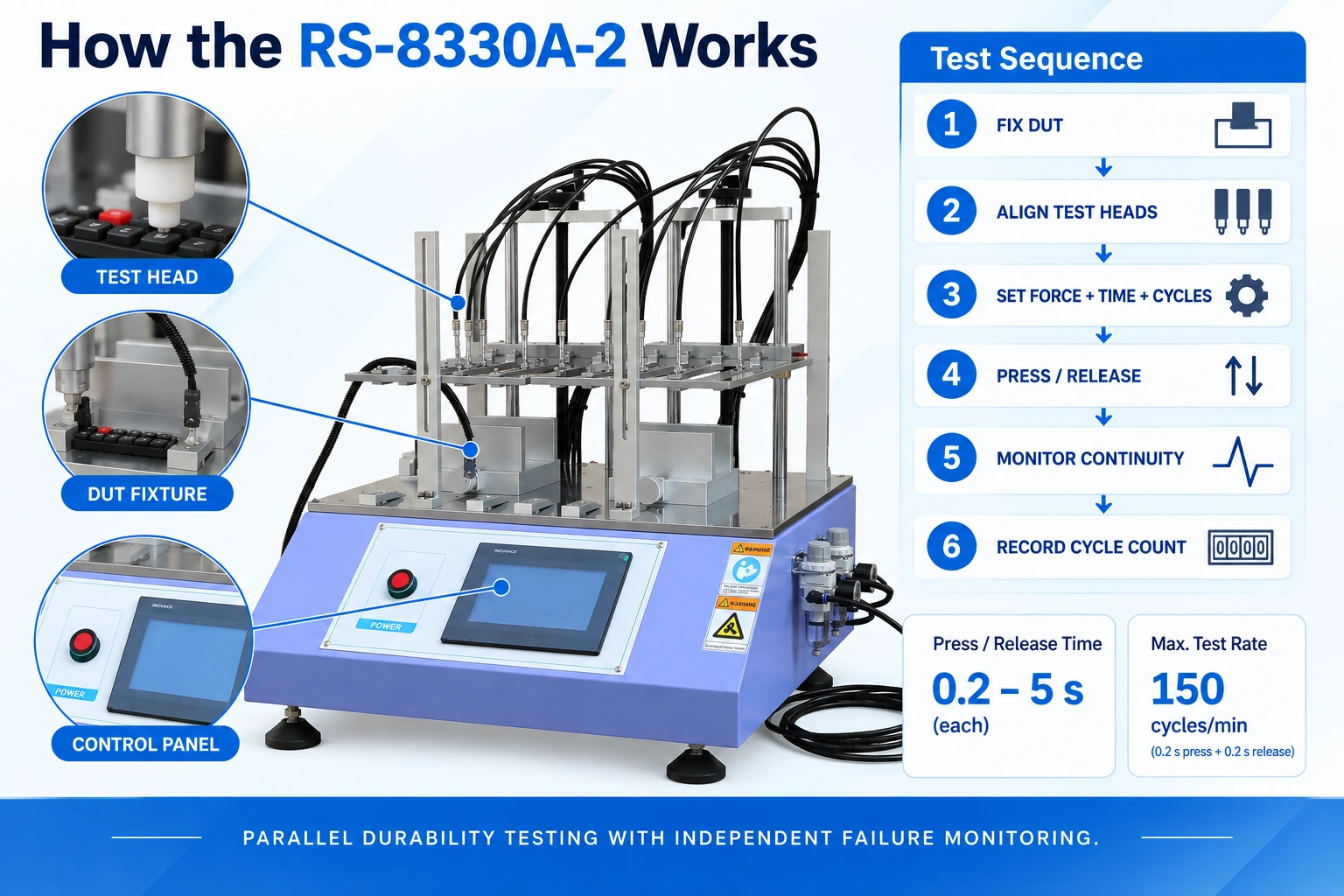
The press and release times can each be set from 0.2 to 5 seconds. The controller calculates the resulting cycling rate; at 0.2 s press + 0.2 s release, the specified maximum rate is 150 cycles/min.
Flexible Test Setup
The RS-8330A-2 is designed around the actual DUT rather than a single fixed button geometry.
| Setup | Capability |
|---|---|
| Test Stations | 2 independent stations |
| Test Heads | 5 per station / 10 total |
| Head Position | Adjustable height and spacing |
| Horizontal Fixture Range | 30–150 mm |
| Max. Vertical Fixture Size | 290 × 210 × 10 mm |
| Sample Fixture | Customized to DUT |
The fixture dimensions and customization information above are specified in the supplied configuration list.
Technical Specifications
| Parameter | RS-8330A-2 |
|---|---|
| Test Stations | 2 |
| Test Heads | 10 pcs — 5 per station |
| Pressing Force | 0.5–1.5 kgf |
| Force Accuracy | ±5% F.S. |
| Pneumatic Cylinder Stroke | 10 mm |
| Test Speed | 10–150 cycles/min |
| Pressing Time | 0.2–5 s |
| Release Time | 0.2–5 s |
| Cycle Setting | 0–999,999 |
| Continuity Monitoring | 10 channels |
| Control System | PLC + 7" TFT touch screen |
| Pneumatic Components | SMC |
| Force Calibration | Digital indicator + Load Cell |
| Air Supply | ≥0.6 MPa |
| Power Supply | AC 220 V, 5 A |
| Dimensions | W780 × D460 × H580 mm |
| Weight | 75 kg |
Applicable Test Standards
-
YD/T 1539-2019 — Mobile Telecommunication Handset Reliability
-
GB/T 15092.1-2020 — Switches for Appliances
-
GB/T 15092.101-2020 — Mechanical Switches for Appliances
-
IEC 61058-1 — Switches for Appliances
-
GB 4706.1 / IEC 60335-1 — Household Appliance Safety
-
GB/T 14048.1 — Low-Voltage Switchgear and Controlgear
-
UL 61058-1 — Switches for Appliances
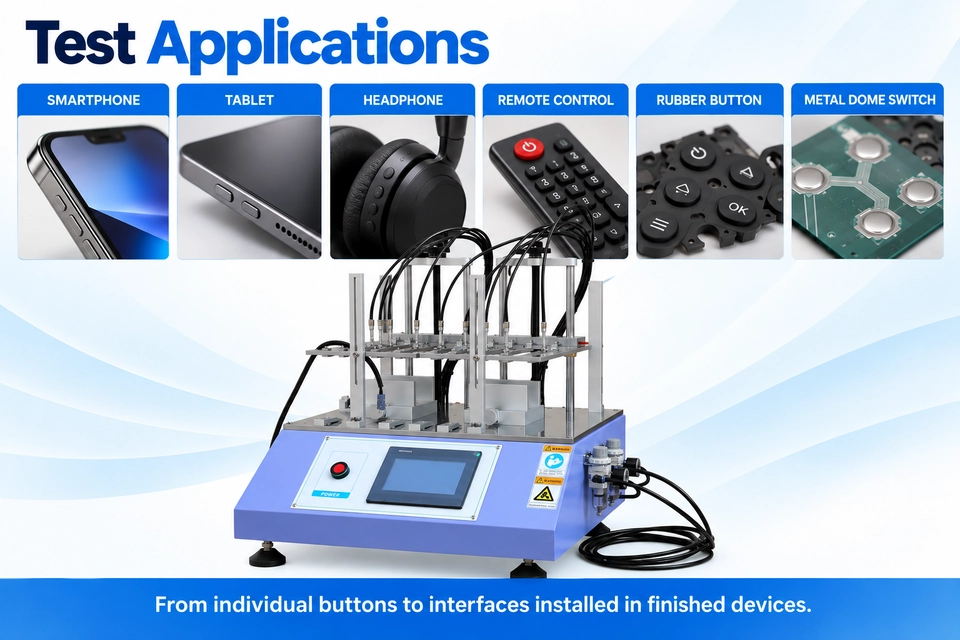
Test Applications
SMARTPHONE → TABLET → HEADPHONE → REMOTE CONTROL → RUBBER BUTTON → METAL DOME SWITCH
Repeated button durability testing—from individual switch structures to buttons installed in finished electronic devices.
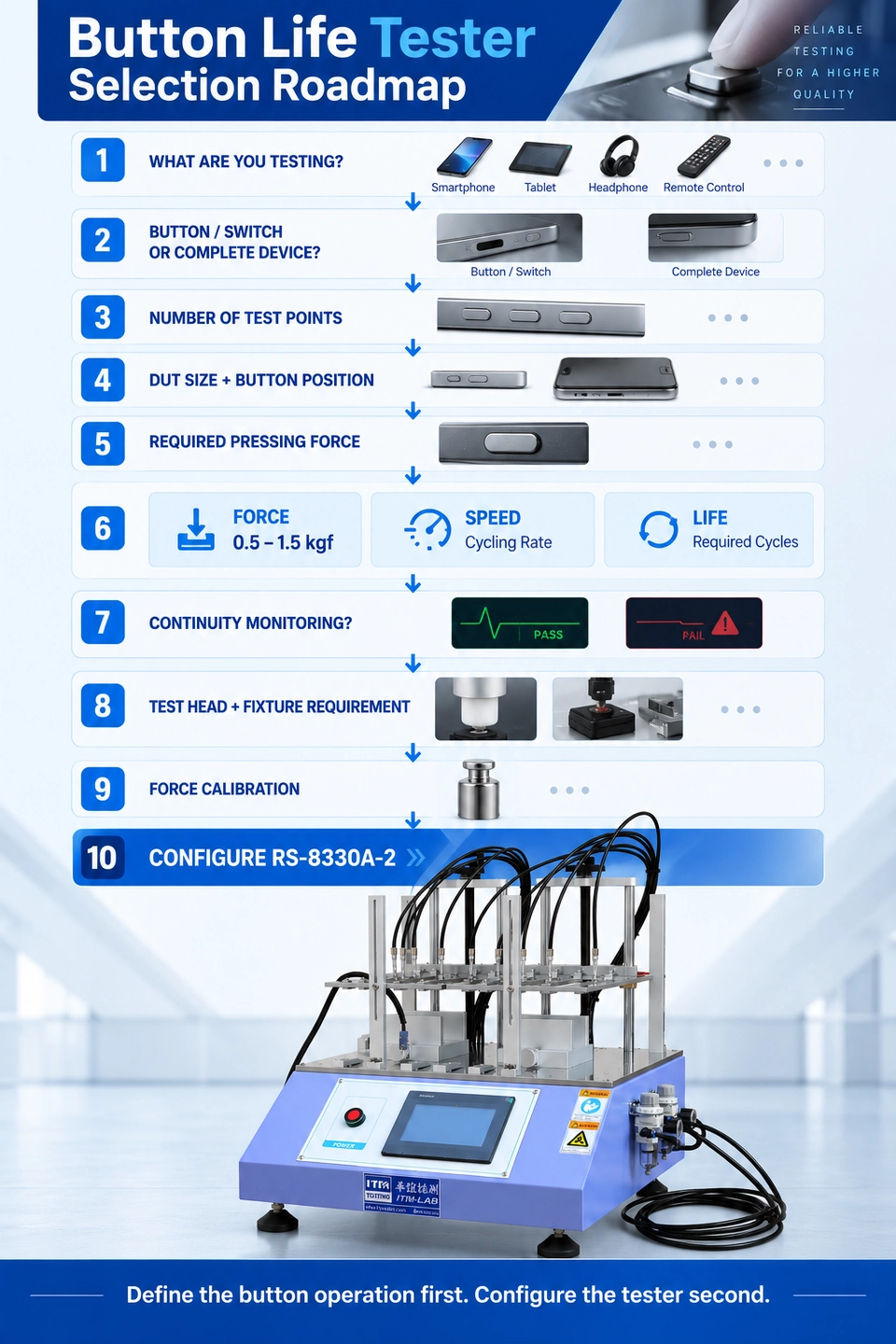
Selecting the Right Test Setup
Define these conditions before configuring the RS-8330A-2 for your application.
| DUT | TEST POINTS | FORCE |
|---|---|---|
| Component or finished device | Number and position of buttons | Required pressing force |
| SPEED | CYCLES | FIXTURE |
| Required cycling rate | Target durability cycles | DUT size and button layout |
Also Confirm
Continuity Monitoring
Is electrical ON/OFF monitoring required during cycling?
Press / Release Timing
Define the required dwell time for each stage of the cycle.
Tell Us Your Test Requirements
Provide the basic test details below so we can confirm the tester and fixture configuration.
| Test Requirement | Your Information |
|---|---|
| Product / Button Type * | ______________________________ |
| DUT Dimensions * | L ____ × W ____ × H ____ mm |
| Number of Test Points * | ____ positions |
| Button Position / Spacing * | ______________________________ |
| Required Pressing Force | ____ N / kgf |
| Required Test Speed | ____ cycles/min |
| Press / Release Time | ____ / ____ s |
| Required Cycles * | ____ cycles |
| Continuity Monitoring | □ Yes □ No |
| Test Standard / Internal Specification | ______________________________ |
| DUT Drawing / Photo | Upload File |
| Additional Requirements | ______________________________ |
Need Help With the Fixture?
Send us a photo or drawing showing the DUT dimensions, button locations and required test points. Our team can review the test arrangement before configuration.
How many buttons can the RS-8330A-2 test at the same time?
The system has two independent stations with five test heads each, providing 10 test heads for parallel durability testing.
Can it detect when an individual button fails?
Yes. Each station provides five continuity-monitoring channels. When a monitored button fails, the corresponding cylinder stops and its cycle count is retained.
What is the available pressing force?
The specified pressing-force range is 0.5–1.5 kgf, with ±5% F.S. force accuracy.
How is the pressing force checked?
A calibration device consisting of a digital indicator and precision load cell is provided to check the pressing force of individual cylinders.
Can it test buttons on finished products?
Yes. The adjustable test heads and customized fixtures support button testing on products such as smartphones, tablets, headphones and other electronic devices.
What is the maximum test speed?
The specified range is 10–150 cycles/min. Actual cycling speed depends on the programmed pressing and release times.