
A drawing calls for “JIS Z 2371, NSS, 480 h.” The parts are zinc-coated automotive brackets, and the laboratory already has a salt spray chamber used for ISO 9227 testing.
Can the same chamber be used?
Possibly—but the standard number alone does not answer the question.
Before setting a temperature or filling the solution reservoir, the laboratory needs to know which JIS Z 2371 method is required, what coating is being evaluated, how the specimens will be loaded, how long the exposure will run, and what specification defines acceptance after the test.
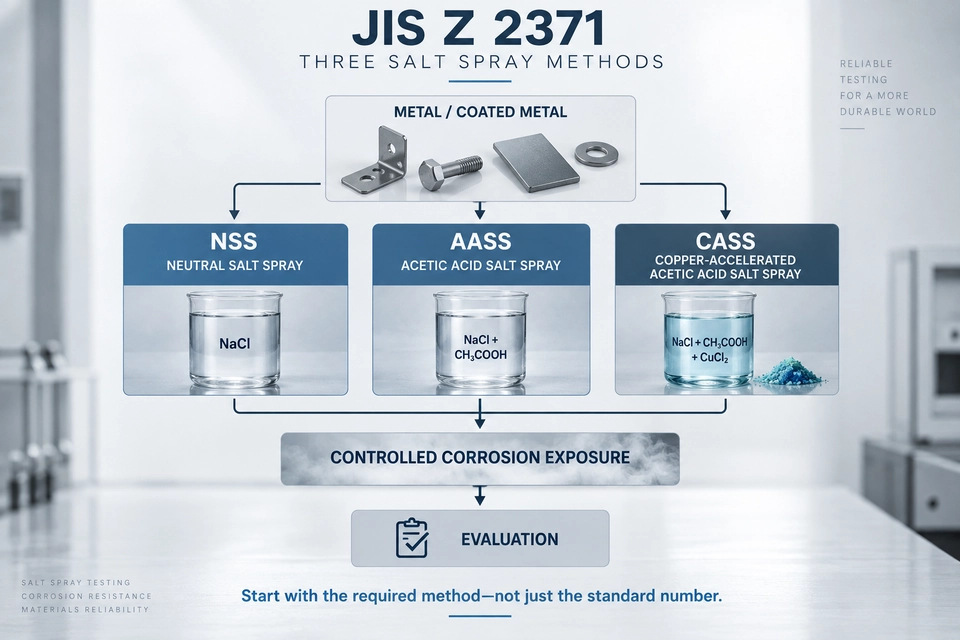
That distinction matters because JIS Z 2371 covers three salt spray methods: NSS, AASS and CASS. They share the same general principle, but they do not use the same test chemistry or operating conditions.
This guide looks at JIS Z 2371 from a practical testing perspective: what the standard covers, how the three methods differ, where it is used, how it compares with ISO 9227, and what to check when selecting a salt spray test chamber.
What Is JIS Z 2371?
JIS Z 2371:2015, Methods of salt spray testing, is a Japanese Industrial Standard for assessing the corrosion resistance of metallic materials and metallic materials protected by electroplating, inorganic films or organic coatings such as paint.
It defines the salt solutions, apparatus and procedures used for three methods:
NSS — Neutral Salt Spray
AASS — Acetic Acid Salt Spray
CASS — Copper-Accelerated Acetic Acid Salt Spray
The standard also addresses test specimens, test conditions, evaluation of results, and methods for checking the reproducibility and corrosivity of the test cabinet.
In other words, JIS Z 2371 is not simply a requirement to spray salt water onto a part. It establishes a controlled corrosion environment that a laboratory should be able to reproduce from one test to the next.
JIS Z 2371:2015 remains an active Japanese standard. It was prepared on the basis of ISO 9227:2012 with modifications to the technical content—a relationship that becomes important when comparing JIS and ISO requirements.
NSS, AASS and CASS: Three Tests Under One Standard
It is easy to talk about a “JIS Z 2371 test” as though it were one fixed exposure. It is more useful to think of JIS Z 2371 as a framework containing three different salt spray methods.
The required method normally comes from the product standard, coating specification, drawing or customer requirement.
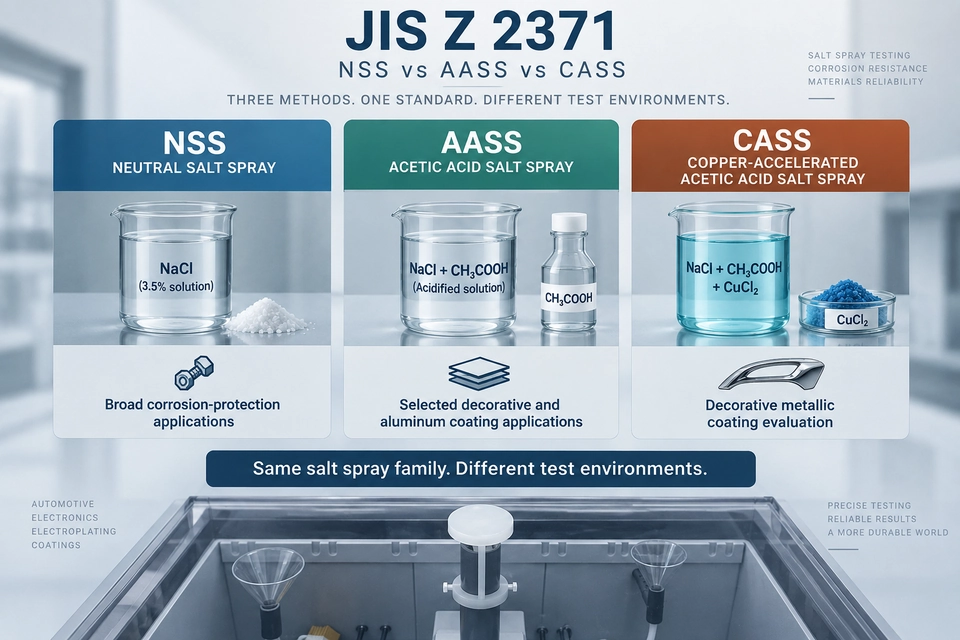
NSS: the general-purpose salt spray method
The Neutral Salt Spray (NSS) test uses a sodium chloride solution under neutral conditions.
Of the three methods, this is the one most engineers encounter first. It is applicable to a broad range of metals and corrosion-protection systems, including metallic coatings, conversion coatings, anodic oxide coatings and organic coatings on metal.
Typical test pieces include zinc-coated fasteners, brackets, painted panels, coated housings and other production parts where the quality of a corrosion-protection system needs to be checked.
NSS is not a direct simulation of years of outdoor or marine exposure. It is a controlled laboratory corrosion test.
AASS: an acidified salt spray
The Acetic Acid Salt Spray (AASS) method changes the chemistry of the test by acidifying the sodium chloride solution with acetic acid.
That distinction is more important than simply saying AASS is “more severe.”
AASS creates a separately defined test environment. It is particularly useful for certain decorative coating systems and can also be applied to anodic and organic coatings on aluminum.
If a drawing calls for AASS, extending the duration of an NSS test is not an equivalent substitute.
CASS: copper-accelerated acidified salt spray
The Copper-Accelerated Acetic Acid Salt Spray (CASS) test adds copper chloride to the acidified salt solution and operates at a higher test-space temperature.
CASS is commonly associated with decorative coating systems such as copper + nickel + chromium and nickel + chromium, as well as selected anodic and organic coatings on aluminum.
For a laboratory, the practical consequence is straightforward: a chamber used only for NSS should not be assumed to be ready for CASS simply because both tests involve salt fog.
Solution chemistry, materials exposed to the solution, temperature capability and the complete chamber configuration need to be checked.
JIS Z 2371 Test Conditions: What Actually Has to Be Controlled?
A salt spray chamber full of visible fog may look convincing through the lid, but fog density by itself says very little about whether the test is under control.
The laboratory has to control the solution chemistry, pH, test-space temperature, atomization and collected fog, while making sure the specimen arrangement does not disturb the intended exposure.
At a practical equipment-selection level, the three methods differ as follows:
| Test Condition | NSS | AASS | CASS |
|---|---|---|---|
| Main solution | Sodium chloride | Sodium chloride | Sodium chloride |
| Acidification | No | Acetic acid | Acetic acid |
| Copper chloride addition | No | No | Yes |
| pH environment | Neutral | Acidic | Acidic |
| Test-space temperature | 35°C class | 35°C class | 50°C class |
| Typical focus | General corrosion protection | Selected decorative / aluminum coatings | Accelerated decorative coating evaluation |
These are selection-level differences, not a replacement for the controlled copy of JIS Z 2371 used by the laboratory. Exact reagent preparation, concentration, pH limits, collection requirements, tolerances and cabinet verification procedures should always be taken from the applicable standard.
Solution chemistry matters
For NSS, getting the sodium chloride concentration right is only part of the job. Water quality, contamination and pH can all affect the exposure.
AASS introduces acetic acid. CASS adds another variable through copper chloride.
Changing from NSS to CASS is therefore not merely a different program on the chamber controller.
Temperature matters
NSS and AASS use a test-space temperature around 35°C, while CASS operates around 50°C.
That difference has a direct impact on equipment capability and configuration.
Fog collection matters
A common mistake is to judge a salt spray chamber by appearance:
“There is plenty of fog, so the test must be working.”
Not necessarily.
The deposited fog needs to be collected and evaluated under the applicable method. A chamber can look densely fogged while the actual collection condition is outside the required range.
Specimen loading matters too
A chamber can physically hold 40 parts and still be a poor test setup for 40 parts.
Consider a row of plated brackets placed too close together. The first parts may shield those behind them. Condensate from an upper specimen may drip onto a lower one. The resulting local exposure is no longer the controlled salt-fog condition the method intends.
For production laboratories, usable capacity is therefore not simply a matter of internal chamber volume.
Spacing, orientation and fog access matter.
How long is a JIS Z 2371 test?
There is no universal answer such as “JIS Z 2371 requires 500 hours.”
A customer may specify 24 h, 96 h, 240 h, 480 h, 500 h, 720 h, 1,000 h or another exposure period.
The important distinction is that the salt spray standard defines the test method, while the relevant product, coating, OEM or customer specification normally defines the exposure period and acceptance criteria.
This prevents a surprisingly common purchasing mistake: selecting equipment from the standard number without first defining the actual test program.
JIS Z 2371 vs ISO 9227: Are They the Same?
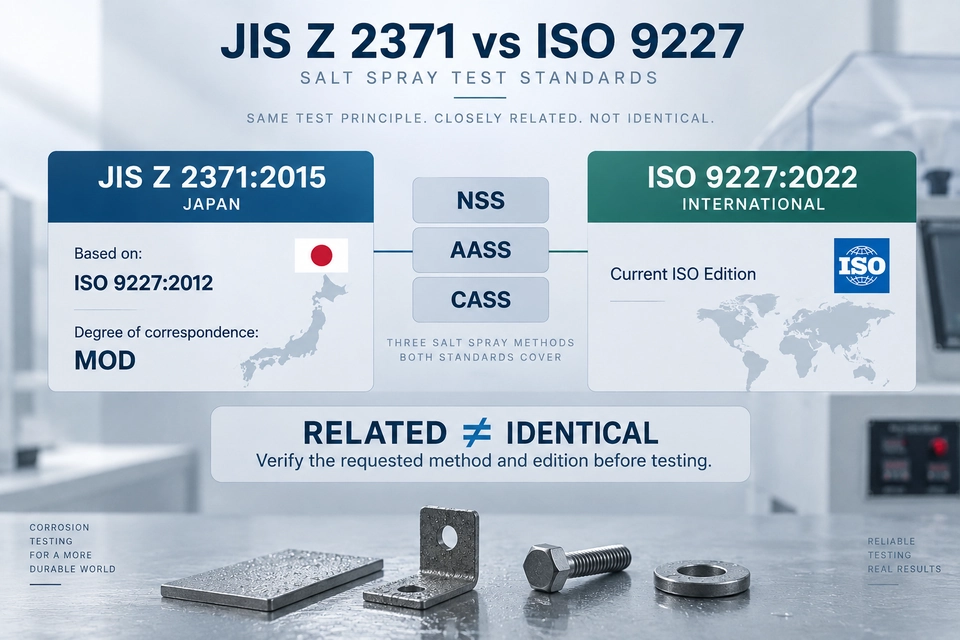
No—but they are closely related.
This distinction matters for laboratories working with both Japanese and international customer specifications.
JIS Z 2371:2015 was prepared on the basis of ISO 9227:2012 with modifications to technical content. Its degree of correspondence is identified as MOD, meaning modified rather than identical.
ISO 9227 has since been revised. The current international edition is ISO 9227:2022, while JIS Z 2371 remains the 2015 edition based on the 2012 ISO document.
The relationship can be summarized like this:
| JIS Z 2371:2015 | ISO 9227:2022 | |
|---|---|---|
| Standards system | Japanese Industrial Standards | International Standard |
| NSS | Yes | Yes |
| AASS | Yes | Yes |
| CASS | Yes | Yes |
| International basis | ISO 9227:2012 | Current ISO edition |
| Degree of correspondence | MOD | — |
| Main principle | Salt spray corrosion testing | Salt spray corrosion testing |
| Automatically interchangeable? | No | No |
The two standards share much of the same test architecture. Both cover NSS, AASS and CASS, and both deal with controlled salt spray corrosion exposure.
But related does not mean identical.
Can an ISO 9227 chamber be used for JIS Z 2371?
Often, the same physical chamber may be capable of supporting both standards.
But capability should be verified against the actual method and applicable edition, not inferred from an ISO 9227 label on the equipment.
Suppose a laboratory owns a chamber configured for ISO 9227 NSS. A Japanese customer then requests JIS Z 2371 CASS.
The question is no longer simply whether the chamber produces salt fog.
The laboratory needs to check the required CASS solution chemistry, test temperature, materials compatibility, fog collection and other applicable JIS requirements.
The reverse is also true. A chamber historically used for JIS Z 2371 should not automatically be declared compliant with the latest ISO 9227 edition without reviewing the current requirements.
Where Is JIS Z 2371 Used?
JIS Z 2371 is relevant wherever a Japanese product specification, customer requirement or supply-chain document calls for salt spray corrosion testing.
The standard is particularly useful for evaluating metals and surface-protection systems, rather than one specific finished product.
In automotive manufacturing, that may mean zinc-coated fasteners, brackets, clips, housings, plated hardware, electrical terminals or decorative trim. The JIS method establishes the exposure environment, while an OEM or component specification may determine how long the part is tested and what level of corrosion is acceptable.
Electronics manufacturers may use salt spray testing on connectors, terminals, metal housings, shielding parts and hardware. A component can remain mechanically intact while corrosion at a contact surface or terminal creates a very different reliability problem.
Electroplating is another natural application. Zinc, nickel, chromium and multilayer decorative coatings can all be evaluated using an appropriate salt spray method. Here, selecting NSS, AASS or CASS becomes especially important because the methods are not intended for exactly the same coating systems.
Painted, powder-coated and anodized components also appear frequently in corrosion test programs. Depending on the governing specification, engineers may look for blistering, substrate corrosion, coating separation, corrosion around an intentional defect or other defined changes after exposure.

What Actually Happens During a JIS Z 2371 Test?
A good salt spray test starts before the chamber starts spraying.
First, the laboratory confirms the governing requirement. “JIS Z 2371” by itself is incomplete; the method, specimen, exposure duration and evaluation requirement need to be known.
The appropriate NSS, AASS or CASS solution is then prepared. The chamber is brought to the required operating condition, and the specimen arrangement is checked before exposure begins.
Specimen placement deserves more attention than it often gets. Parts should not shield one another from the fog, and condensate from one test piece should not fall onto another. Loading the maximum possible number of parts into the chamber is not automatically the same as using the chamber efficiently.
Once exposure starts, the laboratory monitors the conditions that determine whether the test remains valid. Temperature, solution condition and fog collection are more meaningful than simply checking whether mist is visible.
After the specified exposure period, specimens are removed and treated according to the applicable procedure before evaluation.
What happens next depends on the product specification.
One customer may specify an allowable area of red rust. Another may limit white corrosion. A coating specification may require evaluation of blistering or corrosion spread from a scribe.
This is why the salt spray method and the acceptance specification should not be confused.
JIS Z 2371 establishes the exposure method. It does not give every product the same pass/fail criterion.
What Makes Salt Spray Results Unreliable?
Most bad salt spray tests do not fail because somebody forgot to turn on the chamber. The problems are usually less obvious.
One is treating the solution as “close enough.” Salt concentration may receive all the attention while pH, water quality or contamination is overlooked. With AASS and CASS, chemistry becomes even more important.
Another is relying on what the chamber looks like. Visible fog is not a measurement. Collection data is what helps establish whether the intended exposure is actually reaching the specimen zone.
Overloading is another practical problem. Adding another row of parts improves throughput only if the exposure remains valid. Shielding, poor spacing and condensate transfer can compromise the test before the chamber appears physically full.
Temperature can also be misunderstood. A controller displaying the target temperature does not, by itself, prove that every aspect of the test environment is correct. Chamber design, loading and operating stability all contribute to the actual exposure.
Finally, laboratories sometimes assume that NSS capability automatically means CASS capability. It does not. CASS changes both the chemistry and operating conditions, so materials in contact with the solution, temperature capability and overall system configuration need to be reviewed.
These are not minor details. They determine whether hundreds of hours in a chamber produce useful corrosion data—or simply consume hundreds of hours.
Choosing a Salt Spray Chamber for JIS Z 2371
Chamber volume is an easy specification to compare—and one of the easiest to overemphasize.
A 600 L chamber is not automatically the right chamber simply because the parts fit inside it.
For a JIS Z 2371 project, start with four questions.
Which method will you run?
NSS, AASS or CASS?
A laboratory performing only NSS may have different equipment requirements from one that routinely switches between several salt spray methods.
If CASS is required, confirm that the proposed system is actually configured for its chemistry and operating temperature.
What will be inside the chamber?
A flat coating coupon, 50 automotive brackets and one large assembled enclosure create completely different loading conditions.
Useful information includes the specimen dimensions, quantity per batch, material, coating and intended orientation.
How long will the test run?
A laboratory performing short QC exposures has a different operating pattern from one running 500- or 1,000-hour qualification programs.
Long-duration tests put more emphasis on solution supply, continuous operation, maintenance access and stability.
What does the customer specification add?
JIS Z 2371 may be only one line in a much larger requirement.
An OEM drawing or coating specification may add a particular exposure duration, specimen preparation method, inspection requirement or acceptance criterion.
The chamber should be selected against the complete requirement.
Configuring an ITM-LAB YWX/T Salt Spray Test Chamber
For a JIS Z 2371 project, the standard number alone is not enough for a useful equipment recommendation.
The ITM-LAB YWX/T Salt Spray Test Chamber can be configured around the required salt spray method and specimen load. Depending on the selected configuration, the platform can support salt spray test requirements associated with standards such as JIS Z 2371, ISO 9227 and ASTM B117.
The final configuration should always be confirmed against the requested test method rather than assuming that every chamber version performs every salt spray test.
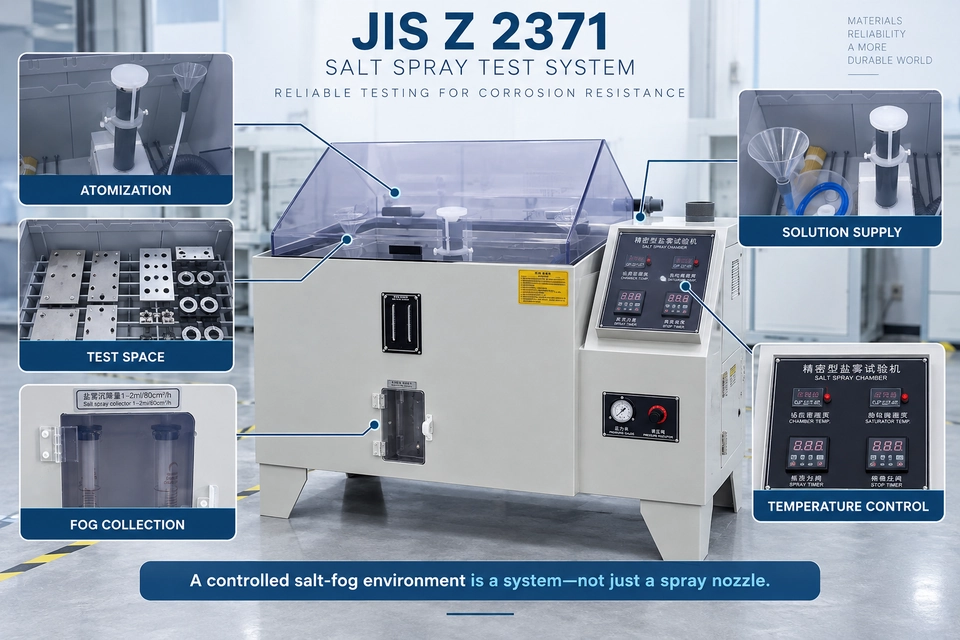
The test space uses corrosion-resistant construction for sustained salt-fog exposure. The system integrates solution supply, atomization, temperature control and fog collection so the laboratory can control the exposure rather than simply generate mist.
Specimen capacity should then be matched to the actual test load.
If a customer plans to test 30 automotive brackets in every batch, for example, we need the bracket dimensions, orientation and required spacing—not just a requested chamber volume. That allows the working space and specimen arrangement to be considered together.
Where AASS or CASS is required, that information should be provided before configuration so the relevant chemistry, temperature and system requirements can be reviewed.
A Practical Selection Example
Consider an automotive supplier that receives this requirement:
Standard: JIS Z 2371
Method: NSS
Product: Zinc-coated automotive bracket
Exposure: 480 h
Batch: 30 parts
There is still not enough information to select a chamber.
The next questions are physical.
How large is each bracket? How will it be oriented? How much spacing is required between specimens? Will all 30 parts be tested in one batch? What rack or fixture is needed?
Then come the evaluation questions.
What corrosion condition is the customer looking for after 480 hours? Is red rust the acceptance criterion? Is white corrosion evaluated separately? Is there an OEM specification in addition to JIS Z 2371?
Once those questions are answered, chamber selection becomes much more meaningful.
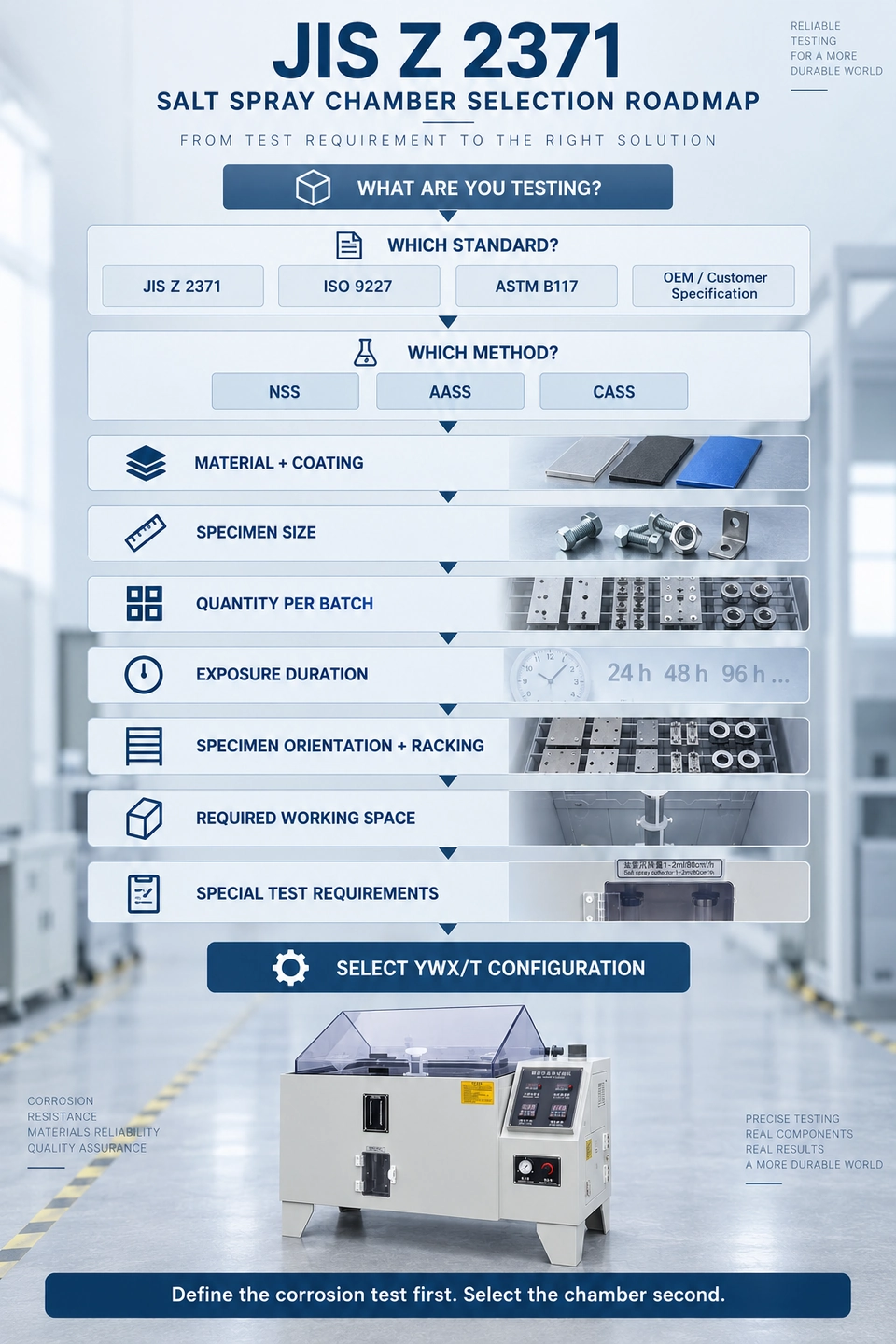
The engineering logic is:
JIS Z 2371
↓
NSS
↓
ZINC-COATED AUTOMOTIVE BRACKET
↓
480 h
↓
30 PARTS
↓
PART SIZE + ORIENTATION
↓
WORKING SPACE
↓
CHAMBER CONFIGURATION
Notice what did not happen.
We did not begin by asking whether the customer wanted a 270 L, 600 L or 1,000 L chamber.
The test defined the equipment—not the other way around.
JIS Z 2371 FAQ
Is JIS Z 2371 the same as ISO 9227?
No. JIS Z 2371:2015 was prepared on the basis of ISO 9227:2012, but its degree of correspondence is MOD, meaning that technical modifications exist.
ISO 9227 has also subsequently been revised. The current international edition is ISO 9227:2022.
Laboratories should therefore verify the standard and edition specified by the customer instead of treating JIS Z 2371 and ISO 9227 as interchangeable names.
Can an ISO 9227 salt spray chamber perform JIS Z 2371 testing?
Potentially, yes—but this should be verified against the specific JIS Z 2371 method and chamber configuration.
A chamber capable of ISO 9227 NSS, for example, should not automatically be assumed to meet every requirement for JIS Z 2371 CASS.
Check the required solution chemistry, temperature, fog collection, materials compatibility and other applicable conditions.
How long does a JIS Z 2371 salt spray test last?
There is no single exposure time for every product.
The required duration is normally defined by the product specification, coating specification, OEM requirement, drawing or customer test plan. This is why requirements such as 96 h, 240 h, 480 h, 500 h or 1,000 h may all appear alongside JIS Z 2371.
Can the same chamber perform NSS, AASS and CASS?
A suitably configured system may support multiple methods, but this should not be assumed.
AASS and especially CASS introduce different chemical and operating requirements. Tell the chamber manufacturer exactly which methods the laboratory intends to run before the equipment configuration is finalized.
Final Takeaway
If a drawing says JIS Z 2371, do not start by choosing a chamber size.
Start by asking which method is required: NSS, AASS or CASS?
Then define the material and coating, specimen dimensions, batch quantity, exposure duration, orientation and acceptance specification.
Only then does chamber selection become an engineering decision rather than a catalog comparison.
JIS Z 2371 and ISO 9227 are closely related, but they are not simply two names for the same document. JIS Z 2371:2015 is a modified adoption based on ISO 9227:2012, while the international standard has since advanced to ISO 9227:2022.
For laboratories working across Japanese and international customer programs, one rule is especially useful:
Verify the test method and edition first. Configure the equipment second.
Need to Configure a Salt Spray Chamber for JIS Z 2371?
Send ITM-LAB your test standard, NSS/AASS/CASS method, specimen material and coating, dimensions, quantity per batch, required exposure time, and customer or OEM specification.
Our engineering team can use those details to recommend an appropriate YWX/T salt spray test chamber configuration for the actual test program.
