

IEC 60068-2-11:2021 defines Test Ka: Salt mist, an environmental corrosion test used for electrotechnical products, components, equipment and materials exposed to a controlled salt-laden environment.
It is commonly used to compare metallic materials with or without corrosion protection and to evaluate the quality and uniformity of protective coatings.
But a valid IEC 60068-2-11 test is more than “spray salt water for a certain number of hours.”
A connector, a plated terminal and a coated enclosure may enter the same chamber, yet the engineering question can be completely different.
For a connector, the concern may be contact resistance.
For a plated terminal, it may be coating breakdown.
For an enclosure, it may be visible corrosion, blistering or loss of function.
That is why a useful salt mist test plan starts with the DUT and the acceptance criteria—not with the chamber catalogue.
Standard → DUT → Exposure → Failure Mode → Evaluation → Equipment
IEC 60068-2-11 at a Glance
| Item | IEC 60068-2-11 |
|---|---|
| Current Edition | IEC 60068-2-11:2021 |
| Edition | 4.0 |
| Test Designation | Test Ka |
| Environment | Salt mist |
| Main Purpose | Comparative corrosion resistance |
| Typical DUT | Components, coatings, metallic parts, electrical equipment |
| Main Equipment | Salt Spray / Salt Mist Test Chamber |
| Evaluation | Corrosion, coating condition and functional performance |
IEC 60068-2-11:2021 replaced the earlier 1981 edition.
The newer edition includes technical updates covering areas such as salt solution preparation, pH measurement conditions, atomization-related parameters, reporting and evaluation of test apparatus.
For laboratories still using older internal procedures, checking the standard edition should be one of the first steps before testing.
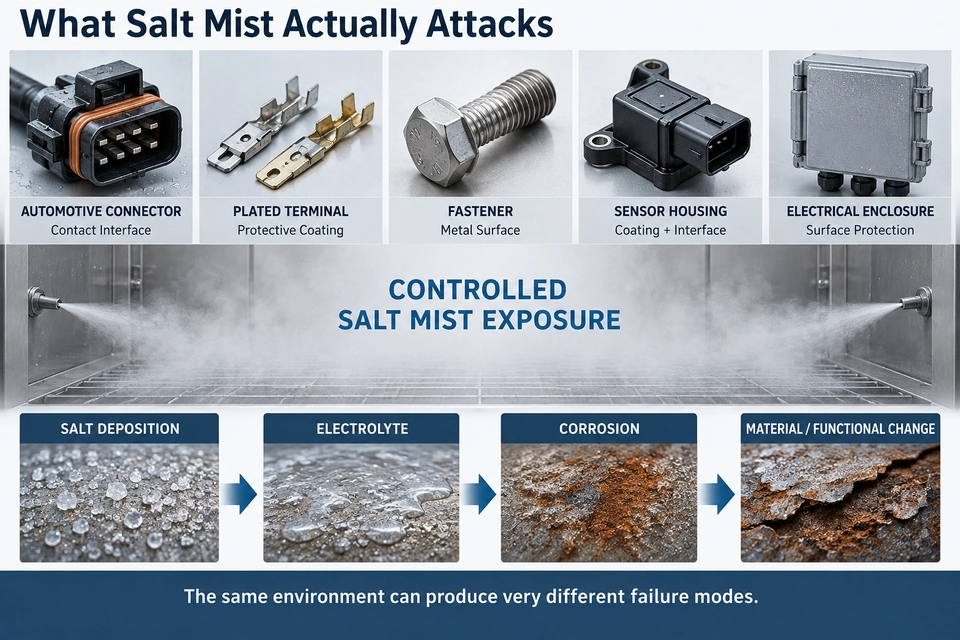
What IEC 60068-2-11 Is Designed to Reveal
Salt mist testing is sometimes reduced to one question:
Did the specimen rust?
That is too narrow for many real products.
IEC 60068-2-11 can be used to assess several forms of deterioration.
Surface Corrosion
Bare or exposed metallic surfaces may develop visible corrosion products, discoloration or localized attack.
Typical examples include:
- screws;
- brackets;
- terminals;
- housings;
- exposed steel edges.
Coating Breakdown
A plated or coated surface may look uniform before testing while still containing weak areas.
Salt mist exposure can reveal:
- thin coating regions;
- pores;
- discontinuities;
- local coating damage;
- substrate exposure.
Localized Attack
Pitting or edge corrosion may be more important than overall surface discoloration.
This is particularly relevant where small local defects can affect long-term reliability.
Electrical Degradation
For connectors, switches, terminals and relays, visible corrosion may not be the most important result.
A component can look relatively acceptable while contact resistance or electrical performance has already changed.
Mechanical Degradation
Salt exposure may also affect mechanical behavior.
Fasteners may seize.
Moving parts may become harder to operate.
Coatings may blister or lose adhesion.
So the real question is not simply:
“How much corrosion appeared?”
It is:
“Did the DUT still meet the requirement that matters?”
Inside a Test Ka Salt Mist Exposure
A salt spray chamber creates a controlled corrosive environment by atomizing the specified sodium chloride solution into a fine mist.
The test is best understood as a sequence.
1. Define the Requirement
Before the chamber starts, confirm:
- applicable standard and edition;
- product or customer specification;
- specimen type;
- exposure requirement;
- pre-test measurements;
- specimen orientation;
- acceptance criteria.
A request such as:
“Run a 96-hour salt spray test.”
is not yet a complete engineering requirement.
The DUT, evaluation method and pass/fail condition still need to be defined.
2. Establish the Baseline
Before exposure, document the initial specimen condition.
Depending on the product, this may include:
- photographs;
- coating condition;
- contact resistance;
- electrical function;
- mechanical operation;
- visible defects;
- dimensional checks.
This baseline makes the post-test result easier to interpret.
3. Prepare the Specimen
Surface condition matters.
Fingerprints, machining residue, cleaning chemicals or handling damage can influence corrosion behavior.
For plated or coated specimens, poor preparation can create localized failures that do not represent normal product performance.
Specimen preparation should therefore be treated as part of the test—not as a minor setup step.
4. Install the DUT Correctly
Specimen arrangement affects exposure.
Check:
- spacing;
- orientation;
- shielding;
- rack design;
- access of the mist;
- direct condensate dripping;
- interaction between different materials.
A chamber can be large enough in litres and still be poorly loaded.
For small terminals, rack area may matter more than total chamber volume.
For a large enclosure, clearance around the DUT becomes more important.
5. Generate a Stable Salt Mist
The chamber should create a controlled exposure—not simply a dense-looking fog.
The complete system must support stable:
- solution supply;
- compressed-air conditions;
- atomization;
- temperature;
- mist distribution;
- collection;
- drainage and condensate handling.
A visible cloud of mist does not by itself prove that the test is valid or repeatable.
6. Complete the Exposure
The specimen remains in the defined environment for the required exposure period.
The duration should come from the applicable product specification, customer requirement or qualification program.
Do not select a duration simply because another company uses:
24 h, 48 h, 96 h or 168 h.
Longer exposure does not automatically mean better testing.
7. Recover and Evaluate the DUT
After exposure, the specimen is recovered and inspected according to the applicable procedure.
Possible evaluation criteria include:
- red rust;
- white corrosion products;
- pitting;
- blistering;
- peeling;
- discoloration;
- contact resistance;
- insulation performance;
- mechanical operation;
- functional performance.
A specimen can have:
Visual PASS + Functional FAIL
or:
Visible Surface Change + Functional PASS
depending on the product requirement.
The acceptance criteria should therefore be defined before testing begins.
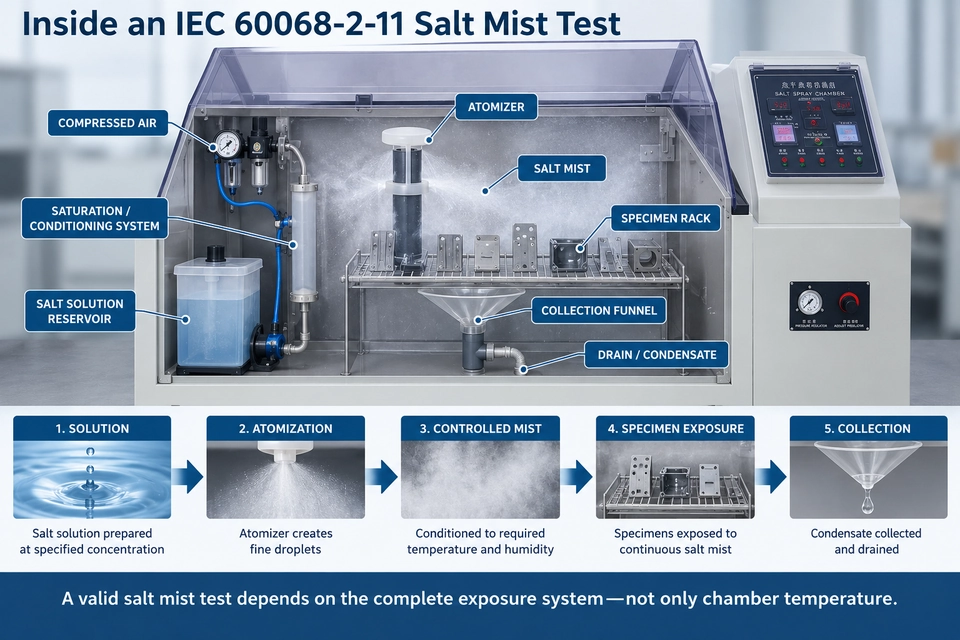
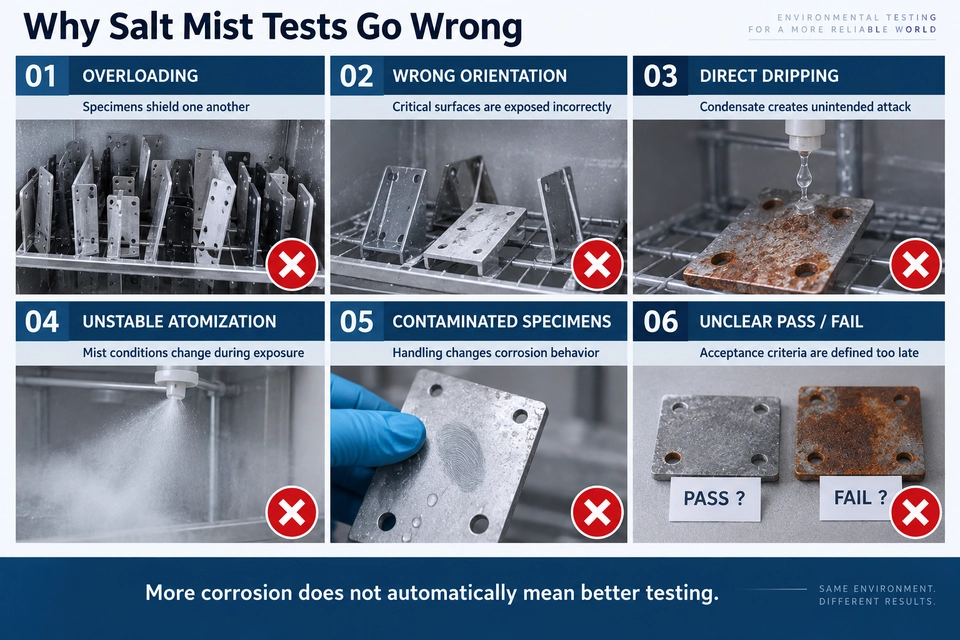
Test Conditions That Actually Affect the Result
Two laboratories can use chambers with similar nominal specifications and still obtain different corrosion patterns if the exposure setup is poorly controlled.
Several practical variables matter.
Specimen Orientation
The position of the DUT influences mist deposition and condensate behavior.
Changing the angle may change which areas are most heavily exposed.
Specimen Spacing
Packing more specimens into the chamber may improve apparent throughput while reducing test quality.
If one specimen shields another, the exposure becomes less consistent.
Direct Dripping
Condensate falling directly from a chamber surface or another specimen can create a local condition different from controlled mist exposure.
Atomization Stability
A spray system that changes during a long test can alter deposition across the run.
Repeatability matters, especially for qualification and comparison work.
Chamber Loading
An almost empty chamber and a heavily loaded chamber do not necessarily behave the same way.
Capacity should therefore be evaluated using the actual specimen layout.
Surface Condition
A fingerprint or small coating defect can become the starting point for localized attack.
Poor handling can easily be mistaken for poor product performance.
Recovery and Inspection
Different cleaning, drying or inspection practices can also affect the final interpretation.
The chamber is only the middle of the test sequence.
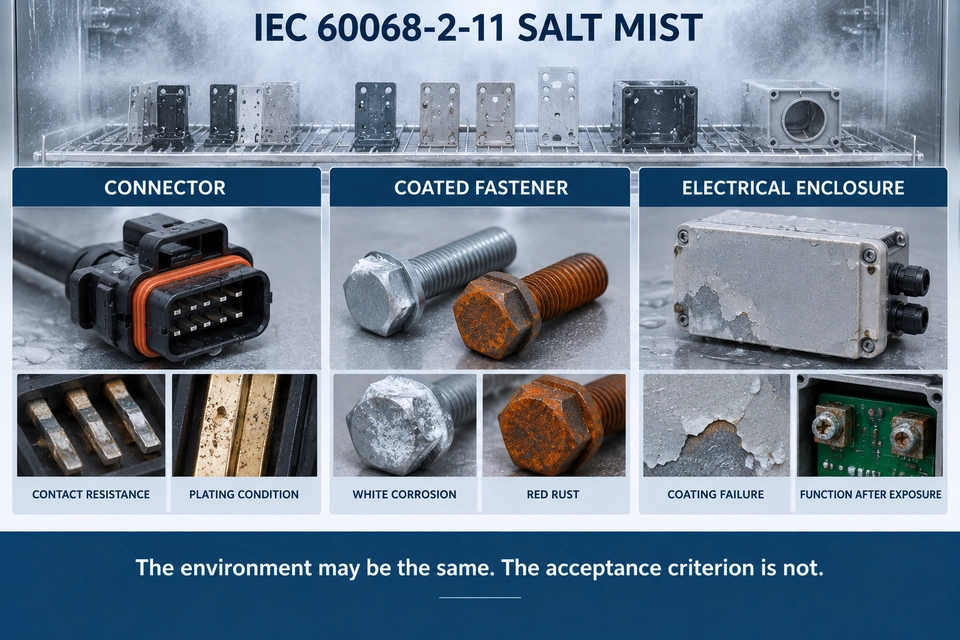
From Connectors to Coated Hardware
IEC 60068-2-11 is especially relevant to electrical, electronic and electromechanical products where corrosion can affect appearance, protection or function.
| Application | Typical DUT | What Engineers Usually Evaluate |
|---|---|---|
| Automotive Electronics | ECU connectors, terminals, sensor housings | Contact corrosion, plating attack |
| Automotive / E-Mobility Components | Connectors, terminals, plated hardware | Interface and surface corrosion |
| Telecom Equipment | Outdoor connectors, cabinets, mounting hardware | Salt-laden atmosphere resistance |
| Industrial Control | Relays, switches, terminals, sensors | Electrical function after exposure |
| Consumer Electronics | Ports, frames, metallic accessories | Cosmetic and interface corrosion |
| Electrical Equipment | Enclosures, brackets, screws, terminals | Coating protection and substrate attack |
| Coated Components | Plated and finished metallic parts | Porosity, coating defects, localized attack |
A connector manufacturer may focus on:
Contact Resistance + Plating Condition
A fastener manufacturer may focus on:
White Corrosion + Red Rust
An enclosure manufacturer may focus on:
Coating Failure + Surface Corrosion + Function
Same chamber.
Different engineering result.
Why Salt Mist Results Can Be Misleading
Salt mist testing is useful because it creates a controlled corrosive environment.
It should not be treated as a universal lifetime conversion.
A statement such as:
“48 hours in salt spray equals two years outdoors.”
should not be used as a general engineering rule.
Real environments include additional variables such as:
- wet/dry cycles;
- sunlight;
- temperature changes;
- pollutants;
- mechanical wear;
- natural salt deposition;
- installation orientation.
IEC 60068-2-11 is therefore best used as a controlled qualification or comparative test under a defined requirement.
It is not a universal service-life calculator.
Another misconception is that more corrosion automatically means a more severe or better test.
Not necessarily.
If excessive attack is caused by poor mist distribution, direct condensate or an overloaded chamber, the result may simply be less repeatable.
Severity without control is not useful repeatability.
IEC 60068-2-11 vs IEC 60068-2-52
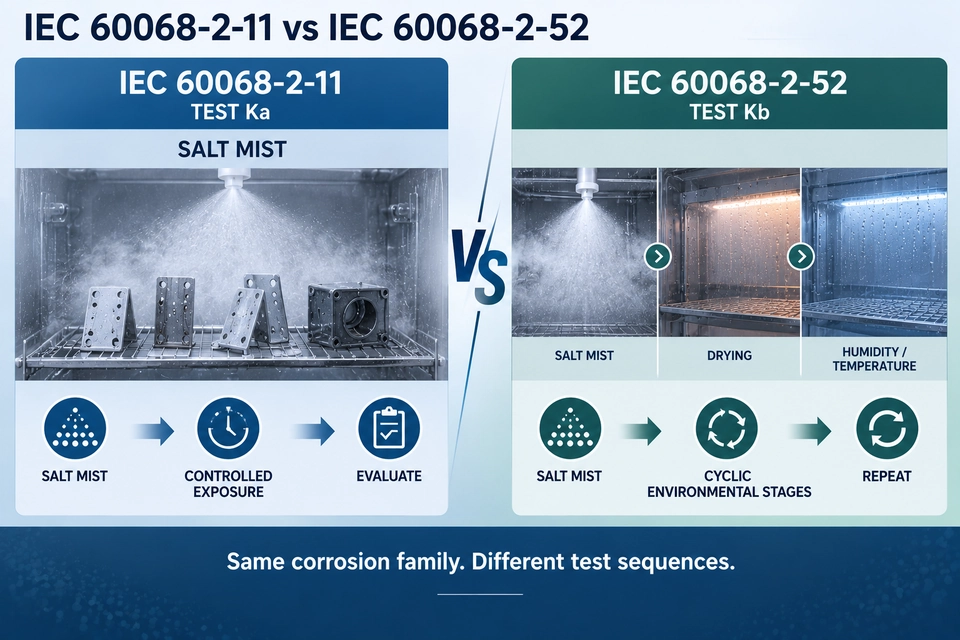
These standards belong to the same IEC environmental testing family, but they use different test concepts.
IEC 60068-2-11
Test Ka — Salt mist
IEC 60068-2-52
Test Kb — Salt mist, cyclic
| IEC 60068-2-11 | IEC 60068-2-52 | |
|---|---|---|
| Test | Ka | Kb |
| Method | Salt mist | Cyclic salt mist |
| Main Concept | Controlled salt mist exposure | Salt mist combined with cyclic environmental stages |
| Typical Use | Comparative corrosion / coating evaluation | Components and equipment exposed to salt-laden environments |
| Equipment Direction | Salt Spray Chamber | Cyclic / Compound Corrosion Chamber |
This difference matters when selecting equipment.
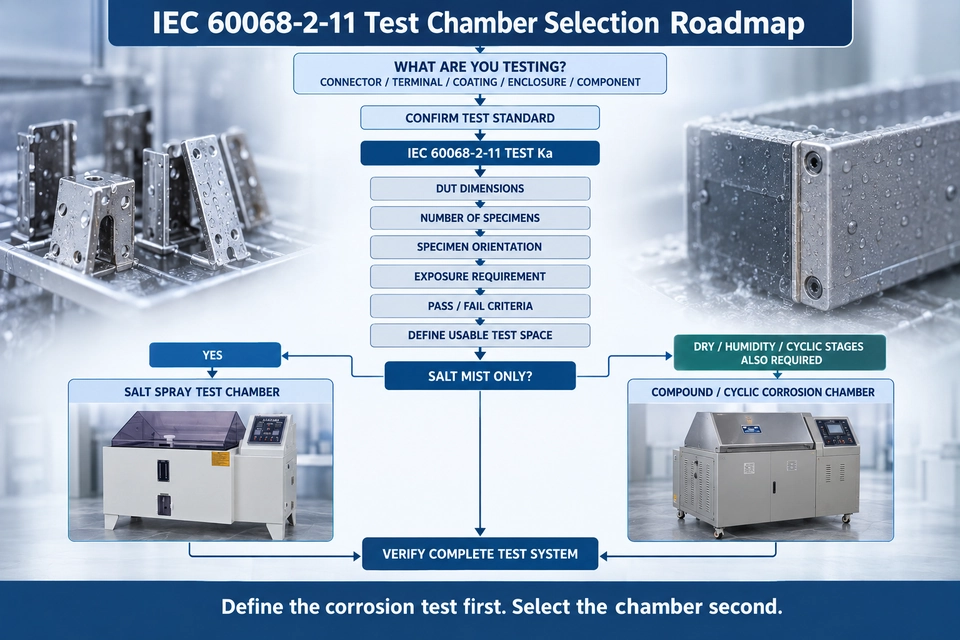
If Test Ka is the only requirement, a conventional salt spray chamber may be sufficient.
If the laboratory also needs controlled drying, humidity or other cyclic stages, a compound corrosion chamber becomes more appropriate.
IEC 60068-2-11 vs ASTM B117 and ISO 9227
IEC 60068-2-11 is often discussed together with ASTM B117 and ISO 9227.
The test environments may be related, but the standards should not be treated as interchangeable.
| Standard | Main Context | Test Family |
|---|---|---|
| IEC 60068-2-11 | Electrotechnical products and materials | Test Ka salt mist |
| ASTM B117 | Corrosion testing of metals and coated metals | Salt spray / fog practice |
| ISO 9227 | Metallic materials and corrosion protection | NSS / AASS / CASS |
| IEC 60068-2-52 | Electrotechnical components and equipment | Cyclic salt mist |
From an equipment perspective, one chamber may support several methods.
From a testing perspective, each standard still needs to be followed individually.
That distinction matters.
A chamber should not simply be described as:
“IEC / ASTM / ISO compliant.”
A better question is:
Which exact methods can this chamber configuration run, and under what conditions?
Choosing the Chamber Around the DUT
When a customer requests:
“IEC 60068-2-11 salt spray chamber”
the first question should not be:
“What volume do you need?”
It should be:
“What are you testing?”
The DUT determines much of the chamber configuration.
Start with Specimen Dimensions
Record:
Length × Width × Height
For irregular products, include:
- cables;
- mounting hardware;
- handles;
- brackets;
- fixtures.
A DUT that physically fits inside the cabinet may still leave too little space for proper exposure.
Define the Quantity
One enclosure and 200 plated terminals create very different loading conditions.
For small components:
Rack area + spacing may matter more than chamber litres.
For larger DUTs:
Clearance + mist access become more important.
Confirm Specimen Orientation
How will the specimen be held?
Rack?
Suspended?
Custom fixture?
Horizontal support?
The holder should:
- resist corrosion;
- avoid contamination;
- maintain the required angle;
- avoid unwanted galvanic effects;
- allow mist access.
The fixture is part of the test system.
Usable Test Space vs Nominal Chamber Volume
Chamber volume is easy to compare.
Usable test space is more meaningful.
Imagine two chambers with the same nominal volume.
One allows:
- proper rack spacing;
- good clearance;
- easy fixture installation;
- repeatable specimen arrangement.
The other forces the DUTs too close together after racks and internal structures are installed.
Both chambers may be listed as:
1000 L
but their useful test capacity is not the same.
For that reason, equipment selection should start with:
DUT dimensions + quantity + fixture + orientation
not just:
“Please quote a 1000 L chamber.”
Salt Mist Only or Cyclic Corrosion?
The required environmental sequence should determine the machine type.
Program A
IEC 60068-2-11 Test Ka only
Equipment direction:
Salt Spray / Salt Mist Test Chamber
Program B
IEC 60068-2-11 + ASTM B117 + ISO 9227 NSS
Equipment direction:
A conventional salt spray chamber may be suitable if the requested methods are supported by the complete configuration.
Program C
Salt Mist + Dry + Humidity Cycles
Equipment direction:
Compound / Cyclic Corrosion Test Chamber
Program D
Multiple Present and Future Corrosion Programs
Equipment direction:
Evaluate the complete laboratory test roadmap.
Additional functions can reduce future equipment duplication—but only when they match real testing requirements.
Buying the largest or most complex chamber the budget allows is rarely the best strategy.
Buy for the test program—not for the specification sheet.
Practical Example: Automotive Connector
Suppose the inquiry says:
“We need a salt spray tester for IEC 60068-2-11.”
That is not enough information for equipment selection.
A better technical discussion looks like this:
DUT
Automotive connector
↓
Critical Area
Plated terminal and contact interface
↓
Quantity
80 specimens per batch
↓
Installation
Rack-mounted
↓
Method
IEC 60068-2-11 Test Ka
↓
Exposure
Defined by customer qualification requirement
↓
Evaluation
Visual corrosion + contact resistance
Now the supplier can evaluate:
- rack area;
- chamber size;
- specimen spacing;
- fixture materials;
- operating duration;
- solution requirements;
- post-test handling.
Change the DUT to a large coated enclosure and almost every equipment decision changes.
Same standard.
Different DUT.
Different configuration.
Practical Example: Plated Fasteners
Now consider hundreds of small plated fasteners.
The first instinct may be:
Buy a larger chamber.
But the real limitation may be:
rack area + specimen spacing + repeatable orientation
not total internal volume.
In this case, a well-designed specimen holder may improve throughput more effectively than simply increasing chamber size.
This is why selection should begin with the test layout.
IEC 60068-2-11 Test Chamber Selection Roadmap
Five Questions to Ask Before Buying a Salt Spray Chamber
1. Can the Installed DUTs Be Exposed Without Excessive Shielding?
Do not calculate capacity from litres alone.
2. How Will the Test Condition Be Verified?
Stable operation matters more than visible fog density.
3. Is the Fixture Suitable for a Corrosive Environment?
The wrong holder can contaminate the test or alter the specimen condition.
4. Does the Laboratory Really Need Cyclic Capability?
If Test Ka is the only requirement, additional functions may add cost without adding test value.
5. What Does PASS Mean?
Visual corrosion?
Red rust?
Contact resistance?
Electrical function?
Mechanical operation?
That answer should exist before the test starts.
IEC 60068-2-11 FAQ
What is IEC 60068-2-11?
IEC 60068-2-11 defines Test Ka: Salt mist, an environmental corrosion test for electrotechnical products, components, equipment and materials.
The current edition is IEC 60068-2-11:2021, Edition 4.0.
Is IEC 60068-2-11 the same as ASTM B117?
No.
Both involve controlled salt spray environments, but they are separate standards with different scopes and procedures.
A chamber may support both methods, but the tests should not be treated as identical.
What is the difference between IEC 60068-2-11 and ISO 9227?
IEC 60068-2-11 defines IEC Test Ka for electrotechnical products and materials.
ISO 9227 covers salt spray methods including:
NSS
AASS
CASS
primarily for metallic materials and corrosion protection systems.
What is the difference between IEC 60068-2-11 and IEC 60068-2-52?
IEC 60068-2-11 defines:
Test Ka — Salt mist
IEC 60068-2-52 defines:
Test Kb — Salt mist, cyclic
The environmental sequence is different, which can directly affect equipment selection.
How Long Should an IEC 60068-2-11 Test Run?
Use the applicable product specification, customer requirement or qualification program.
Do not select exposure duration solely from a chamber brochure or another company's test plan.
Can Salt Spray Hours Be Converted Directly into Outdoor Service Years?
Not as a reliable universal rule.
Natural corrosion depends on many environmental variables that are not reproduced by a simple salt mist exposure.
What Information Should I Provide When Requesting a Chamber?
Send:
Standard + DUT + dimensions + quantity + orientation + exposure requirement + acceptance criteria + other corrosion methods required
This information is more useful than chamber volume alone.
Configure Your IEC 60068-2-11 Test System
A useful chamber specification begins with the DUT.
Before requesting a quotation, prepare these seven items:
1. Test Standard
IEC 60068-2-11 and any additional corrosion standards
2. DUT
Connector, terminal, enclosure, coating, component or finished product
3. Dimensions
Length × Width × Height
4. Quantity
Specimens per batch
5. Exposure Requirement
Required duration or qualification program
6. Installation
Orientation, rack and fixture requirements
7. Evaluation
Visual, electrical, mechanical or functional acceptance criteria
If cyclic corrosion is also required, include the environmental sequence.
ITM-LAB can then configure the test system around the actual requirement rather than simply matching a nominal chamber volume.
Define the corrosion test first. Select the chamber second.
Send Your Test Requirement
View Salt Spray Test Chambers
