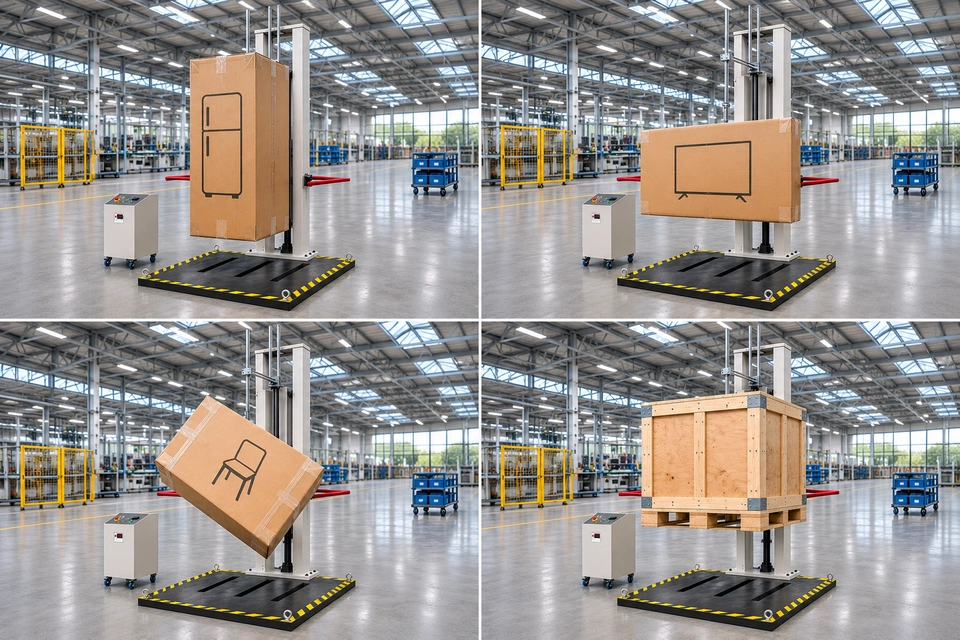
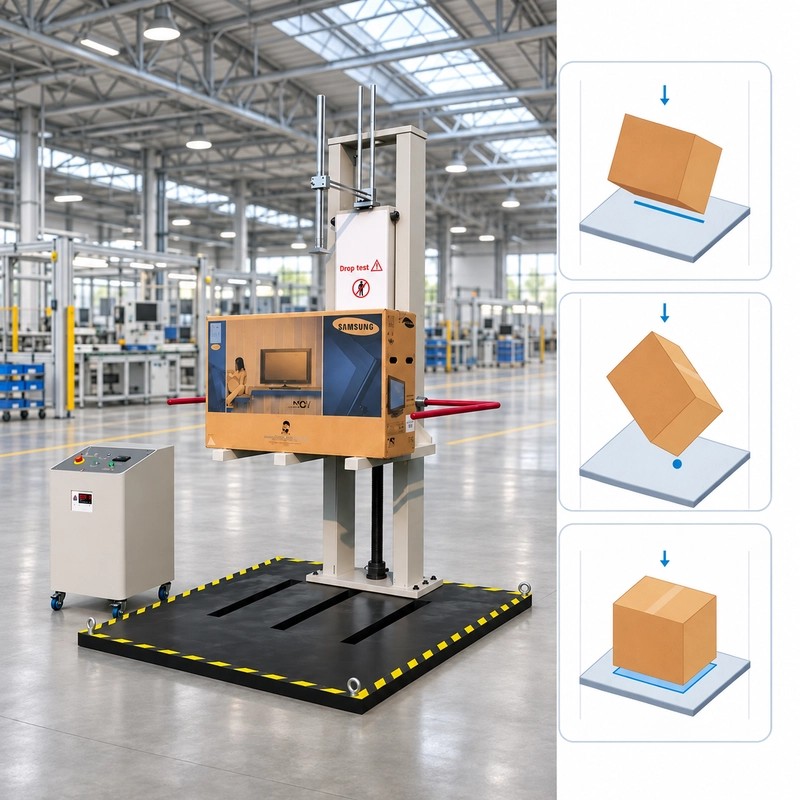
Suppose your lab needs to drop a 180 kg shipping package from 1,100 mm onto a specified bottom edge. An RS-DP-P10 configured for that load passes the weight check. Its nominal maximum drop height is 1,000 mm, so it comes off the shortlist. The RS-DP-P12, with a nominal maximum of 1,200 mm, is the next model to evaluate. The remaining question is whether the package can be supported and released at 1,100 mm with that edge down.
For a large package, check four things before choosing a drop tester: total packed weight, outside dimensions, required drop height, and the face, edge, or corner that must strike first. Keep those details together for each test. The heaviest package in your lab may be straightforward to position, while a lighter, taller carton may need more clearance for an edge drop.
Measure the package as it will be tested
Weigh the complete shipping package, including the product, carton, cushioning, inserts, and any skid or base that stays attached during the test. Record the outside length, width, and height, including any part that protrudes beyond the carton.
Then look at the package in the position called for in the test plan. A tall appliance carton might sit upright for a bottom-face drop. Tilt it for a bottom-edge drop and its upper end may extend toward the frame, while the target edge may sit below the top of the support arms. The carton dimensions are the same, but the clearance and support requirements have changed.
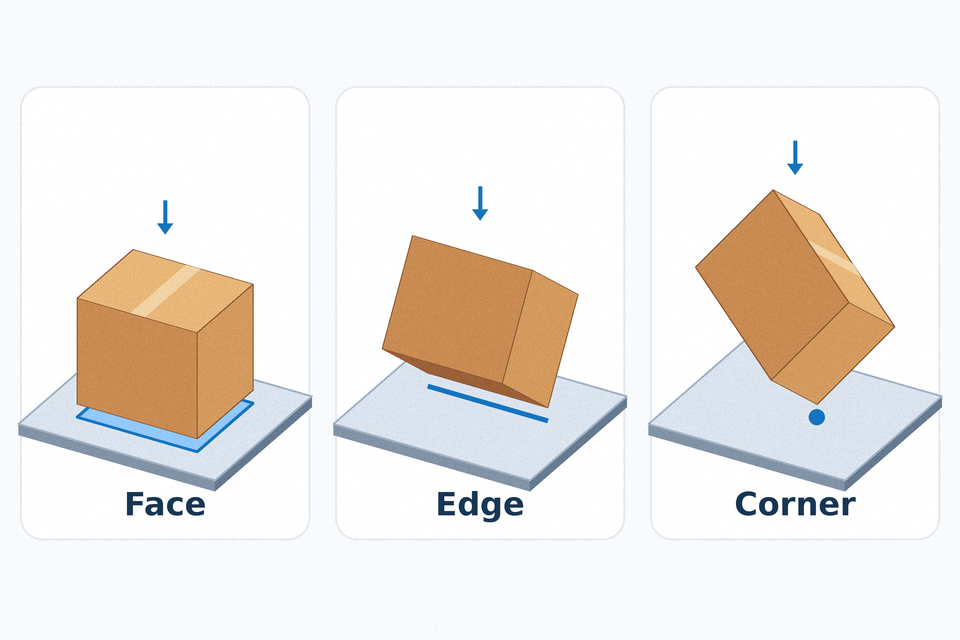
A photo or drawing with the target face, edge, or corner marked gives the equipment supplier a concrete starting point. If one end is noticeably heavier, note that too. It helps the supplier review how the package can be supported in the required position.
Check where the drop height is measured
Drop height is the vertical distance from the lowest point of the positioned specimen to the impact surface immediately before release. For a bottom-face drop, measure from the bottom face. For an edge or corner drop, the reference is the edge or corner positioned to strike first.
The RS-DP-P12 specification gives an example of how the fixture position affects that measurement. When the target edge sits 40 mm below the top of the support arms, the machine display in that example reads 540 mm for a 500 mm drop measured from the edge. The offset depends on how the specimen sits and where the machine measures from.
If a required drop is close to the machine’s nominal limit, ask the supplier to verify the achievable height with the specimen in the required position. This is especially useful when your test plan calls for different heights on different faces, edges, or corners.
Shortlist an RS-DP-P model
Use the nominal drop-height ranges below for an initial comparison. Then verify the load rating of the configuration being quoted, along with specimen clearance and support in each required position.
| ITM-LAB model | Nominal drop height range |
|---|---|
| RS-DP-P10 | 0–1,000 mm |
| RS-DP-P12 | 0–1,200 mm |
| RS-DP-P14 | 0–1,400 mm |
The RS-DP-P10 can be configured for packaged specimens under 200 kg, depending on the project requirements. Use the load rating for the specific configuration being offered when reviewing a quote.
View the ITM-LAB RS-DP-P Series Zero Drop Tester
Give the supplier one line for each drop
When requesting a quote, send the packed weight, outside dimensions, and applicable test procedure or internal test plan. Then list each impact location with its required height. “Bottom edge between the front panel and base, 1,100 mm” gives the engineer a test condition to review. Mark that edge on a photo or drawing so there’s no ambiguity about how the carton should be positioned.
If the tester will serve several product lines, include the heaviest package, the largest package, and any specimen that needs an unusual edge or corner position. Those may be three different specimens.
Send your package details to ITM-LAB for a configuration review
FAQ
Can a drop tester handle its maximum load, specimen size, and drop height at the same time?
That depends on the equipment configuration and the required test position. Ask the supplier to verify those conditions together for your specimen, including how it will be supported and whether it has enough clearance to reach the target height and release in the required orientation.