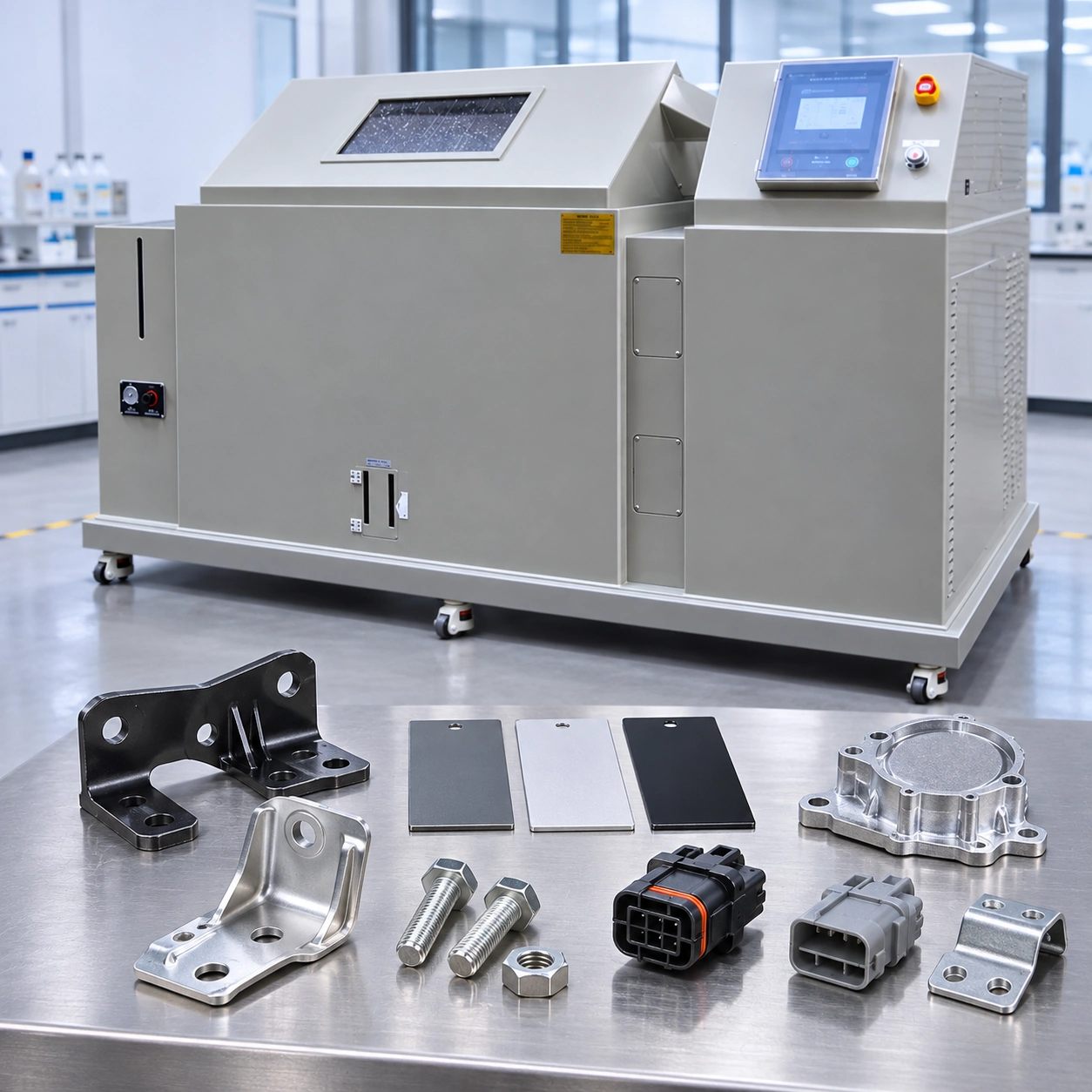
Cyclic corrosion testing evaluates automotive parts under repeated salt exposure, humidity and drying conditions. Unlike continuous salt spray testing, it examines corrosion behavior under changing laboratory environments. Automotive methods such as GMW14872 and SAE J2334 specify different exposure sequences, solution application requirements and test conditions.
For automotive OEMs, Tier 1 suppliers and testing laboratories, selecting a suitable corrosion test chamber means matching the test standard, specimen dimensions, environmental controls and evaluation requirements. This guide explains the key methods, equipment specifications and practical selection considerations, supported by ITM-LAB's documented automotive industry equipment supply experience.
What Is Cyclic Corrosion Testing for Automotive Parts?
Cyclic corrosion testing exposes automotive components to repeated environmental stages, such as salt application, high humidity and drying, according to a specified laboratory procedure.
These changing conditions can influence electrolyte formation, corrosion-product development and coating deterioration.
Automotive components encounter moisture, road salts and drying periods during service. Cyclic testing provides a controlled way to investigate selected corrosion mechanisms, including:
-
General corrosion of exposed metals.
-
Galvanic corrosion between dissimilar materials.
-
Crevice corrosion in joints and overlapping surfaces.
-
Coating blistering and underfilm corrosion.
-
Corrosion-related changes in component function.
The laboratory cycle is designed for controlled evaluation, not as a complete simulation of every real-world environment.
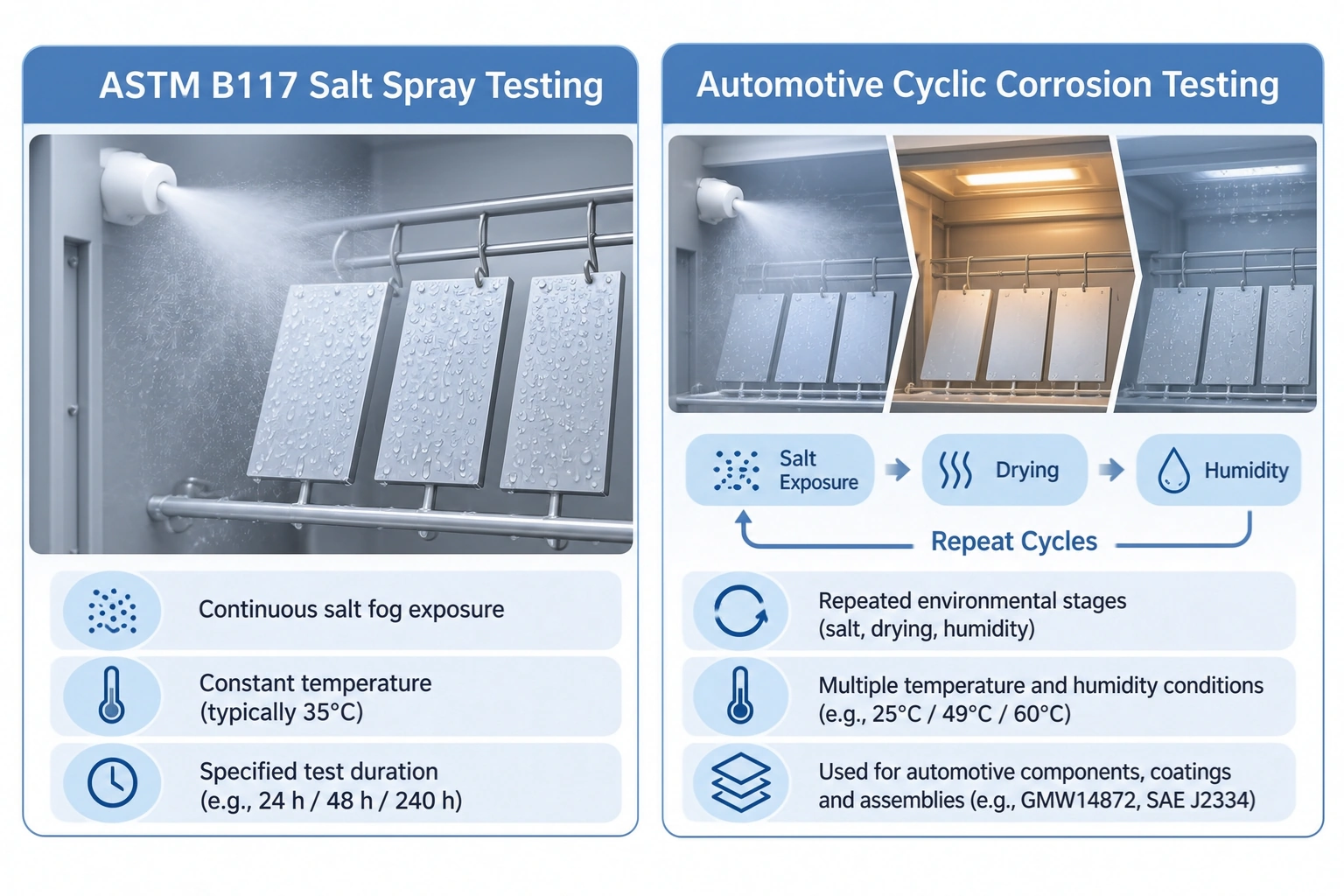
Cyclic Corrosion Testing vs. ASTM B117 Salt Spray
ASTM B117 establishes operating conditions for continuous neutral salt fog exposure. Automotive cyclic methods may combine salt application with controlled humidity, drying and environmental transitions.
| Factor | ASTM B117 Salt Spray | Automotive Cyclic Corrosion |
|---|---|---|
| Exposure | Continuous salt fog | Repeated environmental stages |
| Salt application | Atomized salt fog | Method-specific fog or direct application |
| Temperature | Controlled salt fog temperature | May change between stages |
| Humidity | Salt fog environment | Controlled wet and dry conditions |
| Typical use | Coatings, plating and fasteners | Automotive components and assemblies |
| Equipment | Conventional salt spray chamber | Suitable cyclic corrosion system |
Neither method is universally superior. The correct procedure depends on the component specification and intended corrosion evaluation.
For detailed neutral salt spray requirements, see our ASTM B117 Salt Spray Chamber Testing Guide.
Automotive Corrosion Testing Standards and Chamber Requirements
Automotive corrosion standards differ in solution chemistry, application methods, environmental stages, transition requirements and evaluation procedures.
Before selecting equipment, confirm the exact standard edition and any customer-specific modifications.
| Standard | Main application | Critical equipment requirement |
|---|---|---|
| GMW14872 | Automotive components and assemblies | Solution application, humidity/dry stages and corrosion coupons |
| SAE J2334 | Automotive materials and coating systems | Specified wetting method and environmental sequence |
| ISO 11997-1 | Cyclic corrosion resistance of coatings | Defined wet, dry and humid cycle |
| ASTM B117 | Continuous neutral salt fog | Salt solution, temperature and fog collection |
| ISO 9227 | NSS, AASS and CASS salt spray tests | Method-specific solution and operating conditions |
GMW14872 Test Conditions and Equipment Selection
GMW14872 is a General Motors laboratory cyclic corrosion method used to evaluate automotive components and assemblies.
Public technical descriptions identify salt application, humid exposure and dry-off stages. The following values are illustrative; the customer-specified standard edition governs actual testing.
| Stage | Illustrative condition | Chamber consideration |
|---|---|---|
| Ambient / salt application | Approximately 25°C | Specified solution application |
| Humid exposure | Approximately 49°C, near-saturated RH | High-humidity performance |
| Dry-off | Approximately 60°C, low RH | Heating and dehumidification |
| Transition | Defined by the procedure | Changeover time and stability |
| Corrosion monitoring | Specified corrosion coupons | Mass-loss measurement and records |
A critical distinction is how the salt solution is applied.
GMW14872 procedures may require direct application of solution to specimens rather than conventional salt fog alone. The test also uses corrosion monitoring requirements that cannot be satisfied by chamber temperature and humidity control alone.
Before confirming GMW14872 equipment suitability, verify the solution delivery system, environmental conditions, coupon procedure and required test revision.
SAE J2334 Corrosion Test Chamber Requirements
SAE J2334 is a laboratory cyclic corrosion method used for automotive materials, coatings, manufacturing processes and component designs.
The test specifies environmental exposure conditions and salt solution application requirements.
A suitable SAE J2334 corrosion test chamber must support the prescribed solution, wetting method, climatic stages and cycle timing.
A programmable compound corrosion chamber may provide the necessary environmental functions, but full suitability requires review of the complete procedure.
GMW14872 and SAE J2334 should not be treated as interchangeable test programs.
ISO 11997-1 and Other Corrosion Methods
ISO 11997-1 covers cyclic corrosion resistance testing for coatings under specified wet, dry and humid conditions.
It is relevant to coated automotive panels and protective coating evaluation. The required cycle and standard edition must be identified before equipment selection.
ASTM B117 and ISO 9227 remain important for continuous salt spray testing, while ASTM G85 covers specified modified salt spray procedures.
How a Cyclic Corrosion Test Chamber Works
A cyclic corrosion chamber combines several environmental functions within a programmable test sequence.
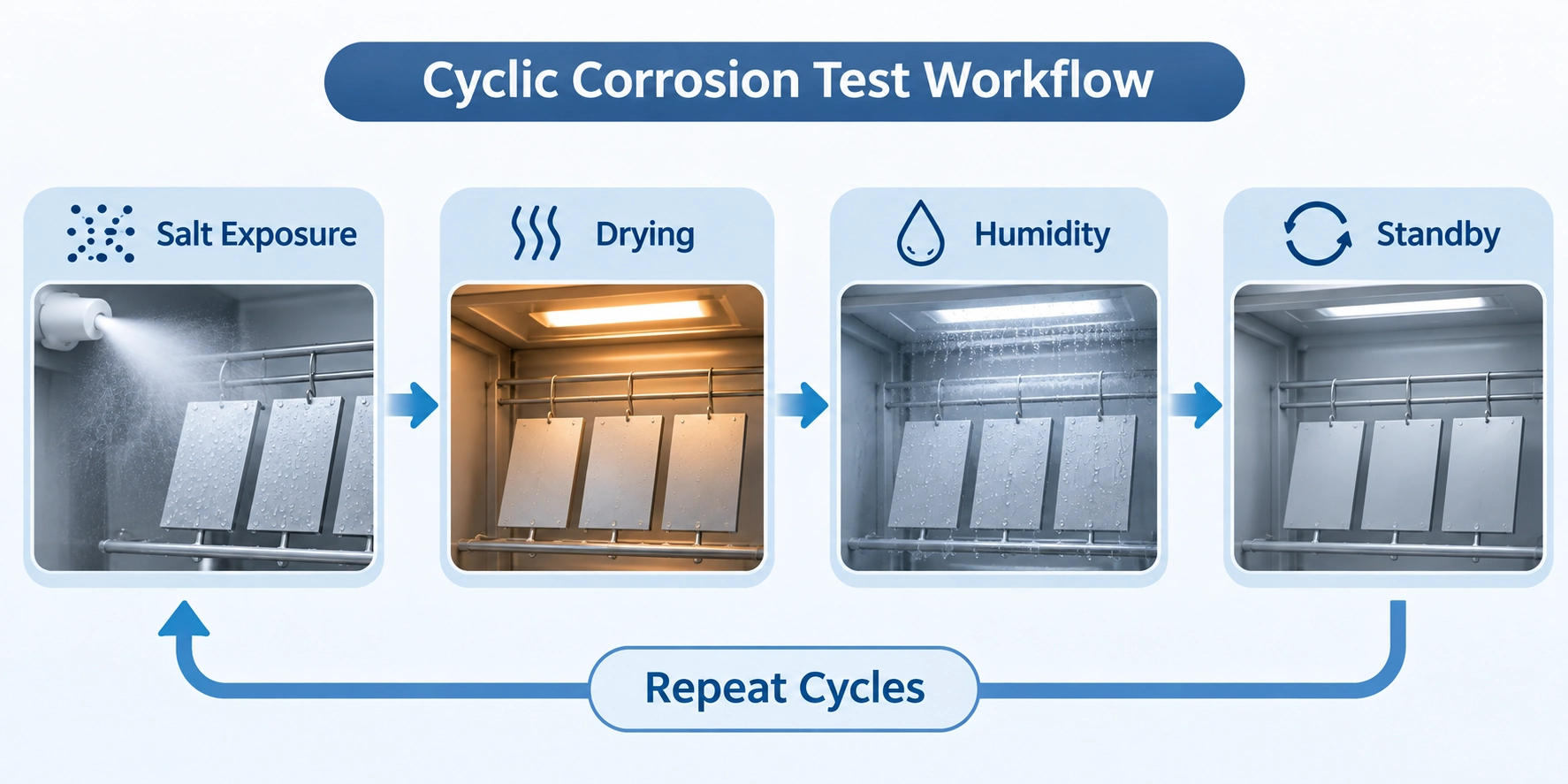
An illustrative operating process is:
Salt Exposure → Drying → Humidity → Standby → Repeat
This sequence explains the equipment principle; it is not the prescribed cycle of any particular automotive standard.
During salt exposure, the system introduces the specified solution through its installed application equipment.
The drying stage reduces moisture under controlled conditions, while the humidity stage increases environmental moisture according to the program.
The controller manages stage duration and repetition. However, successful testing also depends on actual environmental stability, transition performance and the correct solution application method.
For automotive qualification, the chamber must reproduce the specified operating points under the intended specimen load.
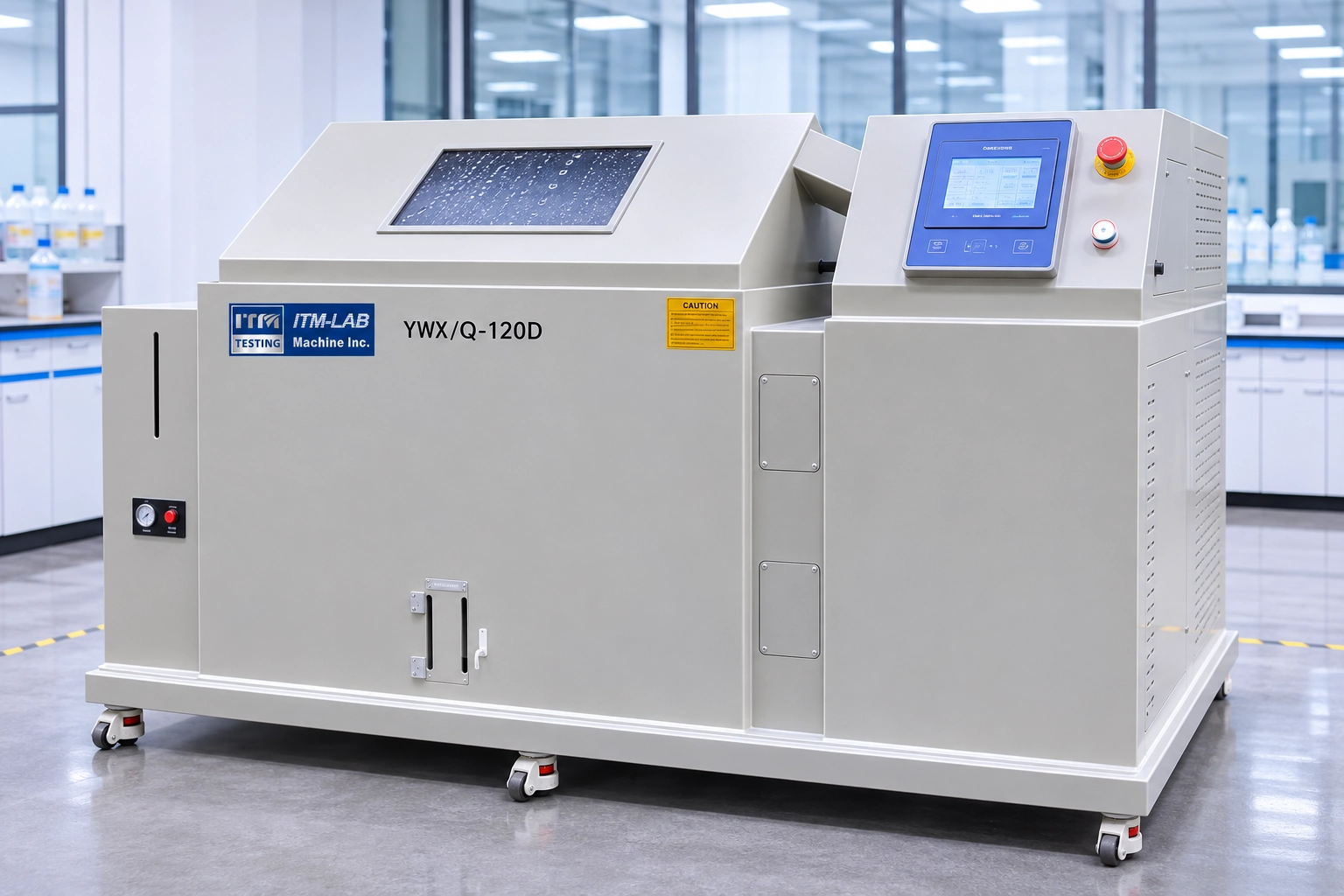
ITM-LAB YWX/Q-120D Cyclic Corrosion Test Chamber
The ITM-LAB YWX/Q-120D is a compound corrosion test chamber designed for programmable salt spray and climatic exposure.
Its reference configuration combines salt spray equipment, temperature and humidity control, programmable environmental stages and data recording functions.
Technical Specifications
| Parameter | YWX/Q-120D |
|---|---|
| Internal volume | 576 L |
| Internal dimensions | 1,200 × 800 × 600 mm |
| Temperature range | 5–80°C |
| Humidity range | 20–100% RH within the operating envelope |
| Temperature fluctuation | ±0.5°C |
| Temperature deviation | ±1.0°C |
| Humidity fluctuation | ±2% RH |
| Humidity deviation | ±2% RH |
| Environmental functions | Salt spray, drying, humidity, standby |
| Controller | Programmable touchscreen |
| Program capacity | Up to 120 programs |
| Chamber construction | 10 mm PP panels |
| Power supply | AC 380 V, three-phase, 50 Hz |
| Rated power | Up to 12 kW |
Specifications refer to the supplied YWX/Q-120D technical document. Operating performance depends on the specified conditions, equipment configuration and specimen load.
Environmental Transition Performance
The reference specification includes the following transition conditions:
| Transition | Reference time |
|---|---|
| 35°C salt fog → 60°C drying at 20–30% RH | ≤30 minutes |
| 60°C drying → 50°C humidity at 95 ±5% RH | ≤15 minutes |
| 50°C humidity → 35°C salt fog | ≤30 minutes |
These values help engineers assess whether a proposed test profile is feasible.
They do not establish compliance with every automotive OEM method. Actual performance must be verified against the required conditions and acceptance procedure.
Control, Automation and Salt Application
The YWX/Q-120D specification describes programmable environmental stages, test curve display, data collection and controller communication interfaces.
The chamber also provides automatic switching between specified environmental functions.
Its reference salt fog collection range is 1–3 mL per 80 cm² per hour. For ASTM B117 applications, the applicable 1–2 mL per 80 cm² per hour collection requirement must be verified separately.
For cyclic procedures requiring direct specimen spraying, the installed solution application system must be checked against the specified method.
Automotive Standard Compatibility
The following matrix distinguishes documented equipment functions from requirements that need project-specific verification.
| Requirement | Documented capability | Verification required |
|---|---|---|
| Salt fog exposure | Salt spray system | Solution chemistry and collection |
| Programmable stages | Salt spray, drying, humidity, standby | Exact test sequence |
| Temperature control | 5–80°C | Required operating points |
| Humidity control | 20–100% RH operating range | High/low RH stability |
| Environmental transitions | Reference transition times | Customer tolerances |
| Direct salt application | Conventional spray system documented | Dedicated application arrangement if required |
| Corrosion coupon monitoring | Not established as an integrated function | Coupon procedure and measurement |
| Data recording | Data collection and interfaces | Export format and test records |
The YWX/Q-120D can be considered for automotive cyclic corrosion projects when its capabilities align with the specified procedure.
GMW14872 or SAE J2334 compliance should only be confirmed after reviewing the complete test method and approved equipment configuration.
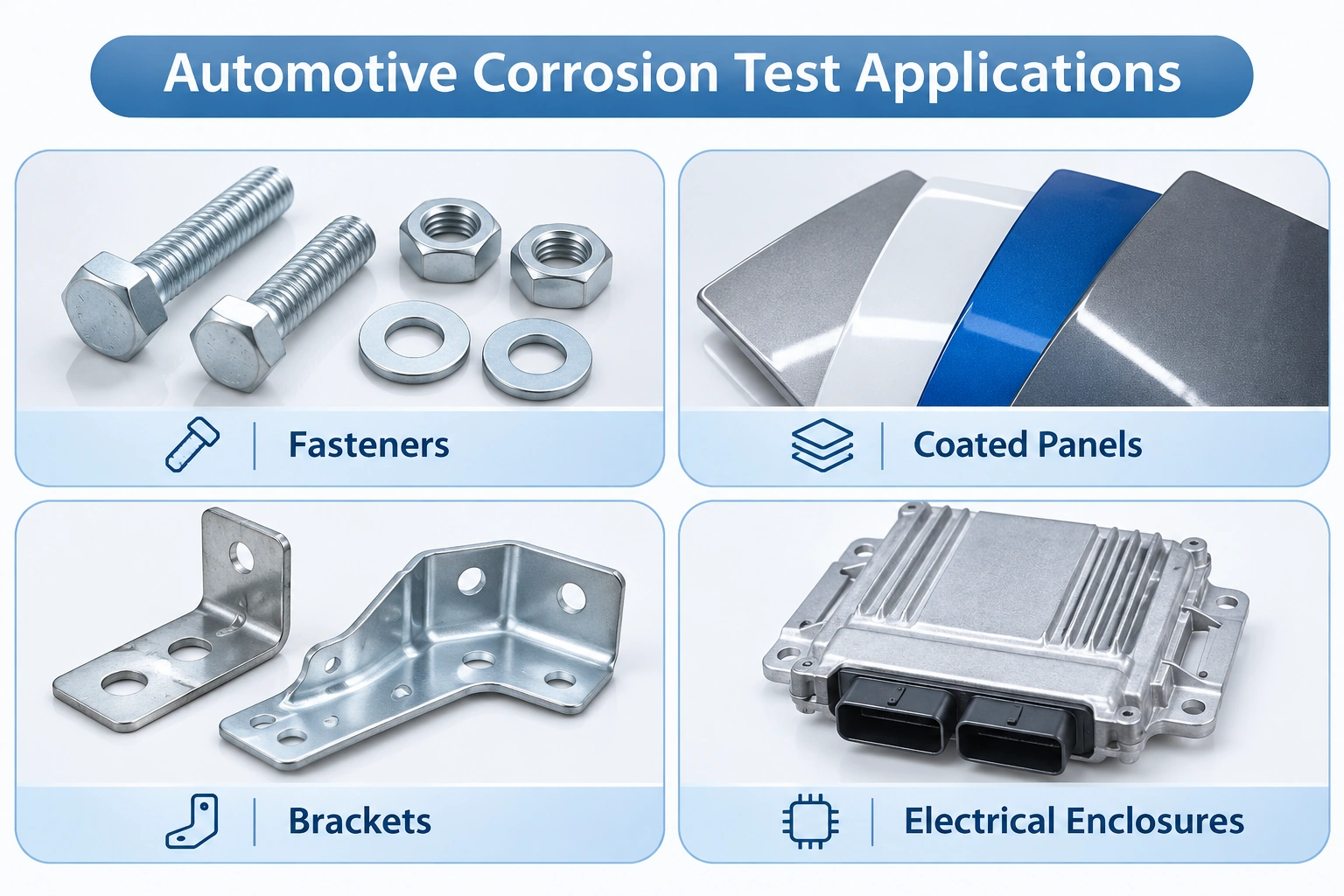
Automotive Parts Corrosion Testing Applications
Automotive corrosion testing requirements vary according to component geometry, material combinations, protective coatings and intended service conditions.
Fasteners and Underbody Brackets
Bolts, nuts, brackets and mounting hardware may be exposed to road salts and repeated wet-dry conditions.
Testing helps evaluate protective coating performance, localized corrosion and deterioration at joints or contact surfaces.
Coated Steel and Aluminum Panels
Painted and plated metal panels are evaluated for rust formation, blistering, underfilm corrosion and coating damage.
Scribed specimens may require corrosion creep measurements according to the applicable evaluation procedure.
Suspension and Brake Components
Suspension brackets and brake-related hardware can require corrosion evaluation under component-specific programs.
Large or irregular assemblies may need customized supports and additional chamber clearance.
Automotive Electrical Housings and Connectors
Metal enclosures, connector housings and exposed conductive components may require corrosion testing.
Where electrical or mechanical performance must be evaluated after exposure, separate measurement instruments may be necessary.
ITM-LAB Automotive Industry Equipment Supply Experience
ITM-LAB's historical sales records document salt spray testing equipment orders from automotive component manufacturers in China.
These records provide evidence of equipment supply experience in the automotive sector.
Automotive Laboratory Equipment Order — 2023
A documented March 2023 order from an automotive technology company included:
| Equipment | Model | Quantity |
|---|---|---|
| Salt spray test chamber | YWX/Q-90 | 1 |
| Programmable temperature and humidity chamber | GDJS-1000L-B | 1 |
The contract included delivery and installation arrangements.
This order demonstrates procurement of corrosion and climatic testing equipment for an automotive-sector customer. The two instruments were purchased together but are not documented as an integrated cyclic corrosion system.
Earlier Automotive Equipment Orders
Sales records from 2015 also document salt spray testing equipment purchases by automotive component manufacturers, including an RS-90 salt spray tester and another salt spray machine ordered with mechanical and electrical testing instruments.
These historical records establish equipment orders, not completed customer qualification tests or verified GMW14872/SAE J2334 results.
Customer identities and commercial terms are omitted. Project information is summarized from historical sales documentation.
How to Choose a Cyclic Corrosion Chamber for Automotive Parts
Selecting an automotive cyclic corrosion test chamber requires more than comparing nominal chamber volume and temperature range.
The most important step is confirming whether the equipment can execute the actual test procedure.
Match the Test Standard
Provide the exact standard number, revision and any OEM-specific requirements.
Identify the solution application method, environmental stages, transition limits and corrosion monitoring requirements.
Check Specimen Dimensions and Loading
Confirm component dimensions, weight, quantity and mounting orientation.
The usable chamber space must accommodate fixtures while maintaining appropriate exposure, airflow and drainage.
Verify Environmental Performance
Review every temperature and humidity operating point.
For cyclic programs, also confirm stabilization and transition times under the intended specimen load.
Confirm Solution Delivery and Test Records
Determine whether the procedure requires salt fog, direct solution application or another wetting method.
Specify the required environmental records, corrosion coupon measurements and evaluation reports.
Review Maintenance and Engineering Support
Consider chamber materials, solution handling, cleaning access, calibration, spare parts and technical support.
For customized automotive methods, the supplier should review the test procedure before confirming the final configuration.
Engineering Example: Coated Automotive Brackets
Consider a supplier evaluating coated steel mounting brackets under a customer-defined corrosion program.
The engineer first confirms the required test standard, coating system, bracket dimensions, batch quantity and evaluation criteria.
If the method requires continuous neutral salt fog, a conventional salt spray chamber may be appropriate.
If the method requires programmable salt exposure, drying and humidity stages, a compound corrosion chamber such as the YWX/Q-120D may be considered.
The final selection depends on the specified environmental cycle, solution application method, specimen arrangement and verified equipment performance.
This is an illustrative selection example, not a completed customer test case.
Corrosion Test Evaluation and Common Problems
Automotive corrosion results should be evaluated according to the approved test procedure and component specification.
Typical assessments include:
| Evaluation | Purpose |
|---|---|
| Rust assessment | Visible corrosion on painted steel |
| Coating blistering | Coating deterioration |
| Scribe creep | Corrosion or coating damage near a scribe |
| Corrosion coupon mass loss | Exposure severity monitoring |
| Functional inspection | Mechanical or electrical performance after exposure |
ASTM D610, ASTM D714 and ASTM D1654 may be relevant to selected coating evaluation programs.
Common testing problems include inconsistent solution application, unsuitable specimen positioning, humidity instability and transition times exceeding the specified limits.
These issues should be investigated through documented chamber verification and test setup procedures.
A laboratory corrosion exposure duration cannot be converted directly into a universal number of years of vehicle service. Field correlation requires supporting evidence for the relevant materials, coatings and exposure conditions.
FAQ
- Can one chamber perform ASTM B117 and automotive cyclic corrosion testing?
A suitably configured compound corrosion chamber may support continuous salt fog and programmed cyclic exposure. Each method must be verified independently, including solution application and environmental conditions.
- Can the YWX/Q-120D perform GMW14872 testing?
The YWX/Q-120D provides programmable salt spray, drying and humidity functions. Full GMW14872 suitability depends on the specified revision, solution application method, environmental conditions and corrosion coupon requirements.
- What is the difference between GMW14872 and SAE J2334?
Both are automotive cyclic corrosion methods, but their prescribed solution application, environmental stages and monitoring requirements must be reviewed separately. They are not interchangeable.
- What chamber size is suitable for automotive components?
Chamber size depends on component dimensions, specimen quantity, fixture arrangement and usable internal space. Nominal volume alone is insufficient for equipment selection.
- Can cyclic corrosion testing predict vehicle service life?
Not directly. Laboratory results can support material comparison and qualification, but service-life prediction requires validated correlation with relevant field exposure.
Standards and Technical References
The following references provide the technical basis for the test methods and evaluation approaches discussed in this guide. Formal testing must follow the applicable official edition and customer specification.
-
GMW14872 — Cyclic Corrosion Laboratory Test. General Motors. Standard catalogue.
-
SAE J2334 — Laboratory Cyclic Corrosion Test. SAE International. Official standard.
-
ISO 11997-1 — Paints and Varnishes: Determination of Resistance to Cyclic Corrosion Conditions. International Organization for Standardization. Official standard.
-
ASTM B117 — Standard Practice for Operating Salt Spray (Fog) Apparatus. ASTM International. ASTM Standards.
-
ISO 9227 — Corrosion Tests in Artificial Atmospheres — Salt Spray Tests. International Organization for Standardization. ISO Standards.
-
ASTM G85 — Standard Practice for Modified Salt Spray (Fog) Testing. ASTM International.
-
ASTM D610, ASTM D714 and ASTM D1654. ASTM International. Coating evaluation methods used where specified.
Equipment specifications are based on the supplied ITM-LAB YWX/Q-120D technical documentation. Historical automotive project information is based on company sales records. Standard-specific conditions require verification against the applicable official edition.
Last updated: November 9, 2026.
Request an Automotive Corrosion Testing Solution
Planning a corrosion testing project for automotive components, protective coatings or metal assemblies?
ITM-LAB supplies conventional salt spray chambers and programmable compound corrosion testing systems, with equipment configurations reviewed according to the customer's application.
Send our engineering team your test standard, component drawing or photograph, specimen dimensions and required environmental cycle. We can review chamber capacity, solution delivery, control functions and the appropriate equipment configuration.
Email: sales2@itm-lab.com
Equipment: Explore ITM-LAB Salt Spray Test Chambers
Request a technical configuration and quotation for your automotive corrosion testing project.
